
You’ve sold investors on your vision, secured funding, and built a roadmap. But now you face a hurdle that keeps many non-technical founders awake at night: the “Imposter Syndrome” of hiring your first engineers. How can you judge the quality of code if you’ve never written a line of it yourself?
The stakes are incredibly high. The average cost of a bad hire can equal 30% of their first-year earnings, but for early-stage startups, the cost is often fatal – lost momentum, technical debt, and a toxic culture. The specific risk for non-technical founders is getting “blinded by jargon,” where a candidate sounds impressive but delivers unmaintainable spaghetti code.
Here is your thesis: You don’t need to know how to code to hire great coders. You need a rigorous process that tests problem-solving, communication, and cultural alignment. This is your ultimate founder hiring guide for bridging the gap in a technical interview non-technical style, ensuring you build a team that scales.
Preparation is 80% of the Battle
Before you ever speak to a candidate, you must define exactly what you need. Many founders fall into the trap of hunting for a “unicorn” – a mythical developer who is an expert in DevOps, Frontend, Backend, AI, and UI design all at once.
- Define Must-Haves vs. Nice-to-Haves: Focus strictly on the immediate business problem. Do you need an MVP in 3 months? That requires a builder, not necessarily a scaling architect.
- Results-Oriented Job Description: Avoid listing 20 programming languages. Instead, list 3 key outcomes (e.g., “Integrate Stripe API,” “Reduce page load time by 50%”).
- The Bus Factor: If your lone developer gets hit by a bus (or quits), can anyone else pick up their work? Prioritize candidates who value documentation over “clever” but unreadable code.
Writing a clear job description is the first step to attracting the right talent. For more on structuring your search, check our guide on how to find the best candidate for your startup.
| Feature | The “Unicorn” Trap (Avoid) | The Results-Oriented Hire (Target) |
| Focus | Lists 15+ technologies (Java, Python, AI, React, AWS) | Focuses on 1-2 core problems to solve |
| Experience | Demands “10 years experience” in a 3-year-old tech | Asks for “Proven track record” of shipping similar products |
| Goal | “Find someone who can do everything.” | “Find someone to launch the MVP in 3 months.” |
| Outcome | Attracts liars or expensive consultants. | Attracts focused builders who deliver. |
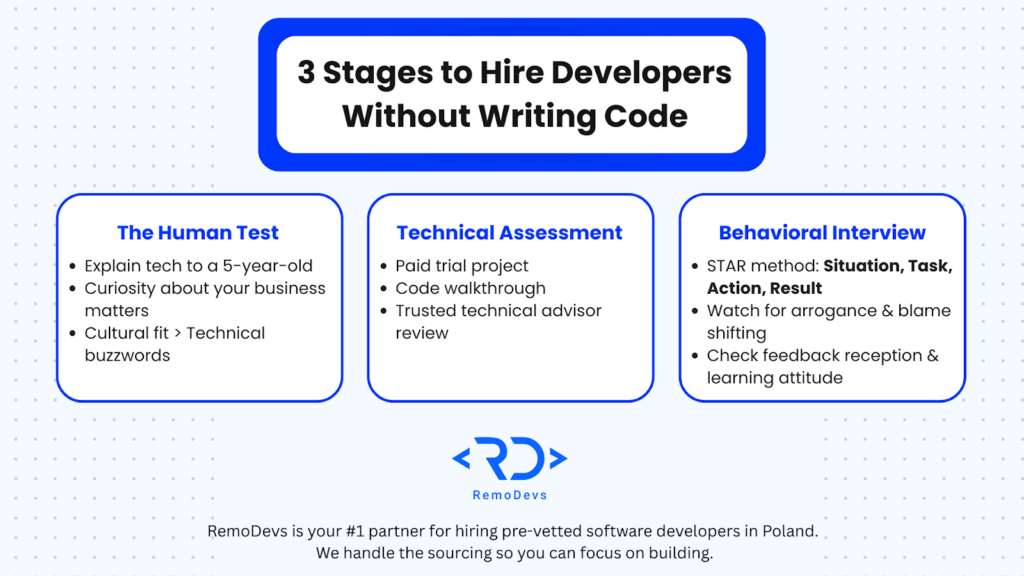
How to Hire Developers as a Founder: The 3-Stage Interview Process
To avoid being overwhelmed, break the interview process into manageable chunks where you, as the founder, have the leverage. You don’t need to be a CTO to run a valid assessment.
Stage 1: The Non-Technical Screen (The “Human” Test)
The first stage is all about communication and enthusiasm. If a developer cannot explain their work to you, they won’t be able to explain it to your future sales or marketing teams.
- The “5-Year-Old” Test: Ask them, “Explain a complex technical concept to me as if I were a 5-year-old.”
- Assess Curiosity: Do they ask about your business model, your users, and your revenue goals? Or do they only care about the tech stack?
- Cultural Fit: Are they excited about the chaos of a startup, or do they prefer the stability of a corporation?
This stage filters out those who lack the soft skills necessary for a small team. For insights on where to find these communicative professionals, read about why major tech giants hire software developers in Poland.
Stage 2: The Technical Assessment (Without You Coding)
This is the core of how to hire developers founder style. Since you cannot review the code yourself, you must use proxy methods to verify their skills.
- Option A: The Paid Trial Project: Assign a small, real-world task like “Connect this API and display the data.” Always pay them for their time; it respects their professionalism and yields better effort.
- Option B: The “Code Walkthrough”: Ask them to walk you through code they wrote for a previous project. Watch for their ability to justify decisions – do they admit where the code could be improved?
- Option C: The Technical Advisor Proxy: If possible, bring in a trusted CTO advisor or a freelance friend just for this stage to audit the output.
Effective assessment is crucial. Even for specialized roles, the principles remain the same – verify practical application over theoretical knowledge. See how we approach this when we hire systems engineers.
Stage 3: The Behavioral Interview
The final stage tests how the candidate handles pressure, conflict, and feedback. Use the STAR Method (Situation, Task, Action, Result) to get specific examples of their past behavior.
- Arrogance Check: Watch out for “I’m the only one who knows how to do this” attitudes.
- Blame Shifting: Be wary of candidates who consistently blame tools, management, or previous teams for project failures.
- Feedback Reception: Ask them about a time they made a mistake. If they claim they haven’t, that is a major red flag.
Common Pitfalls: Where Non-Technical Founders Fail
Even with a process, founders often stumble on psychological traps.
- The “Shiny Object” Syndrome: Hiring for the trendiest tech stack (e.g., “We need AI/Blockchain”) rather than what the product actually needs to solve the user’s problem.
- Ignoring Soft Skills: Hiring a “10x engineer” who is toxic destroys team morale faster than bad code.
- Relying on Resumes Alone: Technology moves too fast for degrees to matter more than a solid GitHub portfolio and proven projects.
Understanding the market landscape helps avoid these errors. For a deeper look at what’s currently driving the market, review the latest IT recruitment trends in Poland.
The Shortcut: Why Smart Founders Don’t Interview Alone
The Reality Check: Even with this guide, the risk of a “false positive” hire remains high if you can’t read the code yourself. The most efficient way to scale is often to introduce the concept of pre-vetted talent.
- The Agency Advantage: Instead of spending 40+ hours interviewing, you can spend 4 hours meeting final candidates who have already passed technical barriers.
- Strategic Value: Agencies like RemoDevs act as your technical co-founder during the hiring process, handling the screening you aren’t equipped to do.
- Focus on Vision: You remain the expert on your product, while the agency ensures the engine under the hood is sound.
If you are unsure if this path is right for you, consider reading about what is the best option for hiring a developer.
How RemoDevs Solves the Technical Gap
At RemoDevs, we specialize in bridging the gap for non-technical founders.
- The “Vetting Engine”: Our senior engineers review code and conduct technical interviews before you ever see a resume. This is why we reject 90% of candidates – so you don’t have to waste time on them.
- Speed & Quality: We provide access to senior Polish developers who are ranked highly globally and screened for English proficiency and remote work readiness.
- Risk Mitigation: We offer a 90-day replacement guarantee and a 30-day free trial. If the developer isn’t the perfect fit, we replace them at no extra cost, removing the financial risk of a bad hire.
Conclusion
Hiring is fundamentally about risk management. You can mitigate risk by asking the right questions and following a structured process, or you can virtually eliminate it by using a partner who speaks the language of code. Don’t let a lack of technical skills stop you from building a great product.
Stop guessing and start building. Let RemoDevs handle the technical vetting so you can focus on the vision. Get matched with a pre-vetted senior developer in 48 hours.
Visit us
Find a moment in your calendar and come to our office for a delicious coffee
Make an apointment