Poland remains a substantial market for international technology recruitment, but broad talent-pool estimates say little about the engineers an individual company can actually hire. The latest job-board data shows a market where opportunities and competition vary sharply by experience and specialization.
- Applications per vacancy have eased on No Fluff Jobs. The platform recorded an average of 24 applications per IT job posting in 2025 and 21 in the first half of 2026. This is a platform-specific measure of applications, not the number of qualified candidates or a national hiring rate. Source: No Fluff Jobs, IT Career in Poland 2026.
- Experienced roles dominate advertised demand. Senior positions accounted for 51.48% of Just Join IT’s 2025 advertisements; mid-level roles made up 43.73%. The split was broadly unchanged from 2024. Source: Just Join IT, 2026 report on 2025 listings.
- AI is becoming a more visible hiring category. In No Fluff Jobs’ first-half 2026 analysis, approximately one in twenty IT advertisements fell into its AI category. Backend and Data & BI remained larger categories by listing volume. Source: No Fluff Jobs.
- Flexibility and pay clarity affect the search. In an online survey of 1,650 Polish IT specialists, 77% said they would consider leaving if their employer restricted flexibility. Employment recruitment rules effective from December 2025 also changed when employers must disclose initial pay information. Sources: Next Technology Professionals and State Labour Inspectorate.
These sources describe different things. Just Join IT’s 2026 annual report covers advertisements published in 2025; No Fluff Jobs includes January–June 2026 platform activity; Next Technology Professionals reports survey responses. The figures are useful market signals, provided they are not treated as interchangeable national statistics.
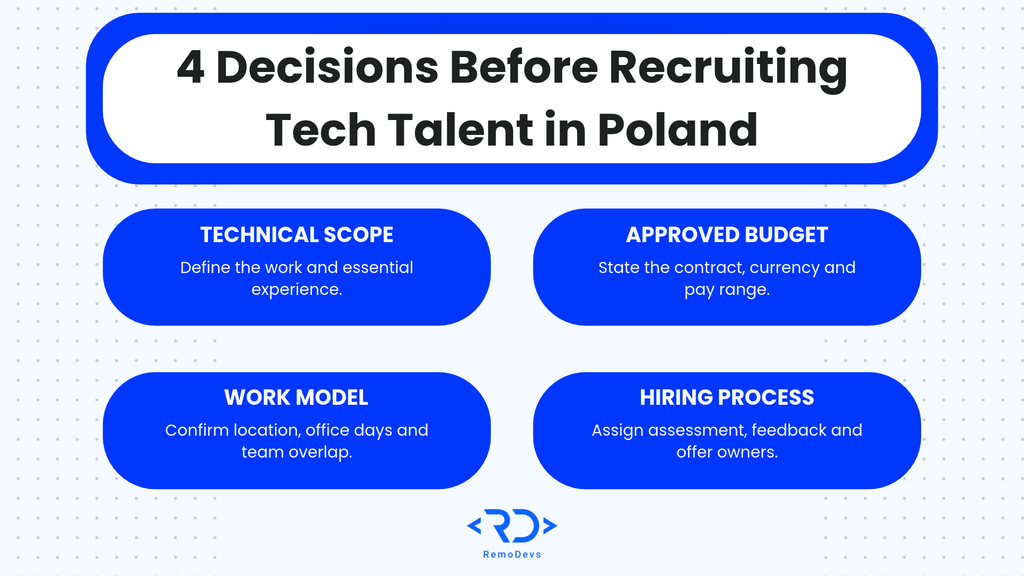
A large talent market is not the same as an available shortlist
A national workforce estimate cannot tell you how many engineers are available for your vacancy. Eurostat’s ICT specialist definition covers a much broader occupational group than software developers.
For the wider workforce, graduate pipeline and advertised salary benchmarks, see the Polish IT Market Report. The recruitment question is narrower: who can do this job, on these terms, and has a reason to consider it?
Take a senior data engineer who needs production PySpark experience, ownership of cloud pipelines and strong English. Requiring three office days a week in Warsaw will produce a different shortlist from allowing one visit a month. Add a narrow industry requirement and the field becomes smaller again.
Before opening the search, distinguish essential production experience from skills the engineer could learn on the job. You can be specific about technical responsibility without turning every preference into a mandatory qualification.
IT recruitment trends in Poland: what employers should do
| Market signal | What it means for hiring | Practical response |
|---|---|---|
| Senior and mid-level roles account for most Just Join IT listings | Experience is in demand, but job titles alone hide different responsibilities | Describe technical ownership and expected outcomes |
| No Fluff Jobs recorded fewer applications per vacancy in H1 2026 | Overall application volume is a poor proxy for relevant talent | Track qualified conversations and reasons candidates decline |
| Backend and Data & BI lead, while AI listings are growing | Searches differ by specialization; a broad developer brief is unlikely to work | Separate software, data, applied AI, platform and security requirements |
| Flexibility matters to surveyed professionals | Office rules and working-hour overlap shape the reachable candidate pool | Agree an explicit remote, hybrid or onsite policy |
| Employment pay-disclosure requirements changed in December 2025 | Late or unclear pay communication creates avoidable friction | Approve a comparable range before the first conversation |
| Technical assessments and AI-assisted work are evolving | Interview format and permitted tools need to reflect the job | Use focused assessments, agreed criteria and a clear AI policy |
The seven sections below connect these signals to decisions an international hiring team can make. Platform figures describe the advertisements and applications observed there; the recommendations reflect recruitment practice.
1. Recruit for responsibility, not a seniority label
Just Join IT’s figures describe a market in which experienced roles dominate advertisements, with little change in the seniority mix from 2024 to 2025. For employers, the more important question is what level of independence the job actually requires.
Maintaining an established service, designing a new platform and leading an architectural change are very different jobs, even when all three vacancies say “senior developer.”
Describe the decisions the person will make, the systems they will own and the support available. A mid-level engineer may be right for a well-supported team; architecture and incident ownership may call for a different assessment and budget.
2. Separate data, AI, cloud and security requirements
In the first-half 2026 No Fluff Jobs review, Backend and Data & BI were the leading categories by advertised job volume, while the AI category reached roughly 5% of IT listings. That is evidence of growing visibility for dedicated AI roles on the platform, not a measure of how many jobs across IT require some AI skills.
Just Join IT also distinguishes Data, DevOps, AI/ML and Security in its 2025 vacancy data. Each calls for a separate budget, sourcing plan and technical assessment.
Turn broad labels into work that can be assessed:
- Data engineering: pipeline reliability, data quality, orchestration and production troubleshooting.
- Applied AI: integrating models into a product, evaluating output quality and managing latency and cost.
- Cloud and platform engineering: infrastructure automation, observability, deployment reliability and operational ownership.
- Security engineering: the relevant discipline, such as application security, detection engineering or cloud security.
Each specialization calls for a different hiring brief. Avoid combining all four into one vacancy unless the scope and budget genuinely require it.
3. Make remote and hybrid requirements specific
In Next Technology Professionals’ 2026 survey, 77% of 1,650 respondents said they would consider leaving if flexibility were restricted. That is a strong signal to explain working arrangements early, even though stated intentions do not predict how every individual will behave.
“Hybrid” leaves too much unanswered. State the office location, required attendance, whether days are fixed, travel expectations and the hours when colleagues need to work together. A remote role should also specify where the person may be based.
International teams should be equally clear about shared working hours, recurring meetings and on-call expectations. Recruit to the real arrangement rather than postponing an unpopular requirement until the final interview.
4. Agree compensation before the search begins
A useful budget has a clear basis. Under Just Join IT’s methodology, employment-contract figures are gross salary, whereas B2B figures are invoice amounts excluding VAT. The latter is revenue to the contractor’s business, not personal take-home pay.
Compare benchmarks for the relevant role, seniority, contract and work model. Agree the amount your team can approve and who can authorize an exception. For international offers, specify the currency and conversion terms.
In employment recruitment, rules effective from 24 December 2025 require employers to communicate initial pay or a pay range at one of the prescribed stages, and prohibit asking about pay in current or previous employment. The rules do not require every vacancy advertisement to display a range, but doing so early makes the process clearer. Independent B2B arrangements need their own legal assessment.
5. Give every interview stage a purpose
In the 2026 Next Technology Professionals survey, 74% of respondents preferred technical interviews as an assessment format. Preference does not prove predictive accuracy, but it gives employers a reason to make interviews useful.
Choose an assessment that resembles the work. A data engineer might explain how to diagnose a failing pipeline; a backend engineer could review a service design; an engineering manager might discuss a difficult delivery decision and how they handled it.
Set the evaluation criteria before the first interview. Ask one person to explore technical trade-offs and another to assess collaboration or scope; avoid making candidates repeat the same conversation with every stakeholder.
6. Use AI assistance with clear limits
AI tools are already part of many engineers’ daily work. In No Fluff Jobs’ 2026 research, 68% of surveyed IT professionals reported using AI at work every day, including for activities such as coding, debugging and documentation. The figure concerns use by technology professionals, rather than AI adoption in recruitment departments.
Recruiters may also use AI to draft outreach or organize interview notes, provided they check accuracy, protect candidate information and retain human responsibility for hiring decisions.
Set the AI rules for technical tasks before sending the assignment. Where tools are allowed, ask candidates to explain decisions and verify the output. Where unaided reasoning matters, make that purpose clear. Either way, assess judgment rather than just a polished submission.
7. Look beyond application volume when planning sourcing
No Fluff Jobs recorded a drop from 24 applications per IT posting in 2025 to 21 in the first half of 2026. Competition still varies markedly by seniority: in its H1 2026 summary, the platform reported an average of 47 applications to junior vacancies, 24 to mid-level vacancies and 19 to senior vacancies across IT categories.
Application counts say little about technical fit or willingness to accept the job. A specialist search may need targeted outreach even when applications arrive, while a high-volume junior search may need stronger screening capacity.
Give recruiters enough context to explain the product, engineering challenges, team and reasons someone might consider a move. Then follow the pipeline: poor responses may indicate weak positioning; salary-related withdrawals point to a budget mismatch; repeated technical rejections may mean the brief or screening criteria need attention.
Hiring software, AI, data, cloud or security specialists in Poland? Share your scope, budget and working model with RemoDevs to discuss a success-fee recruitment search.
Where hiring timelines really slip
Once the brief, compensation and work model are clear, delays often come from scheduling and decisions rather than sourcing alone. Reserve technical interview capacity before the first shortlist arrives. Give each stage an owner, use shared evaluation criteria and agree who can approve the offer.
Prepare employment or contractor terms while interviews are under way. Check the candidate’s availability and notice period early, and arrange access, equipment and onboarding ownership before their first day. The broader 2026 guide to hiring software developers in Poland covers the full recruitment and engagement process.
Four timelines to keep separate
| Milestone | What it measures | What to agree |
|---|---|---|
| Shortlist delivery | Time to present candidates who meet agreed screening criteria | What “qualified” means and what screening includes |
| Interview and decision process | Time spent assessing candidates and deciding on an offer | Stages, interviewer availability and feedback ownership |
| Notice period | Obligations under the candidate’s existing arrangement | Actual availability and any agreed release |
| Start date | When the person can begin the new role | Accepted terms, completed arrangements and onboarding readiness |
A shortlist may be ready quickly while the eventual start date remains weeks away. When discussing timeframes with a recruitment partner, ask which milestone the estimate covers.
Choose the recruitment model around the hiring need
| Model | Suitable situation | What the company needs to own |
|---|---|---|
| Internal recruitment | An established hiring team has the capacity and relevant market knowledge | Sourcing, coordination, assessment and the hiring decision |
| Specialist success-fee recruitment | A direct technical hire needs external sourcing or specialist market access | The role, technical assessment, final decision and direct engagement |
| Recruitment Process Outsourcing | Several searches need additional recruiter capacity within the company’s process | Hiring priorities, process governance and final decisions |
| Staff augmentation | An existing engineering team needs additional specialist capacity | Priorities, technical direction, onboarding and delivery management |
RemoDevs’ recruitment service supports international companies with direct technical hiring, with success-fee terms agreed before the search. Through its RPO service, a recruiter works within the client’s hiring process.
With IT staff augmentation in Poland, RemoDevs sources specialists and handles contracting and coordination while the client directs their work. This model adds capacity to your team; it does not transfer responsibility for software delivery to a managed project provider.
In a published recruitment case involving a German startup, RemoDevs helped search for an Engineering Manager and a JavaScript developer after clarifying the roles. The example shows the value of a specific brief; each search still needs its own timeline and expectations.
Employer checklist before opening a technical vacancy
- The engineering lead has defined outcomes, ownership and essential production experience.
- The approved pay range matches the contract type, currency and payment period.
- Remote, hybrid or onsite requirements and working-hour overlap are explicit.
- The team has agreed assessment criteria, AI-use rules and interview availability.
- The recruiter knows how to position the role and report qualified-candidate feedback.
- The offer owner, notice-period assumptions and onboarding responsibilities are clear.
Frequently asked questions
Which IT recruitment trends should employers act on in Poland in 2026?
Start with the differences that affect your own vacancy: demand for experienced talent, uneven application competition by seniority, growth in dedicated AI postings, work-model expectations and clearer pay disclosure. Build the brief, budget and assessment around those realities.
How long should we allow to hire a developer in Poland?
Plan separately for sourcing, interviews and decisions, the candidate’s notice period and onboarding. A shortlist date is not a start date; ask the recruitment partner which stage any stated timeframe covers.
Should we offer remote work to recruit senior engineers?
If the work allows it, a Poland-wide remote search can broaden the candidate pool. If office attendance is essential, specify the location and frequency from the start. Flexibility matters to many candidates, but each role still needs an operating model that works for the team.
How should we set the budget for a technical hire in Poland?
Compare roles at the same responsibility level and on the same contract basis. Separate gross employment pay, B2B invoice amounts and the full company cost. Use the Polish IT Market Report for context, then test the range against the actual candidate market.
Should we use a recruitment agency or staff augmentation?
Use specialist recruitment to find a direct hire, staff augmentation for engineering capacity under your team’s direction, and RPO when you need more recruiting capacity across searches. The commercial model should follow the work and the responsibilities each party will carry.
Visit us
Find a moment in your calendar and come to our office for a delicious coffee
Make an apointment