
Any reliable overview of Poland’s technology labour market has to begin with definitions. Eurostat’s ICT specialists category is not the same as software developers. Statistics Poland’s graduate data measures completed university programmes. A job board, meanwhile, shows vacancies published on one platform rather than every opening in the Polish economy.
This Polish IT market report 2026 keeps those datasets separate. It combines:
- Eurostat’s occupational definition of ICT specialists;
- a late-2025 Polish Economic Institute benchmark for the scale of ICT employment in Poland;
- Statistics Poland data on graduates in the 2024/25 academic year; and
- Just Join IT’s 2026 report based on job advertisements published during 2025.
The result is a narrower but more defensible picture of the market: how broad the ICT workforce is, how many ICT programmes were completed, which roles appeared most often in job advertisements, and what salary medians employers disclosed.
Polish IT market in 2026: key takeaways
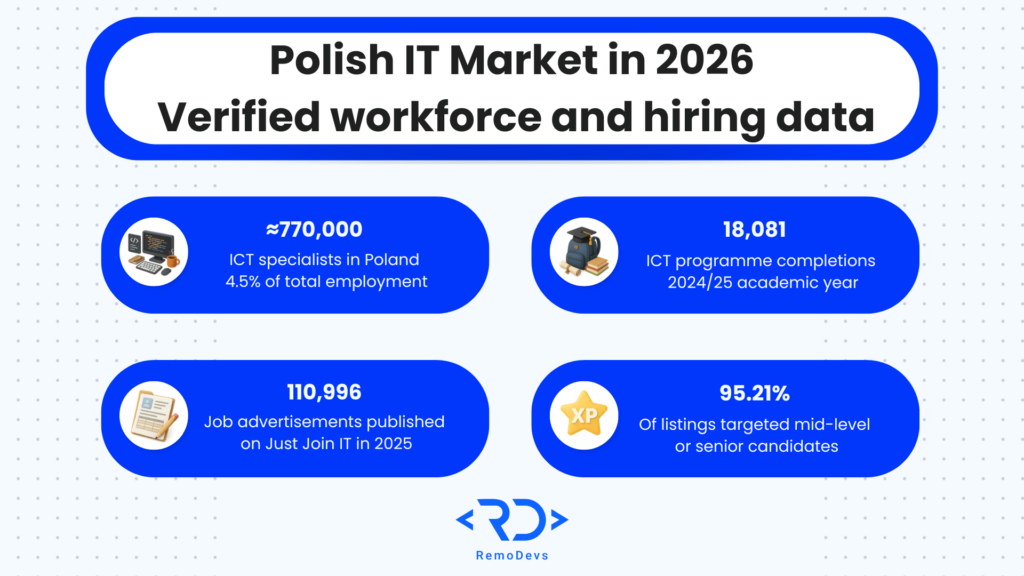
- The Polish Economic Institute reported that ICT specialists represented 4.5% of total employment, or approximately 770,000 people, in late 2025. This is a broad occupational category, not a developer count.
- Statistics Poland recorded 18,081 graduates of ICT programmes in the 2024/25 academic year, not 70,000.
- Just Join IT published 110,996 job advertisements in 2025, compared with 99,363 in 2024. Because the percentage stated on the source page does not reconcile with those raw totals, this article reports the annual counts without repeating the percentage.
- On that platform, senior roles accounted for 51.48% of 2025 listings, mid-level roles for 43.73%, and junior roles for 4.79%.
- Median advertised monthly pay ranged from PLN 8,000 gross on an employment contract for junior roles to PLN 24,780 net on a B2B invoice for senior roles. These figures use different contract and tax conventions and are not directly comparable take-home salaries.
How many ICT specialists work in Poland?
A December 2025 analysis by the Polish Economic Institute placed Poland’s ICT specialist workforce at approximately 770,000 people, equal to 4.5% of total employment.
That figure is useful only when its definition is clear. Eurostat’s ICT specialists statistics are derived from the Labour Force Survey and cover ICT occupations across the whole economy, not only employees of software companies.
Definition matters: Under the Eurostat and OECD definition based on ISCO-08, ICT specialists include ICT service managers; software and multimedia developers and analysts; database specialists and systems administrators; ICT operations, support and communications technicians; electronic and telecommunications engineers; selected designers, trainers and sales professionals; and ICT installers and servicers.
For that reason, it would be inaccurate to describe the benchmark as 770,000 developers. It also does not show how many senior Java engineers, AI specialists, cloud architects or cybersecurity professionals are available to change jobs at a particular salary.
Employers should use the national figure as macro-level context. The addressable candidate market for an actual vacancy depends on the required technology, seniority, industry background, English level, location, contract model and work arrangement.
Poland recorded 18,081 ICT graduates in 2024/25
Statistics Poland reported 306,595 higher-education graduates in the 2024/25 academic year. Of these, 18,081 completed programmes classified as Information and Communication Technologies under ISCED-F 2013.
| Metric | 2024/25 result |
| All higher-education graduates | 306,595 |
| ICT programme graduates | 18,081 |
Source: Statistics Poland.
The methodology adds an important qualification: if one person completed two or more programmes during the academic year, that person was counted more than once. The 18,081 figure therefore measures programme completions and should not automatically be interpreted as 18,081 unique people entering full-time technology employment.
It is still a substantial education pipeline, but it should not be inflated by combining ICT with all STEM subjects, secondary education or commercial courses. It also says nothing about the experience level required for an immediate production role.
Job advertisements increased in 2025 after two years of decline
Just Join IT’s 2026 report provides a platform-level view of IT hiring demand. It lists the following annual totals:
| Year | Job advertisements on Just Join IT |
| 2022 | 175,610 |
| 2023 | 129,836 |
| 2024 | 99,363 |
| 2025 | 110,996 |
The 2025 total was higher than in 2024, reversing two years of decline, but it remained well below the 2022 peak. It is therefore more accurate to describe the change as an initial stabilization than a return to the earlier mass-hiring market.
Scope note: Job-board data is not a national census of vacancies. It reflects the clients, categories, moderation rules and audience of one platform. It is useful for observing direction and relative demand, but it should not be presented as the total number of IT jobs available in Poland.
Which IT specializations appeared most often?
Data was the largest category on Just Join IT in 2025, followed by JavaScript and Java. The platform reported the following shares:
| Category | Share of 2025 listings |
| Data | 10.78% |
| JavaScript | 9.57% |
| Java | 9.46% |
| DevOps | 6.83% |
| Python | 5.67% |
| AI/ML | 4.74% |
| Security | 2.75% |
Source: Just Join IT, Job Offer Statistics.
These figures replace unsupported claims that demand for AI/ML increased by 22% and cybersecurity demand rose by 39%. They show each category’s share of listings on the platform; they do not establish a nationwide growth rate for the occupation.
Job titles also provide only a partial view. AI-related work can appear inside Data, Python, DevOps, cloud and product-engineering roles rather than exclusively under an AI/ML label.
Experienced professionals dominated advertised demand
Just Join IT’s 2025 listings were divided as follows:
| Seniority | Share of listings |
| Senior | 51.48% |
| Mid-level | 43.73% |
| Junior | 4.79% |
This is evidence about the vacancies advertised on that platform, not the seniority structure of Poland’s entire ICT workforce. It does, however, show that employers using Just Join IT concentrated heavily on candidates expected to contribute with limited ramp-up time.
For a specific employer, the available pool becomes smaller when a role combines several constraints, such as a niche technology, regulated-industry experience, architectural ownership, strong English and a strict office requirement.
There is also no defensible universal 10-day time-to-hire benchmark for the whole Polish IT market. Hiring time varies with the role, compensation, work model, interview stages, notice period and the speed of the employer’s decisions.
Developer salary benchmarks in Poland for 2026 hiring
The clearest current benchmark in the selected market report comes from salary ranges disclosed in 2025 job advertisements. Just Join IT’s salary statistics report the following monthly medians across IT categories:
| Seniority | Employment contract (UoP) | B2B contract |
| Junior | PLN 8,000 gross | PLN 9,020 net invoice |
| Mid-level | PLN 15,000 gross | PLN 18,900 net invoice |
| Senior | PLN 21,573 gross | PLN 24,780 net invoice |
Under the report’s methodology, UoP amounts are gross salaries. B2B amounts are net invoice values excluding VAT.
A B2B net invoice is not the contractor’s take-home pay. The contractor still accounts for income tax, social insurance, accounting, time off and other business costs. UoP and B2B should therefore be treated as different engagement models, not as two versions of net salary. For more context, see RemoDevs’ guide to Polish IT contracts.
These market-wide medians are a starting point rather than a final budget for every developer role. Compensation can move materially with specialization, system ownership, management scope, regulated-industry knowledge and office requirements. Employers should benchmark the exact profile they intend to hire.
Remote and hybrid roles remained central to the market
Just Join IT reported 73,997 remote listings, 32,736 hybrid listings and 3,700 fully onsite listings in 2025. Remote was therefore the largest single work model on the platform, while fully onsite work represented a much smaller part of its advertised market.
These figures should not be converted into a statement about how every ICT specialist in Poland works. They do show that employers imposing a strict office requirement compete within a different candidate market from companies offering remote or flexible hybrid work.
For a role based in Warsaw, Kraków or Wrocław, the difference between one office day and five office days per week can materially change the sourcing pool. The expected model should be agreed before a search begins.
What the 2026 data means for employers
1. Define the addressable market, not only the national headline
The 770,000 benchmark does not equal 770,000 relevant candidates. A useful market estimate should specify the stack, seniority, domain, language, location, contract model and genuine non-negotiables.
2. Separate UoP and B2B budgets
A gross employment salary and a net B2B invoice are different cost structures. Publish each range with its unit and assumptions instead of presenting them as directly comparable net pay.
3. Expect a market weighted toward experienced hires
Mid-level and senior vacancies accounted for more than 95% of listings in the selected job-board dataset. Companies hiring these candidates need a credible role, an efficient interview process and timely feedback.
4. Decide the work model before sourcing
Remote, hybrid and fully onsite searches access different candidate pools. Changing the requirement midway through recruitment makes earlier market estimates less useful.
5. Choose the hiring model around the business need
A permanent search through an IT recruitment agency in Poland can fit a long-term core role. IT staff augmentation in Poland can be appropriate for a defined capability gap or project-based scaling.
FAQ: the Polish IT market in 2026
How many IT professionals are there in Poland?
The benchmark used in this report is approximately 770,000 employed ICT specialists, equal to 4.5% of total employment in the late-2025 Polish Economic Institute summary. Eurostat’s underlying occupational definition is much broader than software developers and also includes managers, engineers, technicians, support roles and other ICT occupations.
How many ICT graduates does Poland produce each year?
Statistics Poland recorded 18,081 graduates of ICT programmes in the 2024/25 academic year. Its methodology can count the same person more than once if they completed more than one programme during the year.
What is the average developer salary in Poland in 2026?
There is no single reliable average for every developer. In Just Join IT’s 2025 advertisements, the monthly median was PLN 8,000 gross on UoP and PLN 9,020 net invoice on B2B for junior roles; PLN 15,000 and PLN 18,900 for mid-level roles; and PLN 21,573 and PLN 24,780 for senior roles.
Which IT skills are most in demand in Poland?
In the selected 2025 job-board dataset, Data had the largest share of listings, followed by JavaScript and Java. DevOps, Python and AI/ML were also prominent categories. Employers should still validate demand and supply for the exact role they plan to hire.
How long does it take to hire a developer in Poland?
There is no credible universal national average. Time-to-hire depends on the role, salary, work model, interview process, notice period and decision speed. A role-specific market map is more useful than a generic 10-day promise.
Conclusion
Poland enters 2026 with a large ICT workforce and a job-advertising market that improved in 2025 after two years of decline. The available evidence does not support presenting 650,000 as an exact developer count, 70,000 as annual ICT graduates, or 10 days as a universal hiring cycle.
The defensible findings are more specific:
- a late-2025 benchmark placed broad ICT specialist employment at approximately 770,000 people;
- Polish universities recorded 18,081 ICT programme graduates in 2024/25;
- Just Join IT listed 110,996 job advertisements in 2025; and
- demand on that platform was concentrated heavily on mid-level and senior professionals.
If you are planning to hire in Poland, RemoDevs can map the realistic candidate pool, compensation range and sourcing strategy for your exact role. Discuss your hiring needs.
Visit us
Find a moment in your calendar and come to our office for a delicious coffee
Make an apointment