
There is no single “Eastern Europe developer rate.” A developer’s salary, a B2B contractor invoice and the hourly rate charged to a client by a staff augmentation provider are different numbers. Project outsourcing adds another layer because the supplier may also price delivery management, QA, design or responsibility for an agreed outcome.
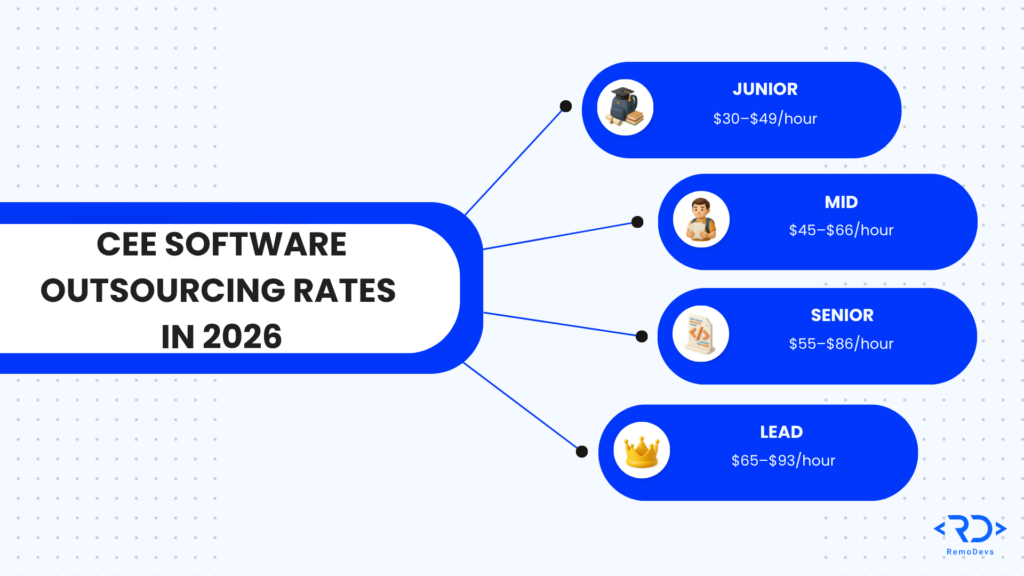
For a client-facing regional benchmark, published 2026 data places Central and Eastern European software development rates at $30–$49 per hour for junior developers, $45–$66 for intermediate developers, $55–$86 for senior developers and $65–$93 for lead developers.
These are broad provider ranges, not country averages, medians or a RemoDevs price list. A quote close to $90 per hour is possible, but the available public evidence does not support presenting it as the typical price of a standard senior developer in Polish staff augmentation. At 160 billable hours, $90 per hour equals $14,400 per month, so the scope and premium should be clear.
This guide shows what the current evidence supports, what it does not support and how to compare Poland, Czechia, Romania and Ukraine without manufacturing precise country averages.
Eastern Europe outsourcing rates: the short answer
- The main 2026 provider benchmark for CEE is $55–$86 per hour for senior developers and $65–$93 for lead developers.
- The same source lists $75–$96 per hour for data engineers and data scientists, showing that specialization can matter as much as seniority.
- On the reviewed Clutch staff augmentation pages for Poland, Czechia, Romania and Ukraine, provider profiles appear in both the $25–$49 and $50–$99 per hour company-wide bands.
- Those Clutch bands are too broad to prove a typical senior rate or rank one country as universally cheapest.
- A rate around $90 per hour is more credible for a lead, architect, scarce specialist, consulting-heavy engagement or broader managed-delivery scope than for an ordinary senior joining a client-managed team.
- The available evidence does not support a blanket claim that Eastern Europe is always 60–75% cheaper than comparable US talent.
Methodology: the RemoDevs CEE Provider Rate Review
This article was researched and reviewed on August 13, 2026. We applied the following rules:
- Define the commercial unit. The primary numbers are client-facing hourly provider rates in US dollars. Employee salaries and B2B invoices are shown separately and are not converted into outsourcing rates using an assumed markup.
- Use staff augmentation as the main comparison model. This is the closest match to RemoDevs’ team-extension service: the specialist works inside the client’s team, while the client retains control of priorities and day-to-day delivery.
- Use one regional role benchmark. The principal source is Accelerance’s 2026 Global Software Development Rates & Trends Guide, which says its research draws on more than 100 software-development firms across several regions. The public role table used below is reproduced by DistantJob.
- Treat country pages as market signals, not averages. We reviewed the Clutch IT staff augmentation directories for Poland, Czechia, Romania and Ukraine. We record only the public company-wide rate bands visible on those pages.
- Keep Polish labour-market data in its original unit. The Poland section uses Just Join IT’s salary-report medians. Its methodology separates gross employment pay from net B2B invoice values excluding VAT.
- Do not infer unsupported averages or savings. We do not calculate a country median from directory profiles, turn salaries into provider prices or compare a US employee wage directly with a CEE provider rate.
Limitations
Accelerance does not publish the country weights, country-level sample sizes or percentile definition for every public regional range. The role table is publicly available through a secondary reproduction rather than a complete open dataset.
Clutch profile rates are broad, provider-reported company bands. They are not limited to one role, seniority, service model or delivery country, and they may change after this review. They show the public pricing categories in which providers position themselves; they do not establish a market average.
For those reasons, this guide does not publish a precise “typical senior rate” for every country. A narrower figure would look useful but would imply evidence that the public sources do not provide.
Salary, contractor invoice and outsourcing rate are not the same
| Cost term | What it measures | What it may include | What it does not automatically include |
|---|---|---|---|
| Gross employment salary | Contractual employee pay before deductions | Base salary | Employer contributions, benefits, equipment, recruitment and internal management |
| B2B invoice | Amount invoiced by an independent business, often excluding VAT | Contractor service fee | Personal take-home pay after tax, social insurance, accounting, leave and business costs |
| Staff augmentation rate | Price charged to the client for an external specialist | Specialist cost plus agreed sourcing, coordination and administration | Project ownership, QA, product management or a fixed outcome unless stated in the agreement |
| Project outsourcing price | Price for an agreed scope, capacity or deliverable | Engineering and the delivery roles included in the proposal | A transparent rate for each person unless the supplier provides a rate card |
This is why a local salary cannot simply be marked up by an assumed percentage and presented as an outsourcing rate.
Regional CEE software outsourcing rates by role
The following published ranges are suitable for initial regional budgeting. They are not mandatory prices or proof that a particular quote is cheap or expensive.
| Role | Published CEE hourly range | Interpretation |
| Junior developer | $30–$49 | Limited independent ownership; provider scope still matters |
| Intermediate developer | $45–$66 | Established individual contributor |
| Senior developer | $55–$86 | Broad provider range for experienced engineers |
| Lead developer | $65–$93 | Technical leadership and greater delivery responsibility |
| Software architect | $50–$105 | Especially broad because role definitions and scope vary |
| DevOps specialist | $45–$87 | Cloud ownership, security and on-call expectations affect price |
| Data engineer | $75–$96 | Specialist regional range from the same source |
| Data scientist | $75–$96 | Production responsibility and domain expertise should be specified |
Source: Accelerance 2026 rate data, publicly reproduced by DistantJob. See the Accelerance report page for its stated research scope.
These ranges overlap because titles are not standardized. An architect with a narrowly defined advisory role may be priced differently from a lead responsible for delivery, mentoring and production decisions.
Country comparison: what public provider data actually shows
The table below reports public company-wide profile bands, not senior-developer rates. Its purpose is to show the pricing categories visible among staff augmentation providers in each market without inventing a country average.
| Market reviewed | Public provider bands visible | What can safely be concluded |
| Poland | $25–$49 and $50–$99 per hour | $90 falls within the upper company band, but the directory does not establish it as a typical senior rate |
| Czechia | $25–$49 and $50–$99 per hour | Both company bands are visible; the directory does not establish a country-level senior average |
| Romania | $25–$49 and $50–$99 per hour | Both company bands are visible; a comparable quote still requires the same role and scope |
| Ukraine | $25–$49 and $50–$99 per hour | Both company bands are visible; the market cannot be described as uniformly below $50 per hour |
The overlap is the important finding. Country labels alone do not explain whether a quote covers one engineer joining the client’s processes, a multi-role team or wider delivery responsibility.
Why this article does not rank the cheapest country
A credible country ranking would require comparable transaction data for the same role, seniority, technology, engagement model, contract length, provider scope and research period. Public sources rarely disclose all of those variables.
Vendor-written country guides often mix developer compensation, contractor expectations and software-house bill rates. Directory profiles use coarse company-wide bands. Combining those numbers would create a precise-looking table without a consistent unit.
Country still matters, but buyers should compare like with like:
- the same role and level of ownership;
- staff augmentation versus managed delivery;
- required technology and domain expertise;
- billable capacity and contract duration;
- equipment, absence and replacement terms;
- account management, technical leadership, QA or product roles;
- security, data-processing and business-continuity requirements;
- invoice currency and rate-review rules.
Is $90 per hour too high for outsourcing in Poland?
Not automatically, but it requires context.
The regional source places senior developers at $55–$86 per hour, leads at $65–$93 and data specialists at $75–$96. On that evidence, approximately $90 per hour sits closer to a lead or specialist benchmark than to the middle of a general senior range.
A quote around that level may be reasonable when it covers:
- a scarce Data, AI, Security, Cloud or architecture profile;
- leadership, mentoring or production ownership;
- an urgent or short engagement with limited guaranteed capacity;
- additional provider responsibilities beyond sourcing and administration;
- consulting or managed delivery rather than straightforward team extension.
For a standard senior developer joining a client-managed product team, the provider should be able to explain why the quote sits near or above the top of the regional senior range. The answer may still be valid, but “Poland” alone is not the justification.
A transparent Poland labour-market reference
Just Join IT reported the following monthly medians in advertisements published during 2025:
| Seniority | Employment contract | B2B contract |
| Junior | PLN 8,000 gross | PLN 9,020 net invoice |
| Mid-level | PLN 15,000 gross | PLN 18,900 net invoice |
| Senior | PLN 21,573 gross | PLN 24,780 net invoice |
Source: Just Join IT Salary Statistics. Under its methodology, employment values are gross monthly salaries, while B2B values are monthly net invoice amounts excluding VAT.
The B2B median is not the contractor’s take-home pay, and neither column is a staff augmentation price. Provider pricing may additionally cover sourcing, coordination, administration and other agreed responsibilities.
For more Polish labour-market context, see The 2026 Polish IT Market Report.
What changes the final outsourcing quote?
- Seniority and ownership: architecture, mentoring, production responsibility and decision-making matter more than years of experience alone.
- Specialization: scarce AI, data-platform, security, cloud or regulated-domain experience can narrow the available pool.
- Delivery model: staff augmentation capacity is not comparable with a managed project that includes leadership, QA, UX or project management.
- Security and operations: access restrictions, on-call work and verified compliance requirements may affect process and price.
- Commercial terms: duration, minimum capacity, start date, notice, scaling flexibility, absence, overtime and rate reviews all matter.
How to calculate a realistic monthly budget
Use the commercial terms in the proposal rather than multiplying a rate by 2,080 theoretical annual hours.
Estimated monthly external cost = agreed bill rate × approved billable hours + separately priced roles and expenses
Check whether the proposal includes:
- account or engagement management;
- technical leadership, QA, design or business analysis;
- equipment, software licences and cloud environments;
- recruitment and onboarding;
- paid or non-billable absence;
- travel or office attendance;
- taxes, VAT and currency-conversion terms;
- replacement and notice provisions.
Two providers can quote the same hourly rate while offering materially different scopes.
Eastern Europe versus US costs: compare like with like
The US Bureau of Labor Statistics reported a median annual wage of $133,080 for US software developers in May 2024. That is an employee wage, not the total employer cost and not a provider rate. BLS employer compensation data is broader than the software occupation and should not be used as a software-specific markup.
A fair employer-cost model may include salary, payroll costs, benefits, equity, equipment, recruitment and internal management. A fair outsourcing model may include billable capacity, provider services, onboarding and separately priced delivery roles.
The result changes with US location, compensation strategy, the selected CEE role, the delivery model and what each party manages. That is why this article does not repeat a universal 60–75% savings figure.
Source: US Bureau of Labor Statistics: Software Developers.
Do not use the “30% bad-hire cost” as a fixed benchmark
The frequently repeated claim that the US Department of Labor sets the cost of a bad hire at 30% of first-year earnings could not be verified as a general DOL economic benchmark. It should not be used as a fixed budgeting input.
A company-specific model is more useful. It can include recruitment and onboarding spend, compensation paid before the engagement ends, interview and management time, delayed work, rework, vacancy time and any replacement cost under the agreement.
A higher hourly rate does not prove quality, and a lower one does not prove that an engagement will fail.
Staff augmentation, project outsourcing or direct recruitment?
| Model | Who manages daily work? | Typical commercial structure | Best fit |
| Direct recruitment | The client | One-time recruitment fee plus employee or contractor compensation | A long-term role joining the client directly |
| Staff augmentation / team extension | The client | Hourly, daily or monthly provider rate | Adding defined expertise or capacity to an existing team |
| Dedicated external team | Depends on the agreement | Team capacity plus included leadership and support roles | Scaling several related roles for an ongoing product |
| Project outsourcing | The provider manages the agreed delivery scope | Time and materials, milestone or fixed-price agreement | An outcome the provider is equipped and contracted to own |
“IT outsourcing” is often used as an umbrella term. Before comparing prices, confirm which product the supplier is actually offering.
How RemoDevs supports technology teams in Poland
RemoDevs focuses on direct IT recruitment and IT staff augmentation in Poland.
In staff augmentation, the specialist joins the client’s existing team. The client retains control over the backlog, priorities, tools and day-to-day work, while RemoDevs handles the agreed search, coordination and administrative support. The client meets the proposed specialists and makes the final selection.
For a permanent role, direct IT recruitment in Poland may be the better fit. The screening scope, any technical assessment or reference checks, pricing, timeline and replacement terms should be stated in the proposal and agreement for the specific search rather than treated as universal promises.
If you are planning a role in Poland, RemoDevs can help calibrate the profile, engagement model and budget before the search starts. Discuss your staffing needs.
Frequently asked questions
What are typical IT outsourcing rates in Eastern Europe in 2026?
The published regional provider benchmark used in this guide is $30–$49 per hour for junior developers, $45–$66 for intermediate developers, $55–$86 for senior developers and $65–$93 for leads. It is a broad CEE benchmark, not a country median or guaranteed quote.
Is $90 per hour a normal senior developer rate in Poland?
It is possible, but public data does not support calling it the normal rate for a standard senior in Polish staff augmentation. It sits closer to the regional lead and specialist ranges. A provider quoting that level should explain the specialization, responsibility and services included.
Why are there no exact senior rates for Poland, Czechia, Romania and Ukraine?
The reviewed public country sources use company-wide provider bands rather than comparable role-level transaction data. Publishing exact country averages would require assumptions about seniority, service model and scope that the evidence does not support.
Which Eastern European country has the lowest outsourcing rates?
There is no defensible universal answer from the reviewed comparable data. All four country directories contain providers in both $25–$49 and $50–$99 per hour bands. Compare proposals for the same role, model, capacity and responsibilities.
Is a B2B contractor invoice the same as a staff augmentation rate?
No. A B2B invoice is revenue received by the contractor’s business before its taxes and other costs. A staff augmentation price may also include the provider’s sourcing, coordination, administration and other agreed services.
Is Eastern Europe always 60–75% cheaper than the US?
No universal percentage can be supported. The result depends on US location and compensation, the CEE market, seniority, delivery model, included services and expected capacity.
Is B2B always the correct engagement structure?
No. The appropriate structure depends on the country and the reality of the working relationship. Contract labels alone do not determine worker status; the US Department of Labor also warns about employee misclassification. Obtain country-specific legal and tax advice.
Is staff augmentation the same as project outsourcing?
No. In staff augmentation, external specialists work inside the client’s team and the client retains control of priorities and daily delivery. In project outsourcing, the provider accepts responsibility for an agreed scope or outcome.
Visit us
Find a moment in your calendar and come to our office for a delicious coffee
Make an apointment