
Hiring a software engineer involves more than finding a CV with the right keywords. The candidate needs to match the responsibilities of the role, the working environment, the compensation range and the client’s interview expectations.
At RemoDevs, we use a role-specific recruitment process rather than treating every developer as universally “pre-vetted.” We first define what a good match means for the open position, then source and screen candidates against those requirements.
This article explains our process for direct recruitment in Poland, what RemoDevs checks before presenting a candidate and which parts of the evaluation may vary from one search to another.
The RemoDevs recruitment process at a glance
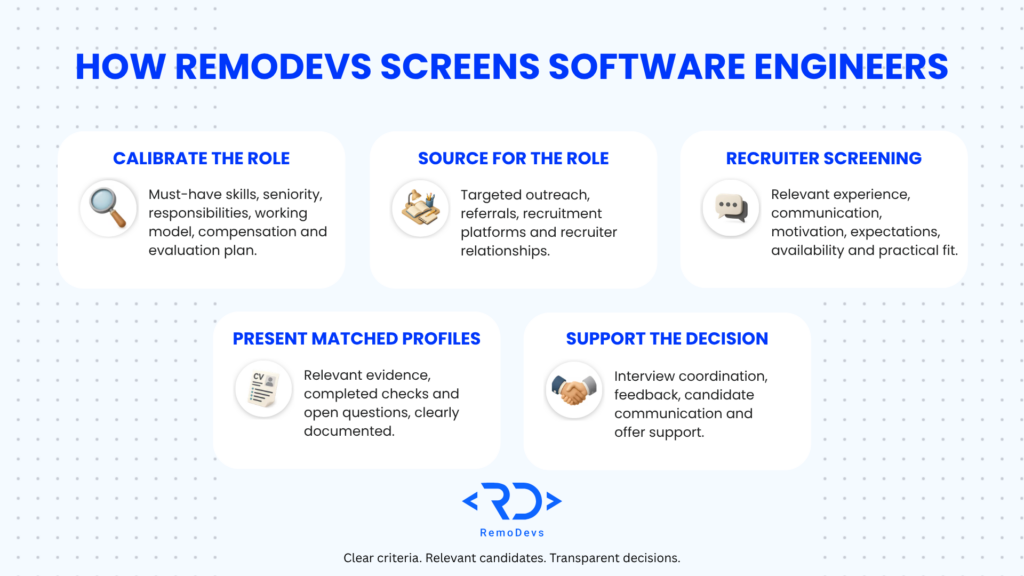
Our direct-hire searches follow five core parts:
- Calibrate the role and evaluation plan.
- Source candidates for that specific position.
- Conduct recruiter screening.
- Present relevant candidates and coordinate technical validation.
- Support interviews, feedback and the offer process.
These are parts of one recruitment workflow, not five identical tests that every candidate must pass. The exact technical assessment, reference-checking requirements and client interview stages are agreed for each search.
What our candidate labels mean
Clear definitions matter because “screened,” “technically assessed” and “hired” are not interchangeable.
| Term | What it means at RemoDevs |
|---|---|
| Sourced candidate | A person identified for a specific role who has not necessarily completed a RemoDevs interview. |
| Recruiter-screened candidate | A person whose relevant experience, communication, motivation, expectations, availability and practical fit have been discussed against the agreed role criteria. |
| Technically assessed candidate | A person who has completed the specific technical evaluation agreed for the search. The format and evaluator should be stated clearly. |
| Presented candidate | A candidate sent to the client with a summary of relevant evidence, completed checks and any open questions. |
| Hired candidate | A candidate selected by the client after its own interviews and decision-making process. |
A recruiter-screened candidate should not automatically be described as having passed live coding, a formal background check or a reference check. We only state that a check has been completed when it has actually taken place.
Step 1: Calibrate the role and evaluation plan
A reliable shortlist starts with a clear brief. Before beginning the search, we work with the client to understand:
- the role’s responsibilities and expected outcomes;
- must-have skills and useful secondary experience;
- the level of seniority and the evidence that should demonstrate it;
- the product, team and business context;
- location, remote or hybrid expectations and required working-hour overlap;
- salary or rate range, preferred start date and engagement model;
- the client’s interview stages and ownership of the technical assessment.
This calibration helps separate genuine requirements from broad wish lists. It also gives both sides the same definition of a relevant candidate before profiles are presented.
For difficult or unusually combined requirements, RemoDevs can provide feedback on the Polish candidate market and discuss which criteria may be limiting the search.
Step 2: Source candidates for the specific role
Once the brief is agreed, we begin active sourcing across Poland. Depending on the role, this can include direct outreach, existing recruiter relationships, referrals and relevant recruitment platforms.
An existing relationship can make outreach faster, but it does not make a candidate automatically suitable for every client. Skills, motivation, compensation expectations and availability can change. That is why candidates are checked against the current role rather than presented solely because they already exist in a database.
During the initial profile review, we look for evidence that the person’s recent work is relevant to the position. We also identify gaps or questions that need to be discussed during the recruiter interview.
Step 3: Conduct recruiter screening
Candidates who appear relevant are invited to a recruiter conversation. The purpose is to verify the practical match between the candidate and the role, not to replace the client’s engineering interview.
The screening normally covers:
- relevant roles, projects and responsibilities;
- experience with the required technologies in context;
- communication and English level required for the team;
- motivation for considering the opportunity;
- salary or rate expectations;
- availability and notice period;
- location, working model and other role-specific logistics;
- unclear points or potential risks identified during profile review.
For senior positions, we ask for concrete examples of ownership, decision-making and collaboration. We record what the candidate has actually done and avoid turning a job title or list of tools into proof of seniority.
A recruiter can assess the relevance and consistency of a candidate’s experience. Product-specific architecture, coding depth and engineering trade-offs are normally best evaluated by the client’s technical team unless a separate technical assessment has been agreed for the search.
Step 4: Present relevant candidates and coordinate technical validation
RemoDevs prepares a focused shortlist instead of forwarding a large volume of unreviewed CVs. A candidate presentation should make it clear why the person may fit the role and what has already been checked.
Depending on the search, the summary can include:
- relevant experience and project examples;
- alignment with the key requirements;
- communication and motivation notes;
- salary or rate expectations;
- availability and notice period;
- location and preferred working model;
- completed assessment stages;
- open questions that the client should explore.
The client chooses and owns the technical validation method. Its process may include an engineering interview, a system-design discussion, live coding, a take-home task or another role-appropriate format. Where agreed, RemoDevs coordinates scheduling and communication around that client stage. We do not imply that every candidate has completed the same technical test.
Reference checks or other verification steps are also treated as role-specific requirements. If they are included, their scope and timing should be clear to the client and candidate.
Step 5: Support interviews, feedback and the offer process
The client decides whom to interview and hire. RemoDevs supports the process by:
- coordinating interview availability;
- keeping the candidate informed;
- collecting and passing on feedback;
- helping resolve questions about the role or offer;
- supporting communication through acceptance or closure.
Fast, specific feedback is important. It gives candidates a better experience and allows the search to be adjusted when the first profiles reveal that the original brief needs refinement.
The client’s technical and hiring teams remain responsible for the final evaluation and selection decision.
How quickly does RemoDevs present candidates?
We begin sourcing and screening after the role has been calibrated. For most direct-recruitment searches, we aim to present the first qualified candidates within five working days.
This is a target for the first relevant profiles, not a guarantee that the complete hiring process will finish within five days. Timing depends on factors such as seniority, technology stack, compensation, location, interview availability and current candidate interest.
For a rare or highly constrained profile, a realistic role-specific estimate is more useful than a universal 24-72 hour promise.
Quality is role-specific, not a universal percentile
RemoDevs does not need a blanket “top 10%” label to explain why a candidate is relevant. Quality depends on the role, and the proportion of sourced candidates who are eventually presented will vary between searches.
Our responsibility is to give the client a focused shortlist supported by evidence from the agreed process. If a requirement has not been verified, it should remain an open question rather than being presented as a completed check.
Direct recruitment and staff augmentation are different services
The screening process should not blur the difference between hiring a person directly and adding an external specialist to an existing team.
| Direct recruitment | IT staff augmentation | |
| Relationship | The client selects and hires the candidate directly. | The specialist joins the client’s team through RemoDevs for an agreed period. |
| Day-to-day management | Managed by the client after hiring. | The client manages the backlog, priorities and daily work. |
| RemoDevs’ role | Role calibration, sourcing, recruiter screening, candidate presentation, interview coordination and offer support. | Requirement calibration, sourcing and matching, agreed screening, administration, onboarding coordination and ongoing engagement support. |
| Commercial and legal terms | Defined in the proposal and direct-recruitment agreement. | Defined in the staff-augmentation agreement for the engagement. |
Contracting, invoicing, replacement support, intellectual-property provisions and any payroll, EOR or B2B administration depend on the selected service and written agreement. They should not be inferred from the screening process or presented as universal features of every RemoDevs engagement.
Learn more about direct IT recruitment in Poland and IT staff augmentation in Poland.
Frequently asked questions
Does every RemoDevs candidate complete live coding or a technical test?
No. In direct recruitment, the client’s technical team normally chooses and conducts the evaluation of product-specific engineering depth. Where agreed, RemoDevs can coordinate scheduling and communication around that client stage. The candidate presentation should state clearly which assessment, if any, has been completed.
Are all candidates in the RemoDevs network pre-vetted?
Candidates may already be known to our recruiters, but suitability, interest and availability are checked against the current role. We use specific labels for the steps a candidate has completed instead of treating “pre-vetted” as a universal status.
Does RemoDevs conduct reference or background checks?
Only where the agreed search process requires them. Their scope and timing depend on the role, the client’s requirements and the applicable process. A recruiter screen or CV review should not be described as a formal background check.
How many candidates does RemoDevs reject?
There is no useful universal percentage. The number varies with the role, sourcing pool and agreed requirements. We focus on presenting candidates who match the brief and documenting why they may be relevant.
Are payroll, EOR, B2B administration or a single invoice included?
Do not assume that they are included in direct recruitment. Contractual and administrative support depends on the selected engagement model and must be stated in the proposal and written agreement.
Discuss your hiring needs
If you are hiring software engineers, AI specialists, data professionals, DevOps engineers or technical leaders in Poland, tell us about the role and your evaluation process. We will help calibrate the search and explain what is realistically available in the market.
Discuss an open role with RemoDevs
Visit us
Find a moment in your calendar and come to our office for a delicious coffee
Make an apointment