Poland is a viable sourcing market for international companies building AI products, deploying machine-learning models or adding specialist engineering capacity. Hiring demand has grown, but the useful question is which part of that market your company can reach: an experienced ML engineer, a Data Scientist and an engineer integrating large language models solve different problems.
For employers planning an AI hire in 2026, three distinctions matter: demand for people who use AI versus people who build it; advertised compensation versus actual earnings; and a nationwide search versus recruitment within commuting distance of an office.
AI & ML Talent in Poland 2026: Key Findings
- AI skills across occupations, 2025: PwC identified nearly 80,000 Polish advertisements requiring AI skills, including both AI-tool users and technical specialists.
- Technical AI development, 2025 vs 2024: Advertisements in PwC’s narrower AI-developer group, requiring advanced ML or LLM skills, increased by 46.3%.
- AI/ML job-board demand, H1 2026 vs H1 2025: Just Join IT recorded 2,352 advertisements, up from 1,029, approximately 129% growth on that platform. These are advertisements, not available candidates, unique vacancies or completed hires.
- Advertised pay, Q1 2026: No Fluff Jobs’ separate median lower and upper limits were PLN 18,000 and PLN 24,000 gross for UoP, and PLN 21,840 and PLN 28,000 in B2B invoice value excluding VAT, all per month. These describe advertised limits, not actual earnings.
- Company access to skills: PARP’s summary published on 11 May 2026 reports access to qualified AI implementation and maintenance personnel in about 25% of surveyed enterprises, and 47% among those already using AI. These are company-reported access measures.
Why Poland matters for AI & ML in 2026
Domestic adoption provides context for international sourcing. Eurostat’s 2025 enterprise survey found AI use in 8.4% of Polish enterprises covered by the survey, compared with 20.0% across the EU. Its scope covers selected business sectors and enterprises with at least 10 employees or self-employed persons.
Domestic adoption and the availability of engineers for international teams are different measures. A company hiring in Poland should evaluate the relevant engineering experience rather than infer candidate quality from a national adoption rate.
For European teams, Poland’s location can support a shared working day. When recruiting across time zones, specify the overlap needed for design reviews and operational handovers.
For the wider workforce and education context, see the 2026 Polish IT Market Report. This report focuses on the AI/ML segment and the decisions it creates for employers.
Current landscape of AI & ML talent in Poland
Hiring demand is growing across different kinds of AI work
PwC’s AI Jobs Barometer 2026, published in June 2026, identified nearly 80,000 Polish job advertisements requiring AI skills in 2025. These included people applying AI tools in their work as well as technical specialists developing AI. Within its more technical “AI developer” group, requiring advanced ML or LLM skills, advertisement volume grew by 46.3% compared with 2024.
A more recent period is covered by the Just Join IT and RocketJobs H1 2026 barometer. It reports 2,352 AI/ML advertisements on justjoin.it in the first half of 2026, compared with 1,029 in the equivalent 2025 period: approximately 129% growth.
Read these as complementary demand indicators: PwC tracks AI skills across occupations, while Just Join IT tracks its AI/ML recruitment category. Together, they show expanding advertised demand across different definitions of AI work.
For employers, the implication is to define the addressable market precisely. A requirement for production model deployment, a particular industry, office attendance and technical leadership describes a much narrower search than “AI talent in Poland.”
Geographic hotspots and nationwide searches
Poland’s tech talent is distributed across several key metropolitan areas. Warsaw, Kraków, Wrocław, Gdańsk/Tricity and Poznań are useful starting points when considering office locations. Our comparison of Polish cities for hiring developers covers that location decision in more detail.
For an AI search, start with the attendance requirement. A remote role can be sourced across Poland; a hybrid role needs a realistic commuting area and a stated number of office days.
Check the actual location of candidates, their willingness to travel and any country restrictions on remote work. “Remote” should describe the working arrangement clearly enough for both parties to make a decision.
In-demand skills and roles for AI & ML engineers in Poland
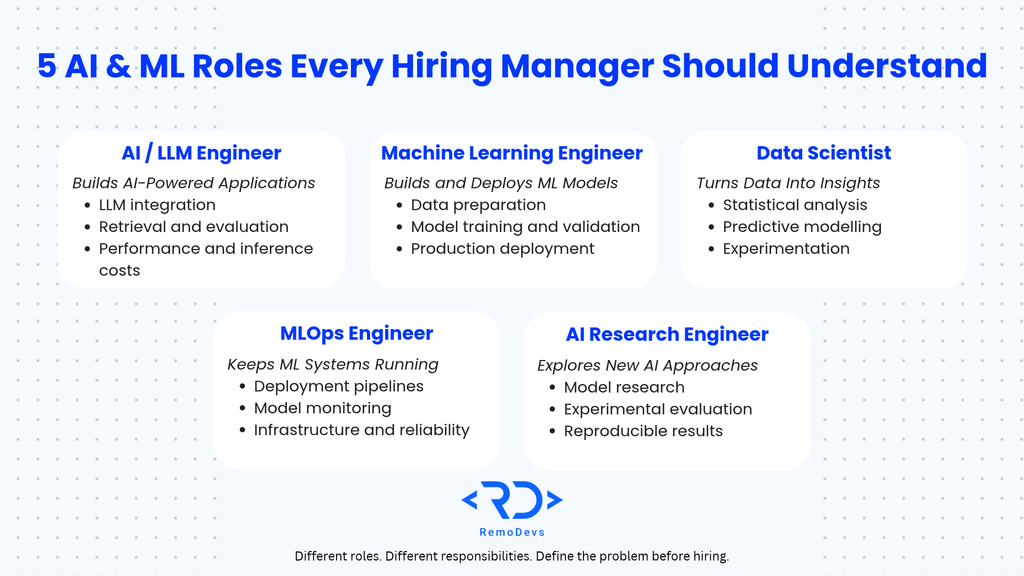
Role titles overlap between employers. Use this responsibility framework to compare specialties and the evidence relevant to each role.
| Specialty | Main responsibility | Evidence relevant to the role |
|---|---|---|
| AI Engineer / Applied AI or LLM Engineer | Integrate models into a usable product or workflow | Backend integration, retrieval where needed, evaluation, permissions, latency and inference costs |
| Machine Learning Engineer | Develop and deploy predictive or learning-based systems | Data preparation, model validation, reproducible training, serving and monitoring |
| Data Scientist | Investigate a business question through analysis, experimentation and modelling | Statistical reasoning, suitable baselines, experiment design and interpretation of results |
| MLOps Engineer | Make model deployment and operation repeatable and reliable | Deployment pipelines, versioning, observability, rollback and infrastructure ownership |
| AI Research Scientist / Research Engineer | Investigate or implement novel modelling approaches | Relevant research depth, experimental rigour and reproducible results appropriate to the problem |
Data engineering sits alongside these specialties: reliable pipelines and access to usable data may be prerequisites for the AI work. Decide whether that capability already exists in the team before assigning it to the new hire.
Production skills sit alongside model knowledge
Current employer advertisements illustrate how these responsibilities combine. An EPAM Senior Cloud Native Developer role in Poland pairs Python and cloud engineering with LLM applications, retrieval-augmented generation and AI agents. Its Senior MLOps Engineer role includes versioning, evaluation gates, promotion between environments and rollback for agent systems.
These individual advertisements, checked in November 2026, illustrate production responsibilities rather than their frequency across the market.
Engineering foundations remain relevant: Python, an appropriate modelling stack and the cloud or deployment environment used by the team. Specify TensorFlow, PyTorch or another framework when the work requires it, rather than making every familiar tool mandatory.
Academic training can matter for research-intensive work. For a product role, assess the candidate’s contribution to a deployed system as well. A degree, a course certificate and production ownership provide different kinds of evidence.
Salary benchmarks and compensation trends
A 2026 benchmark with clear contract definitions
No Fluff Jobs’ Q1 2026 AI salary analysis gives the following medians of the lower and upper advertised monthly pay limits in its AI category:
| Advertised arrangement | Median advertised lower limit | Median advertised upper limit |
|---|---|---|
| Employment contract — UoP, gross monthly pay | PLN 18,000 | PLN 24,000 |
| B2B — monthly invoice value excluding VAT | PLN 21,840 | PLN 28,000 |
Each column is a separate median of advertised limits, not a percentile interval or a measure of actual earnings. The figures cover the broad AI category; the source article provides neither a sample size for them nor a detailed seniority breakdown. Use them as market context, rather than a senior AI/ML or LLM hiring quote.
The B2B amount is not personal take-home pay. For budgeting, distinguish the contractor’s invoice from gross employment pay and from the client-billed price of staff augmentation. Recruitment fees and employer-side costs are separate budget items.
Match the budget to the required autonomy, architectural judgement and operational ownership. A fixed pay premium for an AI job title cannot capture those differences.
For a deeper discussion of LLM-specific responsibilities and budgeting, see our Generative AI Developer Salary in Poland guide.
Compare the full engagement, not only the headline rate
When comparing Poland with another location, use equivalent responsibilities, seniority and contract terms. Include compensation, benefits or agreed contractor terms, recruitment costs, equipment, onboarding and the collaboration arrangement. An advertised salary comparison alone cannot establish a universal saving percentage.
Planning a direct AI or ML hire? RemoDevs’ technical recruitment service in Poland combines nationwide sourcing, recruiter screening and interview coordination for international employers. Success-fee recruitment is available under agreed commercial terms; your engineering team evaluates the technical fit for the product.
Hiring challenges and strategies for 2026
Translate a broad market into a realistic search
In its summary published on 11 May 2026, PARP reports that about 25% of enterprises surveyed in Bilans Kapitału Ludzkiego declared access to qualified IT personnel able to implement and maintain AI-based solutions. Among surveyed firms already using AI, the figure was 47%.
This measures company-reported access to skills, without specifying exclusively in-house employment. The summary does not provide sample or subgroup sizes or fieldwork dates, so these responses should not be converted into a national talent count or shortage percentage.
The first hiring decision is often the balance between specialism and team support. An organisation with an established data platform can recruit a different profile from a company expecting one person to clean source data, choose models, build APIs and maintain infrastructure.
Illustrative planning scenarios:
| Your situation | Hiring implication |
|---|---|
| An internal document assistant must respect existing user permissions | Prioritise applied AI and backend integration, with evaluation and access-control responsibilities defined |
| Predictive models work in notebooks but are difficult to deploy reliably | Clarify the division between ML engineering and MLOps before opening the role |
| Data is fragmented or poorly maintained | Address data ownership and engineering capacity alongside the AI search |
A useful market comparison fixes the problem, production ownership, team support and working arrangement before evaluating candidate availability. Our guide to hiring Machine Learning Engineers in Poland covers the sourcing and technical-assessment process in detail.
Outlook for AI talent in Poland
The evidence from 2025 and H1 2026 shows stronger advertised demand for AI capability. It gives employers a reason to test availability for their specific requirements, rather than assume a broad AI talent pool will meet every search.
Three decisions make that market comparison useful:
- Define the specialty and production ownership. Separate research, model development, product integration and operations before comparing candidates.
- Build a comparable budget. Use the same responsibilities, seniority and period, and distinguish UoP gross pay, B2B invoice value and provider-billed capacity.
- Set a realistic working arrangement. Match the search geography to office attendance, permitted work locations and the hours of collaboration required.
Choose support accordingly: direct recruitment fills a position in your organisation; staff augmentation adds capacity under your team’s priorities and day-to-day management; RPO adds recruiter capacity within your hiring process.
Use the dated market evidence as a starting point, then calibrate the search with relevant candidate responses. Historical advertisement growth supplies context, not a forecast for late 2026 or 2027.
Visit us
Find a moment in your calendar and come to our office for a delicious coffee
Make an apointment