
Two staff augmentation proposals can show nearly identical headline prices and still create very different invoices.
One hourly rate may cover only approved working time. A monthly rate may reserve a specialist’s full-time capacity whether every hour is used or not. Another provider may show the developer’s compensation and add a separate markup, while a fourth gives one bundled figure with no cost breakdown.
That is why the useful question is not simply, “What is your rate?” It is:
What commercial unit am I buying, what is included in it, and which costs or risks remain with my company?
This guide explains how to read the answer. It focuses on the mechanics of staff augmentation pricing rather than country-by-country rates or developer salary benchmarks. For Poland-specific market figures, see RemoDevs’ separate guide to IT staff augmentation costs in Poland.
Start with the commercial unit, not the headline number
In client-managed staff augmentation, the buyer usually purchases access to a named specialist’s capacity for an agreed period. The client retains control of the roadmap, priorities and day-to-day work. RemoDevs describes that responsibility split on its Staff Augmentation in Poland page.
Before comparing prices, identify four elements:
- Billing unit: an hour, day, month, full-time allocation or another agreed unit.
- Cost base: developer compensation alone, the provider’s total employment or contractor cost, or an undisclosed internal figure.
- Provider charge: a visible fee or markup, or a margin embedded in an all-inclusive rate.
- Contract rules: the treatment of leave, overtime, equipment, currency changes, minimum capacity and termination.
A lower unit price is not necessarily the lower commercial offer. The quoted unit may cover less, assume more hours or shift more risk to the buyer.
The main IT staff augmentation pricing models
Hourly rate
The client pays for approved hours worked:
hourly rate × billable hours = base invoice amount
Hourly billing is useful when capacity will vary, a specialist is part-time or the duration is uncertain. It also makes overtime and smaller allocations easier to price.
The trade-off is monthly variability. A calendar with 144 billable hours produces a different base invoice from one with 168, unless the parties have agreed a minimum or capped allocation. The contract should define:
- how time is recorded and approved;
- whether there is a minimum number of hours;
- whether public holidays, annual leave and sick days are billable;
- how overtime, on-call work and weekend hours are authorized and priced;
- whether unused hours expire or carry forward; and
- whether meetings, onboarding and training count as billable time.
An hourly rate does not reveal the developer’s compensation or the provider’s margin unless the proposal discloses them separately.
Fixed monthly rate
Here, the buyer pays one recurring amount for a defined allocation, commonly a named specialist working full-time for the month.
Monthly pricing is easy to place in a budget because the base invoice is stable. It can also reflect reserved availability rather than a count of every hour. Yet “monthly” does not mean unlimited time, and it does not automatically settle what happens during leave or a short calendar month.
Ask what the monthly fee buys: a number of hours, all working days in the relevant calendar, or agreed availability. Confirm whether leave reduces the fee, whether additional hours need approval and whether the specialist can be reassigned if the client has no work ready.
Bench time needs particular care. A provider may use the term for a period before the specialist starts, between client assignments or while work is temporarily unavailable. The agreement should say whether any of those periods are chargeable. Never infer the answer from the phrase “fixed monthly rate.”
Compensation plus vendor markup
In a transparent or cost-plus structure, the proposal separates the specialist’s compensation from the provider charge:
agreed compensation base + provider fee = client rate
The provider fee may be a percentage of the compensation base or a fixed recurring amount. A percentage alone is incomplete unless the contract defines what it is applied to. “Salary” might mean gross employee salary, total employer cost, contractor invoice or another agreed base.
This structure lets the buyer see how changes in compensation affect the final rate. It also makes the provider’s recurring charge easier to track. The fee may cover sourcing, screening, contracting, administration, account support and commercial risk, but only the written scope tells you what it actually covers.
The lowest markup does not automatically create the lowest effective cost. One provider may apply a smaller percentage to a broader cost base, charge sourcing or equipment separately, or offer a thinner support package. Another may charge a larger visible fee but include costs that would otherwise appear elsewhere.
There is no universal “correct” staff augmentation markup. Role scarcity, engagement length, provider scope, employment structure and risk allocation all matter. A proposal should be judged on its total cost and terms, not against an unsupported internet average.
Bundled or all-inclusive rate
A bundled proposal shows one client-facing hourly or monthly rate. The underlying specialist compensation, overhead and margin are not itemized.
This is simple to administer and can provide good budget visibility when inclusions are clearly defined. It gives the buyer less insight into how much of the price reaches the specialist, why a rate changes or how a salary review will flow through to the invoice.
Two vendors can quote the same monthly amount while operating very different internal models. One may include hardware and employment-related costs; another may engage a B2B contractor using their own equipment. “All-inclusive” is useful only when the agreement states what “all” covers.
Recruitment or placement fee
A placement model is commercially different from ongoing staff augmentation. The agency sources a candidate, the client hires or contracts with that person directly, and the agency charges a recruitment fee.
The fee may be:
- a percentage of an agreed annual compensation base;
- a multiple of monthly compensation;
- a fixed amount; or
- a success fee payable after a defined hiring event.
There is usually no recurring augmentation rate because the provider is not maintaining the specialist engagement. The exact fee trigger, compensation base and replacement terms belong in the recruitment agreement. RemoDevs covers those mechanics separately in its guide to IT recruitment agency fees in Poland.
A proposal that combines a placement fee with a recurring charge needs an especially clear scope. The buyer should be able to identify what each payment buys and whether a later direct hire creates a conversion or buyout fee.
Hybrid structures
Some agreements combine elements of the models above. Examples include a setup fee plus a recurring rate, a recruitment charge paired with a smaller monthly administration fee, volume pricing for several specialists or a minimum monthly commitment.
These arrangements are not inherently better or worse. They become difficult to evaluate when one component is presented prominently and the others are buried in contract schedules. Model every compulsory payment over the expected engagement term.
Pricing model comparison
| Model | How it works | Cost predictability | Pricing transparency | Best suited for | What to verify |
|---|---|---|---|---|---|
| Hourly | Approved hours multiplied by a unit rate | Varies with hours | Unit price is clear; underlying margin may not be | Variable, part-time or uncertain demand | Monthly assumptions, time approval, leave, overtime and minimum hours |
| Fixed monthly | Recurring fee for agreed capacity or availability | High at base-fee level | Depends on whether the rate is itemized | Stable, longer-running full-time capacity | Included capacity, leave, bench time and excess hours |
| Compensation plus markup | Disclosed cost base plus fixed or percentage provider fee | High if the base and review rules are stable | Usually highest | Buyers that want visibility into compensation and provider economics | Definition of the base, included services and pass-through costs |
| Bundled rate | One all-in client rate with no internal breakdown | High if exclusions are narrow | Limited | Buyers prioritizing a simple invoice | Exact inclusions, rate-review rules and additional fees |
| Recruitment fee | One-off fee after an agreed hiring event | High once the trigger and base are defined | High if the calculation is disclosed | Direct hiring rather than ongoing augmentation | Trigger, compensation base, guarantee and later-hire clauses |
| Hybrid | Combines one-off and recurring charges | Contract-specific | Contract-specific | Bespoke, scaled or transitional arrangements | Total cost across the full term and purpose of every fee |
What can be inside a staff augmentation rate?
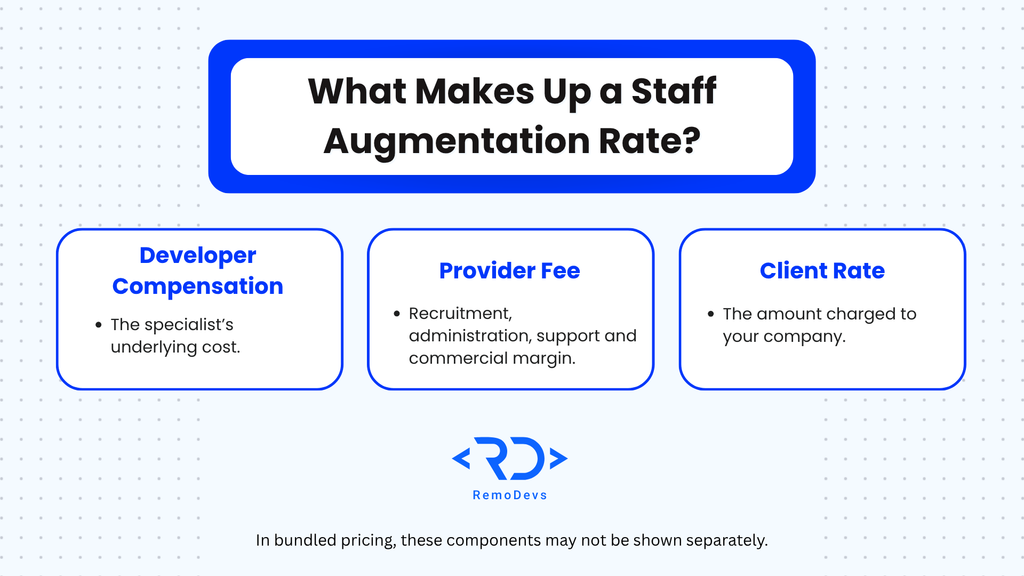
To read a quote correctly, separate three layers: the specialist’s compensation, the provider’s cost base and the provider charge. The cost base may be limited to contractor compensation or may also contain employer-side costs. The provider charge can cover services such as sourcing, screening, contracting and account support, or it may be a narrower administration fee.
Some costs are passed through separately rather than included in either layer. Equipment is a common example. A bundled rate hides these internal divisions, so the proposal must state what the single figure includes and what can still be added to the invoice.
The contract should also identify who engages and pays the specialist. A B2B contractor, a provider employee, an Employer of Record arrangement and direct employment by the client do not create the same cost base. RemoDevs’ Staff Augmentation in Poland page describes its published delivery scope, but it does not publish a universal markup or rate card. Pricing terms therefore need to be confirmed in the specific proposal.
Staff augmentation markup vs margin: read the denominator
Suppose a proposal says “15% markup.” Before using that number in a comparison, ask three questions:
- What is the percentage applied to? It could be contractor compensation, gross employee salary, total employment cost or another defined base.
- Is the percentage a markup on cost or a gross margin on the client rate? These use different denominators.
- What is included in the provider charge? It may cover the full sourcing and engagement service or only administration after selection.
Markup is calculated against the cost base:
markup = provider charge ÷ cost base
Gross margin is calculated against the amount billed to the client:
gross margin = provider charge ÷ client rate
For an illustrative cost base of PLN 30,000:
- a 20% markup on cost produces a client rate of PLN 36,000;
- the PLN 6,000 difference is 16.7% of the PLN 36,000 client rate.
The same PLN 6,000 provider charge is therefore both a 20% markup and a 16.7% gross margin. Ask for the formula, denominator and included scope rather than relying on the labels “markup” or “margin.”
Items to normalize outside the quoted rate
Before comparing proposals, identify every compulsory or likely charge outside the headline rate. The points most likely to change the commercial comparison are:
- setup or recruitment fees;
- equipment and required software;
- overtime or on-call rates;
- treatment of annual leave, sick leave and public holidays;
- minimum monthly capacity or minimum contract value;
- notice periods and early termination charges;
- direct-hire conversion fees;
- billing currency and exchange-rate rules;
- VAT or other applicable taxes; and
- scheduled rate or compensation reviews.
These items are not standard additions to every contract. Their purpose here is to make the same cost categories visible in both quotes.
The comparison can be expressed as:
effective cost = recurring charges + compulsory one-off charges + likely variable charges
Calculate that figure over the same expected contract term and capacity. This section addresses invoice normalization only; broader operational cost leakage is covered separately in RemoDevs’ guide to the hidden costs of offshore development.
Why rates vary for developers with the same title
“Senior Software Engineer” is not a standardized commercial unit. The compensation base can differ because the proposed specialists have different experience, responsibilities or engagement conditions.
Compare role to role rather than title to title: align the required profile, seniority, working pattern and start date before comparing the commercial model. For detailed Polish benchmarks and the factors that move market rates, see How Much Does IT Staff Augmentation Cost in Poland in 2026?.
How to compare two staff augmentation proposals
Quote normalization matters more than comparing headline hourly or monthly rates. Put both offers on the same basis: the same specialist profile, expected capacity, billing period, start date and contract duration.
| Comparison field | Quote A | Quote B | Why it matters |
|---|---|---|---|
| Billing unit | Hour / month / other | Hour / month / other | Different units require conversion |
| Expected billable capacity | Drives the base invoice | ||
| Specialist compensation visible? | Determines cost transparency | ||
| Provider fee or margin visible? | Shows how the vendor charge is calculated | ||
| Sourcing and screening | May be included or charged separately | ||
| Equipment and software | Can alter effective monthly cost | ||
| Leave and public holidays | Changes paid capacity | ||
| Overtime and on-call rules | Controls variable spend | ||
| Setup or recruitment fee | Adds one-off cost | ||
| Replacement terms | Allocates attrition and restart risk | ||
| Minimum commitment | Affects downside cost if demand changes | ||
| Notice and termination | Determines exit cost and flexibility | ||
| Direct-hire conversion fee | Matters if permanent hiring is possible | ||
| Currency and exchange rule | Allocates FX risk | ||
| Rate-review rule | Affects longer-term forecasting |
For hourly versus monthly offers, calculate an effective planning rate:
monthly fee ÷ expected billable hours = effective hourly planning cost
For each quote, first calculate the effective monthly cost:
base monthly charge + recurring extras + allocated one-off fees = effective monthly cost
Then repeat the calculation across the full committed period, applying the same assumptions for leave, overtime, currency and rate reviews. This is a pricing comparison, not a complete vendor assessment. Delivery evidence, candidate quality, references, security and operational fit belong in How to Choose an IT Staff Augmentation Company once that guide is live.
Three illustrative pricing examples
The figures below explain the arithmetic only. They are not RemoDevs rates or market benchmarks.
Example 1: transparent markup
- Developer compensation base: PLN 30,000 per month
- Provider markup: 20% of that base
- Provider fee: PLN 6,000
- Client monthly rate: PLN 36,000
The next question is whether the PLN 30,000 base and PLN 6,000 fee cover all employment or contractor costs, equipment and support. Transparency of the formula does not remove the need to define its inputs.
Example 2: bundled monthly rate
- Client monthly rate: PLN 38,000
- Underlying compensation: not disclosed
- Provider margin: not disclosed
The buyer can forecast the base invoice but cannot compare the internal markup directly. The useful comparison moves to included services, capacity, rate reviews and exclusions.
Example 3: hourly billing
- Rate: EUR 75 per hour
- Planning assumption: 152 approved hours
- Estimated base monthly spend: EUR 11,400
If the actual approved time is 144 hours, the base amount is EUR 10,800. If a minimum of 152 hours applies, the invoice may remain EUR 11,400. The contract, not the multiplication alone, decides the result.
Questions to ask before signing
- Is the rate hourly, daily, monthly or based on another unit?
- How many hours or working days does the price assume?
- Does the monthly fee buy used time, reserved capacity or availability?
- Is the specialist’s compensation visible?
- What is the provider fee calculated on?
- What services does the fee include?
- Are sourcing and recruitment included?
- How are annual leave, sick leave and public holidays treated?
- Is equipment included, and who owns it?
- Are there setup, onboarding or security-check charges?
- How are overtime and on-call work approved and priced?
- Can the rate change during the contract?
- How are compensation reviews handled?
- Which currency and exchange-rate rule apply?
- Is there a minimum capacity or contract term?
- What is the notice period, and are there early-exit charges?
- What happens if the specialist leaves or is not a fit?
- Is replacement support included, and under what conditions?
- Does direct hiring create a conversion fee?
- Which taxes or pass-through expenses can be added to the invoice?
Which model fits which engagement?
Hourly pricing generally fits variable or part-time demand, provided the buyer can tolerate invoice movement and has a reliable approval process.
A fixed monthly rate suits stable, longer-running capacity when the definition of a month, leave treatment and availability are clear.
Compensation plus markup gives procurement teams more visibility into the economics and future compensation changes. It works best when the cost base and provider scope are precisely defined.
A bundled rate favors invoice simplicity. It can be entirely workable when the exclusions, capacity and rate-review rules are explicit.
A placement fee fits a direct-hire outcome, not an ongoing staff augmentation relationship. Hybrid structures can support bespoke arrangements, but every compulsory charge should be modeled across the same period before approval.
Final takeaway
A staff augmentation rate is only the top line of a commercial model. To understand what you will actually pay, identify the billing unit, cost base, provider charge, included services and contract rules.
Then normalize competing offers to the same specialist, capacity and duration. Add one-off and likely variable costs, and examine who carries the risk of leave, replacement, currency movement and early termination.
That process will not tell you which provider is best. It will tell you whether the prices in front of you are genuinely comparable, which is the right place to begin.
Visit us
Find a moment in your calendar and come to our office for a delicious coffee
Make an apointment