Google’s presence in Poland began long before the recent wave of AI investment announcements.
Since entering the market in 2005, the company has built engineering teams, opened a cloud region in Warsaw, worked with startups and universities, and developed relationships with Polish businesses.
Its February 2025 AI partnership was another step in a much longer expansion.
Those activities serve different purposes. Engineers in Poland work on global products, the Warsaw cloud region serves customers across Poland and Central and Eastern Europe (CEE), and partnerships support technology adoption and skills development.
Together, they offer a clearer picture of why Poland has become an important location for Google, and what other international technology employers can learn from it.
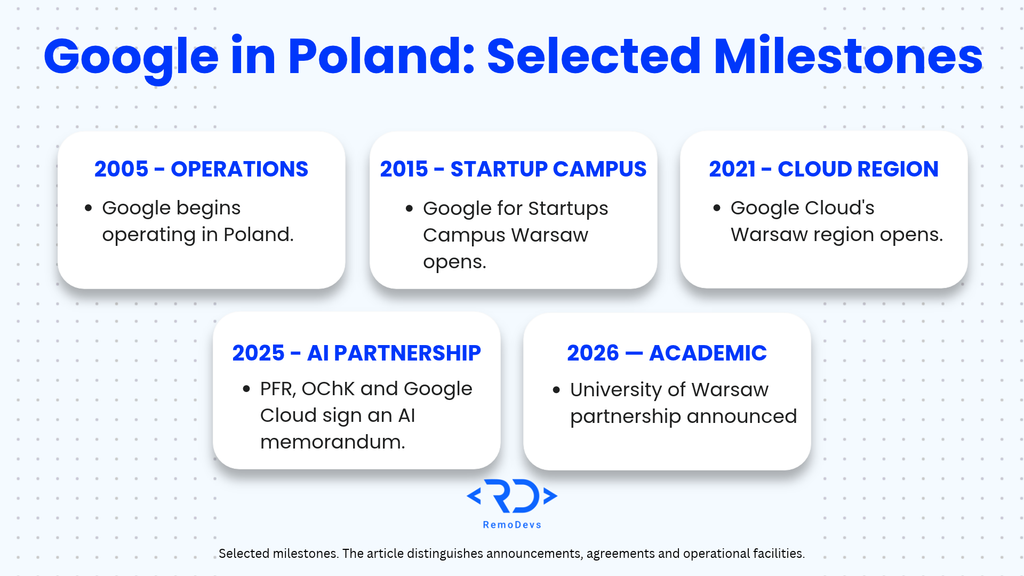
Google in Poland: the key milestones
Google’s development in Poland spans more than two decades. The timeline shows how its engineering, infrastructure and partnership activities took shape.
| Date | Milestone | Why it matters |
|---|---|---|
| 2005 | Google began operating in Poland, according to PFR’s historical account. | The company’s Polish presence predates the current AI investment cycle. |
| 2015 | Google for Startups Campus Warsaw opened, as documented in Google’s account of its CEE startup programmes. | The company established a dedicated space for working with founders. |
| September 2019 | Google announced a partnership with OChK and plans for a Warsaw cloud region. | The company outlined its regional cloud infrastructure plans. |
| 14 April 2021 | Google Cloud opened its Warsaw region. | Cloud infrastructure became available to customers in the region. |
| 7 March 2022 | Google announced nearly US$700 million to purchase and further develop The Warsaw HUB. | A major investment in its Warsaw office facilities. |
| 13 February 2025 | PFR, OChK and Google Cloud signed an AI memorandum. | The organisations set out a framework for cooperation on AI adoption. |
| 10 September 2026 | Google announced a four-year partnership with the University of Warsaw’s Faculty of Mathematics, Informatics and Mechanics. | Cooperation expanded in education, mentoring and research-related work. |
| 9 October 2026 | Google announced the opening of an Accessibility Discovery Centre in Warsaw. | Its local activity extended into assistive technology and inclusive design. |
Why Poland made strategic sense for Google
Engineering teams with responsibility for global products
Google’s investment in Poland is not limited to sales or regional support. In March 2022, the company described Warsaw as its largest European site working on cloud technologies – a sign of the responsibility placed in its local engineering teams.
In February 2025, PFR reported that Google employed more than 2,000 people across Warsaw, Kraków and Wrocław. Their work included cloud technologies, AI, ChromeOS and Pixel. PFR also described Poland at that time as Google’s largest engineering centre in the European Union. The employee figure is a historical snapshot, not a confirmed October 2026 headcount.
The breadth of this work matters more than any general claim about Poland being an inexpensive place to hire. Google’s Polish engineers contribute to products used internationally, showing that teams based here can take on substantial global product responsibilities.
Relationships between engineers and universities
Google has also invested time in its connections with universities. In September 2026, it announced an agreement with the University of Warsaw’s Faculty of Mathematics, Informatics and Mechanics (MIMUW) covering 2026–2030. The announcement described existing teaching by Google engineers and faculty graduates already working in the company’s Warsaw teams.
The partnership includes mentoring, guest lectures and opportunities for master’s and doctoral projects linked to engineering challenges. AI, distributed systems and cybersecurity are among the areas of focus.
For technology employers, the value of this relationship is straightforward: academic collaboration creates opportunities to develop skills and connect students with industry practice. It is a long-term talent investment, however, not a substitute for checking the availability of experienced engineers for a specific vacancy.
A cloud market extending beyond Poland
Google’s Warsaw cloud region was designed to serve a wider customer market. When it opened in April 2021, Google highlighted three availability zones, lower latency and infrastructure for highly available applications serving businesses in Poland and CEE.
The regional opportunity was part of the plan from the outset. Google’s earlier announcement of its partnership with OChK linked the planned region with cloud adoption and implementation services for Polish organisations. Local infrastructure and local delivery partners gave customers different ways to adopt Google’s technology.
Poland’s EU membership also places it within the European single market. For companies planning cloud deployments, individual requirements around data, contracts, architecture and sector regulation still need to be assessed.
An established network of founders and businesses
Google for Startups Campus Warsaw has connected founders with training, mentorship and business networks since 2015. Google’s account of startup activity in CEE describes the role of the campus in that ecosystem.
Alongside its engineering operations and enterprise relationships, these programmes have given Google sustained connections to Poland’s technology market. The company’s local presence now reaches well beyond any single office or infrastructure project.
What the February 2025 AI partnership covered
On 13 February 2025, PFR, OChK and Google Cloud signed a memorandum aimed at advancing AI adoption in Polish companies and institutions. The Ministry of State Assets identified cybersecurity, energy transformation and health data among the proposed areas of cooperation.
PFR explained that working groups would develop a plan for AI adoption and a related investment timetable. The memorandum was a framework for future cooperation, and the relationship was not exclusive to Google.
How much did Google commit to investing?
The February 2025 memorandum did not set out a confirmed, binding US$1 billion investment budget. Two days later, PAP reported that Google’s Ruth Porat envisaged investments worth billions of złoty in Poland, but the statement did not include a detailed project budget or spending schedule.
One specific figure was announced for education. According to PAP’s coverage of the conference, Google committed US$5 million over five years to digital skills training. PFR also set out an ambition to reach another million people with AI skills. The announced budget and participation goal should not be mistaken for completed spending or training outcomes.
Where the 8% GDP estimate comes from
The frequently cited 8% figure refers to the potential economic impact of generative AI across Poland, not the projected return on Google’s own investment.
A 2024 study by Implement Consulting Group, commissioned by Google, examined two scenarios. Under widespread adoption, generative AI could increase Poland’s annual GDP by an estimated €35–40 billion, or around 5%, after roughly ten years. A more ambitious adoption scenario put the potential increase at €50–55 billion, or 8%.
These are economic scenarios based on 2022 GDP levels, not measured growth. The full regional study also notes that some of the modeled potential could overlap with growth already included in existing forecasts.
Poland’s separate public AI investments
Several Polish AI infrastructure and investment programmes were discussed around the same period, but they have their own funding and governance.
A February 2025 government communication outlined PLN 140 million in state support for an AI supercomputer in Kraków. In March, the Ministry of Digital Affairs announced PLN 200 million in EU funding for the PIAST-AI factory in Poznań, alongside PLN 340 million provided by the Polish government for AI factories. The Poznań initiative involves PCSS and an academic consortium.
PFR Deep Tech, launched in May 2025, is another separate programme. Managed by PFR Ventures, it combined PLN 300 million from PFR with an expectation of at least PLN 300 million more from private and institutional investors.
How cloud and AI activity has developed
Google’s Polish operations now span product engineering, cloud infrastructure, enterprise AI projects and education. These activities support one another, while meeting different business needs.
For example, ORLEN’s September 2025 agreement with Google Cloud covered AI, analytics, data platform development and skills. In January 2026, Google described Orange Polska’s AI Concierge, which uses Vertex AI and Gemini to assist customer-service consultants. The details of that deployment come from Google’s own account.
Both examples show how Polish enterprises are putting cloud and AI tools to work. They form part of a broader market for Google’s technology, alongside its engineering presence and regional infrastructure.
The Accessibility Discovery Centre announced in October 2026 adds a different kind of activity: bringing designers, engineers and people using assistive technologies into the same space. It is another way Google’s presence in Poland has developed beyond its original operations.
What Google’s presence tells us about Polish technical talent
Google’s Polish engineering teams demonstrate that complex product development can be carried out from Poland. Their work on global services, together with the company’s university relationships, is a stronger signal than broad claims that Polish developers rank among the world’s best.
That does not mean every employer can recruit the same skills on the same terms. Google’s reputation, compensation, reach and internal development resources give it a different position in the talent market from a smaller company building its first Polish team.
National employment figures can help describe the market, but they rarely tell an engineering leader how many relevant candidates are available. The category “ICT specialists,” for instance, includes many roles beyond software development. Our Polish IT market report explains the definitions and broader labour market context.
A cloud platform engineer, an applied machine learning engineer and a research scientist represent different hiring challenges. Before setting a budget or timeline, employers need to understand the experience required for each role and test the relevant candidate market.
What other companies can learn from Google’s technology expansion in Poland
Define the capability before choosing the location
Start with the work that needs to get done. A company might need someone to operate a production platform, improve the reliability of a data pipeline or develop an ML feature. Each problem calls for different experience.
Write the hiring brief around responsibilities and past delivery. “Has operated distributed services through production failures” gives candidates and interviewers a clearer standard than “strong cloud experience.” It also helps separate essential skills from those a new team member can learn on the job.
Choose how the specialist will join the team
If the role carries ongoing product responsibility, permanent hiring through technical recruitment in Poland may be the right fit. For a defined gap in an existing team, IT staff augmentation can make sense when the company already has technical leadership and a clear delivery process.
The decision depends on the duration of the work, the team’s ability to support the new hire and the level of ownership the role requires.
Build the budget around the actual search
Compensation varies by specialisation, seniority and engagement model. A realistic budget should also account for recruitment, equipment, onboarding and the management time needed to bring someone into the team.
Our guide to the cost of hiring developers in Poland provides a starting point for building that comparison. Use the requirements of your own search rather than assuming a fixed saving against salaries in another market.
Set the work model and assessment process early
A role requiring frequent office attendance in one city will attract a different candidate pool from a Poland-wide remote position. Decide on collaboration hours, travel expectations and security requirements before the search starts.
If the team will work across borders, our guide to building a remote engineering team from Poland covers the wider operating considerations. Keep the hiring process focused on the actual work, assign clear interview ownership and avoid unnecessary delays between stages.
The opportunity comes with hiring constraints
An established technology market also brings competition for experienced engineers. Google’s presence is a positive signal about the work done in Poland, but it does not guarantee easy access to senior talent for every employer.
The hardest searches often involve a combination of specialised skills, tight compensation limits and restrictive work arrangements. Employers can improve their position with a clear product mandate, realistic requirements and a recruitment process that respects candidates’ time. Multiple interview rounds and slow feedback make an already narrow search harder.
What Google’s expansion in Poland really shows
Google’s position in Poland has taken shape over two decades, through engineering work, cloud infrastructure, enterprise relationships and long-term connections with universities and founders. The February 2025 AI agreement fits into that history rather than defining it.
For companies considering Poland, the useful question is more practical: can the market support the skills, team structure and delivery responsibilities their product needs? RemoDevs helps international employers answer that question through technical recruitment and a hiring strategy grounded in the actual candidate market.
Visit us
Find a moment in your calendar and come to our office for a delicious coffee
Make an apointment