A developer’s salary is only one part of the hiring budget in Poland. For example, PLN 23,000 in gross monthly pay becomes PLN 28,055.40 in employer payroll cost once the contributions and basic PPK assumed in this guide are included. Add benefits, software, administration and remote-work expenses, and the monthly budget reaches PLN 28,905.40. With equipment, setup and a sample recruitment fee, the first-year total is PLN 367,864.80.
That’s a worked employment scenario, not a fixed price for hiring in Poland. A direct B2B contract and staff augmentation have their own cost structures. This guide walks through all three so you can build a budget around the role and the way you plan to engage the engineer.
Developer compensation benchmarks for a 2026 hiring budget
The Just Join IT Salary Report 2026 is a useful starting point. It analyses job advertisements published in 2025, reporting monthly medians from advertised pay ranges. These figures show what employers advertised, rather than what candidates ultimately accepted in 2026. UoP refers to an employment contract; B2B figures are monthly invoices excluding VAT, before the contractor’s own taxes and expenses. Source: Just Join IT salary statistics.
| Level or category | UoP: monthly gross salary, PLN | B2B: monthly invoice excluding VAT, PLN |
|---|---|---|
| Junior, broad IT benchmark | 8,000 | 9,020 |
| Mid-level, broad IT benchmark | 15,000 | 18,900 |
| Senior, broad IT benchmark | 21,573 | 24,780 |
| Senior Java | 23,250 | 25,200 |
| Senior Data category* | 23,000 | 26,880 |
| Senior DevOps category** | 23,500 | 26,649 |
| Senior AI/ML category | 23,500 | 27,000 |
Role/category figures: Just Join IT technology statistics. *The Data category covers several specialisms; it can inform a Senior Data Engineer budget but is not a Data Engineer-only median. **The DevOps category offers a nearby reference for cloud roles, rather than a standalone Senior Cloud Engineer rate. The broad IT figures include jobs beyond software development.
The report covers more than 110,000 advertisements. Its researchers took the midpoint of each published pay range and calculated the median for each seniority and category. The report also includes a separate survey of actual and expected earnings; those results should not be mixed with the advertising data. As with any job-board dataset, coverage, salary disclosure and the mix of roles affect the benchmarks. Source: report methodology.
Treat the table as the starting point for a role-specific budget. An engineer who owns architecture, handles production incidents and makes technical decisions with stakeholders may command a different rate from someone joining an established delivery team. Check the stack, scope and candidate availability before setting the final range.
For a shorter breakdown focused specifically on seniority, see our senior developer cost guide for Poland. This guide focuses on the full cost of hiring, including payroll, one-time fees and provider models.
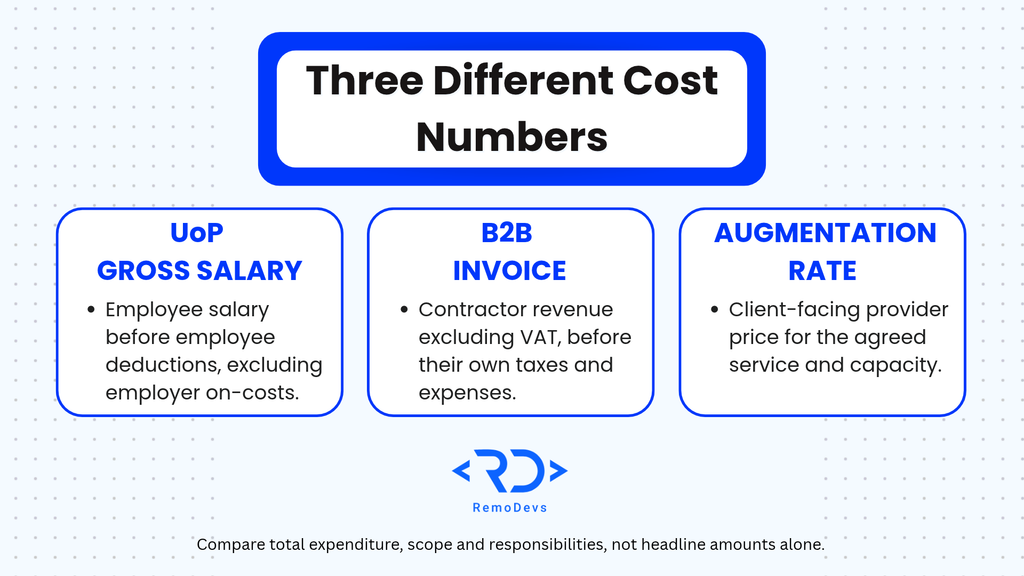
UoP salary, B2B invoice and provider rate: three different numbers
A gross UoP salary is what the employment agreement states before the employee’s deductions. The employer’s own contributions sit on top of it.
For B2B work, “net” usually means the invoice amount before VAT. The developer still pays their own taxes, social insurance and business expenses from that revenue, so it is different from take-home pay.
With staff augmentation, the client pays a provider rate that may cover the engineer, sourcing, administration, support and the supplier’s margin. A B2B pay figure in a job advert tells you little about that client price.
Before comparing quotes, bring them onto the same basis: total expenditure, available capacity and who handles which responsibilities. The legal setup matters too: our B2B versus employment contract guide covers the distinction in more detail.
What an employer pays on top of a Polish gross salary
For a standard employment scenario, the main employer-financed components are:
| Component | Rate used in this guide | Qualification |
|---|---|---|
| Pension insurance | 9.76% | Subject to the annual pension/disability contribution-base ceiling |
| Disability insurance | 6.50% | Subject to the same ceiling |
| Accident insurance | 1.67% | Example assumption; use the employer’s applicable rate |
| Labour Fund, FP | 1.00% | Applies where contribution conditions are met; exemptions exist |
| Solidarity Fund, FS | 1.45% | Check applicable obligation and exemptions |
| Guaranteed Employee Benefits Fund, FGŚP | 0.10% | Subject to payer/worker eligibility and exemptions |
| Basic employer PPK payment | 1.50% | Conditional on participation and applicable PPK obligations |
Sources: ZUS contribution financing, the Ministry’s current fund rates, and the official PPK guidance.
Under the assumptions in the table, employer contributions add up to 20.48% before PPK and 21.98% with basic employer PPK. Your actual rate can differ, particularly where exemptions or the annual contribution ceiling apply.
Accident-insurance rates vary, and some employers qualify for fund exemptions, including certain age-related cases and periods following parental leave. Sources: Labour Fund rules and FGŚP rules.
The annual contribution ceiling matters for higher salaries
In 2026, the annual assessment-base limit for pension and disability insurance is PLN 282,600. It applies to those contributions, not to every item in the table. Relevant earnings across insured employments can affect when it is reached. Source: ZUS annual contribution-base limits.
For a simplified PLN 30,000 monthly salary paid for twelve months, annual gross pay is PLN 360,000. Capping the employer’s combined 16.26% pension/disability payment reduces annual cost by:
(PLN 360,000 − PLN 282,600) × 16.26% = PLN 12,585.24.
For higher salaries, a flat twelve-month percentage may overstate payroll costs. The point at which the ceiling is reached will also depend on bonuses and other income included in the contribution base.
Which other costs are mandatory, conditional or optional?
Start with the costs required to make the role workable. For regular remote employment, employers generally need to provide the necessary tools and cover specified electricity and telecommunications expenses. The allowance depends on the arrangement and applicable rules; there is no single statutory amount for every remote employee. Source: Ministry guidance on remote work.
Then account for payroll administration, occupational-health requirements and the employment setup. Private healthcare, sports benefits and training can strengthen the offer, but they also belong in the budget. Some benefits affect payroll contributions, so use their full employer cost.
Annual leave is part of the employee’s paid salary. Full-time entitlement is normally 20 or 26 days, depending on qualifying service, including relevant education and employment periods. You should not add the same salary cost again for those days. What changes is the engineer’s available capacity; any replacement cover is a separate cost. Source: State Labour Inspection.
Sick leave follows different rules. Employers generally pay sick leave for an initial statutory period, which is shorter for eligible older employees, before the social-insurance allowance applies. Model the payroll treatment and any real replacement cover rather than automatically adding another full salary for an absence. Source: ZUS sickness-benefit guidance.
Worked example: a senior software engineer on UoP
Let’s budget for a senior backend engineer on PLN 23,000 gross per month. The round figure makes it easier to see each cost layer; an actual offer would depend on the specific role and candidate.
We’ll use twelve months under 2026 rules, a 1.67% accident-insurance rate, all listed funds payable and basic employer PPK throughout. The engineer receives no bonus or raise, has no other insured employment and qualifies for no contribution exemption. Annual base salary is PLN 276,000, below the pension/disability ceiling. Even if the benefit allowance below were included in that base in full, it would remain below the limit.
Monthly payroll calculation
| Item | Calculation | PLN/month |
|---|---|---|
| Gross salary | Agreed base | 23,000.00 |
| Employer pension | 23,000 × 9.76% | 2,244.80 |
| Employer disability | 23,000 × 6.50% | 1,495.00 |
| Accident insurance | 23,000 × 1.67% | 384.10 |
| Labour Fund | 23,000 × 1.00% | 230.00 |
| Solidarity Fund | 23,000 × 1.45% | 333.50 |
| FGŚP | 23,000 × 0.10% | 23.00 |
| Employer PPK | 23,000 × 1.50% | 345.00 |
| Total payroll | Sum of the above | 28,055.40 |
Recurring budget and first-year expenditure
Next come the operating costs. These are sample amounts, so replace them with your own benefits policy, suppliers and hiring terms.
| Cost | Monthly recurring, PLN | One-time, PLN |
|---|---|---|
| Payroll including basic PPK | 28,055.40 | — |
| Benefits: total incremental employer expense, including any related employer on-cost | 400.00 | — |
| Software and tools | 200.00 | — |
| Payroll administration | 150.00 | — |
| Regular remote-work expense allowance | 100.00 | — |
| Initial equipment purchase | — | 8,000.00 |
| Initial external setup/review | — | 1,000.00 |
| Illustrative recruitment fee, if an agency is used | — | 12,000.00 |
| Total | 28,905.40 | 21,000.00 |
The PLN 12,000 recruitment fee is an example for the calculation. Request a quote for the actual fee and payment terms.
Annual recurring expenditure = PLN 28,905.40 × 12 = PLN 346,864.80.
First-year expenditure = PLN 346,864.80 + PLN 21,000 = PLN 367,864.80.
For annual planning, the first-year total averages PLN 30,655.40 per month. Cash payments will not be evenly distributed: recruitment and equipment costs arrive at particular points. After those one-time expenses, the model’s regular monthly budget remains PLN 28,905.40.
The figures show expenditure before corporate tax and exclude recoverable VAT. You would need separate lines for any EOR or corporate setup, internal recruitment and onboarding time, vacancy costs, overtime, on-call duties, travel, equity, bonuses, replacement or termination costs. The example assumes normal salary payments, without a specific sickness event, and counts hardware once as an initial purchase. For a hire starting late in 2026, apply the relevant 2027 rules to the months that fall in the following year.
What changes with a direct B2B contractor?
For a genuinely independent B2B contractor, the starting point is the agreed invoice. Their income tax, ZUS contributions and accounting are generally paid from their own business revenue, rather than added to your bill as employee payroll charges.
For a comparable senior backend requirement, take a PLN 25,200 monthly B2B invoice excluding VAT, using the Senior Java advertised benchmark as a reference. Assume twelve agreed monthly payments, PLN 200 for client tools and PLN 150 for contract and invoice administration. This version of the budget does not include a separate benefits package or an agreed paid-absence entitlement.
| B2B cost | Amount, PLN |
|---|---|
| Monthly contractor invoice excluding VAT | 25,200 |
| Monthly client tools and administration | 350 |
| Recurring monthly budget | 25,550 |
| Twelve-month recurring expenditure | 306,600 |
| Client-provided equipment and initial review/setup | 9,000 |
| Illustrative one-time recruitment fee | 12,000 |
| First-year expenditure | 327,600 |
The B2B total is lower in this particular example, but the packages are not like for like. The employment scenario includes benefits, remote-work costs and statutory protections that the contractor model does not replicate. Compare availability, obligations and responsibilities before making a cost decision.
Billing terms have a big impact. A fixed monthly fee may still be payable during some periods without services, depending on the contract. Hourly invoices change with approved billable hours: at a sample rate of PLN 160 per hour, 144 hours cost PLN 23,040 and 168 hours cost PLN 26,880. Agree what counts as billable time before converting a monthly budget into an hourly one.
VAT, independence and cross-border arrangements
Separate the invoice amount from the VAT cash flow and final expense. Recoverable VAT can affect timing without becoming a permanent cost, while non-recoverable VAT must be budgeted. International B2B services may fall under place-of-supply and reverse-charge rules, so the treatment depends on the transaction rather than a blanket Polish 23% VAT assumption. Source: Polish Ministry of Finance on the place of taxation of services.
The arrangement needs to work as an independent business relationship in practice, not just carry a B2B label. How the work is directed and organised matters. Have the contract, IP terms, tax treatment and day-to-day setup reviewed for the specific engagement. Source: State Labour Inspection on forms of employment.
Recruitment fees and other one-time hiring costs
With direct-hire recruitment, the agency searches for and screens candidates while you choose the person to employ or contract. The recruitment fee is separate from that person’s salary or B2B invoice.
For a success-fee search, check when the contract says the fee becomes payable, what amount it is based on and whether a replacement guarantee applies. A shortlist and a completed hire are different milestones.
The calculation is:
First-year direct-hire budget = recurring worker and operating costs + equipment/setup + agreed recruitment fee.
If a proposal uses a percentage, check the compensation base. Annual gross salary, contractor invoices and total employer cost produce different fees. Our guide to IT recruitment agency fees in Poland explains those commercial terms.
Hiring internally avoids an agency invoice, but interviews, assessments and coordination still take staff time. Track that effort separately. Our guide to hidden IT recruitment costs also covers vacancy periods, ramp-up and restarting a search.
Staff augmentation: budget the provider’s client rate
Staff augmentation can help when your existing team needs engineering capacity or specialist expertise for a defined project phase. Your team continues to own the roadmap, technical direction and delivery decisions. RemoDevs sources specialists across Poland for international teams and supports the engagement within the agreed scope. See the staff augmentation service.
Providers may bill by the hour, month or another agreed capacity unit. The quoted rate is what the client pays for the service, not a breakdown of the engineer’s salary.
For illustration, use PLN 205 per hour × 160 approved billable hours = PLN 32,800. Add PLN 350 for client-side tools and administration, and the month’s budget becomes PLN 33,150. At 1,920 billable hours across twelve months, annual recurring expenditure is PLN 397,800. With PLN 9,000 for equipment and setup, the first-year total reaches PLN 406,800.
These are sample inputs, with sourcing included and no separate placement fee. An actual RemoDevs quote would be based on the role and agreed scope. Contractual minimums, time off and the calendar all affect the final number of billable hours; twelve identical 160-hour months are a planning assumption.
Ask the provider which costs are covered: sourcing, administration, equipment, replacement support, onboarding, overtime and minimum commitments. Then add only the expenses that remain with your business. For more detail on provider pricing, see our staff augmentation cost guide for Poland.
If you’re deciding between a direct hire and extra project capacity, RemoDevs can work from the role, tech stack, expected duration and start date to help scope the search and discuss a realistic engagement budget.
What changes the budget most?
Responsibility and seniority. Spell out architecture ownership, mentoring, production support and stakeholder work. The title “Senior Developer” means less than the decisions that person will be expected to make.
Technology and domain requirements. Combining data engineering, cloud, security and production AI can narrow the candidate pool considerably. Test how many candidates actually meet the brief before adding a blanket “AI premium” to the budget.
Location and working pattern. An office attendance requirement narrows the search. Hiring remotely across Poland gives you a wider geographic pool, though it doesn’t guarantee lower compensation. Compare similar roles and working arrangements, and use our broader hiring guide for the recruitment process.
Duration, capacity and availability. Part-time allocation, on-call duties, demanding overlap hours and a tight start date can all change pricing. Augmentation may work for a defined delivery need; permanent recruitment is often better suited to an enduring team role. Cost depends on the actual scope and capacity.
For a US-versus-Poland business case, see our like-for-like developer cost comparison. Keep the cost categories consistent across both markets.
Common budgeting mistakes
Budgeting errors usually begin with the definitions: a B2B invoice gets mistaken for take-home pay, employee deductions get added again as employer costs, or the same contribution rate is applied after the annual ceiling. Counting paid leave as a second salary expense creates another avoidable overstatement.
Service quotes need the same scrutiny. One provider may include sourcing while another charges for it separately. Monthly and hourly arrangements can cover different capacity, and a one-time recruitment fee should not become a permanent monthly charge just because it was spread across a spreadsheet.
Give finance separate lines for cash spending, internal team time and less certain delivery effects. That makes the total easier to review and the assumptions easier to adjust.
Employer budgeting checklist
Before approving the role, confirm:
- The stack, responsibility level, location/work model and required start date.
- Whether you need an employee, a genuine independent contractor or provider-supplied capacity.
- The compensation or rate basis: gross salary, invoice excluding VAT or client-facing provider rate.
- Applicable contribution rates, annual ceilings, exemptions and PPK participation.
- Billable capacity and the financial treatment of absences, holidays, overtime and on-call.
- Who pays for equipment, tools, remote-work expenses, administration and employment setup.
- The recruitment fee, calculation base, payment trigger and agreed replacement terms.
- Recurring monthly expenditure and the full first-year cash commitment.
- Internal interview/onboarding effort, termination exposure and any separately modelled vacancy risk.
- VAT treatment and, if finance reports in EUR or USD, a dated exchange rate and agreed currency assumption.
Frequently asked questions
What is the full cost of hiring a software developer in Poland in 2026?
It depends on the role and engagement model. In our example, a PLN 23,000 gross employment salary creates a PLN 28,055.40 monthly payroll cost with the stated contributions and basic PPK. Including the modelled operating expenses brings it to PLN 28,905.40 per month, or PLN 367,864.80 for the first year once one-time setup, equipment and recruitment are included.
Are Polish employer contributions always 20.48%?
No. The 20.48% figure uses 1.67% accident insurance and assumes the listed funds are payable. Your rate may change with exemptions, contribution bases and the pension/disability ceiling. Basic employer PPK is an additional 1.5% where applicable.
Is a B2B developer’s net invoice their take-home pay?
No. Here, “net” refers to an invoice excluding VAT. The contractor pays their own taxes, insurance and business expenses from that amount.
Should paid annual leave be added to annual salary?
No. The annual salary already covers ordinary paid leave. Budget separately for any replacement capacity you actually need.
Does a staff augmentation rate equal a contractor’s B2B rate?
No. The provider’s rate may bundle sourcing, administration and support alongside the specialist’s services. A B2B benchmark is the contractor’s invoice amount. Review the provider’s billing rules and what’s included before comparing them.
Which route fits a long-term hire versus a project need?
For a lasting role that will join your team directly, IT recruitment in Poland may be the right fit. If your current team needs extra specialist capacity for a project, look at IT staff augmentation. The contract and division of responsibilities should reflect how the work will actually be managed.
Build the budget around the role
A credible hiring budget answers three questions: what will we spend each month, what will we pay once, and what responsibilities will remain with our team? Start with the work the engineer needs to do, validate the compensation or provider quote, and fill in the contract-specific expenses.
RemoDevs can help turn that brief into a targeted search or an appropriately scoped staff augmentation engagement, with candidate availability and commercial terms assessed against the actual requirement.
Visit us
Find a moment in your calendar and come to our office for a delicious coffee
Make an apointment