
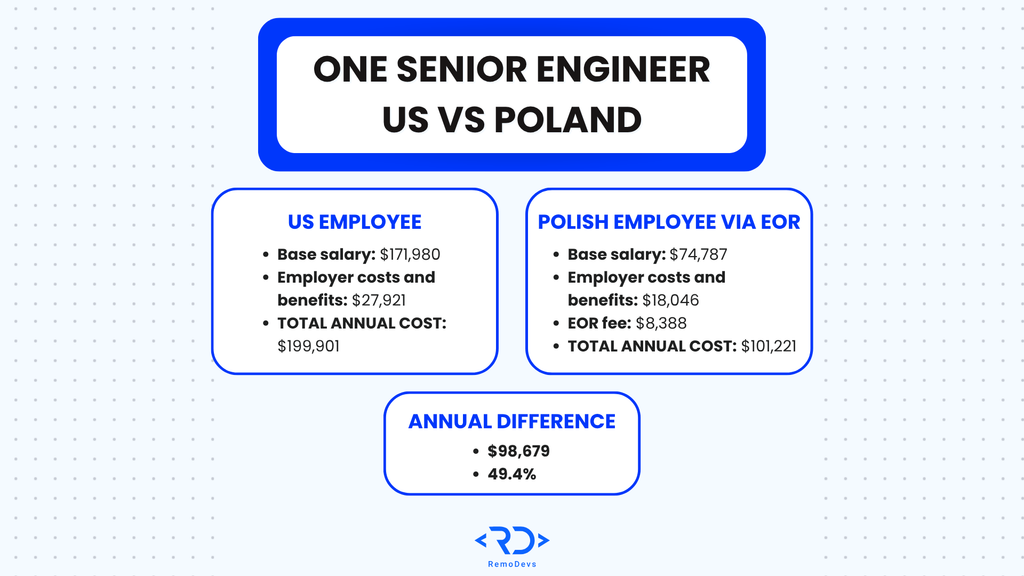
How much can a company actually save by hiring a senior developer in Poland instead of the United States? In the employee scenarios analyzed below, the modeled reduction ranges from 36.6% to 52.3%. In the central employee-to-employee scenario, the difference is $98,679 per engineer per year, or 49.4%.
The result is not a universal market rate. It changes with salary level, benefits, engagement model, location and exchange rate. This guide separates employees, contractors and vendor-provided engineers so that every scenario uses a comparable cost base.
Cost comparison at a glance
| Scenario | US annual cost | Polish annual cost | Modeled difference |
|---|---|---|---|
| Employee, BLS median salary and single health coverage | $159,707 | $101,221 | $58,486 / 36.6% |
| Employee, BLS 75th-percentile salary and single health coverage | $199,901 | $101,221 | $98,679 / 49.4% |
| Contractor example | $158,400 | $75,484 | $82,916 / 52.3% |
| Three-employee team, central scenario | $599,702 | $303,664 | $296,038 / 49.4% |
These are planning scenarios built from the assumptions below. Stack, seniority, contract structure, benefits and exchange rates can move the result substantially.
Methodology and sources
This article uses a worked example for a senior Java/backend engineer. That makes the assumptions auditable; it does not imply that every developer or every Polish technology category has the same rate.
| Input | Assumption used | Source or treatment |
| US employee salary | $171,980 per year | 75th-percentile wage for US software developers in the May 2025 BLS national table. It is used as a senior-market proxy; BLS does not label percentiles as seniority levels. The national median, $135,980, is included in sensitivity analysis. |
| Polish employee salary | PLN 23,250 gross per month | Senior Java median in the Just Join IT 2026 technology statistics. |
| Polish B2B reference | PLN 25,200 net on invoice per month, excluding VAT | Senior Java median in the same Just Join IT report. |
| Exchange rate | PLN 3.7306 per USD | NBP average rate on August 20, 2026. |
| US employer payroll tax | 7.65% FICA | 6.2% Social Security and 1.45% Medicare. The modeled salary is below the 2026 Social Security wage base of $184,500. |
| US health insurance | $7,885 employer cost for single coverage or $20,143 for family coverage | Derived from the 2025 KFF averages: total premiums less average worker contributions. |
| US retirement contribution | 4% of salary | Explicit planning assumption, not a universal employer benefit. |
| Polish employer contributions | 20.48% of gross salary | Based on ZUS contribution rules: 9.76% pension, 6.5% disability, an assumed 1.67% accident rate, 2.45% Labour Fund and 0.10% FGŚP. Exact accident rates and exemptions vary. The modeled annual salary remains below the 2026 pension and disability contribution cap. |
| Polish PPK contribution | 1.5% of gross salary | Assumes the employee participates in PPK; see the official PPK employer guidance. |
| Polish additional benefits | PLN 6,000 per year | Explicit budget assumption for private benefits; replace it with the actual package. |
| EOR platform fee | $699 per employee per month | Remote’s public list price accessed on August 20, 2026. Deel publicly lists $599, so obtain a live quote before budgeting. |
The BLS May 2025 national wage tables cover employees across the occupation, not a specific technology, company type or seniority label. The Just Join IT 2026 report analyzed nearly 111,000 job advertisements published in 2025 and also used a survey of IT professionals. Its methodology calculates seniority medians from the midpoint of advertised ranges and distinguishes gross employment pay from net B2B invoice values.
Costs excluded from the central scenario
The model excludes equity, bonuses, state unemployment tax, workers’ compensation, equipment, travel, recruitment fees, severance, deposits, FX spreads and any outsourcing-provider margin. Those items are company- or contract-specific and should be added symmetrically where applicable.
This is a budgeting model, not legal or tax advice.
Scenario 1: US employee vs Polish employee through an EOR
This is the cleanest comparison for a company that wants an employee relationship in both countries but does not have a Polish legal entity.
Annual cost per senior engineer
| Cost item | US employee | Polish employee through EOR |
| Base salary | $171,980 | PLN 279,000 / $74,787 |
| Employer payroll or social contributions | $13,156 | PLN 57,139 / $15,316 |
| Health or additional benefits | $7,885 | PLN 6,000 / $1,608 |
| Employer retirement contribution | $6,879 | PLN 4,185 / $1,122 |
| EOR platform fee | — | $8,388 |
| Modeled annual total | $199,901 | $101,221 |
Under these assumptions, the Polish employee costs $98,679 less per year, a 49.4% reduction.
If the US employee has family health coverage, the modeled US cost rises to $212,159. The difference then becomes $110,937, or 52.3%.
This does not mean every senior US engineer costs $200,000 or every Polish engineer costs $101,000. It shows what the comparison looks like when both sides include salary, employer contributions, retirement, benefits and the cost of employing internationally.
Sensitivity: the US salary benchmark changes the answer
The 75th percentile is only a proxy for an experienced hire. A company recruiting nationally outside the most expensive US markets may budget closer to the BLS median.
| US salary input | US total with single health coverage | Polish employee total | Modeled saving |
| BLS median: $135,980 | $159,707 | $101,221 | 36.6% |
| BLS 75th percentile: $171,980 | $199,901 | $101,221 | 49.4% |
Using family rather than single health coverage raises those savings to approximately 41.1% and 52.3%, respectively.
The practical conclusion is not that Poland always saves a fixed percentage. It is that a realistic employment comparison often produces a material saving even after Polish employer contributions, benefits and an EOR fee are included.
Scenario 2: US independent contractor vs Polish B2B contractor
For a contractor comparison, use the same expected billable hours and treat both rates as invoices. Do not add an EOR fee to the Polish side.
The following example is deliberately simple:
- US contractor rate: $90 per hour;
- Polish B2B rate: PLN 160 per hour, close to the PLN 25,200 monthly senior Java benchmark when normalized to 160 hours;
- expected billable time: 1,760 hours per year for each contractor;
- no paid bench time, recruitment fee or vendor margin on either side.
| Cost item | US contractor | Polish B2B contractor |
| Hourly rate | $90 | PLN 160 / $42.89 |
| Annual billable hours | 1,760 | 1,760 |
| Annual invoice value | $158,400 | PLN 281,600 / $75,484 |
| Difference | $82,916 / 52.3% |
The $90 US rate is an explicit scenario input, not a claim that it is the US market average. Replace both rates with actual quotes for the role.
If a company wants a contractor-management platform, that is a separate optional line. As of the update date, Remote publicly lists contractor management at $29 per contractor per month and Deel lists contractor management at $49. A Contractor of Record service is more expensive because the provider takes on a broader engagement and compliance role. Neither product should be called EOR.
Contractor compliance belongs in the decision, not in a footnote
A B2B contract is appropriate only where the working relationship is genuinely independent. Polish authorities look at how the work is performed, not only at the name of the agreement. The government’s 2026 guidance emphasizes factors such as supervision, fixed time and place of work, personal performance and economic independence.
Do not choose B2B solely because the invoice is lower. Have the real operating model reviewed and use employment where the relationship has the characteristics of employment.
EOR, B2B and staff augmentation are different cost models
| Model | Who employs or contracts the engineer? | What the client normally budgets |
| Polish employee through EOR | The EOR is the local legal employer | Gross salary, employer contributions, benefits and EOR fee |
| Direct Polish B2B contractor | The client contracts with the engineer’s business | Invoice, payments, legal and compliance support, plus any optional contractor platform |
| Contractor of Record | A third party engages the contractor | Contractor invoice or compensation plus the provider’s broader service fee |
| Staff augmentation or outsourcing | A service provider supplies the engineer under a commercial agreement | Agreed client rate, usually including provider costs, support and margin |
| Direct recruitment | The client hires or contracts the selected person | Employment or contractor cost plus a separately agreed recruitment fee |
If you compare staff augmentation in Poland with direct employment in the US, disclose the mismatch. For a true like-for-like view, compare a Polish vendor rate with a US vendor rate offering a similar scope, or separate the provider’s service layer from the engineer’s underlying compensation.
A three-engineer team scenario
Using the employee assumptions from Scenario 1 and single US health coverage:
| Annual recurring cost | Three US employees | Three Polish employees through EOR |
| Total | $599,702 | $303,664 |
| Difference | $296,038 |
The modeled reduction is again 49.4% because the same per-person assumptions are multiplied by three.
Recruitment fees are intentionally excluded. To model Year 1, add the actual contracted recruitment fee for each market. Do not present a generic percentage as though it applies to every agency, role or RemoDevs engagement. For Year 2 and later, remove one-time hiring fees unless the commercial agreement says otherwise.
What makes this a like-for-like comparison
A cost comparison becomes useful only when both sides include equivalent categories and use the same engagement model.
- Employee should be compared with employee. A US base salary excludes employer payroll tax, health benefits and retirement contributions. A Polish employee cost should likewise include gross salary, employer contributions, benefits and any EOR fee.
- Contractor should be compared with contractor. A Polish B2B amount is an invoice issued by an independent business. It should not be compared directly with a US employee’s base salary.
- EOR belongs only in an employment scenario. An Employer of Record employs a worker locally on the client’s behalf. Direct contractor management and Contractor of Record services are separate products with different pricing.
- Recurring and one-time costs should remain separate. Salary, contributions and benefits belong in the annual run rate. Recruitment, initial equipment and setup costs should be shown separately in Year 1.
- Equity and leave require consistent treatment. Include equity only when it is genuinely part of the offer on the relevant side. Do not add paid leave again as a cash cost when it is already covered by an annual salary; use a separate productive-hour calculation if utilization matters.
How to calculate your own total cost
Use this structure for each location:
Annual total cost = recurring worker compensation + employer contributions + benefits + employment, contractor or vendor fees + recurring operational costs
Then show one-time costs separately:
Year 1 cost = annual total cost + recruitment + onboarding + equipment + setup costs
Before approving the comparison, confirm:
- Is the seniority and role scope genuinely equivalent?
- Are both sides employees, both contractors or both vendor-provided engineers?
- Does the compensation include bonus or equity?
- Which employer contributions and benefits apply?
- Is leave included in salary, paid separately or non-billable?
- Does an EOR, contractor platform or outsourcing fee apply?
- Are recruitment and setup costs shown separately from the recurring run rate?
- Which exchange rate and FX buffer does finance use?
- Who carries equipment, travel, termination and compliance costs?
- Does the contract include rate reviews or currency-indexation clauses?
What can reduce or eliminate the saving?
Poland is not one uniform rate card. The gap can narrow when:
- the role requires scarce AI, security, cloud, data or architecture expertise;
- the candidate competes for global rather than local compensation;
- the US company hires outside a high-cost market or offers limited benefits;
- the Polish package includes equity, a high bonus, extensive benefits or a premium EOR service;
- a vendor rate includes delivery management, replacement coverage, hardware or compliance services;
- the PLN strengthens against the USD after the budget is approved.
Cost also says nothing by itself about engineering output. Team fit, system complexity, communication, ownership and management practices affect the business result more than nationality. A cost model should support hiring decisions, not replace technical and team assessment.
How RemoDevs supports a cost comparison
RemoDevs can help calibrate a role against the Polish candidate market through IT recruitment in Poland or discuss a managed engagement through IT staff augmentation in Poland.
Before a search begins, the commercial scope should state:
- whether the target model is employment, direct B2B or staff augmentation;
- what RemoDevs, the client and any third-party provider each handle;
- the target compensation or client-rate basis;
- the agreed candidate assessment stages;
- the recruitment or service fee;
- any replacement terms or other guarantees.
Recruitment, employment, EOR, contractor management and payroll are separate scopes. They should be treated as included only when the proposal explicitly says so. The number and timing of candidate profiles should likewise be agreed for the specific role rather than presented as a universal promise.
Frequently asked questions
How much can a US company save by hiring a developer in Poland?
In the employee scenarios above, the modeled reduction ranges from 36.6% to 52.3%. The contractor example produces a 52.3% reduction. These figures are outputs of disclosed assumptions, not guaranteed market-wide savings. Use actual salary or rate quotes, benefits and contract fees for the role.
Do I need an EOR to work with a Polish B2B contractor?
Not automatically. An EOR is designed for employment. A genuine independent contractor can be engaged directly or through a contractor-management or Contractor of Record service, subject to legal and tax review. The operating relationship must support contractor status in practice.
What does a senior developer in Poland cost in 2026?
It depends on the technology and engagement model. In the Just Join IT 2026 report, the senior Java median was PLN 23,250 gross per month for employment and PLN 25,200 net on invoice per month for B2B. The employment figure is not the employer’s total cost, and the B2B figure is not an employee salary.
Should recruitment fees be included in the comparison?
Yes, but as a separate Year 1 item using the actual agreement. If one scenario uses an agency and the other does not, disclose that difference. Do not turn a one-time fee into a recurring annual cost.
Does a recruitment fee include payroll or EOR services?
Not by default. Recruitment, legal employment, payroll administration, EOR and contractor management are distinct services and cost lines. The signed proposal should identify exactly what is included.
The bottom line
Poland can offer a meaningful cost advantage for senior engineering talent, but the honest comparison is narrower than “US salary versus Polish invoice.”
Compare employee with employee, contractor with contractor and vendor with vendor. Include employer contributions and benefits on both sides. Use EOR fees only for an EOR scenario. Keep recruitment and setup costs separate from the annual run rate. Then test the result against salary, benefit and exchange-rate changes.
That approach produces a number a CFO can audit and an engineering leader can actually use.
If you are planning a role in Poland, share the stack, seniority, engagement model and target start date with RemoDevs. We can help you calibrate the Polish market and build the hiring process around the commercial structure you intend to use.
Visit us
Find a moment in your calendar and come to our office for a delicious coffee
Make an apointment