
Poland remains one of the largest technology talent markets in the European Union. But the strongest case for hiring in Poland is not an inflated headline number. It is the combination of a large workforce, a measurable education pipeline, experience gained in international product and engineering environments, and practical access to talent across several cities.
Eurostat recorded 778,800 employed ICT specialists in Poland in 2025. This is the most useful comparable public measure of the wider market, although it should not be described as a count of software developers alone. Eurostat’s definition also covers roles in areas such as systems, databases, networks, telecommunications, ICT operations, support and technology management.
For companies considering Poland, that distinction matters. The market is large, but successful hiring still depends on the role, seniority, technology stack, working model and location requirements.
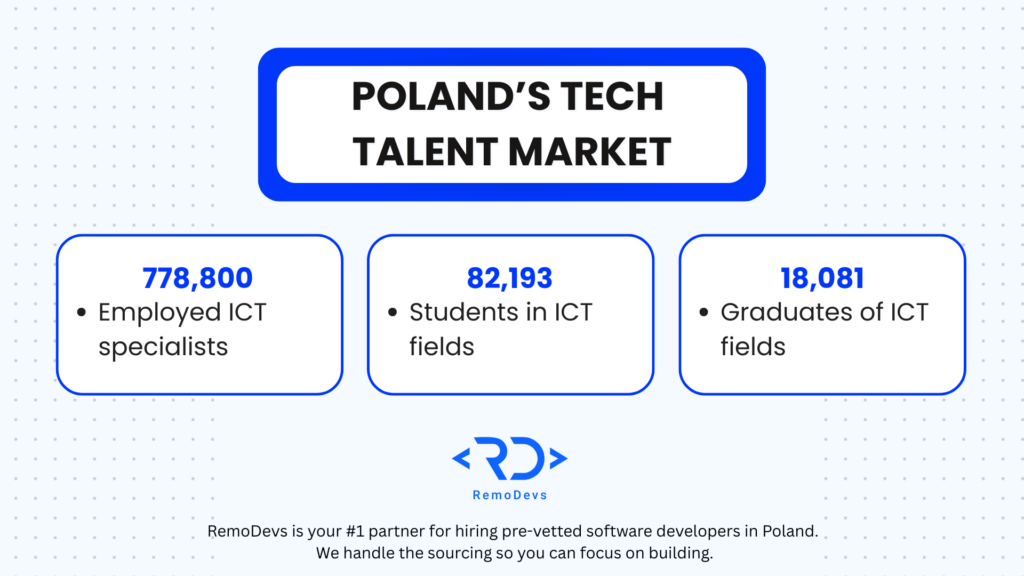
Poland’s tech talent market in numbers
| Metric | Latest verified figure | Period | Source |
| Employed ICT specialists | 778,800 | 2025 | Eurostat: ICT specialists in employment |
| Students enrolled in ICT fields | 82,200 | 2024/25 academic year | Statistics Poland: Information Society in Poland 2025 |
| Graduates of ICT fields | 18,100 | 2024/25 academic year | Statistics Poland: Information Society in Poland 2025 |
These figures measure different groups. The Eurostat total covers people already working in ICT occupations across the economy. The student figure covers everyone enrolled in relevant higher-education fields, while the graduate figure covers people who completed those programs during one academic year.
A large and diverse technology workforce
The scale of Poland’s ICT workforce gives employers access to more than generalist software developers. Companies recruit in Poland for backend and frontend engineering, mobile development, data and AI, cloud and platform engineering, DevOps, cybersecurity, QA, embedded systems and technical leadership.
Talent is distributed across the country rather than concentrated in a single city. Warsaw is the largest business center, while Kraków, Wrocław, Poznań, the Tricity, Katowice and Łódź also have established technology communities. Companies open to remote or hybrid hiring can search nationwide instead of competing within one local market.
This geographic spread is useful, but the national total should not be treated as the available candidate pool for every vacancy. A senior platform engineer with a narrow cloud stack, for example, will be harder to find than a developer working with a widely used backend technology. Requiring full-time office attendance or a specific city reduces the reachable market further.
For a practical overview of the roles and locations companies can target, see our guide to working with an IT recruitment agency in Poland.
A real education pipeline – 45,000 IT graduates a year
Poland’s universities provide a steady inflow of new talent, but student and graduate numbers should not be mixed.
The official category is broader than software engineering and follows the ISCED-F classification of education fields. It provides a credible view of the academic pipeline, but it does not guarantee that every graduate is ready for a commercial engineering role.
Employers should still evaluate practical coding ability, technical fundamentals, communication and ownership. For junior hiring in particular, internships, personal projects and production exposure can be as important as the degree title.
Experience from international product and engineering environments
Polish engineers can gain experience in domestic technology companies, global product businesses, research and development centers, cloud operations and enterprise transformation programs. This gives employers access to candidates familiar with distributed teams, security requirements, regulated industries and production systems used across multiple markets.
Several publicly announced investments illustrate that international companies continue to treat Poland as an important technology location:
- Google opened its Warsaw Cloud region in 2021, supporting cloud workloads for organizations in Poland and Central and Eastern Europe.
- Microsoft announced a PLN 2.8 billion investment plan in February 2025, covering cloud and AI infrastructure, skills and cybersecurity through June 2026.
- Visa confirmed in 2025 that it had created a digital technology hub in Warsaw; the original announcement anticipated up to 1,500 technology and product roles.
These announcements do not mean that every candidate in the market has enterprise-scale experience. They do show that Poland can support substantial technology operations and that local engineers have opportunities to work on products and infrastructure used internationally.
Cost-effectiveness requires a role-by-role comparison
Poland can offer a favorable cost-to-skill ratio for companies hiring from the United States or more expensive Western European markets. However, a single percentage saving applied to every developer is misleading.
The final cost depends on:
- seniority and scarcity of the required skills;
- employment, B2B or Employer of Record structure;
- benefits, paid time off and equipment;
- employer taxes or contractor rates;
- recruitment and administration costs;
- currency movements; and
- remote, hybrid or onsite requirements.
The right comparison is the total annual cost of the same role under the same assumptions. A senior AI, security or platform specialist may command a substantial premium even within Poland, while a role with a broader candidate pool may be easier to budget.
Before setting a budget, compare published salary data with live candidate expectations for the exact role. A specialist IT recruitment team in Poland can help calibrate the brief against the current market. You should also review the differences between B2B cooperation and an employment contract in Poland before choosing a hiring model.
Practical location for European and distributed teams
Poland combines Central European working hours with membership in the European Union. This makes live collaboration straightforward for teams elsewhere in Europe and provides workable overlap with part of the North American business day.
The location is especially practical for companies that need engineers to collaborate frequently with product, security or operations teams rather than work as an isolated delivery unit. Direct communication, clear ownership and shared engineering standards matter more than the label “nearshore” or “outsourcing.”
Companies can hire through a Polish entity, an Employer of Record or a properly structured services relationship, depending on how the work will actually be organized. The contract label alone does not determine compliance, so international employers should obtain legal and tax advice for their specific setup.
What employers should know before hiring in Poland
Poland is a strong hiring market, not an unlimited one. A realistic search starts with role calibration.
Before launching recruitment:
- separate essential skills from preferences;
- decide whether the role can be remote across Poland;
- benchmark compensation for the exact seniority and contract model;
- test English and communication instead of assuming proficiency;
- assess production ownership, not only framework knowledge; and
- move quickly once a strong candidate completes the process.
In RemoDevs searches, the biggest difference is often not the number of profiles found but how closely the role reflects the actual market. A focused brief with a credible budget usually produces a better shortlist than a long list of loosely connected requirements.
Frequently asked questions
How many technology professionals work in Poland?
Eurostat recorded 778,800 ICT specialists employed in Poland in 2025. This is a broad occupational category and should not be presented as the number of software developers alone.
How many IT graduates does Poland produce each year?
Statistics Poland recorded 11,890 graduates of ICT fields in the 2023/24 academic year. The same report counted 82,200 students enrolled in ICT fields in 2024/25, but enrolled students are not annual graduates.
Is hiring software engineers in Poland cheaper than hiring in the US or Western Europe?
It can be, but there is no reliable universal saving percentage. Compare like-for-like roles using the same seniority, contract structure, benefits and total employer cost.
Which Polish cities have the strongest technology talent markets?
Warsaw, Kraków and Wrocław are the most visible hubs, with additional established talent markets in Poznań, the Tricity, Katowice and Łódź. A nationwide remote search usually provides better access than limiting a role to one city.
Can a foreign company hire a developer in Poland?
Yes, several structures are available, including employment through a local entity, an Employer of Record and direct cooperation with an independent business. The correct option depends on the real working relationship and should be reviewed for employment, tax and intellectual-property compliance.
Is Poland still a tech talent hotspot in 2026?
Yes, but the credible case rests on verified data rather than inflated estimates or individual investment announcements. Poland offers a large ICT workforce, a measurable university pipeline, several established technology hubs and candidates with experience in both local and international engineering environments.
The opportunity is strongest for companies that approach the market realistically: define the role clearly, benchmark the right hiring model, search across Poland and run a focused technical and communication assessment.
If you are planning to hire software engineers, AI specialists, data professionals or platform talent in Poland, RemoDevs can source and screen candidates across the country.
Discuss your hiring needs with us.
Visit us
Find a moment in your calendar and come to our office for a delicious coffee
Make an apointment