
The price quoted by an IT recruitment agency tells you very little unless you also know how the fee is calculated, when it becomes payable and what the agency must deliver in return.
Recruitment agreements in Poland can use a success fee, a fixed placement fee, a retainer or a hybrid structure. There is no single percentage, payment trigger or guarantee period that applies to every agency. The commercial terms should be agreed in writing for the specific search.
This guide explains how IT recruitment agency fees can work in Poland and gives employers a practical checklist for comparing proposals without relying on unsupported market averages.
The main IT recruitment pricing models
The right pricing model depends on the type of search, its difficulty and how the employer wants to allocate risk and commitment.
Success-fee recruitment
In a success-fee model, the agency’s fee is linked to a hiring outcome defined in the agreement. The employer hires or contracts with the selected candidate directly, while the agency handles the agreed sourcing, screening and coordination work.
The fee may be triggered when:
- the candidate accepts an offer;
- the parties sign an employment or B2B contract;
- the candidate starts work; or
- another agreed hiring milestone occurs.
These events are not interchangeable. “Success fee” does not automatically mean payment is triggered on the candidate’s first working day. The contract must define what counts as success.
In a pure success-fee arrangement, there is no recruitment retainer. If part of the recruitment fee is payable before a hire, the arrangement is a hybrid or retained search rather than a pure success-fee model.
Fixed placement fee
The employer and agency may agree on a fixed amount for a successful placement. This makes the recruitment cost predictable, but the agreement must still define the payment trigger, guarantee and treatment of materially different roles.
Retained search
In a retained search, the employer pays for dedicated work during the assignment rather than making the entire fee conditional on a hire. Payments may be connected to stages such as kickoff, market mapping, shortlist delivery or completion.
This model may be considered for executive, confidential or particularly narrow searches, but the label itself does not guarantee exclusivity or a particular scope. Those terms still belong in the agreement.
Hybrid model
A hybrid arrangement combines an upfront or project fee with an additional payment after a hire. Employers should check whether the initial payment is refundable, credited against the final fee and tied to specific deliverables.
How can an IT recruitment fee be calculated?
An agency may charge a percentage-based fee or a fixed amount. Neither method is automatically better. The important test is whether the employer can reproduce the calculation from the written proposal.
For a percentage-based fee, the basic formula is:
Recruitment fee = agreed fee rate × agreed compensation base
Both parts must be defined. A proposal containing only a percentage is incomplete.
Employment agreement
If the candidate will be employed under an employment agreement, the fee base may be the annual gross base salary. The recruitment contract should state whether bonuses, commissions, allowances, sign-on payments or other variable compensation are included.
B2B cooperation
If the candidate will provide services through a genuine business-to-business contract, the base may be the agreed monthly service fee multiplied by twelve. The proposal should clarify:
- whether VAT is excluded from the base;
- whether paid time off or other contractual benefits affect it;
- how variable compensation is treated; and
- which exchange rate and reference date apply if the candidate is paid in another currency.
Employment and B2B are legally different forms of cooperation. Poland’s National Labour Inspectorate explains that an employment relationship is governed by labour law, whereas B2B is a relationship between independent businesses. The appropriate form depends on how the work is actually organised, not simply on the recruitment fee or apparent cost.
Source: Polish National Labour Inspectorate: employment agreements and civil-law contracts
This article provides a commercial overview, not legal or tax advice.
A simple fee calculation example
Assume an agency proposal states that its fee equals R of the candidate’s agreed compensation base.
- For an employment agreement, the base could be
monthly gross base salary × 12. - For a B2B agreement, the base could be
monthly service fee excluding VAT × 12. - The placement fee would then equal
R × the applicable annualised base.
This example intentionally uses variables rather than a supposed “average Polish agency rate”. An accurate budget requires the rate and calculation base from the actual proposal.
When does the agency earn and invoice the fee?
The payment trigger, invoice date and payment deadline are separate terms.
For example, the agency may earn the fee when an offer is accepted, issue the invoice when the candidate starts and give the employer a separate payment period. Another agreement may use the start date as both the trigger and invoice date.
Before launching a search, confirm:
- which event triggers the fee;
- when the agency issues its invoice;
- the payment deadline;
- what happens if an accepted offer is withdrawn;
- what happens if the start date is delayed;
- whether VAT is added to the recruitment fee;
- how foreign-currency compensation is converted; and
- whether hiring an introduced candidate later also creates a fee.
Candidate ownership and duplicate introductions
Candidate ownership determines when an agency can claim a fee for a person it introduced.
The agreement should answer:
- what qualifies as an introduction;
- how long the ownership period lasts;
- whether it covers another role within the same company or group;
- how the employer should report a candidate already known to it;
- how duplicate submissions from two agencies are resolved; and
- whether a fee applies when the candidate is hired after the original role closes.
This clause matters even in a non-exclusive search. Without a clear duplicate-candidate process, an employer could receive competing fee claims.
How does a replacement guarantee work?
A replacement guarantee is contractual protection, not a universal Polish market standard. Its practical value depends on the remedy, conditions and exclusions.
The agreement should specify:
- how long the guarantee lasts and when it begins;
- whether the remedy is a replacement search, credit or refund;
- which candidate departures or employer terminations qualify;
- whether the original invoice must be paid on time;
- how quickly the employer must notify the agency;
- how long the replacement search remains open; and
- what happens if the role, salary, location or requirements change.
A longer period is not automatically better if the remedy is narrow or important situations are excluded. Employers should read the entire clause rather than compare the number of days in isolation.
What should be included in the agency fee?
Pricing and service scope should be evaluated together. A direct IT recruitment engagement can include:
- role and market calibration;
- active sourcing and direct outreach;
- recruiter screening against the agreed criteria;
- candidate presentation with relevant context;
- interview scheduling and feedback coordination; and
- offer and hiring support.
The agreement or proposal should also state who is responsible for technical interviews, coding exercises, reference checks, identity or right-to-work verification and other compliance steps.
The employer should retain control of the interview process, technical assessment and final hiring decision. “Screened” or “pre-vetted” should refer to defined work completed for the specific role, not an undefined quality label.
Recruitment fees do not include every hiring cost
The agency fee is only one part of an employer’s hiring budget. Depending on the chosen engagement model, the total cost may also include:
- the candidate’s salary or B2B service fee;
- employer payroll charges and benefits for an employment agreement;
- equipment and onboarding;
- internal interview time;
- legal or tax advice;
- Employer of Record fees; or
- an ongoing supplier margin in staff augmentation.
Do not combine these categories into a single “developer cost” unless the assumptions are clearly stated. A recruitment agency fee, candidate compensation and the cost of an EOR or staff-augmentation provider are different expenses.
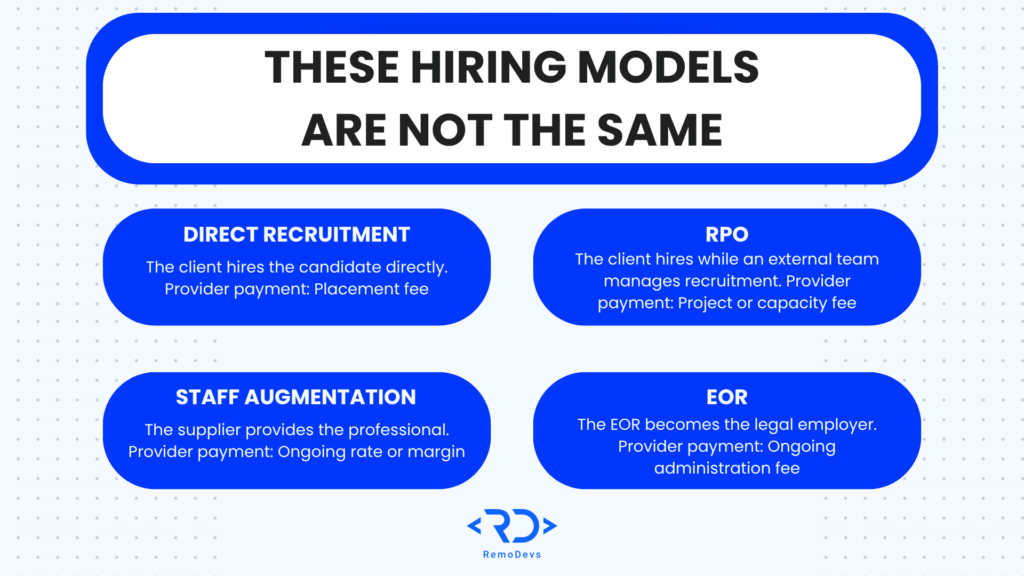
Success fee is not the same as staff augmentation, RPO or EOR
| Model | Who hires or engages the professional? | How the provider is paid |
|---|---|---|
| Success-fee recruitment | The client hires or contracts with the selected candidate directly | Placement fee linked to an agreed hiring outcome |
| Staff augmentation | The supplier usually provides the professional under an ongoing service arrangement | Recurring rate or supplier margin |
| Recruitment Process Outsourcing (RPO) | The client hires, while an external team manages part or all of the recruitment function | Project-based, recurring or capacity-based pricing |
| Employer of Record (EOR) | The EOR becomes the legal employer on the client’s behalf | Ongoing employment administration fee |
A direct-hire recruitment agency does not automatically provide payroll, employment, tax, immigration or EOR services. If these services are required, confirm who provides them and how they are priced.
How RemoDevs approaches direct IT recruitment
RemoDevs supports international companies hiring software engineers, AI specialists, data professionals, DevOps engineers and technical leaders across Poland.
The recruitment process includes role and market calibration, active sourcing, recruiter screening, candidate presentation, interview coordination and offer support. The client decides whom to interview, how to conduct technical validation and whom to hire.
For most searches, RemoDevs aims to present the first qualified candidates within five working days after role calibration. This is a target for the first candidate presentation, not a guaranteed hire or start date. Role complexity, compensation, interview speed, candidate availability and notice periods can affect the full timeline.
RemoDevs offers success-fee recruitment, with the fee calculation, payment trigger and applicable replacement terms agreed in writing before the search begins. Shortlist size depends on the role and candidate market, and each presented profile is assessed against the criteria agreed for that search.
Learn more about working with an IT recruitment agency in Poland.
IT recruitment agency contract checklist
Before appointing an agency, ask for written answers to these questions:
- Is the fee a percentage, fixed amount, retainer or hybrid?
- Which compensation components form the calculation base?
- Which event triggers the fee?
- When is the invoice issued and due?
- How are VAT and currency conversion handled?
- How long does candidate ownership last?
- What happens when two sources introduce the same candidate?
- Is the search exclusive or non-exclusive?
- What remedy does the guarantee provide?
- Which guarantee conditions and exclusions apply?
- Which sourcing, screening and coordination activities are included?
- Who conducts technical assessments and reference checks?
- What happens if the role is paused, cancelled or materially changed?
- Does a later hire for another role trigger the fee?
- Which services are explicitly outside the agency’s scope?
Comparing these terms is more useful than comparing an isolated percentage.
Frequently asked questions
How much do IT recruitment agencies charge in Poland?
There is no universal rate. The price depends on the agency’s model, the agreed compensation base, the role and the scope of work. Ask each agency for a written formula or fixed amount and compare the complete commercial terms rather than relying on an unsupported market average.
How is a success fee calculated?
It may be a fixed amount or a percentage of an agreed compensation base. For employment, that base may be annual gross salary. For B2B, it may be the annualised service fee excluding VAT. The recruitment agreement must define the actual calculation.
Do employers always pay only after the candidate starts?
No. A fee can be triggered by offer acceptance, contract signature, the start date or another agreed event. The trigger, invoice date and payment deadline should be stated separately.
Is a replacement guarantee automatic?
No. Its duration, remedy, conditions and exclusions are contractual. Review the precise clause before the search begins.
Is B2B required for hiring IT professionals in Poland?
No. Technology professionals may work under different arrangements, including employment agreements and genuine B2B service contracts. The appropriate model depends on the real working relationship and the employer’s legal and operational setup.
Does an agency fee include payroll or EOR services?
Not automatically. Direct recruitment, payroll administration, EOR and staff augmentation are separate services unless a proposal explicitly combines them.
How quickly can RemoDevs present candidates?
For most searches, RemoDevs aims to present the first qualified candidates within five working days after role calibration. This is a target rather than a guarantee of when the final hire will be completed.
Final takeaway
An IT recruitment agency fee should never be evaluated as a percentage alone. Employers need to understand the pricing model, compensation base, payment trigger, candidate ownership, guarantee and included work.
If you are planning to hire technology professionals in Poland, talk to RemoDevs about your role. We will explain the proposed search process, realistic market conditions and commercial terms before the work begins.
You can also review what is included in our IT recruitment service in Poland before discussing commercial terms.
Visit us
Find a moment in your calendar and come to our office for a delicious coffee
Make an apointment