
Hiring problems are often blamed on a weak candidate market or the recruitment agency. That diagnosis can be correct. But the process can also break at the handoffs: the role has not been defined precisely, sourcing is mistaken for screening, technical assessment ownership is unclear, or feedback arrives too late to keep the search aligned.
An agency can expand the search and take coordination work off an internal team. It cannot compensate for an undefined role or make the final hiring decision on the client’s behalf. A useful IT recruitment process therefore makes responsibilities, evidence and commercial terms explicit from the start.
This guide explains where agency-supported technology recruitment commonly goes wrong, what a stronger process looks like and what to ask before opening a search. It focuses on direct recruitment, where the selected candidate joins the client’s organization. IT staff augmentation in Poland is a different service model.
Quick answer: The main controllable failure points are an unclear brief, weak definitions of screening, no agreed owner for technical validation, inconsistent interviews, delayed feedback and vague commercial terms. A better process defines the role first, records what has actually been checked and gives the agency and client clear responsibilities at every stage.
Eight reasons an IT recruitment process underperforms
| Process gap | What it looks like in practice | The question to ask |
| The role is not calibrated | Requirements change after candidates enter the process | What evidence will demonstrate that a candidate can do this job? |
| Sourcing is treated as screening | A database match is presented as a qualified candidate | Which checks has this person actually completed? |
| Recruiter screening is treated as technical validation | Broad experience is presented as proof of product-specific engineering depth | Who owns the technical assessment, and what format will it take? |
| CV volume is used as a quality signal | The client receives many profiles but little useful context | Why is each candidate relevant, and what remains unverified? |
| Interviews are inconsistent | Different candidates face different questions and standards | Are questions and scoring criteria tied to the role? |
| Feedback has no owner | The same mismatch appears repeatedly in the shortlist | Who provides feedback, through which channel and by when? |
| Speed is measured against the wrong milestone | First profiles, completed interviews and accepted offers are discussed as if they were the same event | What exactly does the stated delivery time measure? |
| Commercial terms remain implicit | Fee triggers, replacement conditions or service scope emerge late | Which terms are written into the agreement for this search? |
1. The role brief is too vague to guide a search
A list of technologies is not yet a hiring brief. A senior Python engineer building data-intensive backend services is not interchangeable with someone whose recent Python work has focused on automation scripts. The same stack can describe very different jobs.
The brief should connect requirements to the work the person will own. At minimum, the hiring team and agency should agree on:
- the outcomes and responsibilities expected from the role;
- which skills are essential from the first day and which can be learned;
- what would count as evidence of the required seniority;
- the technology stack in its actual product and infrastructure context;
- compensation, contract type, location and working model;
- language and collaboration requirements;
- interview stages, evaluators and decision criteria.
This is not only an agency preference. The US Office of Personnel Management describes job analysis as the foundation for assessment and selection decisions because it links the work performed with the competencies needed to perform it.
If the brief changes during the search, that change should be recorded and shared. Otherwise, the recruiter continues working against an old definition while the hiring team evaluates candidates against a new one.
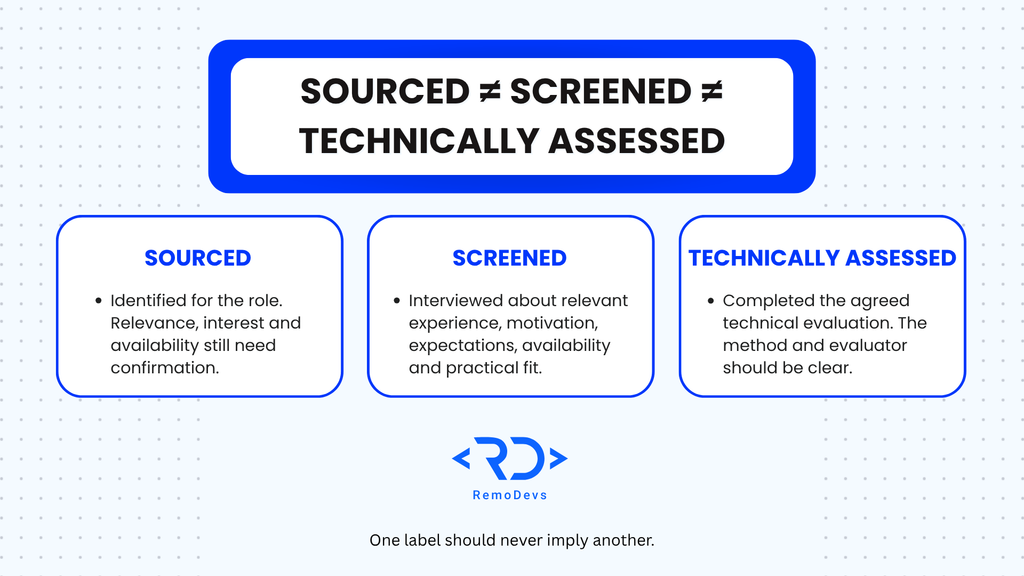
2. Sourced, screened and technically assessed are treated as synonyms
These labels describe different levels of evidence:
| Label | What it should mean |
| Sourced candidate | A person identified for the role. Relevance, interest and availability may still need to be confirmed. |
| Recruiter-screened candidate | A person interviewed about role-relevant experience, motivation, expectations, availability and practical fit. |
| Technically assessed candidate | A person who completed the specific technical evaluation agreed for the search. The method and evaluator should be stated. |
A candidate already known to a recruiter is not automatically suitable for a new role. Skills, expectations and availability change, while every client has a different product environment. The candidate still needs to be checked against the current brief.
The same rule applies to terms such as “pre-vetted.” If the label is used, the agency should explain what was assessed, when it happened and whether the result is relevant to the current position. Our detailed article on how RemoDevs screens software engineers in Poland sets out these distinctions and the checks used in direct recruitment.
3. The recruiter is expected to make the engineering decision
A recruiter screen and an engineering interview answer different questions.
The recruiter can verify whether the candidate’s recent responsibilities are relevant, ask for concrete examples of ownership and decision-making, confirm motivation and expectations, and flag gaps that require deeper investigation. That gives the hiring team better information for the technical stage.
Product-specific architecture, coding depth and engineering trade-offs are normally best evaluated by the client’s technical team. Depending on the role, that evaluation might involve an engineering interview, system-design discussion, live coding exercise or take-home task.
If the agency is expected to provide a separate technical assessment, the scope should be agreed before sourcing starts. The candidate summary should name the method, assessor and result. It should not imply that every person completed live coding, background checks or reference checks unless those steps actually took place.
4. CV volume replaces evidence
Sending more profiles can create the appearance of progress while moving the screening workload back to the client. A useful candidate presentation should reduce uncertainty, not create another stack of profiles to review.
Depending on the search, the summary can include:
- relevant responsibilities and project examples;
- alignment with the agreed requirements;
- motivation for considering the opportunity;
- salary or rate expectations;
- notice period and availability;
- location and preferred working model;
- completed screening or assessment stages;
- open questions for the client’s interview.
There is no universal shortlist size or percentile that proves quality. The relevant measure is whether each presented candidate is supported by evidence connected to the brief.
5. Interviews are conversational but not comparable
An interview can feel productive and still produce weak decision data. This happens when each interviewer asks different questions, uses an unstated standard or scores the overall impression rather than role-related evidence.
CIPD’s guidance on selection methods defines structured interviews as using predefined questions and consistent scoring criteria. Google’s guide to structured interviewing likewise recommends planned, relevant questions and scoring guides.
For a technical role, structure does not mean asking every candidate a rigid script regardless of context. It means evaluating the same core competencies against the same standard, recording the evidence and separating a concern about one criterion from a general feeling that the person was not a fit.
The agency can help keep the process organized, but the client remains responsible for the technical evaluation and final selection decision.
6. The feedback loop is undefined
Recruitment is iterative. The first candidate conversations may reveal that the budget is below current expectations, one requirement excludes otherwise relevant people, or the interview team interprets seniority differently from the recruiter.
Those signals are useful only when they return to the search. Before sourcing begins, both parties should agree on:
- who consolidates feedback from the hiring team;
- which channel is used for candidate and process updates;
- the expected response time after a profile or interview;
- how changes to the brief are approved;
- what information can be shared with the candidate.
Useful feedback refers to the agreed criteria. “Not senior enough” gives the recruiter little direction. “The role requires independent ownership of production incidents, and the interview did not show that experience” can be applied to the next search and screening decisions.
7. Speed claims do not name the milestone
“Candidates in three days” can mean an automated list, the first recruiter-screened profile or a complete shortlist. It does not mean the same thing as an accepted offer or a candidate’s start date.
For most RemoDevs direct-recruitment searches, the current target is to present the first qualified candidates within five working days after the role has been calibrated. This is a target for the first relevant profiles, not a promise that the full hiring process will finish within five days. Seniority, stack, compensation, location, interview availability and current candidate interest all affect timing.
When comparing agencies, ask each provider to define the start and end point of its delivery metric. A smaller number attached to a different milestone is not a meaningful comparison.
8. Commercial terms are treated as universal product features
Recruitment process copy should not substitute for the contract. Before the search starts, the written agreement should explain:
- the fee model and calculation basis;
- what event triggers the fee;
- payment timing;
- any exclusivity or candidate-ownership rules;
- the applicable replacement period and eligibility conditions;
- whether the remedy is a replacement search, refund or another agreed form of support;
- which screening, assessment and coordination activities are included.
RemoDevs offers success-fee recruitment in Poland, but the fee and replacement terms are agreed for the engagement. The applicable replacement period, conditions and remedy should be confirmed in the written agreement for each search.
What a stronger agency-supported process looks like
The exact workflow will vary by role, but the handoffs should remain clear.
| Stage | Agency responsibility | Client responsibility | Evidence at the handoff |
| Role calibration | Ask role-specific questions, share market context and record the agreed search criteria | Define business outcomes, priorities, budget, working model and evaluation plan | Approved brief and named decision criteria |
| Sourcing and recruiter screening | Find candidates for that role and verify the agreed practical criteria | Clarify requirements when the search exposes a trade-off | Screening notes and confirmed logistics |
| Candidate presentation | Explain why the candidate is relevant, list completed checks and flag open questions | Select whom to interview | Candidate summary tied to the brief |
| Technical validation | Coordinate the stage and maintain candidate communication | Choose and conduct the role-appropriate technical evaluation | Recorded technical evidence and specific feedback |
| Decision and offer | Support scheduling, feedback, questions and offer communication | Make the hiring decision and approve the offer | Clear acceptance, rejection or next step |
This division prevents two common errors. The agency does not overstate technical checks it did not perform, and the client does not receive a pile of CVs with no recruitment screening behind them.
How RemoDevs applies the model in direct recruitment
RemoDevs recruits software engineers, AI and machine learning specialists, data professionals, DevOps and cloud engineers, and technical leaders across Poland. Our published direct-recruitment process follows five core stages:
- Calibrate the role and evaluation plan.
- Source candidates for the specific position.
- Conduct recruiter screening.
- Present relevant candidates and coordinate the client’s technical validation.
- Support interviews, feedback and the offer process.
We do not treat every person in a recruiter network as universally pre-vetted. The candidate is checked against the current role, and the presentation should distinguish completed checks from open questions. The client decides whom to interview and hire.
You can review the full process in How RemoDevs Screens Software Engineers in Poland or see the scope of our IT recruitment service in Poland.
What public client evidence can and cannot prove
Client reviews are useful when they describe a specific engagement. They should not be converted into a universal SLA or success rate.
Two published examples illustrate different parts of the process:
- A Better Software Group review reports that RemoDevs provided 30 filtered candidates, five of whom reached the final stage. It also mentions daily communication and coordination through Trello.
- An ElevenLabs review reports three successful hires at the time of publication and highlights communication, collaboration and an adaptable process.
Both examples are available on the RemoDevs profile on Clutch. They show what happened in those engagements. They do not prove that every search will produce the same volume, timeline or result.
Checklist for evaluating an IT recruitment agency
Use these questions before signing an agreement or opening a role:
- How will you calibrate the role before sourcing starts?
- What is the difference between a sourced, recruiter-screened and technically assessed candidate in your process?
- What information will accompany each presented CV?
- Which checks are standard, and which require a separate agreement?
- Who owns product-specific technical validation?
- How will feedback be collected, recorded and applied to the search?
- What does your delivery-time claim measure: first profiles, a shortlist, an accepted offer or a start date?
- What fee event, replacement conditions and service scope will appear in the contract?
- Can you provide engagement-specific evidence for work on comparable roles?
- What happens when the first candidates reveal that the original brief needs to change?
A credible partner should be able to answer these questions directly. If a provider cannot define a term such as “vetted,” “guaranteed” or “delivered,” do not rely on it when comparing agencies.
Frequently asked questions
Why do IT recruitment processes fail?
The process often loses accuracy at the handoffs between the hiring manager, recruiter, technical interviewers and candidate. Common causes include an unclear role brief, inconsistent screening definitions, no agreed technical evaluator, weak feedback and unclear commercial terms.
Should an IT recruitment agency technically assess every candidate?
Not necessarily. In direct recruitment, the client’s engineering team is usually best placed to evaluate product-specific architecture, coding depth and technical trade-offs. If a separate agency-led assessment is required, its method, evaluator and scope should be agreed and reported clearly.
Is a recruiter-screened candidate the same as a pre-vetted candidate?
Only if the agency defines “pre-vetted” as recruiter screening and states the scope clearly. Recruiter screening does not automatically mean that the candidate completed live coding, reference checks, background verification or a formal technical assessment.
How quickly should an IT recruitment agency provide candidates?
Ask which milestone the timeframe describes. RemoDevs currently aims to present the first qualified candidates within five working days for most direct-recruitment searches after role calibration. This is not a guarantee of a completed hire, and timing varies with the role and market conditions.
What should a recruitment replacement guarantee include?
The agreement should state the guarantee period, eligibility conditions, exclusions, notification process and available remedy. These terms can differ by recruitment model and engagement, so they should not be inferred from a general website claim.
Is direct recruitment the same as IT staff augmentation?
No. In direct recruitment, the client selects and hires the candidate. In staff augmentation, a specialist joins the client’s team through a provider for an agreed period, while the client typically manages day-to-day priorities and work. Pricing, administration and contractual responsibilities also differ.
Sources and methodology
This article separates general selection principles, RemoDevs’ published process and engagement-specific client evidence:
- US Office of Personnel Management: Job Analysis
- CIPD: Selection Methods
- Google re:Work: A Guide to Structured Interviewing
- RemoDevs: How We Screen Software Engineers in Poland
- RemoDevs: IT Recruitment Agency in Poland
- Clutch: RemoDevs Reviews
Operational targets are described as targets, not guaranteed outcomes. Client results are attributed to the engagements in which they occurred. Commercial terms should be confirmed in the written agreement for the specific search.
Hiring technology talent in Poland?
Share the role, business context, budget, working model and planned evaluation stages. RemoDevs can help calibrate the search, source and screen candidates across Poland, and coordinate the process through the offer stage.
Discuss an open role with RemoDevs
Visit us
Find a moment in your calendar and come to our office for a delicious coffee
Make an apointment