A candidate screening questionnaire, also called a recruitment questionnaire, is a short set of questions used to check basic alignment before an interview. In IT recruitment, it should fill gaps in the application: an essential requirement, working arrangements, availability or compensation.
Start with the CV. If it already answers a question, do not make the candidate answer it again. Project histories, motivation statements and written communication exercises are rarely necessary just to decide whether to have an initial conversation.
The template below has four short questions and an optional fifth for a genuine role requirement. It supports a recruiter’s decision about the next step; it does not assess technical competence.
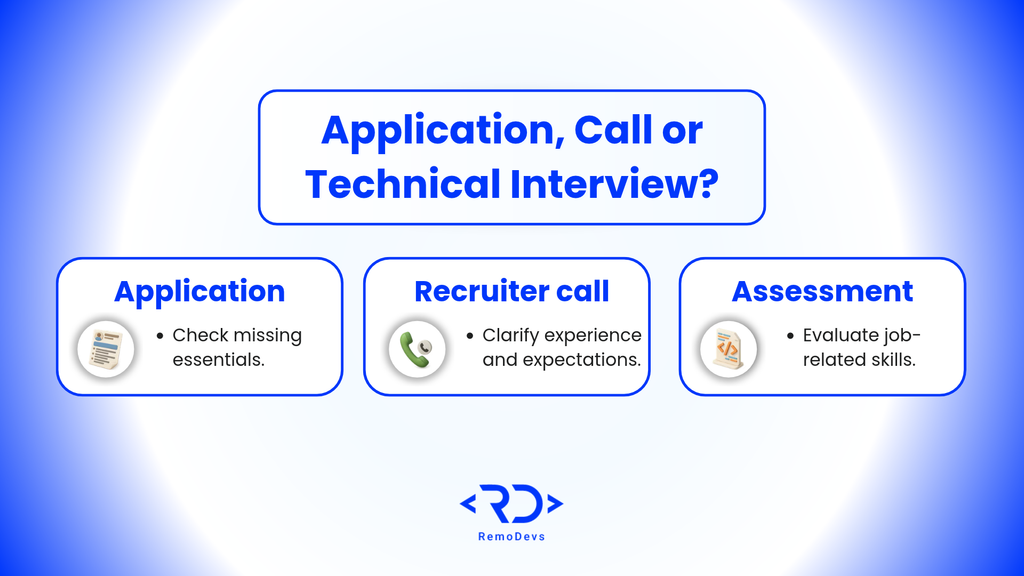
When screening questions help – and when to skip them
A form can help when several applicants need to clarify the same practical point. For example, a role requires regular office attendance, but applications do not say whether candidates can meet that arrangement. Asking once at application stage may prevent a misunderstanding later.
For a small shortlist or an experienced developer approached directly, a short recruiter call may be the better starting point. The candidate may be willing to discuss the opportunity but unwilling to complete another application form. If the CV, LinkedIn profile or earlier conversation already gives you the information you need, move on.
The Oregon Department of Administrative Services’ pre-screening guide makes a useful distinction: pre-screening questions can help narrow a larger pool, but may be unnecessary for a hard-to-fill role with few applicants. It also advises against essay questions at the initial application stage.
Before contacting candidates, agree with the hiring manager on what is essential, which alternatives are acceptable and where there is flexibility. “Experience with our exact framework would be useful” is different from “this person must be able to cover an agreed on-call rota”. A preference should not quietly become a rejection rule.
There is no mandatory sequence. You might use application questions, go straight to a call or clarify a single point by email. Choose the lightest approach that resolves the uncertainty.
Simple IT Candidate Screening Questionnaire
Use only the questions the application has not answered. Replace the bracketed fields before sending, and share the job description, working arrangement and compensation range first. State the currency, time unit and whether the range is an employment salary or contractor fee.
Role: [job title and job description link]
Recruiting contact: [name/contact]
Recruitment privacy notice: [link]

Please answer only what is not already covered in your application.
Short answers are enough. You are welcome to ask us questions too.

1. Essential experience
Have you used [essential technology] for [relevant task]?
Yes / Relevant alternative: [name] / No

2. Working arrangement
Can you meet [disclosed location, remote/hybrid arrangement and required hours]?
Yes / Would like to discuss / No

3. Availability
What is your notice period or earliest realistic start date?
[Short answer]

4. Compensation alignment
Does the disclosed range of [range, currency, unit and engagement model]
broadly match what you would consider?
Yes / Would like to discuss / No
Question 1 is useful only if the requirement is genuinely important and the CV leaves it unclear. Do not repeat it for every technology in the advert. For junior roles, accept relevant study or personal-project experience where the hiring requirements allow it.
Add a fifth question only when another essential condition needs checking. For example, if an agreed on-call rota is part of the actual role, disclose the arrangement and ask:
5. Additional essential requirement
Can you participate in [the disclosed on-call arrangement]?
Yes / Would like to discuss / No
Delete this item if it is irrelevant. Do not add a generic “knockout” question just to fill a slot. If work authorisation is the essential unresolved condition instead, use this fifth slot with wording approved by HR for the hiring country and the employer’s support policy.
If no compensation range has been shared, provide one where possible. Otherwise, ask for expectations with a clear currency, time unit and engagement model. Do not ask for current or previous pay.
What to clarify on a short recruiter screening call
Use the call to understand the person behind the CV and resolve points that need a conversation. Workable’s recruiter guidance identifies CV clarification, availability, working arrangements, expectations and sharing role information as useful phone-screen topics.
Read the application beforehand. Pick relevant follow-ups rather than asking the candidate to recite their CV or complete another questionnaire:
- Experience: “Your CV mentions maintaining Python services. What was your own responsibility?” A brief explanation may be enough to establish whether the work is relevant.
- Role expectations: “This role involves maintaining an existing product as well as building features. How does that fit what you are looking for?” Explain the opportunity as well as asking about interest.
- Practical questions: “You selected ‘Would like to discuss’ for hybrid working. What arrangement could work for you?” Check whether the employer can be flexible.
- Candidate questions: Give them space to ask about the team, responsibilities, process or offer.
Where communication or spoken English matters to the work, use the conversation to explore it in context. Do not infer ability from accent, nervousness, personality or polished application prose alone.
For a senior specialist, focus on relevant responsibilities and expectations. For a junior, allow learning projects where appropriate. If hiring a contractor, clarify the proposed engagement and availability rather than assuming employment terms apply. These differences should shape the discussion, not create longer forms by default.
What belongs in technical assessment instead
A recruiter can establish what someone reports having worked on and whether their experience appears relevant. A “Yes” to a technology question does not prove proficiency, and a clear explanation of a project does not establish architectural judgement.
Coding, debugging, system design and detailed engineering trade-offs belong with a qualified technical interviewer. That person should lead or validate the assessment against the work the role requires. A backend exercise might explore an API’s error handling; a data engineering discussion might examine pipeline failures. Neither needs to become an application-stage essay.
Pass on the useful context and the technical questions still open. Avoid making candidates repeat the same account at every stage. A recruiter screen and a completed technical assessment should remain clearly distinguishable.
Practical examples for backend, frontend and data roles
These examples show where to ask a question, not extra questions to add to every form.
- Backend developer: The CV already lists Node.js and PostgreSQL. Do not request the stack again. If relevant API work is unclear, ask on the call: “Did you build or maintain APIs in that role?” Leave design choices and testing depth to an engineer.
- Frontend developer: The CV shows recent React work. If the question is whether they can attend the advertised office days, ask that directly. Clarify their contribution to a user-facing feature on the call; assess implementation and accessibility with the technical interviewer.
- Data engineer: The CV mentions Python and SQL but not the type of data work. Ask briefly: “Have you built or maintained data pipelines, or was your work mainly reporting?” An engineer can later explore data quality, retries and operational responsibility.
These answers are still candidate-reported. Check unclear or conflicting details before treating them as confirmed. A missing keyword, unfamiliar employer or absent public GitHub profile is not, by itself, evidence that someone lacks the required ability.
Evaluate alignment without creating a scorecard
For an everyday initial screen, three outcomes are enough:
- Meets essential requirements: The available information supports progressing. Technical competence may still need assessment.
- Needs clarification: A response is missing, ambiguous or needs discussion. Ask a follow-up or arrange a call.
- Does not meet essential requirements: A confirmed mismatch with a necessary, predefined requirement remains after checking relevant flexibility or adjustments.
Record the role-related reason in the ATS or normal recruiting notes. You do not need a separate numerical rubric or reviewer form for this template. A missing answer is a gap in information, not a competence score.
For example, “Would like to discuss” against the pay range means clarify the package. A later start date may be negotiable. Experience with an equivalent framework may need an engineer’s view. None should trigger an automatic rejection just because it does not fit a checkbox.
Larger hiring teams, high-volume campaigns or processes with specific documentation requirements may choose a more structured scorecard. The U.S. Office of Personnel Management’s structured-interview guidance offers principles for consistent questions and rating standards. That is an optional assessment-design reference, not a reason to score every application form or claim it predicts job performance.
Common screening mistakes that add friction
- Repeating the CV. Ask about what is missing, not the information already supplied. Read candidates’ answers before the next conversation.
- Turning the application into homework. Move project explanations, motivation discussions and communication follow-ups to the call. Experienced developers may simply choose not to complete a long form.
- Treating preferences as essentials. Agree acceptable technology alternatives, start-date flexibility and working arrangements with the hiring manager first.
- Leaving candidates guessing. Explain the range and role, offer a contact or alternative way to respond, and say what happens next.
Unnecessary hurdles can discourage applicants; the Oregon guidance above recognises that risk. There is no universal drop-off percentage or guaranteed time saving to attach to this template. Check whether your questions actually resolve useful information or merely move administrative work onto the candidate.
Keep screening fair and respect candidate data
Keep questions tied to the role. Leave unrelated family, religion and health questions out of the initial screen, and keep requests for an accessible response format separate from selection decisions.
For employment recruitment in Poland, UODO’s guidance explains permitted data collection and when consent may be appropriate, including specified future recruitment. A blanket consent checkbox does not replace the correct legal basis.
Where GDPR applies, provide an appropriate recruitment privacy notice, limit access and set a justified retention period in line with Articles 5 and 13. Country and engagement rules differ; have HR or the privacy owner approve the actual form. Do not silently add applicants to a future-candidate database or put confidential answers into unapproved public AI tools.
A simple form also does not authorise automated rejection. GDPR Article 22 addresses certain solely automated decisions with legal or similarly significant effects; get appropriate review before introducing automated exclusion.
When specialist IT recruitment support helps
An agency can help reach relevant candidates, calibrate a technical brief and manage screening and follow-up. A form alone will not fix unrealistic requirements or an unclear offer.
RemoDevs’ published screening process describes role calibration, sourcing, recruiter screening and coordination with client-led technical validation. Agree on the checks and responsibilities for your search.
Keep the initial screen focused on one decision: is there enough alignment to continue, or one point to clarify first? If you are planning a direct technical hire in Poland, discuss the role with RemoDevs’ IT recruitment team. Your company makes the hiring decision and engages the selected person directly, under the agreed terms.
Visit us
Find a moment in your calendar and come to our office for a delicious coffee
Make an apointment