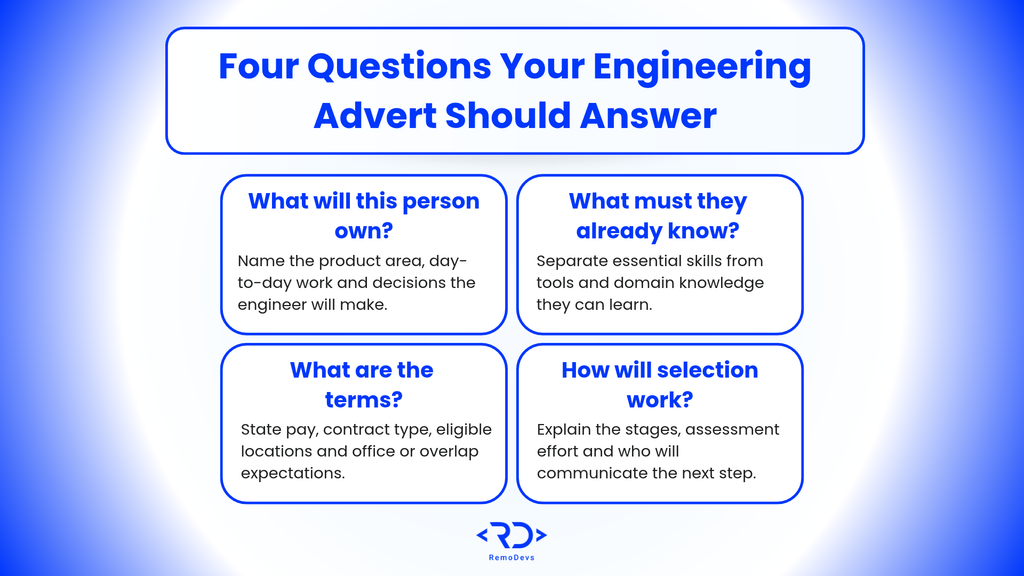
A useful software engineer job description explains the work, essential skills, team and terms. Agree on the role first, then write an advert that helps candidates decide whether to apply.
Use the template, seniority examples and checklist below to prepare your advert. All examples are illustrative, not real vacancies or RemoDevs salary benchmarks.
Job description, job advertisement or job offer?
The job description defines the role: its purpose, responsibilities, requirements and reporting line. The job advertisement presents it publicly, adding pay, working arrangements, benefits and application instructions. A job offer is the proposal made to a selected candidate later in the process.
You can combine the first two. Keep confidential hiring constraints and assessment notes in a separate recruitment brief.
Agree on the work, budget, seniority and essential skills with the hiring manager. If an agency supports the search, share a technical recruitment brief.
Copy-Ready Software Engineer Job Description Template
This illustrative mid-level backend advert uses full-time employment and remote work within Poland. Copy the text between the separators and replace the bracketed fields with approved details. It is not a RemoDevs vacancy.
The optional skills assume the employer can provide onboarding; confirm that support before using the wording. For frontend or embedded hiring, keep the layout and replace the backend work and requirements.
Software Engineer – Backend, Python
Company: [Company name]
Seniority: Mid-level
Location and work model: Remote within Poland; [office visits and travel requirements]
Working hours: [Weekly hours and collaboration window, with time zone]
Contract: Full-time employment
Compensation: PLN [minimum]–[maximum] gross base salary per month. [Bonus or equity terms, if offered]
Reporting to: [Reporting role]
Role overview
Our product helps [users] achieve [specific outcome]. You will join the team responsible for [product area], delivering [current engineering priority] alongside maintaining existing services.
The team and environment
You will work with [team composition]. Our backend uses Python, FastAPI and PostgreSQL, with Docker-based development and automated CI checks.
Production support: [On-call arrangements, escalation support and associated terms]
What you will do
- Build and maintain backend features, turning agreed product requirements into API and database changes.
- Write automated tests for the code you change and review colleagues’ pull requests.
- Investigate defects using logs, tests and reproducible examples.
- Discuss implementation choices with the team, including security, reliability and maintenance trade-offs.
- Document important changes and coordinate releases with the people responsible for deployment.
Required skills
- Experience delivering and maintaining Python applications, with examples you can discuss during an interview.
- Ability to design HTTP APIs, work with relational data and write SQL queries.
- Practical experience with Git, automated testing and reviewing code.
- Ability to investigate a software defect and explain the reasoning behind a proposed fix.
- Ability to discuss technical decisions and write clear documentation in [working language].
Preferred skills — not required
- Experience with FastAPI or a comparable Python web framework.
- Familiarity with Docker and the team’s hosting platform.
- Experience with background processing or the product’s industry domain.
We support learning these optional skills through [available onboarding support].
What early success looks like
During onboarding, you will learn the product, development workflow and release process. With team support, you will deliver an agreed change, add tests and explain how it behaves in production.
Benefits
[Benefits, leave, equipment and development support, with eligibility conditions]
Recruitment process
Apply through [application route] with [required application materials]. Our process consists of [stages, participants and estimated duration]. Any practical exercise involves [task, expected effort and payment arrangements].
We will explain the next step and response date after each stage. Contact [recruitment contact] to discuss accessibility adjustments.
Recruitment privacy notice: [Privacy notice URL]
Before publishing, check every fixed detail as well as the placeholders. Change the responsibilities and stack for your role. For hybrid work, add the office and attendance policy. For B2B, replace the employment terms with the agreed capacity, invoice rate excluding VAT and contract-specific benefits. Remove inapplicable bonus or assessment lines; state explicitly if there is no on-call duty.
Add hosting and release ownership where they affect the role. Describe planned migrations separately from the current stack, and set onboarding expectations that account for access, documentation and support.
Adjust responsibilities and requirements to seniority
Define seniority through the work and decisions the engineer will handle. Years of experience alone do not describe the job.
The SFIA software development framework distinguishes levels through responsibility and increasing independence. These examples adapt that principle; they are not an official mapping of SFIA levels to job titles.
- Junior: Implement scoped changes, investigate straightforward defects, add tests with guidance and act on review feedback. Ask for a project, placement or work example demonstrating programming fundamentals, Git and testing. Explain who mentors them and how changes reach production; avoid unsupported ownership of critical systems.
- Mid-level: Deliver features across relevant components, consider failure cases, review code and investigate issues with appropriate escalation. Ask about completed features, debugging and team decisions. Explain their design authority, review support and production duties. Select technical requirements for the actual stack.
- Senior: Lead design for a defined area, weigh trade-offs, guide difficult changes and help colleagues improve implementation quality. Ask for examples of complex delivery, technical judgement and managing reliability risks. Define system boundaries and their relationship with technical leads; state people-management duties separately.
Avoid combining these levels into one advert with an unexplained salary span. If you can hire at more than one level, describe the different scopes and how compensation relates to each.
For more on senior-specific ownership, see our guide to writing a job description for senior talent.
Separate essential requirements from skills people can learn
For each requirement, ask: what work would this person be unable to do without it, and could we support them in learning it?
The CIPD’s inclusive recruitment guidance recommends specific, behaviour-based requirements and checking that each is necessary. Apply that principle to technical skills as well as collaboration.
| Requirement under review | Keep essential when… | Make optional or rewrite when… |
|---|---|---|
| A particular language | The engineer must work independently in that codebase from the start. | A related background and supported transition would be acceptable. Say which alternatives you can consider. |
| A framework or cloud service | Immediate expertise is needed for a specific responsibility. | The work depends mainly on transferable concepts and the team can provide onboarding. |
| A degree or certification | There is a clear, role-related reason for the qualification. | Relevant experience or another learning route would demonstrate the required capability. |
| Communication skills | The role requires concrete activities such as design reviews, customer discussions or written handovers. | The advert relies on personality labels such as “outgoing” without explaining the work. |
Keep the full technology inventory separate from the entry requirements. If the team uses Kubernetes but this engineer will not administer it, explain that context instead of making cluster administration a screening gate.
Keep optional skills optional in screening and interviews too.
Explain the stack, team and engineering work
Technology names are more useful when attached to responsibilities. “Java, Spring, PostgreSQL and AWS” gives less information than explaining which services the engineer will maintain and who owns deployment.
Include details that affect the decision to apply:
- Product and work: what users need, what is being built and how much maintenance the role involves.
- Current versus planned technology: distinguish the existing codebase from a migration or experiment.
- Team and decision-making: who reviews designs, who sets priorities and who supports a new joiner.
- Operational work: whether the role includes deployments, incident response or an on-call rota, with the schedule and terms explained.
- Constraints: legacy integrations, regulated data, customer contact or travel that materially affect the job.
Use these details to shape interview questions. Clear requirements support consistent evaluation; they do not guarantee application volume or hiring speed.
Make compensation and working arrangements explicit
Publish a range the company is prepared to offer for this role. State the currency, time period, contract type and whether the figure is gross salary or a contractor invoice excluding VAT. Keep base pay separate from bonuses and equity, and explain how placement within the range is assessed.
Avoid a broad range covering several different jobs. If the budget cannot support the scope, revisit one or both before advertising. Benefits should not obscure that mismatch.
When comparing external benchmarks, check their date, location, seniority, stack and contract basis. For a fuller budgeting exercise, our developer hiring cost guide for Poland separates compensation from employer costs, recruitment fees and provider rates.
“Remote” also needs a definition. Specify eligible countries, any office visits, who pays for required travel and the working-hour overlap. For example, an illustrative requirement might read: “Remote within Poland, with collaboration hours from 14:00 to 17:00 Europe/Warsaw on working days.” Using a named time zone helps readers interpret seasonal clock changes.
For hybrid roles, give the office location and expected attendance. State whether the arrangement applies during onboarding, afterwards or both.
Recruiting developers in Poland
Distinguish an employment contract, often called umowa o pracę or UoP, from an independent B2B engagement. Present their compensation and benefits separately. A contractor’s invoice amount excluding VAT is not a promise of personal take-home pay, and a staff augmentation provider’s client rate is a different price again.
For recruitment into employment in Poland, the Labour Code amendment effective from 24 December 2025 introduced requirements concerning pay information, gender-neutral job titles and advertisements, and a non-discriminatory recruitment process. Candidates must receive initial pay or a pay range based on objective, neutral criteria, plus relevant collective-agreement or remuneration-policy provisions where applicable.
The information can be supplied in the advert, before the interview if omitted there, or before employment begins if not provided earlier, with enough advance notice for informed negotiations. This is not a blanket requirement to put a salary range in every advert. The amendment also excludes current and previous employment pay from the employment-history information an employer may demand.
These are employment-law rules; do not automatically apply them to independent B2B contracts. Confirm the obligations for your employer, engagement and jurisdiction before launching the search.
For international teams hiring in Poland, also explain the employing or contracting organisation, the language used at work and any location or work-authorisation conditions. State these conditions precisely rather than implying that remote work is available from anywhere.
Weak versus effective job advertisement wording
All examples below are illustrative. Use a stronger version only if it accurately describes the role.
| Weak wording | More useful wording |
|---|---|
| “Work with cutting-edge technology.” | “Maintain our Python API and PostgreSQL database; help assess which background jobs should move to a queue.” |
| “Must know AWS, Azure, GCP and Kubernetes.” | “You will deploy to AWS with support from our platform team. Experience with another cloud is acceptable.” |
| “Excellent communication skills.” | “Explain design choices in English during team reviews and document decisions for colleagues working asynchronously.” |
| “Competitive salary.” | “Gross monthly base salary: PLN [approved minimum]–[approved maximum]. Any bonus is described separately.” |
| “Flexible hybrid working.” | “Work from our Wrocław office two agreed days each week; the remaining days can be remote within Poland.” |
| “Senior developer who owns everything.” | “Lead design for the billing service. The Engineering Manager owns staffing and performance reviews; the platform team owns shared infrastructure.” |
| “We are looking for a culture fit.” | “Give constructive review feedback, raise delivery risks and work with product colleagues to agree priorities.” |
If nobody can confirm the office policy or ownership boundary, resolve it before publishing the advert.
Avoid a clear advert followed by a confusing process
The advert and recruitment process should describe the same role. Common problems include adding requirements after applications arrive, making an optional framework a rejection reason or revealing office attendance only at the final stage.
Give candidates the selection stages and a realistic time commitment. Explain what a practical assessment evaluates, whether it uses live discussion or independent work, and what materials are needed. Use an exercise that reflects the advertised responsibilities rather than asking candidates to solve an unrelated problem.
Provide a recruitment contact and a way to request accessibility adjustments. Keep application requests proportionate: a public GitHub history, for example, should not be the only way to demonstrate experience when professional work is confidential.
If the role changes, tell people already in the process and update the advert. Where the actual difficulty is budget, availability or assessment design, rewriting the opening paragraph will not resolve it.
Hiring manager’s checklist before publication
- The title describes the function and level without inflated labels.
- The role has a defined purpose, responsibilities and reporting line.
- The essential skills are necessary for the work and match the interview criteria.
- Optional skills are clearly labelled and supported by a realistic learning plan.
- The stack distinguishes current technology from planned changes.
- Seniority matches the expected independence, support and decision authority.
- Compensation has an approved range, currency, contract basis and time unit.
- Location, attendance, overlap hours, travel and on-call expectations are explicit.
- Benefits and conditions match the actual engagement model.
- Selection stages, assessment effort and candidate communication are explained.
- The language is specific and inclusive, and applicable recruitment obligations have been checked.
- A person doing comparable work has reviewed the advert for accuracy.
Turn the description into a hiring brief
Once the advert is agreed, use the same role scope in sourcing, screening and interviews. That gives the hiring team and candidates a shared reference for what the job involves.
If you need help finding engineers for a direct hire, RemoDevs provides IT recruitment in Poland for international employers. Bring the role scope, essential skills, working arrangements and budget to the conversation so the search can be discussed against a concrete requirement.
Visit us
Find a moment in your calendar and come to our office for a delicious coffee
Make an apointment