
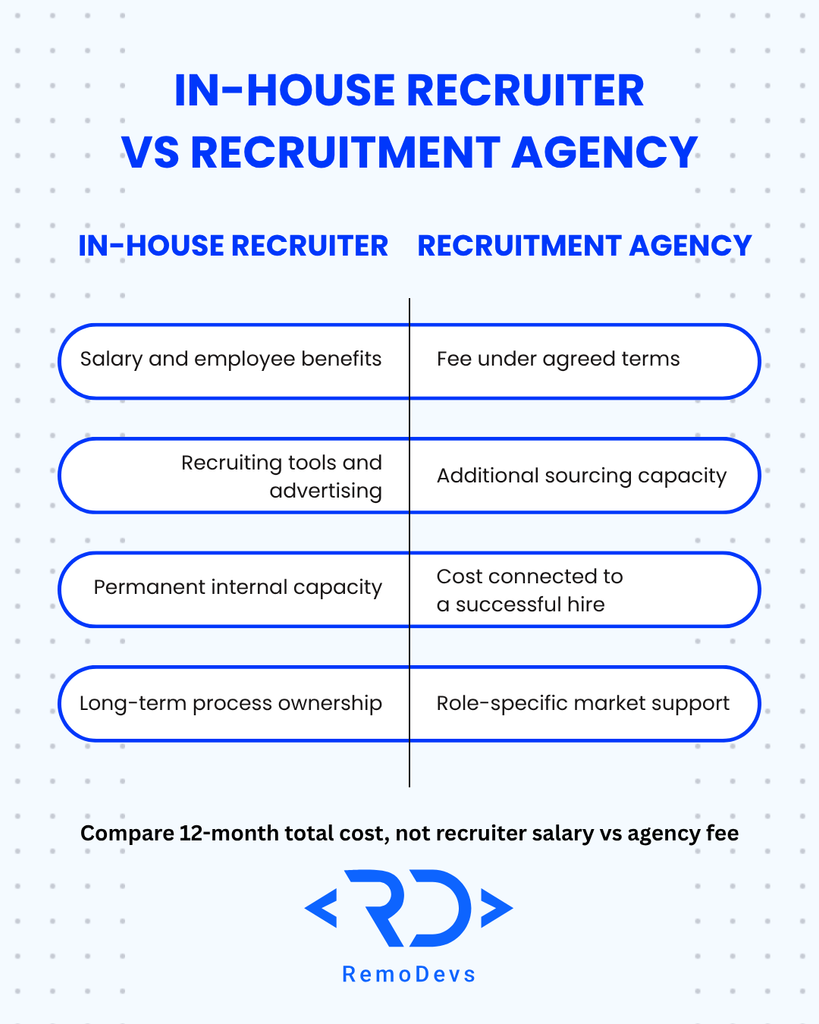
Should you hire an in-house tech recruiter or use a specialist recruitment agency? There is no universal winner. An internal recruiter gives you permanent capacity and deeper day-to-day knowledge of the company. An agency converts part of that fixed capacity into a search-specific cost and can add sourcing support when hiring is irregular, specialized or focused on a new market.
The useful comparison is therefore not “salary versus agency fee.” It is the total cost, available capacity, scope of work and elapsed time measured on the same basis.
The short answer
- An in-house recruiter is usually easier to justify when a company has a stable, year-round hiring plan and enough work to use that capacity well.
- A success-fee agency can be a better fit when hiring volume is intermittent, the role is difficult to source or the company needs market-specific support without adding permanent recruitment headcount.
- Public hiring benchmarks describe the market, not the cause of an individual result. They cannot prove that every agency search is faster than every in-house search.
- RemoDevs aims to present the first qualified candidates within five working days for most direct-recruitment searches. That is a target for initial candidate presentation, not a guarantee of a shortlist, accepted offer, hire or start date.
First, compare the same service
This article compares an employed recruiter with RemoDevs’ direct recruitment service in Poland.
In this model, RemoDevs supports:
- role and market calibration;
- active candidate sourcing;
- recruiter screening;
- candidate presentation;
- interview coordination; and
- communication and offer support.
The client chooses whom to interview, owns the final technical validation and makes the hiring decision. A technical assessment, reference check or background check is included only when it has been specifically agreed for the search. Direct recruitment should not be confused with staff augmentation, payroll administration or employer-of-record services.
That scope matters. Comparing an in-house recruiter with an agency that also employs or contracts the engineer would mix two different commercial models.
What does an in-house recruiter really cost?
Start with compensation, not an unsupported “senior tech recruiter” estimate
The US Bureau of Labor Statistics does not publish a separate national wage category for technical recruiters. The closest official category is human resources specialists, which includes recruitment specialists.
The latest occupational figure published by the BLS at the time of this update is from May 2024. It reports:
- a median annual wage of $72,910 for human resources specialists; and
- a median of $81,330 in professional, scientific and technical services.
These are broad occupational benchmarks, not quoted salaries for a senior technical recruiter in a specific city. See the BLS Human Resources Specialists profile.
Salary is also not the full employment cost. In March 2026, wages and salaries represented 69.9% of average private-industry compensation costs, while benefits represented 30.1%, according to the BLS Employer Costs for Employee Compensation release.
Used only as a broad planning proxy, that ratio produces the following illustration:
| Wage benchmark | Illustrative wage-plus-benefits cost |
|---|---|
| $72,910 | approximately $104,300 |
| $81,330 | approximately $116,400 |
The calculation is annual wage ÷ 0.699. It combines two different BLS datasets and is not a measured compensation figure for technical recruiters. A company should replace it with its actual salary band, payroll burden and benefits package.
It also excludes recruitment software, sourcing licenses, job advertising, onboarding and any temporary support required while the recruiter is being hired or trained. Public list prices are not a reliable substitute for the company’s negotiated contracts, so these costs should come from the buyer’s own budget.
A practical in-house cost formula
Use a 12-month period and calculate:
Annual in-house recruiting cost = salary + employer taxes and benefits + recruiting tools and advertising + other directly attributable operating costs
Then calculate:
In-house delivery cost per successful hire = annual in-house recruiting cost × share allocated to the relevant hiring work ÷ successful hires
The allocation matters. If the employee spends only half of the year on technical recruitment and the rest on onboarding, employer branding or other HR work, charging 100% of the role to tech hires would overstate the recruiting cost. Conversely, treating an already overloaded recruiter as “free” ignores the opportunity cost of displaced searches.
How to calculate the cost of using RemoDevs
RemoDevs offers success-fee direct recruitment. The fee is connected to a successful hire, while the calculation basis, payment trigger, candidate ownership and replacement terms are agreed before the search begins.
The correct formula is:
Agency delivery cost per successful hire = total placement fees and agreed search-specific charges ÷ successful hires
This model does not require the client to employ an additional recruiter or maintain tools specifically for the agency’s sourcing work. It is not, however, “zero overhead.” The client still invests time in role calibration, interviews, technical evaluation, feedback and the final offer.
Do not compare the agency fee with base salary alone. Compare it with the portion of the in-house function that is genuinely avoidable or capacity-constrained.
A simple break-even calculation
Once RemoDevs has provided a written fee for the role, use:
Break-even hires = avoidable annual in-house recruiting cost ÷ average agency fee per successful hire
This is a planning threshold, not an automatic buying rule. An in-house recruiter also creates value through employer branding, workforce planning, internal mobility and long-term process ownership. An agency may add value through market-specific sourcing and flexible capacity. Those benefits should be evaluated separately from the arithmetic.
Speed: use the same clock for both models
“Time-to-hire” is often used to describe several different intervals. A fair comparison needs a defined start and end point.
| Metric | What it measures |
| Search launch time | From an approved requirement to active sourcing |
| Time to first qualified candidate | From search launch to the first relevant profile presented |
| Time to first fill | From opening the role to the first successful hire |
| Time to hire | From a candidate entering the process to accepting an offer |
| Time to start | From offer acceptance to the employee’s first day |
The Ashby Recruiter Productivity 2026 report analyzed more than 109 million applications and 247,000 jobs from January 2021 through March 2026. For technical roles, it reported:
- a 76-day median time to first fill, defined as the period from opening a job to making the first hire;
- a 40-day median time to hire from candidate entry to accepted offer, with 75% completed within 57 days; and
- an average of 3.8 technical hires per recruiter in Q1 2026.
These figures are useful market context, but they are not an in-house-only control group and do not measure RemoDevs. They also show why “first candidate in five days” and “hire in five days” are fundamentally different claims.
What RemoDevs can state about speed
After the role has been calibrated, RemoDevs begins sourcing and screening. For most direct-recruitment searches, the team aims to present the first qualified candidates within five working days. The RemoDevs screening-process article explains the scope and limitations of that target.
It is not a universal commitment to hire within 7–14 days. The full timeline depends on:
- role rarity and the combination of required skills;
- compensation and working model;
- candidate interest and availability;
- the number and design of client interview stages;
- interviewer availability and feedback speed;
- offer approval; and
- the selected candidate’s notice period.
An agency can add sourcing capacity quickly, but it cannot unilaterally compress the client’s decision process or a candidate’s notice period.
Screening quality and internal workload
Neither model removes the need for client-side technical judgment.
Ashby’s 2026 dataset found that a technical hire involved an average of 23.3 total interview hours across the hiring team in Q1 2026. That is a useful reminder to count engineering and hiring-manager time in both models rather than assigning it only to in-house recruitment.
An internal recruiter may have a stronger understanding of the employer brand, team dynamics and historical hiring decisions. A specialist external recruiter may contribute focused market knowledge and additional sourcing capacity. Neither advantage guarantees a good hire.
For RemoDevs direct recruitment:
- candidates are screened against the requirements of the current role;
- the recruiter checks relevant experience, communication, motivation, expectations, availability and practical fit;
- the client normally owns product-specific technical validation;
- technical tests and reference or background checks are described as completed only when they have actually taken place; and
- an existing recruiter relationship does not make someone universally “pre-vetted.”
There is therefore no support for a universal “90% rejected,” “top 10%,” “3–5 candidates” or “every candidate technically assessed” promise. The proportion and number of candidates will vary by search.
In-house recruiter vs RemoDevs: direct comparison
| Decision factor | In-house recruiter | RemoDevs direct recruitment |
| Cost structure | Ongoing employment and operating cost | Search-specific success fee under agreed terms |
| Capacity | Fixed by team size and current workload | Additional external capacity for the agreed search |
| Company knowledge | Built continuously inside the organization | Developed through role calibration and ongoing feedback |
| Poland market focus | Depends on the recruiter’s experience and network | Core focus of the direct-recruitment service |
| Sourcing | Internal tools, database, referrals and outreach | Active sourcing, recruiter relationships, referrals and recruitment platforms |
| Recruiter screening | Defined by the employer’s process | Role-specific recruiter screening before presentation |
| Technical assessment | Chosen and owned by the company | Chosen and owned by the client unless a separate assessment is agreed |
| Reference/background checks | Per company policy | Only when agreed for the search; scope and timing must be stated |
| First-candidate timing | Depends on existing capacity and role | Target of five working days for first qualified profiles on most searches; not a hire guarantee |
| Final hiring decision | Employer | Client |
| Best fit | Sustained hiring and long-term TA ownership | Intermittent or specialized Poland-focused searches and additional capacity |
When an in-house recruiter is likely to make more sense
An internal hire deserves serious consideration when:
- the company expects continuous recruitment across multiple teams;
- there is enough predictable work to use the role throughout the year;
- employer branding, internal mobility and workforce planning need dedicated ownership;
- the organization wants to build and retain its own recruiting systems and candidate relationships; or
- several roles require constant alignment with many internal stakeholders.
The exact annual hiring threshold cannot be set credibly without the company’s compensation, tool costs, hiring mix and agency quote.
When RemoDevs may be the better fit
Direct recruitment may be useful when:
- the company needs a small or uneven number of hires rather than permanent recruiting capacity;
- an existing talent team is temporarily at capacity;
- the role is senior, specialized or difficult to source;
- the company is hiring in Poland without established local recruiting coverage; or
- the buyer wants to connect cost to a successful hire under agreed terms.
This does not mean that an agency is automatically cheaper or faster. It means the cost shape and available capacity may fit the hiring plan better.
A hybrid model is often the real comparison
Many companies do not need to choose one model for every role. An internal talent team can own employer branding, process design, stakeholder alignment and the final candidate experience, while RemoDevs supports selected Poland-based searches.
A hybrid approach works best when ownership is explicit:
- one agreed role brief and compensation range;
- clear candidate-ownership rules;
- one technical evaluation process;
- named decision-makers;
- feedback deadlines; and
- consistent candidate communication.
Without these rules, adding an agency can create duplication rather than speed.
A 12-month decision checklist
Before deciding, put the following inputs into one sheet:
- Expected number and type of technical hires.
- Actual recruiter salary band, employer costs and start-up lead time.
- Annual ATS, sourcing, advertising and operating costs.
- Percentage of internal recruiter capacity allocated to these searches.
- Written agency fee, payment trigger and replacement terms.
- Hiring-manager and technical-interviewer hours per successful hire in each model.
- The same start and end points for every speed metric.
- Internal evidence for any vacancy cost, without using a generic salary multiplier.
- Quality measures such as offer acceptance, probation retention, hiring-manager satisfaction and time to productivity.
This produces a company-specific answer instead of a marketing estimate.
Frequently asked questions
Is a recruitment agency always cheaper than an in-house recruiter?
No. An agency can reduce fixed recruiting capacity and tool requirements for intermittent searches, but repeated placement fees may exceed the allocated cost of an efficiently used internal team. Use actual 12-month inputs for both models.
Does RemoDevs guarantee a hire within 7–14 days?
No. For most direct-recruitment searches, RemoDevs aims to present the first qualified candidates within five working days after role calibration. Candidate presentation is not the same as an accepted offer, hire or start date.
Does every RemoDevs candidate pass a technical assessment?
No. RemoDevs conducts recruiter screening. The client normally selects and owns the technical validation method unless a separate assessment has been agreed for the search.
Are all candidates in a current vetted pool?
No universal pool should be treated as continuously verified. Even when a candidate is already known to a recruiter, current suitability, interest, expectations and availability must be checked against the specific role.
Does RemoDevs conduct background and reference checks?
Only when required by the agreed search process. Their scope, timing and ownership should be documented rather than assumed.
Make the decision using your own hiring plan
If you have sustained hiring volume and need long-term talent-acquisition ownership, an in-house recruiter may be the stronger investment. If you need additional capacity for a limited number of specialist roles in Poland, a success-fee search may align cost more closely with completed hires.
RemoDevs can help you calibrate an open role, assess the current Polish candidate market and provide written, role-specific commercial terms. Discuss your hiring needs with RemoDevs.
Visit us
Find a moment in your calendar and come to our office for a delicious coffee
Make an apointment