
- Fintech, SaaS, and MedTech are the three verticals where RemoDevs has the deepest hiring expertise and the strongest candidate networks.
- Each industry demands a highly specific tech stack and a rare combination of domain knowledge – generic recruiters consistently fail here.
- RemoDevs filters out 90% of applicants upfront, delivering only the top 10% of vetted developers who match both technical requirements and industry context.
- If you’re a CTO or VP of Engineering hiring in any of these three verticals, stop burning time on unqualified pipelines – book a 15-minute call to see a shortlist built for your stack.
You’re Not Hiring a Developer. You’re Hiring Domain Intelligence.
Bad hires in Fintech, SaaS, or MedTech don’t just slow you down – they expose you to compliance failures, churn your product roadmap, and cost you up to 200% of that engineer’s annual salary to fix.
The root cause almost always isn’t a lack of coding ability. It’s a lack of domain context. A React developer who has never touched PCI-DSS environments is a liability in a payments product. A backend engineer without multi-tenant SaaS architecture or LLM-integration experience will bottleneck your platform from day one.
Most recruiters don’t understand the difference. We do – because we’ve built hiring pipelines exclusively in these three verticals for years.
Here is a breakdown of each industry in the 2026 landscape, what makes hiring hard, and what good actually looks like.
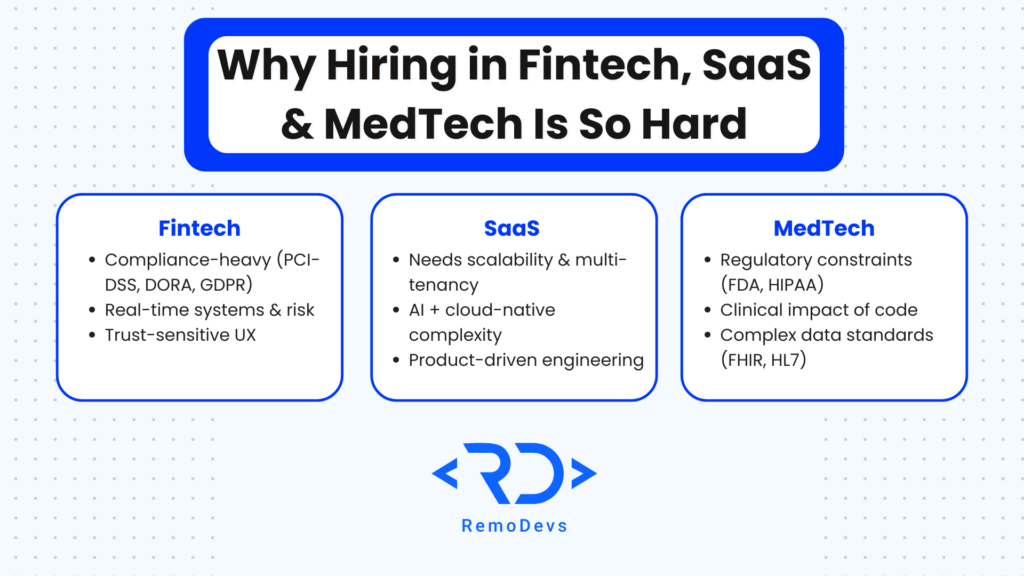
1. Fintech Recruitment: Hiring Where Compliance Meets Engineering
Why Fintech Hiring Is Harder Than It Looks
Fintech sits at the intersection of financial regulation, real-time data processing, and consumer trust. The engineers who thrive here aren’t just technically strong; they understand why the constraints exist. With the enforcement of frameworks like DORA (Digital Operational Resilience Act) in the EU changing global standards, the stakes are higher than ever.
Hiring managers in Fintech consistently report the same three failure modes:
- Developers who can build fast but ignore PCI-DSS, SOC 2, DORA, or GDPR requirements until it’s too late.
- Backend engineers unfamiliar with high-frequency transaction processing, ledger logic, or reconciliation architecture.
- Frontend talent that doesn’t understand the UX compliance requirements unique to banking and payments products.
What the Ideal Fintech Developer Profile Looks Like
When we screen for Fintech roles, here’s what we evaluate beyond the resume:
| Evaluation Layer | What We Screen For |
| Core Tech Stack | Java, Python, Go, Rust, Kotlin, Spring Boot, Kafka, PostgreSQL |
| Security & Compliance IQ | PCI-DSS, SOC 2 Type II, DORA resilience testing, AML/KYC workflows, data encryption patterns |
| System Design | Event-driven architecture, idempotency, distributed ledger concepts |
| Soft Skills | Ability to work under audit pressure, documentation rigor, async communication |
Bottom Line: Fintech doesn’t forgive technical shortcuts. Neither does our screening process.
2. SaaS Recruitment: Scaling Teams Without Breaking the Product
The SaaS Engineering Hiring Paradox
SaaS companies grow fast and break things – but only until they hit the scale where breaking things costs customers and triggers churn. The engineers who got you to Series A are often not the engineers who will get you to Series C in a market heavily driven by AI and automation.
The challenge isn’t finding developers who know your stack. It’s finding developers who understand multi-tenancy, horizontal scalability, cloud-native infrastructure, and AI-agent workflows at a level where they can own decisions, not just execute tickets.
Three hiring mistakes we see SaaS companies make repeatedly:
- Hiring for stack familiarity over system design depth: A developer who knows React or Node.js but has never thought about caching strategies or rate limiting will struggle at scale.
- Undervaluing DevOps/MLOps fluency: Modern SaaS engineers need to own their deployments. CI/CD pipeline blindness is a red flag.
- Ignoring product sensibility: The best SaaS engineers think about the end-user. Engineers who only think about the ticket will build technically correct features that nobody uses.
What We Look For in SaaS Candidates
Our SaaS recruitment process goes well beyond stack matching:
- Architecture pattern fluency: Microservices vs. modular monolith decision-making, event sourcing, API versioning.
- Cloud-native & AI literacy: AWS, GCP, or Azure proficiency with IaC tools like Terraform or Pulumi, plus experience integrating LLM APIs.
- Observability mindset: Experience with logging, tracing, alerting – not just building features, but owning uptime.
- Agile maturity: Genuine experience in sprint planning, technical grooming, and cross-functional collaboration.
3. MedTech Recruitment: Where Technical Errors Have Real-World Consequences
The Stakes Are Different Here
MedTech engineering is not like other software engineering. The code you ship may directly influence clinical decisions, patient data flows, or FDA-regulated device behavior. That’s not a metaphor for “high stakes” – it’s a literal regulatory and ethical reality.
Most developers have never worked inside a HIPAA, FDA 21 CFR Part 11, ISO 13485, or the strict new EU AI Act framework for Software as a Medical Device (SaMD). The ones who have are rare, in high demand, and not browsing job boards.
What Makes MedTech Recruiting Uniquely Difficult
| Challenge | Why It Matters |
| Regulatory fluency | Developers must understand validation protocols, audit trails, and change control – not just as process overhead, but as engineering requirements. |
| Interoperability standards | HL7, FHIR, and DICOM are non-negotiable in health data platforms. Generic developers don’t know these exist. |
| Quality management systems | Engineers need to operate within QMS environments (ISO 13485), affecting everything from code reviews to bug logging. |
| Cross-disciplinary communication | MedTech engineers regularly collaborate with clinical staff, regulatory affairs, and biomedical engineers. |
The MedTech Talent Gap Is Real
Fewer than 15% of experienced software engineers have any exposure to regulated medical software environments. That number drops further when you filter for strong system design, modern stack fluency, and the soft skills to work in clinical teams.
This is exactly why MedTech companies who use generalist recruiters fail. They’re fishing in the wrong pond.
How RemoDevs Solves the Domain-Specific Hiring Problem
Most recruitment agencies send you ten resumes and let you do the filtering. We operate on the opposite model.
We filter 90% of candidates before you see a single profile.
Here’s what that means in practice:
- Technical screening: Every candidate completes a stack-specific technical assessment designed with senior engineers, not HR templates.
- Domain context interview: We evaluate whether the developer understands the regulatory, architectural, and product context of your specific industry.
- Soft skill and async communication assessment: Your hire will work across time zones and with non-technical stakeholders. We verify they can do that.
- Cultural and team-fit profiling: We map candidates against your team structure, engineering culture, and growth stage.
What you receive is not a candidate list. It’s a shortlist of the top 10% – engineers who are technically strong, domain-aware, and ready to contribute from week one.
Why Poland-Based Tech Talent Fits the US Market
For US-based CTOs building distributed teams, hiring senior engineers in Poland – from tech hubs like Wrocław, Warsaw, and Krakow – offers a structural advantage that goes beyond cost arbitrage.
| Factor | US Senior Engineer (2026 Est.) | Poland Senior Engineer via RemoDevs (2026 Est.) |
| Annual Salary | $170,000 – $240,000+ | $70,000 – $110,000 |
| Time Zone Overlap with US East | Full | 4–6 hours (perfect for morning syncs) |
| English Proficiency | Native | Professional working proficiency (EF EPI Top Tier) |
| Regulatory Familiarity | Variable | Strong (GDPR, EU MDR, DORA, PSD2) |
| Contract Structure | Full-time employment (W2) | B2B (Independent Contractor), highly flexible |
Polish engineers consistently rank among the top technical talent globally, with strong foundations in computer science, mathematics, and systems thinking. The cost difference is real – but the quality difference that generic recruiters ignore is equally real. We bridge both.
Ready to Stop Reviewing Unqualified Pipelines?
If you’re hiring in Fintech, SaaS, or MedTech and you’re tired of recruiters who don’t know the difference between a FHIR endpoint and a REST API, it’s time to work with a team that does.
Book a free 15-minute discovery call with RemoDevs.
In that call, you’ll:
- Walk us through your open role and tech stack.
- See a sample vetted candidate shortlist from your vertical.
- Get a clear timeline and process overview – no commitment required.
→ Schedule Your Discovery Call Now We only deliver the top 10%. Let’s find yours.
Visit us
Find a moment in your calendar and come to our office for a delicious coffee
Make an apointment