
Public data does not support one reliable average Staff Augmentation rate for Poland in 2026. Clutch’s current pricing guide places Poland-based Staff Augmentation companies in a broad $50–$99 per hour band. Wider Central and Eastern European provider benchmarks put senior developers at $55–$86 per hour, data engineers at $75–$96 and software architects at $50–$105.
Neither source is a Polish senior-engineer price list. Clutch reports a company-level location band, while the CEE figures cover a wider region. They do not show the exact role, capacity or services included in a specific proposal.
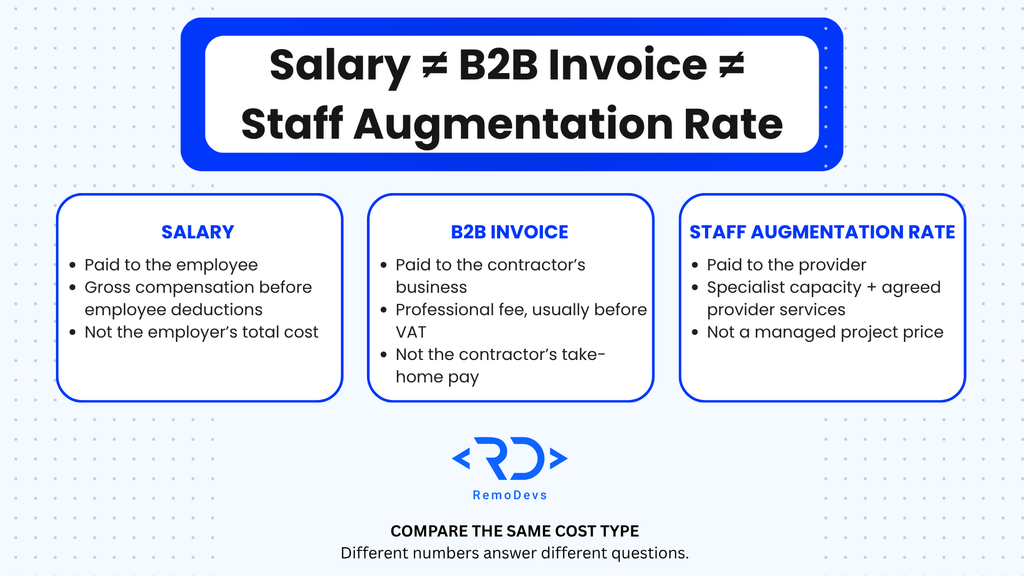
A useful budget therefore starts with the role, planned hours and quote structure, not one “average Poland rate.” It must also separate a developer’s salary, a direct B2B invoice and the rate charged by a Staff Augmentation provider. This guide explains those differences, converts rates into monthly scenarios and shows how to compare two proposals on equal commercial terms.
If you already know the role, seniority and duration, review our IT staff augmentation service in Poland for the delivery model and scope.
What Does IT Staff Augmentation Cost in Poland?
The best available public figures are budgeting references rather than a definitive Polish rate card.
| Public reference | Hourly band | Monthly equivalent at 152 hours | Important limitation |
|---|---|---|---|
| Poland Staff Augmentation companies on Clutch | $50–$99 | $7,600–$15,048 | Company-location band, not a role-specific average |
| CEE senior software developer | $55–$86 | $8,360–$13,072 | Regional provider benchmark |
| CEE data engineer | $75–$96 | $11,400–$14,592 | Regional specialist benchmark |
| CEE software architect | $50–$105 | $7,600–$15,960 | Wide range because role scope varies significantly |
The CEE role bands come from Accelerance’s software-development rate research, publicly reproduced in DistantJob’s 2026 rate guide. Accelerance says its 2026 global analysis draws on data from more than 100 firms across several regions.
The monthly amounts are simple calculations: hourly rate × 152 planned billable hours. They are not RemoDevs prices or official Polish averages. A real monthly invoice may be based on 144, 152 or 160 hours, a fixed number of working days or a monthly capacity fee. Before using any figure in a forecast, confirm the workload and what sits inside the rate.
Treat the bands as a reasonableness check, not a pass/fail test. A quote below them may reflect a different seniority level, narrower provider scope or a longer commitment. A quote above them may be justified by scarce expertise, part-time availability, demanding working hours or additional responsibilities. In either case, ask the provider to explain the difference in terms of the actual role and contract.
Salary, B2B Invoice and Staff Augmentation Rate Are Different
The easiest way to misread a Polish proposal is to compare it with the wrong cost category.
| Cost type | Who receives the payment? | What it may include | What it does not automatically include | Best use |
| Gross employee salary | Employee | Contractual gross pay | Employer contributions, benefits, equipment and recruitment | Comparing direct-hire compensation |
| Total employment cost | Employee, authorities and benefit providers | Salary, employer-side costs and chosen benefits | Recruitment, equipment and internal management unless added | Building an all-in employment budget |
| Direct B2B invoice | Contractor’s business | Professional service fee, usually before VAT | Contractor take-home pay or provider services | Budgeting a direct contractor relationship |
| Staff Augmentation provider rate | Provider | Specialist capacity and agreed provider responsibilities | Project ownership, delivery management or a fixed outcome unless stated | Buying external capacity managed by the client |
| Managed outsourcing price | Delivery vendor | Agreed engineering and delivery scope | A transparent per-person rate unless supplied | Buying vendor-managed delivery |
Just Join IT’s 2026 salary report explicitly labels employment figures as gross salary and B2B figures as net invoice amounts excluding VAT. For senior roles, it reports PLN 23,000 gross / PLN 26,880 B2B in Data and PLN 26,042 / PLN 30,240 in Architecture.
Those figures describe the underlying talent market. They are not provider prices. A Staff Augmentation invoice may also cover sourcing, coordination, administration, support, overhead and margin. Subtracting a B2B figure from a provider rate does not reveal pure profit because the two numbers may also use different hours, currencies, leave assumptions and contractual risk.
For a deeper compensation breakdown, see What Does a Senior Developer Actually Cost in Poland in 2026?.
What Determines a Staff Augmentation Rate in Poland?
1. Role, seniority and autonomy
A senior engineer executing defined work is different from a specialist expected to shape architecture, mentor others or make production decisions. Define the expected contribution instead of relying on the title alone.
2. Specialization and domain knowledge
A common backend stack usually has a broader market than a narrow combination of data-platform, security, cloud and regulated-industry experience. The rate reflects the complete requirement, not one technology keyword.
3. Capacity and engagement duration
A stable full-time engagement can be priced differently from a short assignment or partial allocation. Limited or irregular capacity may carry a higher effective rate because the remaining specialist time is harder to schedule.
4. Working model and time-zone overlap
Remote or on-site expectations, communication requirements and non-standard working hours affect availability. Extended overlap with North America may matter; ordinary English-language collaboration should not be treated as an unexplained premium.
5. Security and compliance requirements
Client-controlled hardware, certifications, checks, secure environments and sector-specific access rules can narrow the candidate pool or create additional provider work. The proposal should say who performs and pays for each requirement.
6. Provider scope and commercial terms
Rates can cover different levels of sourcing, screening, contracting, equipment, administration and ongoing support. Minimum commitments, notice periods, currency clauses, holiday treatment and replacement terms also change how commercial risk is divided.
Three Illustrative Monthly Cost Scenarios
These examples show the calculation, not what RemoDevs or every Polish provider charges. The assumed rates sit within the published CEE role bands above.
| Scenario | Illustrative rate | Planned capacity | Monthly calculation | What it represents |
| Senior Software Engineer | $65/hour | 152 hours | $9,880 | Full-time-equivalent capacity in a sample month |
| Senior Data Engineer | $82/hour | 152 hours | $12,464 | Full-time-equivalent specialist capacity |
| Solution Architect | $100/hour | 64 hours | $6,400 | Eight eight-hour days of architecture support |
The formula is straightforward:
client-facing rate × agreed billable time = base provider cost
The result still does not show whether hardware, licences, travel, overtime or onboarding sit inside the quoted rate. Partial allocations may also be priced differently from full-time capacity, so do not assume a perfectly linear conversion.
What Can Be Included in a Staff Augmentation Rate?
Providers may include:
- role calibration and sourcing;
- agreed candidate screening;
- interview and onboarding coordination;
- contracting and invoicing administration;
- ongoing account communication;
- agreed replacement support; and
- provider overhead and margin.
The package varies. Ask for a written list rather than assuming that the “Staff Augmentation” label includes a standard set of services.
At RemoDevs, our Staff Augmentation support currently covers role and requirement calibration, active sourcing, technical, business and team-fit screening, candidate and interview coordination, contractual and administrative support, onboarding coordination, ongoing communication and replacement support under the agreed terms.
What May Sit Outside the Quoted Rate?
Depending on the agreement, budget separately for:
- hardware and specialist software licences;
- travel or on-site work;
- overtime, on-call work or unusual working hours;
- additional security requirements or checks;
- client-side legal, procurement and security review;
- internal engineering management and onboarding;
- currency conversion or bank charges; and
- project-specific taxes or pass-through expenses.
Even an “all-inclusive” quote should define what that phrase covers.
Hourly vs Monthly Staff Augmentation Pricing
Hourly pricing
The client pays for approved billable time:
hourly rate × approved hours = monthly base cost
At $72 per hour, 144 hours cost $10,368, 152 hours cost $10,944 and 160 hours cost $11,520. The agreement should define time reporting, minimum capacity, public holidays, absences and approval of additional hours.
Monthly pricing
The client pays a fixed amount for an agreed allocation or availability. It can simplify forecasting, but “monthly” does not mean unlimited hours or identical capacity in every calendar month.
To compare it with an hourly quote, calculate:
monthly fee ÷ expected billable hours = effective hourly planning cost
Then confirm whether the fee changes during holidays or planned leave, whether unused capacity rolls over and how work above the allocation is billed.
How to Compare Two Staff Augmentation Quotes
Headline rates are comparable only after the underlying offers are normalized.
1. Use the same role
Match responsibilities, seniority, required experience, location, working hours and expected start. A general backend engineer and a payments specialist with production ownership are not the same unit.
2. Use the same workload and period
Convert both proposals to the same expected hours or days and the same contract length. This separates a real price difference from a different capacity assumption.
3. Add inclusions and exclusions
Account for equipment, licences, travel, setup charges, sourcing fees and other costs likely to appear outside the headline rate.
4. Compare commercial terms
Review minimum commitment, payment terms, currency, rate-review clauses, notice, replacement, conversion or buyout terms and early-termination costs.
5. Confirm delivery ownership
In Staff Augmentation, the client normally owns the backlog, daily management, engineering standards and delivery outcome. If a proposal also includes vendor-led delivery management or outcome responsibility, it is a different scope.
A normalized Quote A vs Quote B example
Assume the buyer expects 152 hours in the month.
| Item | Quote A | Quote B |
| Headline price | $68/hour | $10,800/month |
| Base cost for 152 hours | $10,336 | $10,800 |
| Equipment/licence charge | $250 | Included |
| Normalized monthly cost | $10,586 | $10,800 |
| Difference | $214 more than Quote A |
The original figures look difficult to compare. Once the same capacity and included costs are applied, the gap is only $214. The decision should then turn to the remaining differences: holiday treatment, minimum term, rate-change protection, screening scope, notice, replacement and delivery ownership.
Run the same calculation across the full committed period, not only one convenient month. A six-month forecast should account for different working-day counts, one-time setup charges, planned leave, possible indexation and the cost of ending the engagement early.
Also test a realistic lower-utilization month. A fixed monthly fee may become more expensive per productive hour when client demand drops, while an hourly model may provide more flexibility but less budget certainty.
Poland Staff Augmentation vs Hiring Directly
Staff Augmentation is not automatically cheaper than hiring an employee. Direct employment can produce a lower long-term cost for stable, permanent core headcount. The company accepts the recruitment process, employer obligations, benefits, equipment and longer-term commitment in return for building its own organization.
Staff Augmentation can make more economic sense when the business needs capacity for a defined period, access to a difficult specialist or flexibility without adding permanent headcount immediately. The provider rate may be higher than the specialist’s salary or direct B2B invoice because it buys a different commercial setup.
Compare both options over the same period. For direct hiring, include compensation, employer costs, benefits, recruitment, equipment, onboarding and internal management. For Staff Augmentation, include the provider invoice, excluded expenses and the client time required to direct the specialist.
Timing also has economic value. If an unfilled specialist gap delays a migration, launch or security initiative, the relevant comparison is not limited to payroll. Conversely, speed and flexibility should not become blanket reasons to keep a permanent role external indefinitely.
The answer often changes with duration: a six-month platform migration and a permanent backend role should not default to the same model. For deeper comparisons, see Poland vs US Developer Costs in 2026 and the RemoDevs guide to senior developer costs in Poland.
Poland vs Other Staff Augmentation Locations
A country comparison is useful only when both sides describe the same purchase. Match the role, seniority, client-managed engagement model, expected hours, time-zone requirements, provider inclusions and commercial terms.
Poland can sit above lower-cost markets for some roles and below Western European or US alternatives. That does not make every Polish quote expensive or inexpensive. A scarce specialist with extensive provider support may cost more than a standard engineer in another country, while a superficially cheaper offer may exclude equipment or administration.
Time-zone overlap should also be priced consistently. A standard Poland-based working day may align closely with European teams but provide only partial overlap with North America. If one proposal includes extended hours and another assumes ordinary local hours, the location comparison is not like for like.
Use geography after normalizing the service, not before. For the broader evidence and country-level limitations, see Eastern Europe IT Outsourcing Rates 2026.
When Is Staff Augmentation Worth the Cost?
Strong fit
- A project has a temporary capacity gap.
- The team needs specialist expertise it cannot justify hiring permanently yet.
- An internal engineering or product leader can direct the work.
- Requirements will evolve inside the client’s existing tools and process.
- The business values flexibility more than the lowest long-term employment cost.
Probably not the right model
- The company wants the vendor to own the project or contracted outcome.
- Nobody internally can manage priorities, architecture and acceptance.
- The role is clearly permanent core headcount.
- A complete managed delivery team is required rather than additional capacity.
The additional cost of the Staff Augmentation model can be rational for a defined specialist need. It is harder to justify indefinitely for a role that should sit permanently inside the company. For the operating-model decision, read A Buyer’s Guide to the Staff Augmentation Model in Poland.
Questions to Ask Before Accepting a Staff Augmentation Quote
- What responsibilities and outcomes define the role?
- How many hours or working days does the price assume?
- Which sourcing, screening, administration and support services are included?
- Which expenses can be billed separately?
- How are holidays, absences, overtime and unused capacity treated?
- Can the rate change during the engagement?
- What are the minimum term, notice and early-termination conditions?
- How do replacement and handover work?
- Are there conversion or direct-hire fees?
- Who owns daily management, technical decisions and delivery acceptance?
If a provider cannot answer these questions clearly, the lower headline rate is not yet the lower-cost offer.
FAQ
How much does Staff Augmentation cost in Poland in 2026?
Clutch places Poland-based Staff Augmentation companies in a broad $50–$99 hourly band. Wider CEE benchmarks put senior developers at $55–$86, data engineers at $75–$96 and software architects at $50–$105 per hour. These are planning references, not official Polish averages or RemoDevs prices.
What does a Staff Augmentation rate include?
It may include specialist capacity, sourcing, agreed screening, contracting, administration, onboarding coordination, account support and replacement terms. Hardware, licences, travel, overtime and client-side management may sit outside the rate. The proposal should list both inclusions and exclusions.
Is Staff Augmentation cheaper than hiring directly?
Sometimes, but not automatically. Direct hiring may be more economical for stable, permanent headcount. Staff Augmentation can offer better value for temporary capacity, scarce expertise and flexibility. Compare total cost over the same period rather than comparing salary with a provider invoice.
How is Staff Augmentation priced?
Common structures include hourly billing, day rates and fixed monthly capacity. Convert different models to the same expected workload and period, then account for exclusions, holidays, minimum commitment, notice and possible rate changes.
What is the difference between Staff Augmentation and outsourcing?
In Staff Augmentation, the client normally manages the specialist and remains responsible for delivery. In managed project outsourcing, the vendor may manage the team and own an agreed scope or outcome. The price may therefore include project management, QA and delivery risk.
Is Poland a good Staff Augmentation location?
Poland can be a practical market for senior Data, AI, Security, Java, Python and architecture expertise, particularly for European working-hour overlap. It is not automatically the cheapest option, and location does not guarantee fit. Evaluate the individual specialist, provider scope and contract.
Build the Budget Around the Role
Start with the specialist’s expected contribution, planned capacity and engagement length. Confirm what the provider includes, add the costs outside the rate and compare commercial terms on the same basis.
If those inputs are already defined, talk to RemoDevs about a realistic Staff Augmentation setup in Poland.
Visit us
Find a moment in your calendar and come to our office for a delicious coffee
Make an apointment