
Hiring a Python developer starts with a more important question: what engineering problem will this person own?
A backend engineer building FastAPI services, a data engineer working with Spark and a machine learning engineer deploying models may all use Python every day. They are not interchangeable roles, and searching for a generic “Senior Python Developer” can attract the wrong candidates.
This guide explains how to define, budget and assess a Python engineering role in Poland. It also separates direct recruitment, B2B cooperation, Employer of Record arrangements, Staff Augmentation and project outsourcing.
Quick answer: hiring Python developers in Poland
Before starting the search, define five things:
- The role: backend, data, AI/ML, automation, platform or genuine full-stack engineering.
- The outcomes: what the engineer should build, improve or own.
- The technical context: architecture, data volumes, infrastructure, reliability and domain constraints.
- The compensation basis: UoP gross salary, B2B invoice excluding VAT or provider rate.
- The engagement model: direct hire, independent B2B cooperation, EOR, Staff Augmentation or outsourced delivery.
Python represented 5.67% of advertisements in Just Join IT’s 2025 Job Offer Statistics. That shows meaningful activity in the platform’s Python category, but it is not a count of all Python jobs or developers in Poland.
Global evidence points in the same general direction without proving Polish demand. The 2025 Stack Overflow Developer Survey reported that Python adoption among respondents increased by seven percentage points from the previous year and associated its use with backend development, data science and AI.
The practical implication is not simply that Python is popular. It is that the label covers several distinct candidate markets.
What does a Python developer in Poland cost in 2026?
There is no single reliable national average for a narrowly defined Python engineer role. Public data mixes different responsibilities, seniority levels, contract types and technical specialisations.
A useful budget therefore needs two layers:
- A broad benchmark from a large historical job-advertisement dataset.
- A current snapshot of comparable vacancies for the role being opened.
Python salary benchmarks from the 2025 job market
Just Join IT’s 2026 report analysed advertisements published during 2025. For each offer, it calculated the midpoint of the advertised range and then reported the median midpoint for each seniority and contract category.
| Seniority | UoP gross salary per month | B2B net invoice per month, excluding VAT |
|---|---|---|
| Junior | PLN 8,750 | PLN 9,750 |
| Mid-level | PLN 17,000 | PLN 19,740 |
| Senior | PLN 23,488 | PLN 25,500 |
Source: Just Join IT, Salaries in Category Python.
These figures describe advertised compensation in one job-board category. They are not guaranteed 2026 salaries, candidate take-home pay or total employer cost.
A B2B “net” amount is the value of the contractor’s invoice before VAT. It is not personal net income after tax, social insurance, accounting, unpaid time off and other business costs. UoP figures are gross employee salaries and do not include the employer’s entire cost.
The broad benchmarks are useful for initial planning, but a specialised AI engineer or senior backend architect may compete in a different part of the market from a standard Python application developer.
What current Python vacancies are offering
On 10 September 2026, 33 current full-time vacancies were reviewed in the Just Join IT Python category. Each included offer:
- was accessible to candidates based in Poland;
- treated Python as a central technology;
- disclosed compensation;
- stated a recognisable role and seniority;
- used a clear UoP or B2B compensation basis.
Duplicate location postings, part-time roles, tutoring positions, mixed-contract ranges and offers with visibly incorrect units were removed.
The table below covers the 21 most comparable B2B vacancies. “Median offer endpoints” means that the median lower bound and median upper bound were calculated separately. It is not a national average or a prediction of the final accepted rate.
| Comparable profile | Offers | Median advertised endpoints | Full observed span | Basis |
|---|---|---|---|---|
| Mid Python, backend or Python-led full-stack engineer | 6 | PLN 90–105/hour | PLN 70–150/hour | B2B invoice excluding VAT |
| Senior Python, backend or Python-led full-stack engineer | 7 | PLN 140–180/hour | PLN 120–260/hour | B2B invoice excluding VAT |
| Senior Python, backend or Python-led full-stack engineer | 8 | PLN 26,000–32,500/month | PLN 20,000–46,459/month | B2B invoice excluding VAT |
Source and research input: current Python vacancies on Just Join IT, checked 10 September 2026.
The wider spans matter. The top end appeared in roles involving areas such as large-scale systems, AI infrastructure, architectural responsibility, cloud security or specialist data workloads. Those offers should not be treated as the normal price for every Senior Python Developer.
Python-heavy data, AI, platform and robotics roles were also present, but their responsibilities and rate units varied too much to combine into one useful band. The three qualifying UoP offers were insufficient for a separate current employment-salary calculation.
What moves the budget?
The main variables are:
- role type and technical specialisation;
- genuine seniority and decision-making responsibility;
- architecture and system-design ownership;
- production scale, performance and reliability requirements;
- cloud, deployment, observability and incident-response responsibilities;
- regulated-industry or domain experience;
- remote, hybrid or office requirements;
- employment or engagement model;
- required working-hour overlap and stakeholder communication.
The salary or contractor invoice is also not the complete hiring budget. Depending on the model, the company may need to account for employer contributions, benefits, equipment, legal review, EOR fees, recruitment fees, provider margins and internal interview time.
A Staff Augmentation rate must not be compared directly with a candidate’s salary or B2B invoice. The provider price may cover additional contractual, administrative and engagement responsibilities.
For broader context, see the RemoDevs 2026 Polish IT Market Report.
What kind of Python engineer do you actually need?
“Python Developer” is too broad for a useful hiring brief. Start with the systems and outcomes the person will own.
| Profile | Typical work | What to verify |
|---|---|---|
| Backend Python Engineer | APIs, application logic, integrations, background processing and distributed services | Django, Flask or FastAPI where relevant; API design; SQL; data modelling; caching; queues; testing; observability; production debugging |
| Data Engineer using Python | Batch and streaming pipelines, data transformation, orchestration and platform integration | Python and SQL depth; data modelling; Spark or another processing framework; orchestration; schema evolution; data quality; cloud platform experience |
| ML/AI Engineer | Model integration, inference services, ML pipelines, evaluation, deployment and monitoring | Production Python; ML fundamentals appropriate to the role; model evaluation; APIs; data pipelines; deployment; monitoring; cost and latency trade-offs |
| Automation or Platform Engineer | Internal tools, infrastructure automation, testing systems and operational workflows | Python scripting at production quality; APIs; Linux; CI/CD; cloud tooling; error handling; permissions; maintainability |
| Python-led Full-stack Engineer | Backend ownership plus meaningful frontend delivery | Python backend depth and the specific frontend framework required; do not add JavaScript merely because the product has a user interface |
A backend engineer does not automatically need Spark. A data engineer does not automatically need Django. An ML engineer who integrates existing models may not need the same mathematical depth as a research-oriented specialist.
The job description should distinguish required experience from skills that can be learned after joining.
Define the engineering problem before listing frameworks
Instead of starting with a long technology list, describe:
- the service, platform or pipeline being built;
- current architecture and technical debt;
- expected traffic or data volume;
- databases, queues and external integrations;
- reliability, security and performance requirements;
- deployment and infrastructure ownership;
- decisions the person will make independently;
- the expected results during the first months.
This gives candidates enough context to judge whether their experience is relevant. It also prevents a team from rejecting a strong Django engineer because the CV does not list every library used in the current codebase.
For a broader technology-neutral view, see the backend developer hiring guide.
Skills to look for when hiring a Python developer
Some capabilities apply across most production Python roles, but their required depth changes with seniority.
Python engineering fundamentals
Look for evidence that the candidate can:
- organise code into understandable modules and boundaries;
- choose appropriate data structures and language features;
- manage dependencies and development environments;
- use typing where it improves reliability and maintainability;
- handle errors and failure states deliberately;
- write useful automated tests;
- review and improve existing code;
- diagnose production behaviour using logs, metrics and traces;
- explain performance or concurrency limitations relevant to the system;
- work safely with credentials, permissions and sensitive data.
Avoid turning these areas into a trivia quiz. Knowing an obscure language detail from memory is not the same as designing, operating and improving production software.
Role-specific skills
| Area | Backend | Data engineering | ML/AI | Automation/platform |
|---|---|---|---|---|
| Application frameworks | Django, Flask or FastAPI where relevant | Usually secondary | API framework for model services where relevant | Task-specific libraries and internal tooling |
| Data | SQL, transactions, indexing and schema design | SQL, modelling, pipelines, lineage and data quality | Training or inference data, evaluation datasets and feature pipelines | Configuration, operational data and system APIs |
| Concurrency | Async I/O, workers, queues and failure handling | Parallel processing and distributed workloads | Batch or online inference patterns | Parallel jobs, retries and idempotency |
| Infrastructure | Containers, cloud deployment and observability as required | Data platforms, orchestration and storage | Model serving, MLOps and monitoring | Linux, CI/CD, cloud automation and permissions |
| Testing | Unit, integration, API and contract tests | Pipeline, schema and data-quality tests | Evaluation, regression and service tests | Safe execution, rollback and integration tests |
The candidate does not need to own every layer personally. The important question is where their responsibility ends and where another team takes over.
How to assess a Python engineer
A useful assessment resembles the actual job. For senior candidates, previous production decisions usually reveal more than a large set of syntax questions.
1. Screen against the real brief
Confirm:
- the kind of Python systems the candidate has worked on;
- what they personally designed, changed or operated;
- scale and reliability constraints;
- production and incident responsibility;
- role seniority and decision-making scope;
- contract, location and availability expectations;
- communication requirements for the team.
Recruiter screening can establish relevance, motivation and practical fit. It should not be presented as a replacement for technical validation by the client’s engineering team.
2. Use evidence from previous work
Useful prompts include:
- Tell us about a Python service you designed or significantly changed.
- Which parts of the system did you personally own?
- What production problem were you responsible for diagnosing?
- What evidence helped you find the cause?
- What trade-off did you make, and why?
- What would you change if you rebuilt the system today?
- How did you test the riskiest part of the change?
A strong answer should distinguish personal responsibility from the work of the wider team.
3. Make the technical exercise relevant
A short code-review or design task is usually more useful than a large unpaid project.
For a backend role, the exercise might cover an API change, database interaction, background processing and failure handling. For a data engineer, it might involve late-arriving records, idempotency or schema evolution. For an ML engineer, it could examine an inference service, evaluation approach or monitoring plan.
Ask candidates to explain assumptions and alternatives. The reasoning is often more informative than whether they reproduce the interviewer’s preferred implementation.
4. Test production judgement
Discuss what happens when:
- traffic increases substantially;
- a dependency becomes slow or unavailable;
- a queue starts accumulating messages;
- a database query degrades;
- data arrives twice or out of order;
- a model’s output quality changes;
- a deployment must be rolled back;
- an incident occurs outside normal working hours.
Only assess scenarios relevant to the actual role. A standard application developer does not need to answer staff-level distributed-systems questions unless that responsibility is part of the job.
5. Use a shared scorecard
Before interviews begin, agree on:
- required evidence;
- acceptable gaps;
- who assesses each area;
- how interviewers record their conclusions;
- what would justify rejecting or progressing a candidate.
Separate “demonstrated”, “not demonstrated” and “not assessed”. This reduces the risk of confident interview style being mistaken for technical depth.
How to hire Python developers in Poland
1. Define responsibilities and outcomes
Describe what the engineer will own rather than opening with a list of frameworks.
2. Calibrate seniority
Decide whether the role requires independent feature delivery, production ownership, architecture decisions, technical leadership or mentoring. Years of experience alone do not establish seniority.
3. Choose the engagement model
Confirm who will contract with the specialist, who manages delivery and who handles employment or administrative responsibilities.
4. Validate the compensation range
Use current vacancy data, recent candidate conversations and broader salary reports. Keep UoP salary, B2B invoices and provider rates separate.
5. Prepare the market-facing brief
State the role, outcomes, range, contract options, work arrangement, interview stages and required language level clearly.
6. Source candidates
Combine direct outreach, referrals, specialist job boards, professional communities and inbound applications. A job advertisement alone may not reach relevant people who are not actively applying.
7. Conduct recruiter screening
Check relevant experience, motivation, expectations, availability, communication and the practical fit with the agreed brief.
8. Run technical validation
The client’s technical team should own the final role-specific assessment unless a separate technical-assessment service has been explicitly agreed.
9. Make the decision and prepare onboarding
Give timely feedback, prepare the intended agreement early and define initial ownership, access, documentation and success expectations.
Where to find Python developers in Poland
Useful channels include:
- Poland-focused technology job boards;
- direct sourcing through professional networks;
- referrals from engineers and industry contacts;
- Python, Django, data and AI communities;
- local technology events and meetups;
- university networks for junior or graduate hiring;
- specialist recruitment partners.
Choose the channel around the profile. A general Python advertisement may work for a mid-level application role, while a search combining FastAPI, high-scale infrastructure and a specialised business domain will usually require more targeted outreach.
A nationwide remote search can cover candidates outside Warsaw, Kraków and Wrocław. A strict office requirement narrows the addressable market and should be disclosed before sourcing begins.
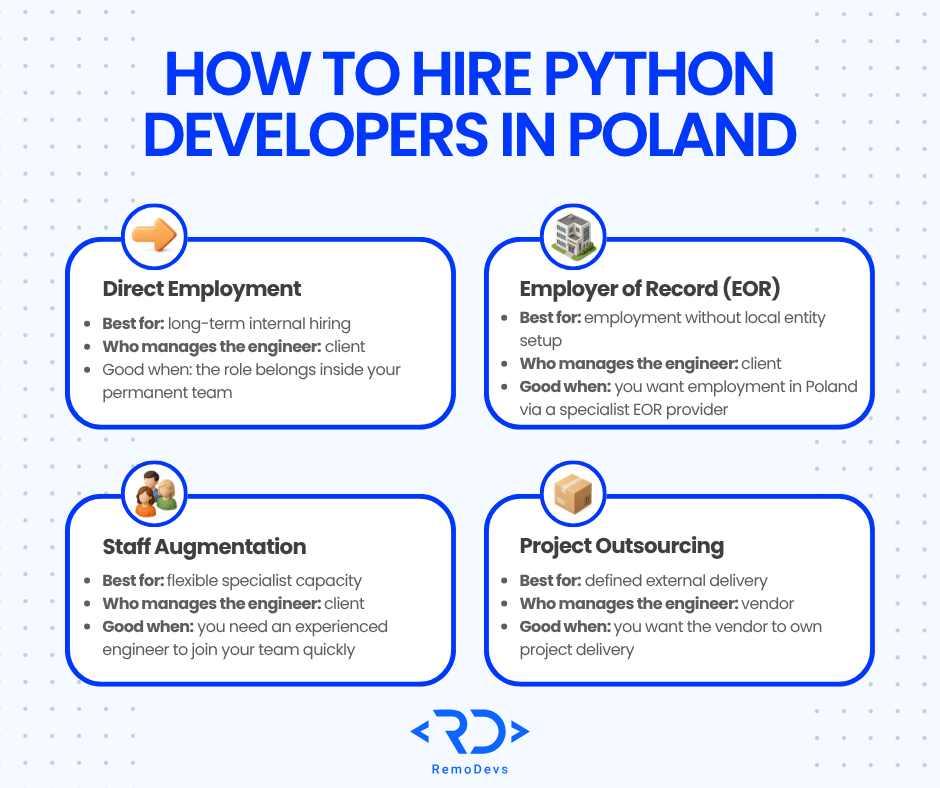
Direct hire, B2B, EOR or Staff Augmentation?
| Model | Relationship and delivery setup | Usually fits when |
|---|---|---|
| Direct employment | The developer becomes the client’s employee. The employer handles the applicable Polish employment, payroll and social-security responsibilities. | The role belongs in the long-term internal team and the company has a suitable employment setup. |
| Direct B2B cooperation | An independent Polish business provides services under a commercial agreement. The operating model must support genuine independence. | The work is legitimately business-to-business after appropriate legal and tax review. |
| Employer of Record | A specialist EOR is the legal employer and handles the employer-side administration covered by its agreement. The client directs the work within that structure. | The company wants employment in Poland but lacks the required local setup. |
| Staff Augmentation | A specialist joins the client’s existing team through a provider. The client owns priorities, technical direction and day-to-day delivery. | The team needs additional capacity or specialist expertise without outsourcing the entire project. |
| Project outsourcing | A software vendor manages delivery of an agreed project, workstream or outcome. | The client wants an external company to take responsibility for defined delivery. |
A recruitment agency can find candidates for a direct UoP or B2B relationship, but recruitment alone does not make the agency the employer, payroll provider or EOR.
B2B should not be treated as a label that automatically removes employment, tax or intellectual-property considerations. The Polish State Labour Inspection explains that the contract’s name is not decisive when the real working relationship has the characteristics of employment.
Companies should confirm the chosen arrangement with appropriate Polish legal and tax professionals.
For a broader comparison, see Hire Software Developers in Poland: 2026 Guide.
Common mistakes when hiring Python engineers
Hiring for “Python” rather than a role
A generic brief attracts candidates from several different disciplines. Define whether the work is backend, data, AI/ML, automation or full-stack.
Treating years of experience as seniority
Tenure does not prove architecture ownership, production judgement or the ability to lead difficult decisions. Assess evidence from comparable work.
Requiring every Python framework
Listing Django, Flask, FastAPI, Spark, Kubernetes, TensorFlow and several clouds as mandatory can signal that the role has not been defined. Prioritise the capabilities needed for the actual system.
Using trivia-heavy assessments
Language puzzles can filter for interview preparation rather than job performance. Use code review, debugging, design and production scenarios relevant to the position.
Confusing recruiter screening with technical validation
Recruiters can check experience, communication, motivation and alignment with the brief. The client’s engineering team should still validate role-specific technical depth unless another arrangement is explicitly agreed.
Mixing salary and provider pricing
An employee’s gross salary, a contractor’s invoice and a Staff Augmentation rate represent different cost structures. Label every figure clearly.
Changing the work model during the search
Switching from remote to office-based work, or from UoP to B2B, changes the candidate market. Settle those decisions before outreach begins.
Running a slow, unclear process
Explain the stages in advance, assign decision owners and provide feedback quickly. Additional interviews should have a defined purpose.
Hiring a Python engineer in Poland with RemoDevs
RemoDevs supports international companies through IT Recruitment in Poland and IT Staff Augmentation in Poland.
For direct recruitment, RemoDevs can help calibrate the role, source candidates across Poland, conduct recruiter screening, present relevant profiles and coordinate interviews and the offer process. The client retains the final hiring decision and technical validation.
For selected senior Python requirements, Staff Augmentation is also available. The specialist joins the client’s existing team, while the client keeps control of priorities, technical direction and day-to-day delivery. RemoDevs supports sourcing, screening, candidate presentation, interview coordination, onboarding coordination and the contractual or administrative scope agreed for the engagement.
Share the role type, seniority, technical context, compensation range and preferred engagement model to calibrate the requirement against the current Polish market.
FAQ
How much does a Python developer earn in Poland?
In Just Join IT’s dataset of advertisements published during 2025, median advertised compensation for Python roles ranged from PLN 8,750 gross per month on UoP for juniors to PLN 25,500 per month as a senior B2B invoice excluding VAT.
In the September 2026 live snapshot, comparable senior B2B offers had median advertised endpoints of PLN 140–180 per hour or PLN 26,000–32,500 per month. These are different compensation bases and should not be treated as universal rates.
Is it difficult to hire Senior Python developers in Poland?
Difficulty depends on the role, compensation, location, domain and required production responsibility. A general application role and an engineer combining Python, AI infrastructure, cloud architecture and regulated-industry experience belong to different candidate markets.
What skills should a Senior Python developer have?
A senior candidate should demonstrate production-level Python, maintainable design, testing, debugging and sound technical judgement. Additional requirements depend on the role: APIs and databases for backend work, distributed processing for data engineering or deployment and evaluation for ML/AI.
Should I hire a Python developer on UoP or B2B?
Choose UoP when the relationship is employment and the company has an appropriate employment structure. Consider B2B only where the relationship is genuinely independent and the agreement and operating model have been reviewed appropriately.
Can an international company hire Python developers remotely from Poland?
Yes. Depending on its setup and the intended relationship, the company may use direct employment, genuine B2B cooperation, an EOR through a specialist provider or Staff Augmentation. Legal, tax, IP and administrative responsibilities should be confirmed for the selected model.
Does RemoDevs provide Python developers through Staff Augmentation?
Yes, for selected senior Python requirements. The client chooses the specialist and manages daily delivery, while RemoDevs supports the engagement within the scope agreed with the client.
Visit us
Find a moment in your calendar and come to our office for a delicious coffee
Make an apointment