
Hiring a backend developer in Poland starts with defining what the engineer will own, setting a realistic budget and choosing an engagement model with clear contractual and delivery responsibilities. The language or framework is only part of the brief.
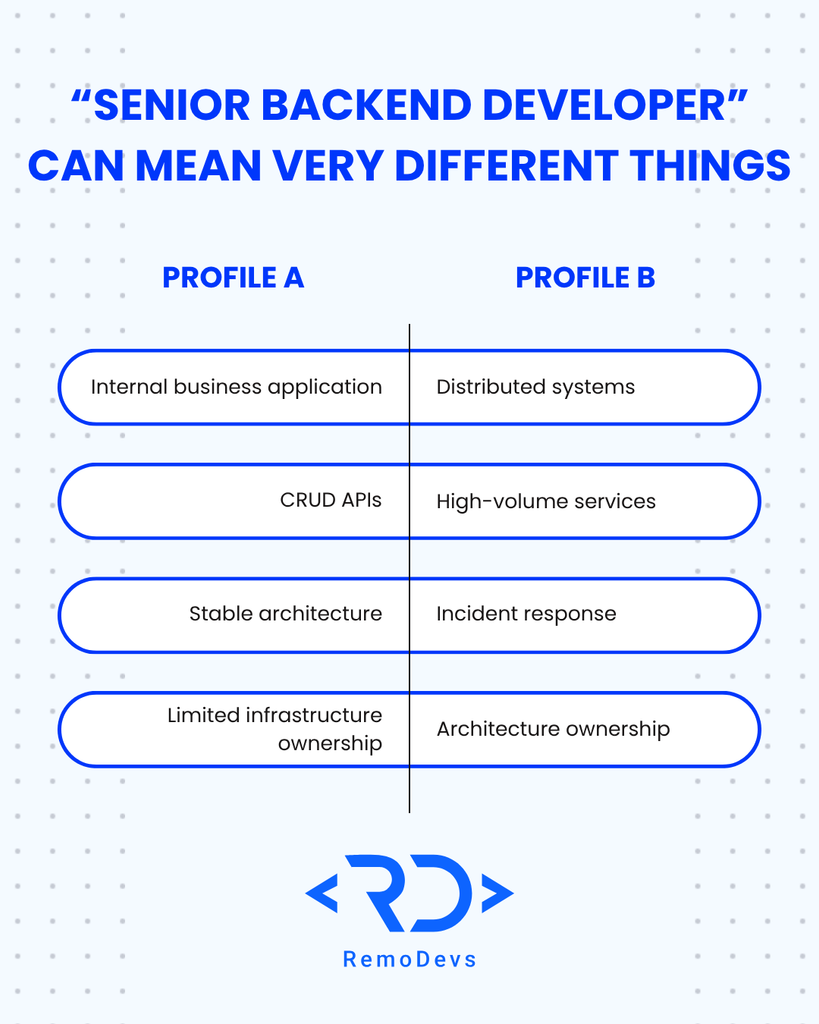
Poland has backend communities across several technology hubs and supports different contract models. The search still needs to be role-specific: an engineer who has built high-volume, event-driven services is not interchangeable with somebody whose experience is mainly maintaining internal CRUD applications, even if both CVs list the same language.
This guide explains how to define, budget and assess a backend role in Poland while keeping recruitment, staff augmentation, an Employer of Record and software outsourcing separate.
Quick answer: hiring backend developers in Poland
Before starting the search, settle four points:
- The work: what the developer must improve, build or own during the initial period.
- The profile: stack, system context, seniority, domain knowledge and level of architectural responsibility.
- The budget: a range stated in PLN and labelled as employment salary, B2B invoice or provider rate.
- The model: direct employment, genuine B2B cooperation, EOR, staff augmentation or managed outsourcing.
In No Fluff Jobs’ 2025 dataset, Backend was the largest category, representing 20.1% of listings. This confirms substantial hiring activity on that platform. It does not measure Poland’s total backend talent pool, candidate quality or how easy a particular role will be to fill.
Why companies hire backend developers in Poland
A nationwide search can cover Warsaw, Kraków, Wrocław, Poznań, the Tricity, Silesia and candidates based elsewhere in Poland. Remote and flexible hybrid roles are not limited to one local hub. Poland’s CET/CEST working day also fits European teams and provides partial overlap with North America.
The market includes established enterprise ecosystems and product-focused stacks. Just Join IT’s report based on more than 110,000 advertisements published in 2025 recorded significant listing volume in Java, JavaScript, Python and .NET. Go and Scala were smaller and more heavily weighted towards experienced candidates. These job-market statistics describe activity on one platform, but they help employers see which technology searches may be broad and which need tighter market validation.
Companies can also choose between direct employment, genuine B2B cooperation, EOR and staff augmentation, depending on the relationship they need. English, technical depth and product judgement still have to be assessed candidate by candidate.
What backend developer do you actually need?
A backend developer may own application logic, APIs, data access, integrations, background processing and parts of production reliability. The hiring brief should specify which of these responsibilities actually belong to the role.
| Profile | Often relevant when you need | What to verify beyond the language |
|---|---|---|
| Java / Spring | Enterprise platforms, payments, high-throughput services or long-lived systems | JVM performance, Spring ecosystem, concurrency, messaging, testing and migration experience |
| Python / Django / FastAPI | Web products, internal platforms, automation or services close to data and AI workloads | Production API design, typing, async work, performance limits, observability and clear separation from data-science experience |
| Node.js / TypeScript | Product APIs, real-time applications or teams using TypeScript across the stack | Event-loop behaviour, concurrency, queues, runtime failure modes and production ownership—not only frontend JavaScript |
| .NET / C# | Microsoft ecosystems, enterprise applications and Azure-based platforms | Modern .NET, legacy-modernisation context, cloud design, data access, testing and distributed-system experience |
| PHP / Laravel / Symfony | SaaS, commerce, publishing platforms or modernisation of established PHP products | Framework depth, codebase quality, upgrade history, security, testing and ability to work beyond legacy maintenance |
| Go or backend/platform engineering | Networked services, infrastructure products, concurrency-heavy systems or cloud-native platforms | Distributed systems, protocols, performance, failure handling and operational responsibility |
Technology is only the first filter. The brief should also cover:
- expected traffic, data volume and reliability targets;
- current architecture, data stores, messaging and integration patterns;
- cloud, deployment, observability and infrastructure ownership;
- API, security, regulatory and on-call requirements;
- decisions the person can make without escalation;
- required stakeholder and English communication.
If the work involves redesigning service boundaries, leading incident reviews and setting reliability standards, the search may be for a staff or platform engineer rather than a standard senior backend developer. A stable business application, on the other hand, may not require deep distributed-systems experience. Adding fashionable architecture requirements to every brief can exclude capable candidates without improving the hire.
It is also worth defining the boundary with adjacent roles. Some backend engineers own deployment pipelines, Kubernetes and infrastructure as code; others collaborate with a separate platform team. Python roles may include data pipelines, while product backend roles may only consume them. Candidates need to know which side of that boundary they will own.
Backend developer salary and hiring cost in Poland in 2026
One backend average is a weak basis for an offer. The same technology label can cover a mid-level API developer, a senior engineer responsible for a distributed platform or a specialist working in a regulated environment. Contract type also changes what the headline figure means.
What current backend vacancies are actually offering
To compare broad market benchmarks with live hiring budgets, we reviewed 18 current backend vacancies available to candidates in Poland on Just Join IT and No Fluff Jobs. Every role disclosed compensation and contract type, had identifiable seniority and was centred on backend engineering. Duplicate postings of the same role were excluded.
Market snapshot reviewed: September 8, 2026.
The table aggregates the advertised ranges; it does not expose individual employers or offers. “Typical observed band” describes the central cluster in this small sample, not a calculated national average. The broader span shows how far current offers in that group extended without treating an outlier as the headline rate.
| Backend profile in the reviewed sample | Typical observed advertised band | Broader observed span | Compensation basis |
|---|---|---|---|
| Senior Java / JVM backend | PLN 130–170/hour | PLN 110–190/hour | B2B net invoice, excluding VAT |
| Senior .NET backend | PLN 20,000–30,000/month | PLN 19,000–34,000/month | B2B net invoice, excluding VAT |
| Senior Go backend | PLN 22,000–32,000/month | PLN 18,000–34,000/month | B2B net invoice, excluding VAT |
| Mid-to-senior backend, across stacks | PLN 15,000–26,000/month | PLN 13,000–44,000/month | UoP gross salary |
The employment-contract subset was smaller, so splitting it further by technology would imply more confidence than the sample supports. Python, Node.js and PHP also appeared in the review, but there were too few comparable, current vacancies in the same units to publish a useful technology-specific band.
For B2B roles, the amount is the contractor’s invoice before income tax, social insurance, accounting, time off and other business costs. UoP figures are gross employee salaries, not total employer cost. Hourly B2B rates have been left hourly because converting them would require an assumption about billable hours, holidays and time off.
This snapshot is deliberately narrow. It reflects advertised budgets in current vacancies, not every backend job in Poland or the final amount accepted by a candidate.
How this compares with the wider Polish IT market
The RemoDevs 2026 Polish IT Market Report gives a broader reference point. Using Just Join IT advertisements published in 2025, it reports senior medians of PLN 21,573 gross per month on UoP and PLN 24,780 per month as a B2B net invoice excluding VAT.
These are senior IT-market benchmarks, not backend-only salaries. They are also based on the same Just Join IT advertised-compensation dataset described in the platform’s methodology, so the two publications should not be treated as independent corroborating sources.
The current backend sample overlaps with those broader medians, but real vacancies also sit materially below and above them. In the reviewed offers, the upper end was associated with requirements such as architectural ownership, distributed or low-latency systems, application security and specialist domain experience.
What moves a backend offer above or below the benchmark?
The main drivers are seniority, architectural scope, system scale, stack scarcity, domain requirements, on-call expectations and the work model. A role with production ownership across cloud infrastructure, observability and incident response will usually compete in a different part of the market from a role focused on feature delivery in an established application.
Office requirements and communication scope matter as well. A nationwide remote search has a different addressable market from a role requiring several days a week in one city, while a staff-level engineer working directly with international product leaders carries broader expectations than a standard senior individual contributor.
The full hiring budget may also include employer contributions, payroll, benefits, equipment, provider fees, legal review and internal hiring time. None of the figures above is an EOR invoice, recruitment fee, outsourcing quote or staff augmentation price.
UoP, B2B, EOR or staff augmentation?
Choose the model after deciding what relationship and delivery setup the company needs.
| Model | Relationship and delivery | Usually fits when |
|---|---|---|
| Direct hire on UoP | The developer is the client’s employee. The employer handles the applicable Polish employment, payroll and social-security obligations. | The role belongs in the long-term core team and the company has a suitable employment setup. |
| Direct B2B cooperation | An independent Polish business provides services to the client and invoices under a commercial agreement. The real working relationship must support genuine independence. | The work and operating model are genuinely business-to-business, after appropriate legal and tax review. |
| Employer of Record | The EOR is the local legal employer and provides the employer-side administration defined in its agreement; the client directs the work within that structure. | The company wants employment in Poland but does not have the required local setup. |
| Staff augmentation | The specialist joins the client’s team through a provider for an agreed period. The client normally owns the backlog, priorities and day-to-day delivery. | The team needs temporary capacity or a particular capability without outsourcing the whole project. |
| Managed software outsourcing | A software vendor manages a team and accepts responsibility for an agreed scope, deliverable or outcome. | The client wants to buy project delivery, not add one person to its engineering workflow. |
A recruitment agency can support direct UoP and B2B searches, but its responsibilities depend on the agreement. Recruitment alone does not make the agency the employer, EOR, payroll provider or contracting intermediary, and it does not settle IP ownership.
For the legal and operational distinctions, see RemoDevs’ B2B vs employment contract guide and its broader guide to hiring software developers in Poland. This article is general hiring information, not legal or tax advice.
How to assess a backend developer
Use evidence that resembles the job. A generic algorithm test may show coding fluency, but it says little about production incidents, data modelling or architecture decisions.
The evaluation should cover:
- Production relevance: Ask what the candidate personally owned, at what scale and under which constraints.
- Architecture and data design: Use a realistic system change to discuss trade-offs, schema evolution, transactions, APIs and migration risk.
- Debugging and reliability: Work through an incident involving latency, failed messages or database contention. Look for a structured investigation, useful evidence and a safe recovery plan.
- Code quality and security: A small coding or review exercise can cover testing, deployment safety, permissions and maintainability without becoming a generic exam.
- Communication and ownership: Check whether the candidate identifies missing context, explains uncertainty and works through disagreement constructively.
Adjust the discussion to the role. For a Node.js engineer joining a real-time product, ask about backpressure, queues and failure under concurrency. For a Java engineer modernising a monolith, explore dependency boundaries, incremental migration and rollback. For a Python API role, distinguish production engineering from experience limited to notebooks or scripts.
A structured scorecard keeps interviewers focused on the same evidence. Record what was demonstrated, what remains unverified and which gaps are acceptable.
How to hire a backend developer in Poland
- Define the work. Describe the product, architecture, constraints and expected outcomes.
- Set the profile. Agree on seniority, stack, domain knowledge, ownership and communication requirements.
- Choose the engagement model. Confirm the contractual chain, payment, administration and delivery responsibilities.
- Validate the budget. Compare job-ad data with recent candidate conversations, keeping UoP, B2B and provider pricing separate.
- Source the market. Use job boards, direct outreach, referrals and specialist communities. State the range, work model and interview stages clearly.
- Screen against the brief. Check relevant experience, motivation, expectations, availability and practical fit.
- Run a role-specific technical evaluation. Involve engineers who understand the system and the decisions the new hire will face.
- Prepare the offer and onboarding. Keep feedback moving, prepare the agreement early and define the first outcomes.
Before interviews begin, agree who assesses each criterion and how quickly feedback will be recorded. This avoids adding stages because an earlier conversation did not have a clear purpose.
Hiring directly vs using a recruitment agency
Direct sourcing can work well when the company has recruiter capacity, a recognised employer brand in Poland and enough local knowledge to calibrate the range. The internal team must then own sourcing, screening and candidate communication.
A specialist agency becomes useful when the role is hard to source, the hiring team has limited reach in Poland or internal recruiters cannot give the search enough attention. The client should still retain final technical and hiring judgement.
Ask how the agency defines a qualified candidate, which checks are standard, who conducts technical assessment and what the commercial terms cover. “Screened,” “technically assessed” and “ready to hire” should have clear, separate meanings.
How RemoDevs helps companies hire backend developers in Poland
RemoDevs supports international companies through direct IT recruitment in Poland and IT staff augmentation. These services address different hiring needs.
For direct recruitment, RemoDevs calibrates the role, sources across Poland, conducts recruiter screening, presents relevant candidates and coordinates interviews, feedback and the offer process. Its current screening guide explains that the client owns final selection and normally handles product-specific technical validation unless a separate assessment is agreed.
For most direct-recruitment searches, RemoDevs aims to present the first qualified candidates within five working days. This is a target for initial relevant profiles, not a guaranteed time-to-hire. Stack, seniority, compensation, location, interview availability and candidate interest can all affect timing.
In staff augmentation, the specialist joins the client’s team through RemoDevs for an agreed period. The client keeps control of priorities, technical direction and daily delivery. RemoDevs supports sourcing, screening, contractual and administrative setup, onboarding coordination and ongoing communication as defined in the agreement.
If you are planning a backend hire in Poland, RemoDevs can calibrate the profile against the market and define which parts of the search and engagement it will handle.
FAQ
How much does a backend developer cost in Poland?
In the September 2026 vacancy sample, senior backend B2B offers commonly clustered around PLN 20,000–32,000 per month or PLN 110–180 per hour, depending on the stack and how the rate was advertised. The broader senior IT benchmark in RemoDevs’ market report was PLN 21,573 gross per month on UoP and PLN 24,780 as a B2B net invoice excluding VAT. These are different compensation bases, and no single rate applies to every backend role.
How long does it take to hire a backend developer in Poland?
There is no reliable national average. Timing changes with seniority, stack, budget, location, interview stages and decision speed. RemoDevs’ five-working-day target covers first qualified candidates in most direct searches, not a completed hire.
Can a US company hire a backend developer in Poland?
Yes. The company may use a suitable employment structure, genuine B2B cooperation, an EOR or staff augmentation. The legal, tax, social-security and IP implications should be reviewed for the chosen arrangement.
Should we choose UoP, B2B or an EOR?
Use UoP for employment, B2B for a genuinely independent commercial relationship and an EOR when local employment is needed without the company’s own setup. Review responsibilities and total cost before deciding.
What backend technologies are available in Poland?
Employers recruit Java/Spring, Python, Node.js/TypeScript, .NET, PHP, Go and Scala profiles. Availability depends on seniority, domain, architecture experience, work model and budget.
Can RemoDevs search across Poland?
Yes. RemoDevs’ current recruitment and staff augmentation pages state that sourcing covers Poland rather than one city. Remote or flexible hybrid requirements can widen the candidate pool.
Does RemoDevs employ the developers it recruits?
In direct recruitment, the selected candidate signs with the client under the chosen structure. In staff augmentation, the specialist works through RemoDevs under the agreed contractual chain. Employment, payroll, EOR, IP and administrative responsibilities must be confirmed in the written agreement.
Visit us
Find a moment in your calendar and come to our office for a delicious coffee
Make an apointment