To hire Rust developers from Poland, start with the system they will own: a network service, a performance-critical backend, an embedded device or a blockchain component. Then assess practical Rust experience against that workload, agree on the engagement model and validate the budget with candidates who meet the brief.
A developer who has built a small Rust application may be ready to contribute within an experienced team. Your first Rust hire may need to do much more: choose dependencies, establish testing and review practices, and take responsibility for production. This guide explains how to define that distinction, source relevant engineers and evaluate them before making an offer.
When does hiring a Rust engineer make sense?
Rust is worth considering when control over memory, predictable resource use or concurrent systems is important to the product. Its ownership system checks memory-management rules at compile time, without requiring a garbage collector.
Those properties do not make every Rust application fast, secure or correct. The Rust Book’s testing chapter explains why type checking cannot establish that software does what its authors intended. Performance still needs measurement, and security depends on architecture, dependencies and implementation. Code using unsafe Rust also requires developers to uphold safety obligations that the compiler cannot fully check.
Before opening a role, identify the problem Rust is meant to solve. A measured bottleneck, an existing Rust codebase or a hardware constraint gives the hiring team a clearer brief than a general ambition to adopt the language. For a conventional business application, compare the expected benefit with the cost of introducing another stack and supporting it over time.
Choose the Rust engineering profile your project needs
“Rust developer” covers different jobs. Use the workload to decide which experience belongs in the essential requirements.
| Profile | Work the engineer may own | Evidence to look for |
|---|---|---|
| Systems programmer | Native libraries, storage components, operating-system interfaces or integration with C/C++ | Memory-layout decisions, profiling, platform constraints and careful handling of unsafe or foreign-function boundaries |
| Backend engineer | APIs, transaction services and performance-sensitive application components | Database design, error handling, service observability and experience operating comparable workloads |
| Infrastructure or networking engineer | Proxies, network services, developer tools and distributed infrastructure | Protocol knowledge, concurrent connections, bounded resource use and failure recovery |
| Embedded engineer | Firmware, device software and hardware-facing components | Experience with the target hardware, debugging tools, memory limits and the relevant operating environment |
| Blockchain engineer | Protocol components, off-chain services or on-chain programs where Rust is used | Experience with the specific chain, execution model, security constraints and testing approach |
| Data infrastructure engineer | Ingestion components, parsers or processing tools | Correctness under malformed input, throughput measurement, memory use and integration with the wider data stack |
For network services, Tokio’s documentation is a useful reference: it describes an asynchronous runtime designed for I/O-heavy applications and distinguishes that work from CPU-bound parallel computation. Listing Tokio in a vacancy makes sense when the actual service needs it; it should not be a requirement for every Rust role.
Embedded hiring needs similar precision. The Embedded Rust Book distinguishes environments with operating-system support from bare-metal development using no_std. Experience building a Linux service does not, by itself, demonstrate readiness to work on a constrained device.
If you are still choosing the application stack, our broader backend hiring guide for Poland covers that earlier decision. For Solidity smart-contract work, use a Solidity-specific hiring profile rather than treating blockchain developers as interchangeable.
Which Rust skills should employers evaluate?
The strongest evidence connects a technical choice to a constraint, a trade-off and a result the candidate can explain. Build the assessment around these areas:
- Ownership, borrowing and lifetimes. Can the engineer explain why data is owned, borrowed or shared in a real component? Ask about an API they changed after encountering a borrowing problem, and the consequences of that change.
- Data modelling and errors. Look for sensible use of types, traits,
OptionandResult, with clear treatment of invalid input and failures. Discuss where a panic would be acceptable and where errors must reach the caller. - Concurrency. For a concurrent role, assess shared state, channels, synchronization and the responsibilities expressed by
SendandSync. The Rust Book’s concurrency guidance explains these mechanisms. Follow with practical questions about contention, deadlocks and shutdown. - Async programming, where relevant. For an async service, explore task lifecycles, timeouts, cancellation, backpressure and blocking work. Ask what happens when a dependency slows down or incoming work exceeds capacity.
- Performance and resource use. Request a walkthrough of a profiling or benchmarking decision. What was measured, under which workload, and how did the engineer rule out a misleading improvement?
- Testing, dependencies and production ownership. Review unit and integration tests, failure cases, Cargo workflows, dependency choices, deployment and incident diagnosis. For hardware, storage or protocol work, add the relevant specialist checks.
Communication belongs in this assessment. Have the candidate explain a design decision to a future colleague, respond to a review comment and describe how they handled disagreement. These are observable working behaviours; a vague “culture fit” judgement tells you less.
Match seniority to the support you can provide
For a first Rust hire, prioritise someone who can make design decisions, review code and establish maintainable practices. A senior engineer should be able to discuss the parts of a previous system they personally owned, the mistakes they encountered and what they would change. Years of general software experience and years of production Rust experience answer different questions.
An experienced C++, Go, Java or other backend engineer who has learned Rust can also be a viable candidate. Assess their Rust work directly and make the learning period explicit. This approach is more practical when an experienced Rust reviewer is available than when the person would immediately become the sole technical authority.
A junior or mid-level hire can work well within an established team that offers bounded tasks, code review and mentoring. Avoid giving a developing Rust engineer responsibility for a new platform while budgeting as though they will need no support.
Illustrative hiring scenario: a company maintaining a mature Rust API may accept a strong backend engineer with a smaller amount of commercial Rust experience. A company building its first storage engine may need deeper systems and Rust experience from the outset. The job title alone does not capture that difference.
How to source Rust developers in Poland
Build a search around relevant work, rather than relying only on exact job titles. An engineer maintaining Rust infrastructure may be described as a platform, backend or systems developer.
Combine direct outreach, referrals and relevant vacancies with specialist channels such as RustJobs.dev. A specialist board can reach people interested in Rust, but location, availability and experience still need checking. Public repositories can help identify relevant work; they should be one source of evidence alongside commercial experience that cannot be shared publicly.
The 2025 State of Rust Survey results, published in March 2026, report continued hiring interest among responding organisations. The authors also caution against broad extrapolation from the survey. It is useful community context, rather than a count of available engineers in Poland or proof that a particular vacancy will be easy to fill.
For a focused search:
- Separate essentials from preferences. Specify the workload and production responsibilities, then identify which libraries, domains and tools can be learned.
- Search across Poland where the work allows it. A nationwide remote role avoids restricting the search to commuting distance from one office. If hardware access or regular attendance is essential, state the location and frequency before outreach.
- Make the opportunity concrete. Explain why the product uses Rust, what the engineer will own, who reviews their work, the compensation basis and the interview stages.
- Use early conversations to calibrate. Record why relevant candidates decline, which requirements exclude them and whether the range matches the responsibility. Adjust the constraint causing the mismatch instead of simply increasing outreach volume.
For a Poland-based search, state whether you offer an employment contract (UoP), direct B2B cooperation or both. Specify gross employment pay or the B2B invoice amount excluding VAT, and confirm that the arrangement suits both parties. Define working-hour overlap with your international team and whether “remote” means working from Poland. Regular access to a specific office or laboratory creates a different search from a nationwide remote backend role.
Senior Rust experience, a narrow industry background and a fixed local work model create a more restrictive search when required together. Decide which constraints protect the project and which are negotiable. Agree on a review point for the search, without promising a universal time-to-hire.
We also have published experience relevant to Rust hiring. Our blockchain recruitment case study describes searches for senior C++, Rust and Elixir developers and reports a Rust developer hire for a web3 development studio. For an employer with a similarly specialised requirement, it is a relevant example of delivered recruitment work.
Need help reaching the right Rust profiles in Poland? Discuss your hiring brief with RemoDevs.
How to evaluate practical Rust experience
Use a project discussion, a relevant practical task and a shared scorecard. Each stage should resolve a specific uncertainty.
Start with work the candidate actually owned
Ask the candidate to walk through one component: its purpose, their contribution, the main constraints and a difficult failure or design decision. Follow the explanation into details. Why was data copied? Why was a lock needed? How did they diagnose a latency problem? What changed after release?
For confidential commercial work, accept a sanitised diagram, an architectural discussion or a prepared example. Do not require disclosure of an employer’s source code. With public work, discuss individual commits and design choices rather than treating repository popularity as a competence score.
Use an exercise that resembles the role
For an async backend role, an illustrative assessment could use a small service that accepts work from clients. Ask the candidate to review or extend it, explain error handling and add a test. Then introduce a slow dependency, malformed input or a shutdown requirement.
The useful evidence is how the engineer reasons about capacity, failure and maintainability. Agree in advance on permitted documentation and AI assistance, and ask the candidate to explain and validate what they submit. Keep the task bounded; a substantial take-home project should have an agreed scope and compensation.
For an embedded role, substitute a hardware-relevant debugging or design exercise. For protocol or storage work, use the corresponding correctness and recovery problem. An unrelated algorithm puzzle will leave important uncertainties unresolved.
Record evidence against the same criteria
| Area | Interview prompt | Useful evidence |
|---|---|---|
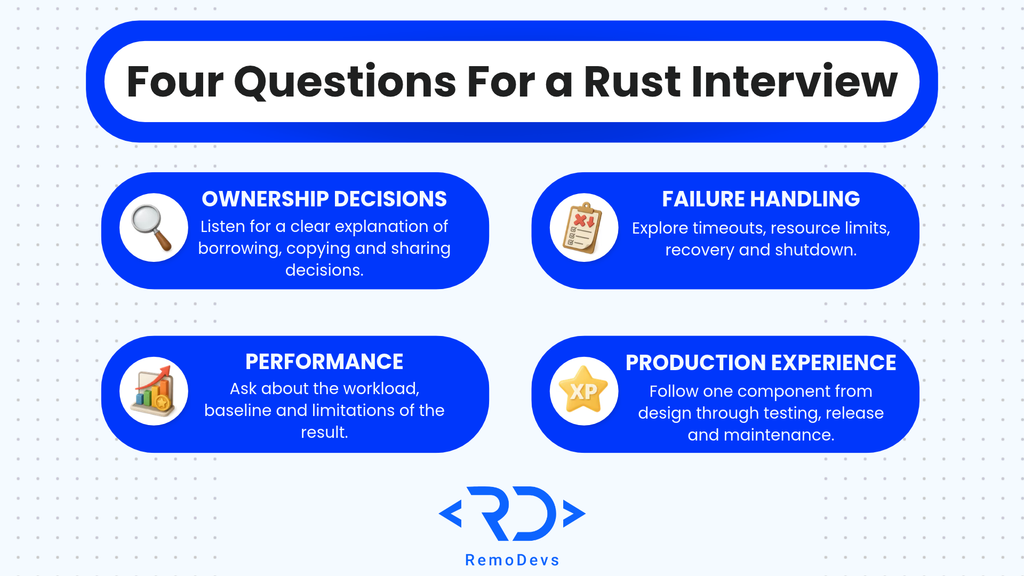
| Rust design | “Why did you choose these ownership boundaries?” | A reasoned explanation of borrowing, copying and sharing decisions |
| Reliability | “What happens when this dependency stops responding?” | Explicit timeouts, failure handling, resource limits and recovery choices appropriate to the task |
| Performance | “How would you investigate this slowdown?” | A measurement plan before optimisation, with realistic workloads |
| Production and teamwork | “How would another engineer operate and change this?” | Tests, diagnostics, reviewable code and a clear explanation of limitations |
Use written observations to distinguish demonstrated ability, remaining uncertainty and gaps the team can support. Recruiter screening can establish relevant background, motivation, communication, availability and expectations. Your engineering team, or an explicitly agreed technical assessor, should evaluate Rust implementation and architecture decisions.
How to budget for hiring a Rust developer in Poland
Build the budget around the specific profile and engagement. A senior embedded engineer, an async backend developer and a protocol specialist are different searches. An advertised offer for one of them is a reference point, rather than a reliable national Rust average.
Validate a proposed range against comparable current vacancies and conversations with qualified candidates. Match seniority, domain, location, work model and currency. Keep these figures separate:
| Figure | What you are comparing | What to clarify |
|---|---|---|
| Employment salary | The employee’s gross compensation | Employer costs, benefits, equipment and any on-call or bonus arrangements |
| Direct contractor fee | The agreed B2B invoice or hourly fee | Currency, VAT basis, billable capacity, absence terms and client-provided tools |
| Staff augmentation price | The provider’s client-billed rate | Included services, capacity, minimum commitment and notice terms |
| Recruitment fee | The charge for an agreed recruitment service | Fee basis, payment trigger, scope and any replacement terms |
For a direct hire, budget for recurring compensation and operating costs, initial equipment and setup, any agreed recruitment fee, and the internal time needed for interviews and onboarding. Use our developer hiring cost guide for Poland for the wider cost structure; its general software benchmarks should not be relabelled as Rust salary data.
Expect the requirement to affect the viable range. Independent architecture ownership, specialised hardware or protocol knowledge, on-call duties and mandatory office attendance change what you are asking a candidate to accept. If the budget is fixed, consider a narrower scope or a hire with mentoring support before expecting the same profile at a lower price.
Choose the engagement model and remote setup
Decide whether you need a person for your team or a supplier responsible for an outcome. The same Rust skill can be engaged through different arrangements.
| Model | When to consider it | Responsibility to establish |
|---|---|---|
| Direct hire, sourced internally or through an agency | You want an engineer within your own long-term team | Your company selects and directly engages the person under the chosen employment or contracting structure |
| Independent specialist engagement | You have a bounded need for expert contribution | Agree on scope, availability, handover and how the relationship operates |
| Client-managed staff augmentation | You own the roadmap and need additional engineering capacity | The specialist works through a provider; your team directs daily priorities and delivery |
| Managed project delivery | You want a supplier to own a defined result | The supplier’s delivery obligations, acceptance criteria and support belong in a separate scope |
Recruitment is the service of finding and qualifying candidates for a hire. It does not, by itself, transfer responsibility for developing the product. Likewise, staff augmentation from Poland adds capacity to a client-managed team; confirm fit and availability for a specialist Rust requirement before planning around it.
For an international remote team, agree on working-hour overlap, meeting expectations, written communication and incident coverage. Check English communication through relevant conversations. For hybrid or embedded work, confirm office attendance, laboratory or device access and travel expectations early. The engagement structure and responsibilities for contracts, IP and administration also need to be clear before an offer is accepted.
How RemoDevs supports Rust recruitment in Poland
RemoDevs helps international employers recruit technical talent through nationwide sourcing in Poland. Its IT recruitment service covers role calibration, targeted search and recruiter screening, candidate presentation with relevant context, and interview coordination. Success-fee recruitment is available, with commercial terms agreed before the search.
For your search, the starting point is the workload, expected ownership, essential Rust experience, work model and budget. Agree on the division between recruiter qualification and your engineering assessment so the shortlist addresses the requirements that matter.
Planning a Rust hire in Poland? Share the system you are building and the responsibilities the engineer will take on. Discuss your recruitment brief with RemoDevs to define the profile, sourcing scope and commercial terms.
Visit us
Find a moment in your calendar and come to our office for a delicious coffee
Make an apointment