
There is no reliable public average for interim CTO rates in Poland. The clearest figures we found come from Head of Engineering vacancies at NFQ, Roche and Meniga, with disclosed pay for employment and B2B arrangements.
These offers are useful reference points, but they are not a national CTO or VP Engineering salary range. Each company was hiring for a different remit, industry and reporting line. Interim and fractional work is priced differently too: the fee depends on the time commitment, urgency and decisions the leader will own. We start with the available evidence, then explain how to turn it into a realistic budget for your own hire.
Interim CTO and VP Engineering costs in Poland: the short answer
The public figures give you a baseline, not a ready-made budget. A full-time turnaround leader responsible for architecture, delivery and a large engineering organisation is doing a very different job from a fractional adviser joining one strategy session a week.
| Evidence or calculation | Figure | What it measures | How to use it |
|---|---|---|---|
| Archived NFQ Head of Engineering vacancy | PLN 25,300–40,800/month | Gross employment salary | One disclosed permanent offer |
| Roche Head of Engineering vacancy | PLN 30,300–56,300/month | Gross employment salary, with a 20% target annual bonus listed separately | One specialised permanent role in diagnostics R&D |
| Meniga Head of Engineering vacancy | PLN 28,000–37,000/month + VAT | Advertised B2B range, plus equity | One specific scope: 27 engineers, five teams and regulated banking clients |
| Archived NFQ Head of Engineering vacancy | PLN 30,400–49,100/month + VAT | Advertised B2B range | A second role-specific B2B reference |
The original NFQ page is no longer live, so its figures come from an external job archive. All three listings support the amounts quoted here. None of them, on its own or combined, represents the whole Polish market.
How we estimated CTO and engineering leadership costs
We reviewed the sources in September 2026. The estimate draws on four types of evidence:
- Public job listings. The main figures come from Meniga, a 2026 Roche vacancy and an archived NFQ vacancy. Each reflects one employer’s budget for one role.
- The scope in those listings. Team size, reporting line, industry and technical ownership help explain the differences between similarly titled positions.
- Employer-cost guidance. PwC’s Poland tax summary, reviewed on 11 August 2026, supplies the contribution rates and annual pension and disability cap used in the permanent-hire example.
- Legal and service-model sources. We use these to keep employment, independent contracting, recruitment and provider-supplied capacity separate. They are not salary benchmarks.
There are important gaps in the data. Publicly disclosed CTO and VP Engineering offers are too few and too inconsistent to support a nationwide range, and we found no robust dataset dedicated to interim CTO work in Poland. Head of Engineering vacancies are the closest usable evidence, so we treat them as calibration points rather than relabelling them as CTO market data.
Every calculation below shows its inputs. The scenarios are planning examples, not RemoDevs quotations or legal or tax advice.
CTO vs VP Engineering vs Head of Engineering
These titles are not used consistently. A Head of Engineering at a smaller company may have the remit of a VP elsewhere. The reporting line and actual mandate tell you more than the title alone.
CTO. The CTO usually sets the technology direction, covering strategy, architecture, major platform decisions and alignment with the wider business. In an early-stage company, that can still involve hands-on technical work. In a larger organisation, the emphasis may shift towards investment choices, risk and executive stakeholders.
VP of Engineering. The VP often owns engineering execution: organisational design, delivery, hiring, performance and the management layer. Some VPs also control architecture; others work alongside a CTO who retains that responsibility.
Head of Engineering. This can be effectively the same job as VP Engineering in a scale-up, or a level below it in a larger structure. Meniga’s advertised Head of Engineering, for example, reports to the CTO and runs 27 engineers across five teams. It is clearly a senior leadership role, but it does not carry the company-wide remit of the CTO.
Before setting a budget, define the decisions this person will own, the teams in scope, the expected outcomes and the executive conversations they will join. Starting with the title alone can distort both the salary comparison and the candidate pool.
Permanent vs interim vs fractional technical leadership
A permanent CTO or VP Engineering takes the leadership position on an ongoing basis. The person may be an employee or, where the relationship is genuinely independent, operate through a B2B arrangement. The package can also include bonus, equity and benefits.
An interim CTO or VP Engineering comes in for a defined period, often during a leadership gap or transition. The brief might be to stabilise delivery, reshape the organisation, prepare for a permanent hire, support technical due diligence or lead a transformation. An interim role can still be full-time.
A fractional CTO works with the company for only part of the week or month. Strategy, architecture, governance and coaching are common areas of focus, although the exact brief varies. The lower monthly spend reflects less capacity and usually a narrower remit; it does not buy the day-to-day availability of a full-time executive.
Senior engineering leadership costs in Poland: the available evidence
Publicly disclosed pay gives us four useful reference points for senior engineering leadership. It does not give us a single CTO average.
An archived NFQ Head of Engineering vacancy advertised PLN 25,300–40,800 gross per month for employment or PLN 30,400–49,100 plus VAT on B2B. The role covered backend teams working on marketing technology as well as architecture, delivery and incident management. These figures are preserved by an external job archive because the original vacancy is no longer live.
Roche disclosed PLN 30,300–56,300 gross per month, plus a 20% target annual bonus, for a specialised Head of Engineering role in diagnostics R&D. The remit covered managers and engineers, regulated life-sciences systems, production AI/ML, platform architecture, delivery and budget responsibility.
Meniga advertised PLN 28,000–37,000 plus VAT on B2B, together with an equity component. The Head of Engineering reports to the CTO, manages 27 engineers across five teams and is expected to lead a transformation for regulated banking clients.
The ranges overlap, yet the jobs behind them are quite different. A VP responsible for several engineering groups, budgets and executive-level delivery may need a larger package. A Head of Engineering running one product area may sit lower. Crucially, none of these listings quotes an interim CTO fee.
For an interim CTO, it is more useful to follow a pricing process than to rely on an invented market average:
- Start with the relevant permanent and B2B leadership benchmarks.
- Define the expected time commitment and term.
- Adjust for the mandate, decision risk, urgency and specialist context.
- Compare quotes on the same basis, including what is excluded.
Interim leaders may quote by the hour, day, month, milestone or retainer. Before comparing two monthly figures, check the promised availability, response times, deliverables and anything charged separately.
Salary vs B2B vs interim fee: what are you actually paying for?
Six kinds of cost often end up in the same hiring conversation. Mixing them leads to bad comparisons.
| Model or cost | What the quoted figure usually represents | Best suited for | Main cost variable |
|---|---|---|---|
| Permanent employee | Contractual gross salary; total employer cost is higher | Long-term leadership and organisational ownership | Scope, seniority, bonus, equity, benefits and employer costs |
| Independent B2B leader | Contractor’s net invoice, normally excluding VAT | A genuinely independent service relationship | Hours, scope, responsibility, expenses and contract terms |
| Interim executive | Temporary engagement fee, which may be hourly, daily, monthly or milestone-based | Leadership gap, transition or defined transformation | Duration, urgency, availability and mandate |
| Fractional CTO | Part-time fee or retainer | A business that does not need full-time executive coverage | Committed capacity, access and defined outcomes |
| Recruitment | Fee for finding and hiring the person | Bringing a leader into the organisation | Search model, fee base, seniority and difficulty |
| Staff Augmentation | Provider’s commercial rate for externally supplied capacity | Client-managed temporary specialist work | Specialist profile, scope and provider service |
Gross employment salary
Gross salary is the amount stated in the employment contract before the employee’s deductions. The employer pays more than that. Bonus, equity, benefits, equipment and recruitment also sit outside the figure unless the package explicitly includes them.
Employer cost
According to PwC, employer social-security contributions are generally 19.21%–22.41% of gross salary below the applicable cap. In 2026, pension and disability contributions are capped at a salary base of PLN 282,600. Some employer contributions continue above that point, but at a lower combined rate. Applying one flat percentage to an executive’s full annual salary can therefore overstate the cost.
B2B contractor invoice
A B2B invoice is revenue earned by an independent business. It should not be read as either an employee’s gross salary or the contractor’s take-home pay. The commercial agreement also needs to cover availability, expenses, equipment, intellectual property, termination and liability.
B2B is one possible structure, but it is not the default answer for every senior hire. Under Article 22 of the Polish Labour Code, work performed under the conditions of an employment relationship remains employment regardless of what the contract is called. How the relationship operates in practice matters, so the proposed setup should be checked with qualified Polish legal and tax advisers.
Interim or fractional engagement fee
Here, the company is buying agreed executive capacity and accountability for a limited period. The same hourly rate produces very different monthly bills for four days and sixteen days of availability. A retainer may also cover reserved access and responsibility, not only time logged.
Recruitment fee and provider rate
A recruitment fee pays for finding and hiring the person. It is separate from the candidate’s compensation. Check which part of the package the fee is based on, when payment is due and what terms apply if the hire leaves.
Staff Augmentation uses another type of figure: the provider’s commercial rate for supplying external capacity and supporting the engagement. That rate is not the specialist’s salary and it is not an executive-search fee.
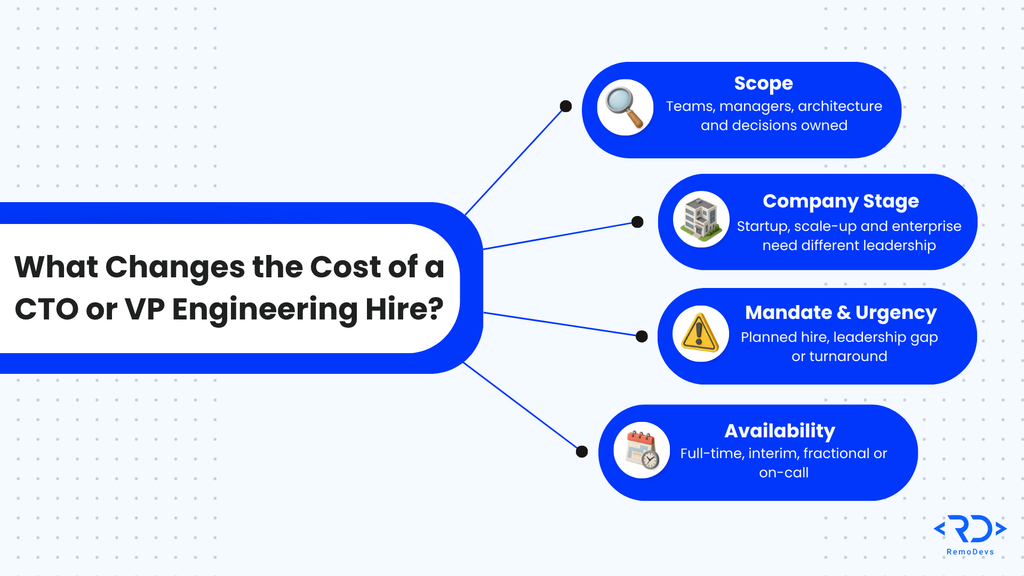
What changes the cost of a technical leadership hire?
The size of the organisation. Count direct and indirect reports, the management layer and planned hires. Leading several team leads demands different experience from supervising one small team.
The decisions attached to the role. Architecture, platform investment, security and vendor choices can carry considerable risk. Be clear about which decisions the leader will make, which they will recommend and where they will only advise.
Company and product stage. A pre-product startup may need someone who can still build. A scale-up is more likely to value management systems and predictable delivery, while an enterprise transformation brings governance and legacy constraints.
Why the leader is needed now. Covering an unexpected departure is very different from running a planned advisory project. A turnaround, post-merger integration or due-diligence deadline can narrow the candidate pool and require the person to reserve capacity at short notice.
Industry and regulation. Financial services, healthcare and other regulated sectors may require experience with specific controls. If the role carries cybersecurity accountability, data-residency requirements or audit exposure, say so in the brief rather than hiding it inside a generic CTO title.
Relevant technical depth. Cloud, data or AI experience matters when it is central to the mandate. Start with the decisions ahead and work backwards to the expertise required; a list of fashionable technologies rarely makes the search more precise.
Commercial and stakeholder exposure. Board work, investor discussions, enterprise sales, fundraising and M&A due diligence are distinct experiences. Screen for the ones the job will involve.
Availability and working pattern. Full-time, fractional and on-call coverage will be priced differently. Travel, Warsaw office attendance, time-zone overlap and responsibility for incidents outside working hours can also affect the quote.
The package and contract. Cash salary is only one part of a permanent offer. Bonus, equity and benefits influence both the employer’s budget and the candidate’s decision. In a temporary engagement, liability, termination rights and deliverables can all shape the price.
Example budgets
The scenarios below show the arithmetic in practice. They are budgeting examples, not market averages or RemoDevs quotations.
Scenario A: permanent technical leader employed at PLN 40,000 gross per month
PLN 40,000 falls within both permanent Head of Engineering ranges cited above. We use it to demonstrate the calculation; it is not a recommended salary for every CTO hire.
- Annual gross salary: PLN 40,000 × 12 = PLN 480,000.
- Estimated employer-side contributions: approximately PLN 66,207 per year.
- Approximate annual salary plus employer contributions: PLN 546,207, equivalent to an average PLN 45,517 per month.
This estimate uses the rates listed in PwC’s 2026 Poland summary: 16.26% for pension and disability contributions up to the PLN 282,600 cap, an assumed 1.67% accident-insurance rate, 2.45% for the Labour Fund and 0.10% for the Employee Guaranteed Benefits Fund. PPK, bonus, equity, benefits, recruitment, equipment and payroll administration are excluded. The actual employer cost will depend on the company and the employment setup.
Scenario B: six-month, full-time interim engagement
Assume a candidate quotes a fixed fee of PLN 50,000 net per month for a full-time six-month mandate.
- Monthly invoice: PLN 50,000 net.
- Six-month invoice total: PLN 50,000 × 6 = PLN 300,000 net.
The PLN 50,000 fee is hypothetical, not a market benchmark. Before accepting a quote like this, confirm how VAT, expenses, travel, insurance, legal review, provider charges and any outcome-based fees will be handled. “Full-time” should also be defined in terms of availability, response time and deliverables.
Scenario C: fractional CTO for four days per month
Assume a fractional leader quotes an illustrative PLN 2,500 net day rate for four days per month:
- Monthly capacity: 4 × 8 = 32 hours.
- Monthly fee: 4 × PLN 2,500 = PLN 10,000 net.
- Three-month fee: PLN 10,000 × 3 = PLN 30,000 net.
This level of capacity could suit a focused architecture review, governance setup or coaching brief. It would not cover the day-to-day work of a full-time executive. In practice, a fractional proposal may use a retainer or minimum commitment, and reserved access can increase the effective rate.
Why we do not publish a US-vs-Poland savings percentage
A fair comparison would need to match role scope, company stage, seniority, working pattern and compensation definition. Public figures rarely allow that. US executive data often includes bonus and equity, while Polish sources may show monthly gross salary or a B2B invoice. Interim fees are another category altogether.
Comparing a Polish contractor’s invoice with a US employee’s total compensation can produce an impressive savings percentage, but the two figures do not describe the same purchase. Poland can still be an attractive market for senior technical leadership. The case should be based on access to the right experience, a realistic budget and a suitable engagement structure, rather than a headline savings claim.
How to evaluate an interim CTO or VP Engineering quote
You can compare prices properly only once the mandate is clear. Give every candidate or provider the same brief, then ask:
- Scope: Which teams, systems and decisions does the quote cover?
- Capacity: How many days or hours are reserved? What response time can you expect?
- Outcomes: What should have changed after 30, 60 and 90 days?
- Comparable experience: What size and stage of company has the person worked in, and how similar was the technical context?
- Architecture ownership: Which major decisions did they personally own, and what happened afterwards?
- People leadership: How many managers and engineers have they led through hiring, reorganisation or performance issues?
- Stakeholders: Have they worked with boards, investors, customers or regulators where the brief calls for it?
- Handover: If the role is interim, how will they transfer decisions, documentation and open risks to a permanent leader?
- Commercial terms: What is included, what is charged separately, and how can the engagement be extended or ended?
- Evidence: Can they provide relevant references or case examples?
The cheapest quote is not automatically the lowest-cost option, just as the highest quote is not proof of quality. Look at the evidence against the mandate. For a tightly defined problem, four well-used days of fractional support may offer better value than paying for executive availability the company does not need.
Hiring technical leadership in Poland
Shape the search before sourcing begins. Decide how much of the role is technical strategy and how much is engineering execution, then set the reporting line, decision rights, engagement model and compensation range. Screening can focus on comparable operating experience instead of familiar titles.
If you want the leader to join your organisation, RemoDevs’ IT Recruitment service in Poland is the more relevant starting point. RemoDevs recruits Engineering Managers, Heads of Engineering and CTOs. We can help calibrate the role, search the Polish market, screen candidates and prepare a focused shortlist with recruiter context before coordinating interviews. The recruitment model and fee are agreed before the search and reflect the seniority and scope of the hire.
For temporary specialist capacity managed by the client, IT Staff Augmentation in Poland may be a better fit. It is a separate service from executive recruitment and it is not an EOR arrangement. If an overseas company needs a mechanism for employing someone in Poland, an EOR may be one option, depending on the circumstances. Legal and tax advisers should confirm the appropriate structure.
A salary benchmark only tells you whether the budget is plausible. The search still has to establish whether a candidate has worked at the required scale and handled comparable technical risk and stakeholder complexity. That is where RemoDevs can turn a broad leadership title into a focused recruitment brief.
FAQ
How much does a CTO earn in Poland?
Public data is not strong enough to give one reliable national salary range for CTOs. The closest disclosed employment offers reviewed here are for Heads of Engineering: PLN 25,300–40,800 gross per month in the archived NFQ listing and PLN 30,300–56,300 gross per month in the Roche listing. A CTO with wider company-level responsibility may require a different budget.
How much does an interim CTO cost in Poland?
No robust public dataset provides an average interim CTO rate for Poland. Disclosed senior leadership vacancies can help set a baseline, but the quote still needs to reflect the length of the assignment, expected availability, urgency and level of responsibility. Compare several proposals against the same written brief.
Is an interim CTO the same as a fractional CTO?
No. “Interim” means the mandate is temporary, while “fractional” means the leader works only part-time. An interim CTO can work full-time. A fractional CTO may support the company on an ongoing basis, or the arrangement can be both temporary and part-time.
Can a US or UK company hire a CTO in Poland?
Generally, yes. The right structure will depend on whether the company has a Polish entity, the individual’s status and how the working relationship is meant to operate. Direct employment, independent B2B cooperation and third-party employment arrangements have different legal, tax and operational implications, so the setup should be reviewed for the specific case.
Should we use an employment contract or B2B agreement?
Choose the model based on how the relationship will work in practice. Employment and independent B2B cooperation differ in integration, direction, commercial risk and responsibility; the name on the agreement does not settle the question. Have qualified Polish legal and tax advisers review the proposed arrangement.
How much does CTO recruitment cost in Poland?
There is no single standard fee. Recruitment firms may work on a success, retained or milestone basis, and they do not always calculate fees from the same part of the compensation package. Ask for a written proposal that states the percentage or fixed amount, the fee base, payment schedule, replacement terms and exclusions. RemoDevs agrees the model and fee before starting the search, based on the role’s seniority and scope.
Can RemoDevs recruit CTOs and Heads of Engineering in Poland?
Yes. RemoDevs recruits Engineering Managers, Heads of Engineering and CTOs in Poland. Support can include role calibration, sourcing, candidate screening, shortlist preparation and interview coordination.
Visit us
Find a moment in your calendar and come to our office for a delicious coffee
Make an apointment