
Most hiring managers spend only 6 to 10 seconds scanning a resume before making a decision. For technical roles, missing critical warning signs during this brief window results in costly bad hires. To avoid this, you need to know how to read developer cv profiles efficiently and identify the subtle red flags cv that generic screenings often miss.
At RemoDevs, we reject approximately 90% of candidates based on a deep vetting philosophy that looks for what is missing or misleading. Drawing from years of experience, we have identified the top three indicators that a developer lacks the depth or reliability required for senior roles.
Red Flag #1: Listing Responsibilities Instead of Measurable Achievements
One of the most pervasive red flags cv reviewers encounter is a “Skills & Experience” section that reads like a job description rather than a career history. Weak candidates often list what they were supposed to do, rather than what they actually did.
When vetting developer resume entries, be wary of bullet points that are passive or vague.
Common mistakes include:
- “Responsible for maintaining the codebase.”
- “Worked with Java and Spring Boot.”
- “Attended daily Scrum meetings.”
- “Helped the team with bug fixes.”
These statements tell you nothing about the candidate’s quality of work. Anyone can “work with” a technology or “attend” a meeting.
What strong candidates do instead:
Top-tier developers understand the business value of their code. When learning how to read developer cv profiles effectively, look for impact metrics, percentages, and clear outcomes.
- “Reduced API response time by 40% by refactoring legacy database queries.”
- “Led the migration of a monolith to microservices, supporting 10k+ concurrent users.”
- “Automated deployment pipelines, cutting release time from 2 days to 3 hours.”
In our experience hiring software developers in Poland, the best engineers are problem solvers who can quantify their success. If a senior developer cannot articulate the result of their work, they may have been “coasting” rather than contributing.
Red Flag #2: Unexplained Employment Gaps or Frequent Job Hopping
In the fast-paced tech world, moving jobs isn’t inherently bad. However, a pattern of excessive short tenures staying at companies for less than 12 to 18 months repeatedly is a significant concern when vetting developer resume timelines.
While contract work or project-based roles are common, a full-time employee who jumps ship every year often signals deeper issues.
Why this raises concerns:
- Onboarding costs: It takes 3-6 months for a developer to become fully productive. If they leave at month 12, you barely got a return on investment.
- Lack of depth: Developers who leave quickly often leave before they have to maintain their own code or deal with the long-term consequences of their architectural decisions.
- Cultural friction: Frequent exits can sometimes indicate an inability to collaborate or resolve conflicts.
Insider advice:
Don’t immediately disqualify a candidate, but treat it as a signal to investigate. During the interview, ask specific questions: “What prompted you to leave Company X after 10 months?” or “What are you looking for here that you didn’t find in your last three roles?”
Honest explanations (like company layoffs or a drastic shift in tech stack) are acceptable. Vague answers are not. To understand what motivates long-term retention, it helps to know what developers really want.
Red Flag #3: Overloaded Skills Section with Buzzwords, Generic Tools, or No Proof of Depth
The “Skills” section is often the most deceptive part of a resume. A classic red flags cv example is the “Kitchen Sink” approach, where a candidate lists 15+ programming languages, five different cloud platforms, and tools ranging from “Kubernetes” to “Microsoft Word.”
When learning how to read developer cv skills, remember: depth trumps breadth. No one is an “expert” in C++, Python, Java, Rust, and React simultaneously.
Signs of shallow knowledge:
- Buzzword Stuffing: Listing trendy technologies (like “AI/ML,” “Blockchain”) without any corresponding project experience in the work history.
- Incongruent Skills: A “Senior Backend Developer” listing HTML/CSS as their top skills.
- Lack of Evidence: Claiming passion for coding but having no link to a GitHub profile, portfolio, or personal projects.
Experienced recruitment agencies look for a T-shaped skill set — deep expertise in one or two core areas (e.g., Python/Django) supported by a broad understanding of related tools (e.g., Docker, AWS). If a candidate claims to know everything, they likely know nothing well enough to deploy it in production.
Bonus: Practical Framework for Vetting Developer Resumes Effectively
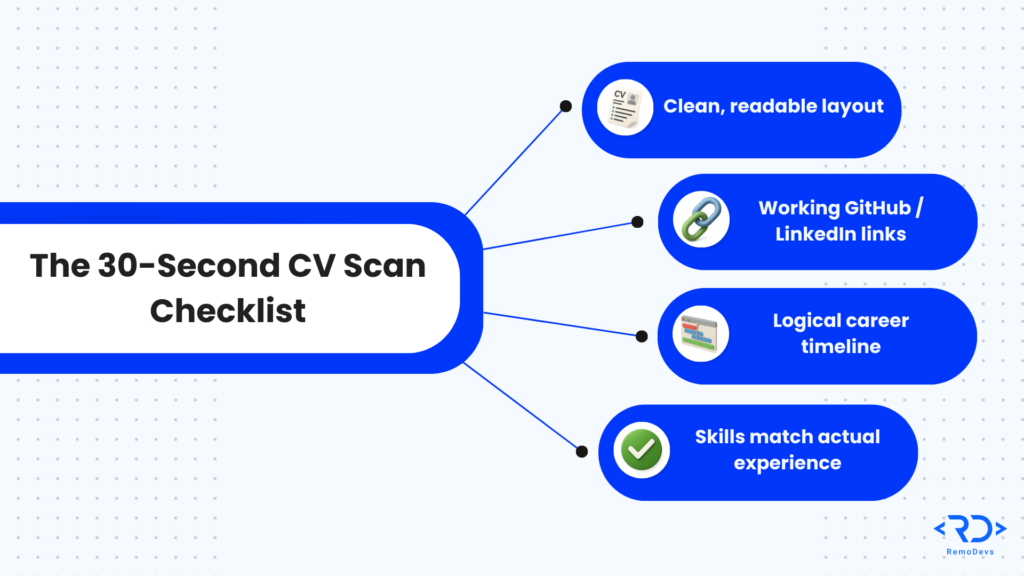
To streamline your process, use this quick 30-second scan checklist before committing to a full read:
Quick Scan Checklist:
- Layout: Is it clean and readable, or chaotic? (Attention to detail matters in code and CVs).
- Links: click the GitHub/LinkedIn links. Do they exist? Is there activity?
- Timeline: Are there unexplained gaps or 6-month stints?
- Tech Stack Match: Do the skills listed actually appear in the work history bullet points?
Red-to-Green Signals:
| Feature | Red Flag 🚩 | Green Flag 🟢 |
| Description | “Wrote code for X feature” | “Built X feature resulting in Y% growth” |
| Tenure | 4 jobs in 3 years | promoted internally or 2+ years tenure |
| Skills | List of 20+ keywords | Curated list relevant to the role |
Moving beyond the CV is crucial. A resume is just a marketing document; real validation happens during technical interviews and code tests. For roles like Systems Engineers or other specialized positions, you must test for problem-solving ability, not just memory.
Conclusion
Recapping the top 3 red flags cv screeners must watch for:
- Task lists instead of achievements.
- Job hopping without valid context.
- Buzzword-stuffed skill sections with no proof of depth.
Spotting these early can save you months of wasted time and the high cost of a bad hire. However, even the best CV reading skills can’t replace a robust technical vetting infrastructure.
If you are tired of wasting time on low-quality resumes and want access to truly vetted senior developers from Poland, let RemoDevs handle the heavy lifting. Our rigorous screening process allows us to choose the best IT talent, filtering out 90% of candidates so you only see the best fits.
Ready to build your elite team? Contact us today to get started.
Visit us
Find a moment in your calendar and come to our office for a delicious coffee
Make an apointment