Choose an IT recruitment agency in Poland by comparing its experience with your roles, sourcing plan, screening responsibilities, delivery capacity and written commercial terms. Give shortlisted agencies the same brief and ask for comparable evidence. The right partner depends on what you need to hire, where the person will work and which parts of recruitment your own team can handle.
This guide is published by RemoDevs. The framework below is designed to help you assess any shortlisted agency, including ours.
Start with a clear recruitment brief
Before comparing suppliers, write down the role’s business responsibilities, essential skills, seniority, compensation range, location and working model. Include the proposed employment or direct B2B arrangement, interview stages and target start date.
A senior data engineer working remotely across Poland and an engineering manager required in a Warsaw office three days a week need different sourcing plans. An agency should explain how your constraints affect the search, including which requirements may be difficult to satisfy together.
If you are still planning the wider hiring setup, use our guide to hiring software developers in Poland. If you need names for an initial shortlist, start with our comparison of IT recruitment agencies in Poland, then evaluate two or three relevant providers against your own brief.
How to Compare IT Recruitment Agencies in Poland
Get the proposals in writing so your engineering, talent and procurement teams can compare them.
| Evaluation criterion | What to check | Questions to ask | Evidence to request |
|---|---|---|---|
| Technical specialization | Assigned team’s relevant role experience | Which comparable searches has this team completed? | Recent role examples with stack and seniority |
| Sourcing capability | Search approach and realistic geographic reach | How will you reach candidates who meet our work model? | Role-specific sourcing plan and location assumptions |
| Screening methodology | Checks completed before submission | Who assesses what, and what remains with us? | Anonymized candidate summary and assessment ownership |
| Relevant experience | Outcomes under similar constraints | What made a comparable assignment difficult? | Dated case study and relevant client reference |
| Delivery metrics | Defined milestones and reporting | What starts and stops your timing measures? | Comparable cohort data and sample pipeline report |
| Commercial terms | Fee basis, triggers and remedies | What would we pay if a hire starts, leaves or never starts? | Written proposal and applicable contract clauses |
| Collaboration and capacity | Named ownership and concurrent workload | Who runs our search, and what happens if progress stalls? | Delivery team, reporting cadence and escalation plan |
How to assess the evidence
1. Technical specialization that matches the assignment
Focus on the assigned team: have they worked with your combination of seniority, technical domain and hiring constraints?
For a senior backend role, that might mean recruiting engineers who owned distributed services in production. For an AI role, distinguish model research from building and operating AI features. Useful examples describe the responsibilities behind the job title and how the agency agreed the requirements with its client.
A list of technology names tells you little about that experience. A generalist agency can still be a strong choice if its relevant practice and assigned recruiters have the required experience.
2. A sourcing plan built around your location and working model
Nationwide reach matters for remote hiring. For hybrid or onsite work, the agency must establish who can meet the actual office schedule, including commute or relocation expectations.
A useful sourcing plan explains how the agency will combine direct search, referrals, existing relationships and advertised vacancies. It should justify the search area and show what changes if too few candidates meet the brief.
Database size alone tells you little about who is interested, available or suitable for your vacancy. The agency still needs to explain how it will confirm those points. A sourcing plan that ignores your office requirement is a warning sign.
3. Screening responsibilities that your engineering team understands
Agree on which of these four activities the agency will handle and which your team will own:
- Experience qualification: checking whether previous responsibilities and projects are relevant.
- Recruiter screening: discussing motivation, communication, expectations, availability and practical fit.
- Technical evaluation: an agreed engineering interview, work sample, coding exercise or system-design assessment.
- Final validation: your team’s assessment of suitability for its product, responsibilities and working environment.
An anonymized candidate presentation should show what has been checked and what remains open. For any technical testing, confirm who evaluates the candidate, the method and scoring criteria, and whether it costs extra.
There is no requirement that every agency run the same coding test. A recruiter-screened shortlist can be useful when your engineers own technical validation. Be cautious if an agency says an assessment is complete but cannot explain what was done or who performed it.
4. Comparable experience rather than an impressive client list
A client logo tells you little about what the agency actually did. A recent case with similar roles, work arrangements, budget constraints or hiring volume is more useful.
Profiles presented, interviews completed, offers accepted and people hired are different milestones. The case should make clear which outcome was achieved, what the agency contributed and what the client handled.
Confidentiality may rule out a named case, but an anonymized account and a reference shared with permission can still be useful. The agency should be able to explain its contribution without exposing candidate information. Any reported success percentage needs a clear definition of the searches included.
5. Delivery measures you can compare
Time to first qualified candidate and time to accepted offer answer different questions. Compare them separately, with an agreed starting point, a clear distinction between working and calendar days, and a defined set of recent roles.
The sample size matters, as does the treatment of paused, cancelled and unfilled searches. A median from comparable assignments is more informative than the fastest placement in the agency’s history.
A sample pipeline report will show how the agency tracks candidate stages, rejection reasons, blockers and next actions. Timing promises deserve scrutiny if they leave out your team’s interview availability, offer approvals or the candidate’s notice period.
6. Commercial terms you can apply to real scenarios
Compare fees for equivalent scope, including any engineering assessment or dedicated recruiting capacity.
Before signing, clarify the compensation base, fee trigger, invoice timing, taxes, additional charges, exclusivity and treatment of candidates already known to your team. The replacement clause should spell out when it applies, what it excludes and what the agency will provide. A repeat search, a credit and a refund are different commitments.
Walk through three scenarios with each agency: a candidate accepts but never starts, leaves during the guarantee period or is introduced by another source. Resolve any difference between the sales proposal and the contract before appointing the agency. Our guide to IT recruitment agency fees explains the commercial details.
7. A delivery team with enough capacity to do the work
Meet the person who will be accountable for the search. You should know who handles sourcing, candidate conversations and client reporting, and how your work will fit alongside the team’s existing assignments.
If you have several vacancies, agree on which searches launch first and how changing priorities will be handled. Set a reporting channel, name the people responsible for feedback and decide when to review the search if the initial shortlist misses the brief.
The agency should have a clear delivery team and a plan for covering an unavailable recruiter. Your team also needs to commit to timely, specific feedback.
IT Recruitment Agency Evaluation Scorecard
Use this scorecard once you have the proposals and supporting evidence. The weights are suggestions for your decision, not a validated industry benchmark or a ranking of real agencies.
Score each criterion from 0 to 5: 0 means evidence is missing; 1 is a claim without support; 2 is a partial answer; 3 is a complete, relevant answer; 4 adds convincing supporting evidence; 5 adds strong corroboration relevant to your assignment.
| Criterion | Suggested weight | Hypothetical Agency A | Hypothetical Agency B |
|---|---|---|---|
| Technical specialization | 20% | 4 | 5 |
| Sourcing capability | 15% | 4 | 3 |
| Screening methodology | 20% | 4 | 3 |
| Relevant experience and evidence | 15% | 3 | 4 |
| Delivery metrics | 10% | 3 | 4 |
| Commercial terms and guarantees | 15% | 4 | 3 |
| Communication and collaboration | 5% | 4 | 3 |
| Total | 100% | 75/100 | 73/100 |
Calculate each contribution as score ÷ 5 × weight, then add the contributions. Agency A’s technical-specialization contribution is 4 ÷ 5 × 20 = 16 points.
Adjust weights before comparing suppliers. A confidential leadership search may need more weight on relevant experience and assessment; hiring for several roles at once may make capacity and collaboration more important. Keep the revised total at 100%.
Record the supporting evidence beside every score. A two-point difference should prompt discussion rather than an automatic decision. Do not appoint an agency with unacceptable contract terms, insufficient capacity or unclear responsibility for technical assessment, however high its score.
Success Fee, Retained Search or RPO: Which Fits Your Hiring Needs?
Agree on the engagement model before appointing the agency. Payment structure, search ownership and deliverables need to be discussed separately.
| Model | When to consider it | What to establish |
|---|---|---|
| Success-fee recruitment | One or a few specialist vacancies | Placement-linked fee trigger, assigned capacity, exclusivity and candidate ownership |
| Retained search | A confidential leadership role or difficult search requiring dedicated research | Paid stages, deliverables, assessment scope, confidentiality and any exclusivity |
| RPO | Recurring vacancies or a hiring peak requiring embedded recruitment capacity | Capacity, tools, division of work, reporting and exit arrangements |
Success-fee terms vary between agencies. For retained search, confirm exclusivity and payment stages in the agreement. Neither model automatically means more thorough screening.
If you need ongoing recruiting capacity, review embedded recruitment support through RPO.
With direct recruitment, you hire the person yourself. Staff augmentation adds a specialist through a provider; RPO adds recruiting capacity. Employment, payroll, EOR administration, tax obligations and worker classification do not automatically become a recruitment agency’s responsibility. Agree in writing on any additional services and who is responsible for them.
Red flags that deserve further investigation
Pause the selection process when an agency:
- describes candidates as technically assessed but cannot show the assessment scope;
- provides no evidence from comparable roles and no alternative reference;
- ignores your location, compensation or work-model constraints;
- presents placement or speed metrics without definitions;
- leaves fee triggers, candidate ownership or replacement conditions unclear;
- cannot identify the delivery team, reporting process or escalation route.
A missing public case study or small review sample is not an automatic rejection. Ask for another form of relevant evidence. Equally, a long guarantee or famous client should not compensate for an unclear proposal.
A practical process for selecting an agency
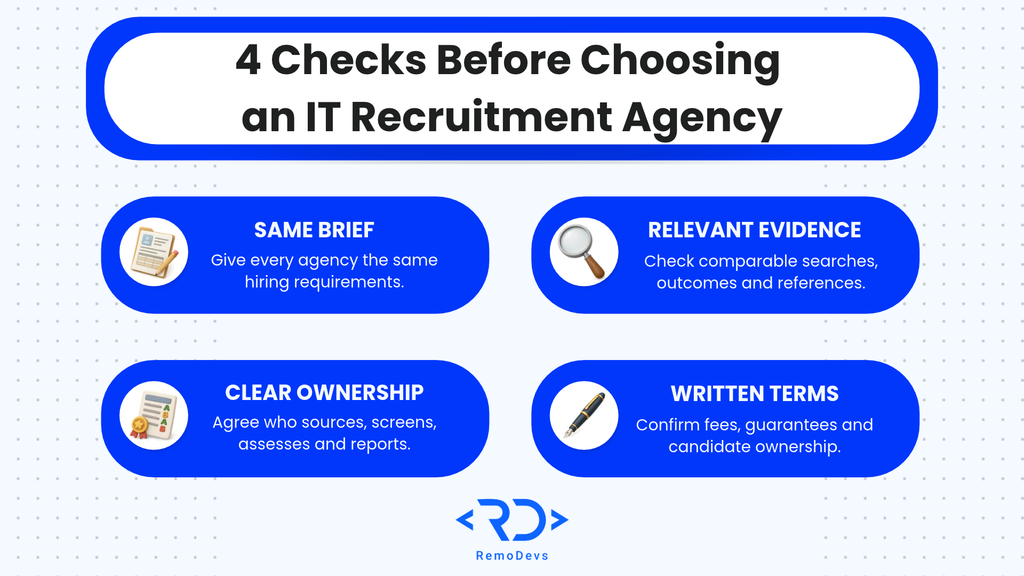
- Define the assignment. Agree on role outcomes, constraints and the responsibilities your team will retain.
- Shortlist two or three providers. Use role relevance and the required engagement model to narrow the options.
- Send the same brief. Request a sourcing plan, screening scope, assigned team, delivery expectations and written terms. Our technical recruitment brief guide helps prepare the input.
- Compare the evidence. Use the scorecard and record gaps before the sales calls influence the decision.
- Validate the finalists. Check comparable references and work through the contract scenarios with the colleagues involved in the decision.
- Agree on launch expectations. Name the technical assessment owner, feedback owners, reporting cadence and first review point.
Keep a short decision record explaining why the selected agency fits the assignment and which assumptions still need testing once sourcing begins.
How to verify RemoDevs’ experience and approach
RemoDevs supports international employers hiring software, AI, data, cloud and technical leadership talent in Poland. Our specialist IT recruitment service describes nationwide sourcing, role calibration, screening and interview coordination.
Our published screening process explains that client engineers normally own product-specific technical validation. A presented candidate has not necessarily completed a coding test.
More recent evidence comes from Razoyo founder Paul Byrne’s June 2025 Clutch review. For an Elixir role with leadership responsibilities, he reports over 20 qualified resumes, five first interviews, two second interviews and one final interview. Razoyo selected a candidate. He also notes that the team corrected an initial mismatch after receiving feedback.
A 2022 Scandinavian startup case study reports six profiles presented and three people hired for Go and iOS roles.
On Clutch, ElevenLabs CEO Mati Staniszewski’s December 2022 review describes around 30 filtered candidate leads and approximately five reaching final stages.
The current recruitment offer describes a 30-day period before agency payment and a 90-day replacement guarantee. Ask for the conditions applicable to your search in writing.
Final checklist before you appoint your recruitment partner
Confirm that you have:
- relevant evidence for the assigned team’s experience;
- a sourcing plan consistent with your location and work model;
- a clear record of agency screening and client technical responsibilities;
- defined delivery milestones and reporting;
- written fees, candidate-ownership and replacement terms;
- named people responsible for delivery and feedback.
If you are considering working with RemoDevs on a technical search, share the role, compensation range, location and interview process. We can discuss the proposed scope and commercial terms so you can evaluate the fit against the same criteria.
Visit us
Find a moment in your calendar and come to our office for a delicious coffee
Make an apointment