
If you want to know how to write recruitment brief documentation that actually yields results, start by understanding its core function. A technical recruitment brief is a foundational strategic document outlining the exact technical requirements, business context, and soft skills necessary for an open IT role.
Unlike a generic job description, the brief is an internal alignment tool shared between your engineering leadership and your external talent partners.
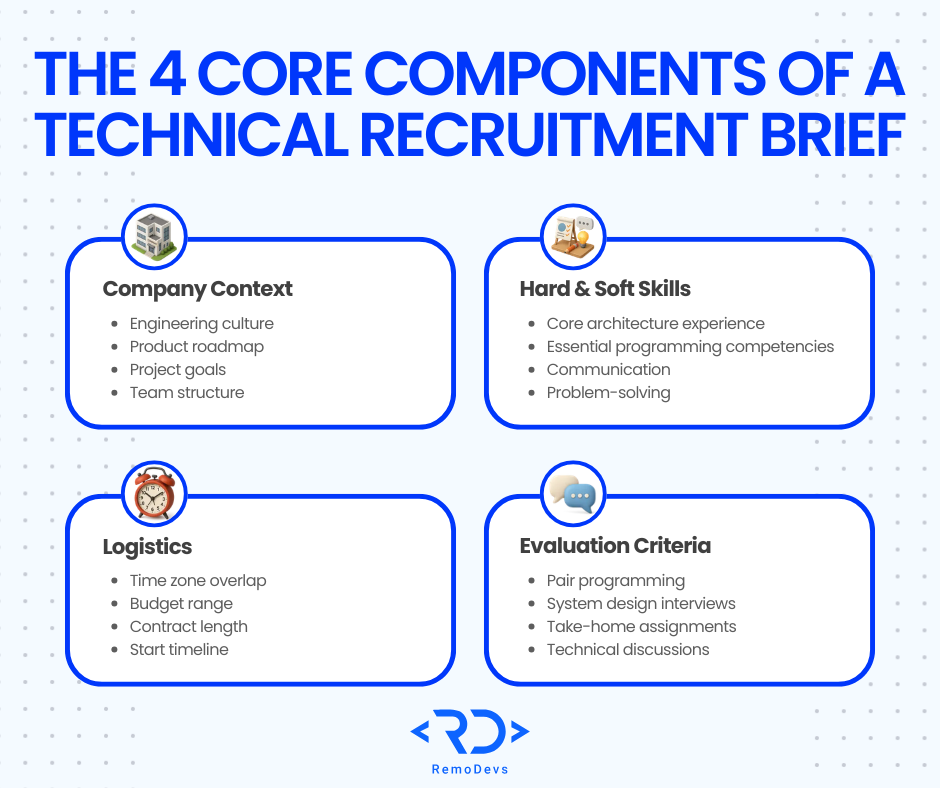
A high-functioning brief must include four core components:
- Company Context: The engineering culture, product roadmap, and specific project goals.
- Hard & Soft Skills: A clear delineation between mandatory architectural knowledge and trainable frameworks, plus required communication competencies.
- Logistics: Time zone overlap requirements, project duration, and precise budget ranges.
- Evaluation Criteria: How the technical assessment will be conducted (e.g., pair programming, system design whiteboard, or take-home assignment).
Why a Detailed Recruitment Agency Brief is Your Secret Weapon
Treating your recruitment agency brief as an afterthought is the fastest way to drain your engineering budget. Vague requirements lead to misaligned candidate sourcing, extended vacancy periods, and ultimately, mismatched hires.
The financial impact of this is severe; the Society for Human Resource Management (SHRM) consistently highlights that the cost of a bad hire can reach up to 30% of the employee’s first-year earnings. In specialized IT roles, the hidden costs of delayed product releases and technical debt multiply that figure.
Conversely, a comprehensive brief accelerates the time-to-fill metric. By explicitly stating your architecture (e.g., event-driven microservices) and cloud infrastructure (e.g., AWS vs. GCP), you eliminate back-and-forth clarification emails.
It allows your talent partners to instantly filter out unqualified candidates, ensuring that every resume hitting your CTO’s desk warrants an interview.
A Technical Brief Template You Can Steal
To streamline your onboarding, use this technical brief template to structure your requirements. Breaking your needs down into these four categories ensures nothing is lost in translation.
1. Company Context and Project Vision
Senior developers evaluate the scope of the problem just as much as the salary. They want to know what they are building, not just the code they are writing. Provide a clear window into your engineering environment.
- The Mission: What core problem does your software solve for the end user?
- Team Structure: Will this developer integrate into a cross-functional squad of 5, or operate independently? Outline the reporting structure.
- Development Life Cycle: Detail your sprint lengths, CI/CD pipeline maturity, and code review culture.
2. Hard Skills vs. Nice-to-Haves
The most common failure point in a technical brief template is conflating necessary architectural experience with easily acquired syntax knowledge.
- Must-Haves: Specify non-negotiable core competencies. If the role requires optimizing complex SQL queries or building scalable Node.js backends, state this clearly.
- Trainable Bonuses: Identify technologies that are beneficial but not mandatory. Referencing industry data, such as the Stack Overflow Developer Survey, can help you understand realistic technology groupings and avoid demanding conflicting toolsets.
- System Architecture: Mention whether the candidate will be maintaining legacy monolithic systems or building new serverless features.
3. Soft Skills and Remote Work Culture Fit
Technical brilliance cannot compensate for poor communication, especially in distributed teams. Your recruitment agency brief must define the required operational autonomy.
- Asynchronous Communication: Does the candidate need to proactively document their code and utilize tools like Jira and Confluence effectively without prompting?
- Stakeholder Interaction: Will the developer need to translate technical constraints to non-technical product managers?
- Defining these traits is critical for successful IT outsourcing and remote team building, as it guarantees candidates possess the self-management skills required to thrive outside a traditional office.
4. Logistics, Budget, and Timelines
Ambiguity in logistics wastes everyone’s time. Be absolute in your operational parameters.
- Time Zone Overlap: Specify the exact hours (e.g., “Must overlap 4 hours with CET”).
- Budget: Provide a realistic hourly rate or annual salary range based on the required seniority.
- Timeline: State the absolute deadline for the developer’s first commit.
| Aspect | Recruitment Brief | Job Description |
| Purpose | Internal strategic document | Public hiring advertisement |
| Audience | Recruitment agencies and talent partners | Job seekers |
| Focus | Technical requirements, architecture, hiring constraints | Responsibilities, perks, company culture |
| Detail Level | Highly specific and technical | Broad and marketing-oriented |
| Usage Stage | Before candidate sourcing begins | During candidate attraction |
| Main Goal | Deliver qualified candidates faster | Generate applications |
How RemoDevs Uses Your Brief to Secure Top Remote Talent
Providing a high-quality brief helps us help you. When you submit a structured recruitment brief, it fundamentally transforms the speed and accuracy of our staff augmentation process.
Streamlining the Search
A perfect brief allows our technical recruiters to bypass broad searches and immediately query our pre-vetted talent pool using strict technical parameters. If you specify a need for a Senior React developer with GraphQL experience, we isolate that exact cohort instantly.
Customized Technical Vetting
We do not rely on generalized coding tests. We map the hard skills from your brief directly into our technical assessment phase. If your brief highlights a need for robust data security, our technical interviewers will drill into the candidate’s knowledge of encryption and secure API design.
This targeted vetting is the driving force behind our successful technical placements.
Setting the Hook
Top-tier engineers are overwhelmingly passive candidates – they are already employed, well-compensated, and rarely browsing job boards. Because the demand for specialized IT architecture and development skills persistently outpaces global supply, we must actively recruit them.
We use the “Company Context” section of your brief as our primary pitch, selling your technical roadmap, product vision, and engineering culture to compel the highest caliber talent to leave their current roles and join your team.
Common Mistakes to Avoid When Writing Your Brief
- The “Unicorn” Syndrome: Avoid demanding a developer who is an expert in DevOps infrastructure, highly complex backend logic, and pixel-perfect UI design, all on a mid-level budget. This guarantees a stalled search. Focus on the core engineering problems you need solved.
- Copy-Pasting Generic Job Descriptions: Internal HR job descriptions are designed for public job boards, heavily focused on company perks and compliance. A recruitment agency brief is an internal strategic document that must prioritize technical architecture, system constraints, and team dynamics.
Ready to Hire? Let’s Put Your Brief into Action
Stop wasting engineering cycles interviewing the wrong candidates. By formalizing your technical requirements, you enable us to deliver candidates who can contribute to your codebase from day one.
If you have defined your project scope and are ready to hire dedicated remote developers, submit your brief to our team today. We will align your technical needs with our top 1% of vetted IT professionals.
Frequently Asked Questions (FAQ)
How long should a technical brief be?
A technical brief should be concise but highly specific, typically ranging from one to two pages. Focus entirely on clarity, eliminating corporate jargon to prioritize system architecture, exact skill requirements, and business objectives.
What is the difference between a job description and a recruitment brief?
A job description is an external-facing marketing document designed to attract candidates on public job boards. A recruitment brief is an internal strategic alignment document shared with your talent agency, detailing the exact technical vetting criteria, budget constraints, and project realities.
Can a technical brief template be used for staff augmentation?
Absolutely. Utilizing a technical brief template is even more critical for staff augmentation than standard hiring. It ensures the external developer possesses the exact framework knowledge and communication habits required to seamlessly integrate into your existing internal workflows and sprint cycles immediately.
Visit us
Find a moment in your calendar and come to our office for a delicious coffee
Make an apointment