
IT outsourcing in Poland can mean adding one engineer to an existing product team, securing a stable external squad, asking a provider to run a workstream, or contracting for a defined software project. Vendors do not use these labels consistently. The same arrangement may be sold as Staff Augmentation, Team Extension, a dedicated team or simply software outsourcing.
That makes the operating model more useful than the service name. Before comparing providers, establish who will set priorities, manage the people, make technical decisions and remain accountable for delivery.
A practical way to view the market is as a spectrum:
client-managed capacity ← shared delivery management → provider-managed outcome
Staff Augmentation usually sits closest to the client-managed end. Managed delivery and project outsourcing move more responsibility to the provider. A dedicated team can sit almost anywhere between them, depending on the contract and how the team actually works.
What does IT outsourcing mean in the Polish market?
In its broadest commercial sense, IT outsourcing means using an external company or contractual arrangement to perform technical work that could otherwise be handled internally. The work may involve software engineering, data, AI, cloud, security, quality engineering, maintenance or another technology function.
The phrase does not explain how responsibility is divided. A Polish engineer working inside a client’s Scrum team and a Polish software house delivering an application against agreed acceptance criteria are both examples of outsourcing, but they are operationally different.
Staff Augmentation is therefore not the opposite of outsourcing. It is commonly one form of it. Team Extension is often used as a near-synonym. “Dedicated team” is less precise: it may describe specialists reserved for one client but managed by that client, or a vendor-led squad with its own delivery lead.
The useful questions are more concrete:
- Who owns the backlog and decides what should be built next?
- Who provides technical leadership and reviews the work?
- Who manages individual performance and resolves delivery problems?
- Is the client buying named specialist capacity or an agreed result?
- Can team size and priorities change during the engagement?
- What evidence will show that the supplier has fulfilled its obligation?
The answers reveal the model more reliably than the heading on a proposal.
IT outsourcing is a spectrum, not a rigid taxonomy
As provider responsibility increases, the client usually gives up some direct control over individual tasks and team composition. This is not inherently better or worse. It changes what the buyer must be capable of managing.
At the client-managed end, an engineering manager may need two backend developers who can join existing ceremonies, repositories and standards. The provider supplies the people and supports the engagement, while the client remains responsible for turning their capacity into a product result.
Farther along the spectrum, a vendor may provide a complete squad and a delivery lead. The client still owns product decisions, but the provider takes responsibility for planning and running an agreed workstream.
At the provider-managed end, the buyer specifies a scope or outcome and evaluates the delivered result. The supplier decides how to organize the team within the contract. This can reduce the client’s daily management burden, but only when scope, dependencies, acceptance and change control are sufficiently clear.
These boundaries may move during a long engagement. A specialist can join first, a stable team can form around the work, and management responsibility can later be transferred in either direction. Any change should be explicit. Otherwise, the client may think it bought an outcome while the provider believes it sold capacity.
1. Staff Augmentation or Team Extension
In Staff Augmentation, external specialists join the client’s existing engineering organization. They normally work in the client’s tools and processes under priorities set by the client. The provider sources and engages the specialists and handles the support or administration defined in the agreement.
Roadmap decisions, backlog ownership, technical direction, code review, releases and daily coordination remain with the client. Provider support may cover performance or engagement issues, but it does not automatically include responsibility for a project outcome.
Consider a product company that already has a CTO, product owner and backend team but needs two experienced Python engineers for a new workstream. If the internal lead can define the work and integrate the engineers, Staff Augmentation is a natural fit. The company gains capacity without handing the product roadmap to another organization.
This preserves direct integration and control, but it also leaves the management load with the client. External capacity does not replace missing engineering leadership. If nobody can prioritize work, review decisions or remove blockers, adding people may increase coordination rather than throughput.
Hourly, daily and monthly specialist rates are common, often under Time & Materials terms. The inclusions vary. A rate may cover sourcing, contracting, administration and ongoing engagement support, but it does not imply project management or a fixed delivery commitment unless the agreement says so.
For RemoDevs’ current version of this model, see IT Staff Augmentation in Poland. The client leads priorities and delivery; RemoDevs handles sourcing, screening, contracting and coordination within the agreed scope.
2. Dedicated Development Team
A dedicated development team is a stable group allocated to one client or product for an agreed period. It may include engineers only, or a broader mix of engineering, QA, product, design and delivery roles.
The word “dedicated” describes continuity and allocation more clearly than it describes management. One provider may supply a team that works inside the client’s organization under the client’s engineering lead. Another may include a vendor-side delivery manager and accept responsibility for a workstream. Both may use the same label.
This model makes sense when the need is larger and more persistent than one isolated skills gap. A company may, for example, want a Poland-based squad to develop and maintain one product area over several releases. Keeping that group together preserves context and avoids rebuilding the team whenever the roadmap moves into a new phase.
Continuity also creates commitment. A dedicated team can be poor value when priorities are unstable, the workload cannot sustain the reserved capacity, or client stakeholders are rarely available. Capacity-based Time & Materials and monthly team fees are common. More provider-led versions may add delivery-management charges, service levels or milestone commitments. The proposal should state whether the client is buying reserved people, managed capacity or an agreed result.
RemoDevs’ separate guide to building a dedicated development team in Poland focuses on the client-managed Team Extension version. It should be used when the practical next question is how to define and assemble that team.
3. Managed Team or Managed Delivery
Managed delivery moves day-to-day coordination toward the provider without necessarily turning the engagement into a single fixed project. The vendor may supply a cross-functional team, appoint a delivery lead, plan the work with the client and take responsibility for agreed service or workstream results.
Product and business decisions still need a client owner. The client may control the roadmap, approve priorities and provide access to internal stakeholders or systems. Within that boundary, the provider organizes the team, manages execution, reports progress and addresses delivery performance.
This structure can suit a company that knows which capability or product area it needs but cannot spare an internal engineering manager to run every task. A migration workstream, platform-maintenance function or sustained feature area may fit, provided its interfaces with the client’s organization are clear.
The model earns the word “managed” only when the supplier takes real responsibility for execution. Otherwise, it is Staff Augmentation with an extra status meeting. The buyer also gives up some control over individual assignments and must govern the service through outcomes, interfaces and escalation paths rather than daily task allocation.
Pricing may be Time & Materials for the team, a monthly managed-capacity fee, or a hybrid arrangement with service levels and milestones. The commercial unit alone does not determine the operating model. A T&M team can still be vendor-managed if responsibility for planning and delivery is written into the scope.
4. Project-Based Software Outsourcing
In project outsourcing, the provider accepts responsibility for delivering a defined scope, application, migration or other agreed result. The supplier chooses or proposes the team, manages the delivery process and demonstrates completion against contractual acceptance criteria.
Outsourcing a project does not remove the buyer’s obligations. It must still provide a usable brief, timely decisions, access to systems and stakeholders, and any dependencies assigned to it. The vendor is accountable for organizing delivery inside the agreed scope rather than supplying individuals for the client to manage.
A clearly bounded internal tool, a defined mobile application or a migration with known source systems and acceptance tests may be suitable. Work with unresolved product discovery, volatile dependencies or rapidly changing priorities is harder to price and govern as a fixed project. It may require an initial discovery phase or a T&M delivery structure instead.
The attraction is clear: one supplier is responsible for an agreed deliverable. That clarity becomes harder to preserve after scope, price and timeline have been committed. A change that looks small in a feature request may affect effort, schedule, architecture or acceptance, so the contract needs a workable change process.
Fixed Price can suit a sufficiently defined scope, but project delivery may also use T&M, milestones or a hybrid commercial model. The provider’s delivery responsibility, rather than the invoice format, is what makes it project outsourcing.
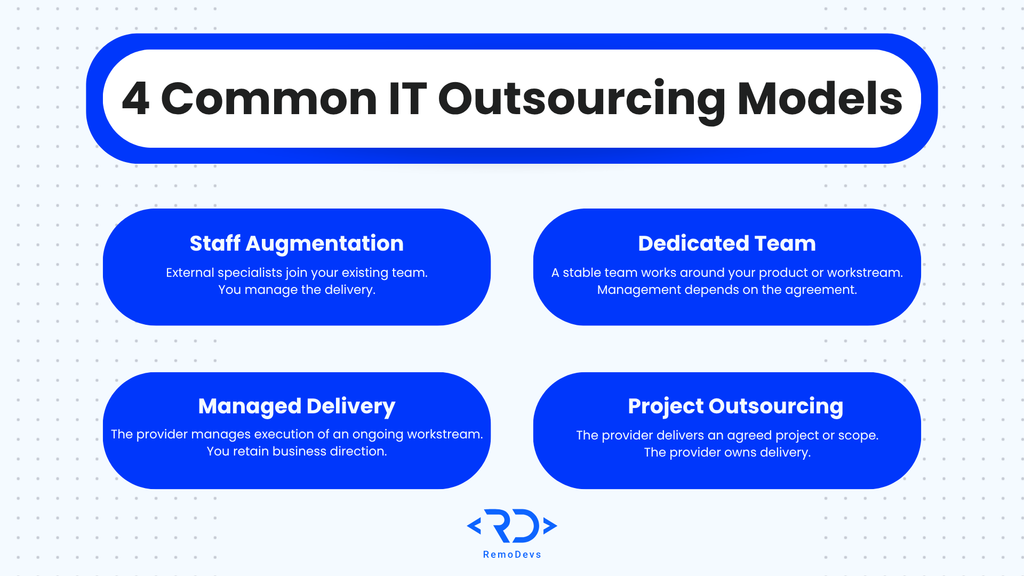
IT outsourcing models compared
| Model | Client responsibility | Provider responsibility | Team integration | Flexibility | Best suited for |
|---|---|---|---|---|---|
| Staff Augmentation / Team Extension | Owns backlog, priorities, technical direction and delivery; usually approves each specialist | Supplies and supports agreed specialists without normally owning the project outcome | Specialists join the client’s tools, processes and engineering team | Priorities and skills can change, subject to availability and notice terms | Adding specific capacity to an established engineering organization |
| Dedicated Development Team | May manage the team directly or share management with the provider, depending on the agreement | Provides a stable team and may also take responsibility for an ongoing workstream | A consistent group is allocated to one client or product | Roadmap can evolve, but the buyer usually commits to team capacity | Sustained product development requiring several complementary roles |
| Managed Team / Managed Delivery | Sets business direction, key priorities and governance | Organizes execution, manages the team and owns agreed workstream or service responsibilities | Team works closely with the client while retaining vendor-side management | Priorities can evolve within agreed capacity and governance boundaries | Running an ongoing capability with less client-side delivery management |
| Project-Based Outsourcing | Defines the business need, provides dependencies and approves scope or acceptance | Delivers the contracted scope or outcome and manages the delivery team | Team can remain largely within the provider’s organization | Scope changes normally require commercial and delivery review | A sufficiently defined application, migration or bounded project |
The table is a starting point, not a substitute for a responsibility matrix. A proposal should name the owner of backlog management, architecture, QA, releases, security, performance management, acceptance and handover.
Delivery model and pricing model are different decisions
Delivery models describe who manages the work and who is accountable for the result. Pricing models describe how the supplier charges.
Common commercial structures include:
- Hourly or daily Time & Materials: payment follows recorded effort or capacity.
- Monthly specialist or team rate: payment reserves agreed capacity for a period.
- Fixed Price: payment covers a defined scope under stated assumptions and acceptance rules.
- Milestone-based pricing: payments are triggered by agreed stages or deliverables.
- Hybrid pricing: part of the service is capacity-based while another part depends on milestones, service levels or outcomes.
There is no one-to-one mapping. Staff Augmentation is commonly sold through T&M or monthly rates, but a dedicated or managed team may use the same structure. A project can be fixed price, T&M or milestone-based.
This article deliberately does not compare detailed rates or fee mechanics. For current budgeting context, use RemoDevs’ guides to Staff Augmentation cost in Poland and Eastern Europe IT outsourcing rates. The planned IT Staff Augmentation Pricing Models article should become the deeper internal link once published.
Which outsourcing model fits your company?
Start with the capability your organization already has, not the label you prefer.
You have engineering leadership and need more capacity
Staff Augmentation is usually the cleanest fit. Your team can define work, make technical decisions and review delivery. The external specialist fills a skills or capacity gap without creating a second management structure.
If the requirement grows into a stable, multi-role group, the arrangement may become a dedicated Team Extension setup. Decide whether the client will continue to manage the entire team or whether some coordination should move to the provider.
You need a stable squad, but priorities will keep changing
A dedicated team or managed-capacity model may be more suitable than a fixed-scope project. The team can retain product knowledge while the roadmap evolves. The key choice is whether the client or provider supplies the delivery lead.
You need an outcome and cannot manage individual engineers
Look toward managed delivery or project outsourcing. Define the outcome, boundaries, dependencies and decision process before requesting a quote. If the work cannot yet be specified, begin with discovery or a limited validation stage rather than forcing premature fixed-price certainty.
You know exactly what needs to be delivered
Project outsourcing becomes more viable when scope and acceptance can be described credibly. Check that the provider is responsible for the complete delivery roles it needs, not only engineering hours. Dependencies on client systems and stakeholders still need named owners.
You are testing a longer-term presence in Poland
Team Extension can provide external capacity while the company learns the market. Direct recruitment may be better for roles that should become permanent internal capability.
You are unsure because different providers use different labels
Give each supplier the same responsibility table and ask it to complete the gaps. Compare the operating answers rather than trying to make every vendor accept one universal definition.
The decision can be reduced to four questions:
- Do we already have engineering leadership capable of managing external specialists?
- Are we buying people and capacity, or responsibility for an outcome?
- How stable are the scope and priorities?
- Which delivery responsibilities do we want the provider to own?
Once those answers are clear, provider proposals and pricing become easier to compare.
Why companies use Poland for these models
Poland’s relevance is operational, not a guarantee that every Polish supplier or engineer will be a good fit.
A substantial, experienced ICT labour market
The Polish Economic Institute reported approximately 770,000 ICT specialists in Poland in late 2025, equal to 4.5% of total employment. This is a broad occupational category, not a count of software developers available for outsourcing.
The hiring market is weighted toward experienced profiles. In Just Join IT’s 2026 report, based on advertisements published on that platform during 2025, senior positions represented 51.48% of listings and mid-level roles 43.73%.
Job-board data is not a national census, but it helps explain why Poland is used for experienced engineering, data, cloud and specialist requirements rather than only entry-level delivery.
The same report listed remote work as its largest work-model category, which supports sourcing beyond a single Polish technology hub. Availability still depends on the exact stack, seniority, domain, rate, location and working model, and every engagement should specify location, security and office-attendance requirements.
A national workforce figure should not be converted into a promise that a rare specialist can start immediately. RemoDevs’ 2026 Polish IT Market Report keeps those definitions and limitations separate.
Working-hour compatibility with European teams
Poland operates on Central European time and participates in the EU’s seasonal clock changes. This gives companies in much of Europe substantial same-day collaboration time. North American companies can also work with Polish teams, but overlap depends on the agreed schedule and is more limited, particularly with the US West Coast.
“Nearshore” therefore describes Poland well for many European buyers but not for every client. Calculate overlap from the actual working hours of the people involved rather than from geography alone. RemoDevs’ hidden-cost guide covers the coordination implications in more detail.
An EU business and data-protection environment
Poland has been an EU Member State since 1 May 2004. For EU and EEA buyers, that can make the regulatory context more familiar than a delivery arrangement outside the bloc.
It does not make an outsourcing contract automatically compliant. Data roles follow what each party actually does. The European Data Protection Board’s controller and processor guidance explains that a processor relationship requires a binding written arrangement and specific information about responsibilities and security. Buyers still need to review data access, subprocessors, intellectual property, confidentiality, security, tax and the contracting chain for the individual engagement.
Several contracting structures are visible in the market
Polish technology offers commonly distinguish employment compensation from B2B invoice amounts. A B2B contract is a contractual basis, not another outsourcing delivery model. It does not tell the buyer who owns the roadmap, manages the engineer or accepts project risk.
The same applies to EOR, payroll and permanent recruitment. They address legal employment or hiring structure. They may support a Poland strategy, but they should not be placed in the same category as Staff Augmentation, managed delivery or project outsourcing.
How RemoDevs fits into the outsourcing landscape
RemoDevs currently operates on the client-managed side of the spectrum.
Its IT Staff Augmentation service is designed for companies that already own the roadmap and delivery. RemoDevs supports requirement calibration, sourcing, screening, interview coordination, contracting and administration, onboarding coordination, ongoing communication and replacement support as defined in the agreement. The client selects the specialists, sets priorities, provides technical direction and manages day-to-day delivery.
The current focus covers senior and specialist requirements across software engineering, AI and machine learning, data, cloud and DevOps, quality engineering and technical leadership, with particular emphasis on difficult senior requirements.
RemoDevs does not currently present this service as vendor-managed project delivery, a universal EOR or a promise to run every outsourcing model described in this guide. A company seeking a supplier to own a complete project’s scope, milestones and outcome should evaluate managed software-development providers for that responsibility.
For permanent internal roles, RemoDevs separately provides IT recruitment in Poland. For recurring hiring capacity, its RPO service embeds a recruiter in the client’s hiring process. Those are hiring models, not software-delivery models.
If your organization has engineering leadership and needs selected Poland-based specialists to extend an existing team, discuss the requirement with RemoDevs. If you need the provider to own the entire delivery outcome, state that at the start so the operating model is not mistaken for Staff Augmentation.
Frequently asked questions
What are the main IT outsourcing models?
The most useful practical categories are Staff Augmentation or Team Extension, dedicated development teams, managed teams or managed delivery, and project-based outsourcing. They differ mainly in who manages the people and who accepts responsibility for delivery.
Is Staff Augmentation the same as IT outsourcing?
Staff Augmentation is commonly a form of IT outsourcing, but it is not the only form. External specialists join the client’s team while the client normally retains the backlog, technical direction and delivery responsibility. In managed or project outsourcing, the provider accepts more responsibility for running the work or delivering an agreed result.
What is the difference between Staff Augmentation and a dedicated team?
Staff Augmentation can involve one person or several people added to an existing team. A dedicated team usually describes a stable group reserved around one client or product. The dedicated team may still be client-managed, so the label does not by itself prove that the provider owns delivery.
What is the difference between outsourcing and managed services?
Outsourcing is the broader category. Managed services usually means the provider operates an ongoing function or service under defined responsibilities, governance and often service levels. Project outsourcing is typically bounded by a project or deliverable; Staff Augmentation supplies capacity that the client manages.
Is Poland a good location for IT outsourcing?
Poland can be a strong fit when a company values access to an established ICT labour market, Central European working hours, remote collaboration and an EU business environment. Fit still depends on the role, provider, responsibility model, security requirements and total delivery cost. Poland should not be selected on a generic “cheap developers” claim.
Which outsourcing model gives the client the most control?
Staff Augmentation normally gives the client the most direct control because the client selects specialists and manages their daily work. That control also brings responsibility for prioritization, technical leadership, integration and delivery.
Can a company combine Staff Augmentation and project outsourcing?
Yes. A company may augment its core product team while outsourcing a bounded migration, application or testing workstream to another provider. The interfaces must be explicit: ownership of architecture, repositories, environments, acceptance, incidents and cross-team dependencies should not be left between contracts.
Visit us
Find a moment in your calendar and come to our office for a delicious coffee
Make an apointment