
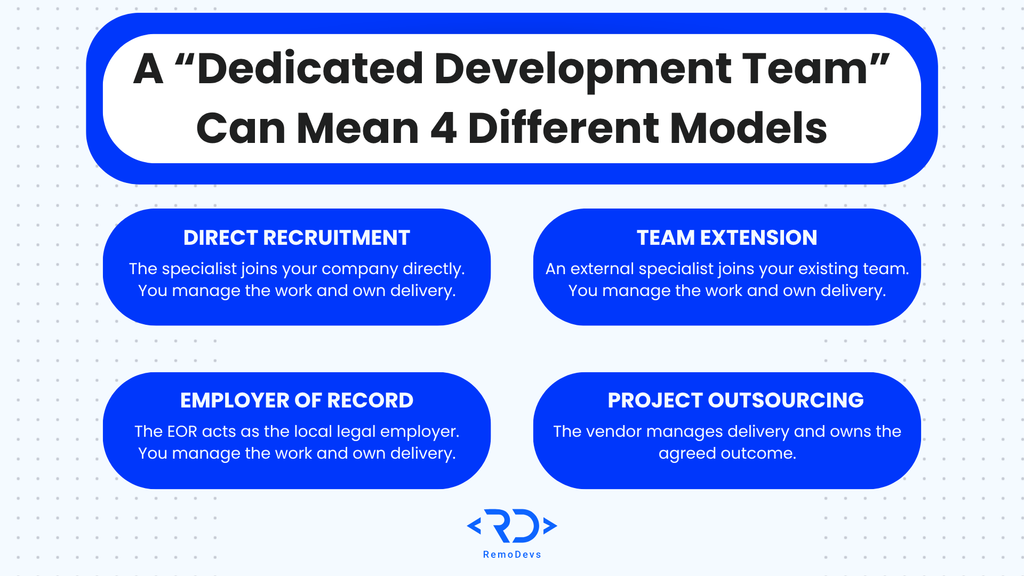
“Dedicated development team” is used to describe several very different services. One provider may mean a vendor-managed delivery team responsible for an agreed project. Another may mean individual specialists who become part of the client’s existing engineering organization. A third may be describing permanent recruitment or employment through an Employer of Record.
Those models are not interchangeable. They assign hiring, employment, day-to-day management and delivery responsibility to different parties.
This guide focuses on team extension: Polish technology specialists join your existing team for an agreed period, while you retain control of the roadmap, backlog, technical standards and daily work. RemoDevs supports this model through its IT outsourcing service by handling specialist sourcing, screening, coordination and the administrative scope agreed for the engagement.
If you instead need a supplier to own project management, milestones and delivery of a defined output, you are looking for managed project outsourcing rather than the service described here.
First, Define What “Dedicated Team” Means for Your Company
The safest way to start is to name the operating model before discussing roles or rates.
| Model | Typical relationship | Who manages daily work? | Who owns delivery? | Best suited to |
|---|---|---|---|---|
| Direct recruitment | The selected person joins the client directly under the agreed hiring arrangement | Client | Client | Building permanent internal capability |
| Team extension / staff augmentation | External specialists work within the client’s team through an agreed provider arrangement | Client | Client | Adding expertise or capacity to an existing delivery organization |
| Employer of Record (EOR) | The EOR is the legal employer and handles the employment and payroll framework | Client, within the agreed employment structure | Client | Employing someone locally without the client’s own entity |
| Managed project outsourcing | A vendor organizes a team and delivery process around an agreed scope | Vendor | Vendor, within the contract | Buying a defined project, workstream or outcome |
A B2B contract is a contractual form, not a separate delivery model. It may be used within different commercial arrangements, but calling an engagement “B2B” does not explain who manages the specialist or who is accountable for the project.
Why Companies Consider Poland for Team Extension
Poland offers access to experienced software, data, AI, cloud and security professionals across several established technology hubs and a nationwide remote market. Its Central European time zone supports full working-day collaboration across Europe and planned overlap with teams farther west.
However, Poland should not be treated as an unlimited pool of immediately available engineers. The European Commission’s 2026 Digital Decade Country Report for Poland describes the country’s pool of ICT specialists as stagnating. Senior specialists with a rare combination of domain, architecture and communication experience still need to be actively sourced and given a credible reason to join an engagement.
Market size claims also require careful definitions. Eurostat’s ICT specialist dataset covers a broad occupational category; it should not be relabelled as a count of software developers. A practical hiring plan should therefore be based on the current availability of the specific skills you need, not on a large national headline number.
The business case for Poland is strongest when it combines:
- access to relevant senior expertise;
- workable collaboration and communication;
- a delivery model that fits your internal organization;
- a like-for-like total-cost comparison;
- clear contractual, security and intellectual-property terms.
When Team Extension Is the Right Model
Team extension works best when your company already has the structure required to lead delivery.
It is usually a good fit when:
- you own the product roadmap and can define priorities;
- an engineering manager, technical lead or product owner can manage the work;
- your team lacks a specific capability or needs additional capacity;
- the specialist will work inside your existing tools, ceremonies and engineering standards;
- you want to retain architectural and product decisions internally;
- the expected scope or duration may evolve.
Consider a different model when:
- you need a vendor to accept responsibility for a fixed scope, timeline and outcome;
- nobody in your organization can own the backlog or review the work;
- you specifically require a local legal employer and payroll service;
- the role is intended to become a permanent internal position from the start.
In the final case, direct IT recruitment in Poland is usually the clearer route.
How to Build the Team Step by Step
1. Define the Capability Gap, Not an Arbitrary Headcount
Starting with “we need a team of five” can lock you into a structure before the actual bottleneck is understood. Start with the business and technical problem instead.
A useful requirement should explain:
- the product, platform or workstream involved;
- the result the specialist is expected to support;
- the current architecture and technology stack;
- which expertise is essential and which can be learned;
- the level of autonomy expected;
- the internal people who will work with the specialist;
- communication, location and time-zone expectations;
- security or industry constraints;
- the preferred start date and likely engagement horizon;
- the budget basis and what it must include.
This makes it possible to decide whether you need a senior engineer, an architect, a security specialist or a different combination altogether.
2. Assign Ownership Before Sourcing Begins
The client and provider should agree on responsibilities before candidates enter the process.
| Area | Client | RemoDevs |
| Product roadmap and priorities | Owns | Uses as context for the search |
| Backlog and day-to-day direction | Owns | Does not take over daily delivery management |
| Architecture, quality standards and code review | Owns | Screens for relevant experience against the agreed requirements |
| Role and market calibration | Provides business and technical context | Leads calibration and shares market feedback |
| Sourcing and initial screening | Reviews the agreed profile | Leads |
| Final interviews and selection | Decides | Coordinates and supports |
| Access, security and technical onboarding | Owns | Coordinates the agreed onboarding steps |
| Contractual and administrative scope | Provides required information and approvals | Handles the elements specified in the agreement |
| Project deadlines and delivery outcomes | Owns | Does not assume end-to-end project responsibility |
| Engagement issues and replacement | Provides timely feedback and decisions | Supports resolution and replacement under the agreed terms |
This division is the central difference between team extension and managed project outsourcing.
3. Choose the Smallest Team Shape That Solves the Current Problem
There is no universal “ideal” dedicated team composition. The right sequence depends on the work already owned by your internal team.
For example:
| Situation | A sensible starting point | Add another role when… |
| A data platform needs stronger implementation capacity | Senior Data Engineer | architecture or AI adoption becomes the main constraint |
| An AI initiative lacks technical direction | AI Architect | the data foundation and use case have been validated |
| A security gap requires specialist ownership | Security Specialist | remediation work exceeds the current team’s capacity |
| A backend platform needs senior expertise | Senior Java or Python Engineer | cross-system architecture becomes the bottleneck |
These are starting hypotheses, not packaged teams. Validate the first requirement, integrate the specialist and then decide whether another capability is necessary.
4. Turn the Requirement Into an Evidence-Based Scorecard
Avoid evaluating candidates against a loose list of technologies. Define what evidence would demonstrate that someone can succeed in the actual environment.
The scorecard may cover:
- comparable technical problems solved;
- scale, complexity and production responsibility;
- depth in the required architecture or tools;
- decisions made personally rather than only observed;
- ability to explain trade-offs and risks;
- collaboration with product, security or data stakeholders;
- written and spoken communication;
- availability, expectations and working-model fit.
The assessment method should follow the role. A system-design discussion may be valuable for an architect, while a review of past incident ownership may provide better evidence for a security or platform specialist. There is no defensible universal pass rate, “top percentage” or identical test that proves quality across every search.
5. Run a Focused Selection Process
A practical team-extension search usually includes:
- calibration of the role and market;
- active sourcing against the agreed scorecard;
- screening for relevant experience, communication and engagement fit;
- presentation of focused, relevant profiles;
- client-led technical and team interviews;
- final selection by the client;
- contractual and onboarding coordination.
Additional technical exercises, reference checks or security verification should be used where they are relevant and agreed, not presented as automatic steps in every search.
The goal is not to claim that a fixed percentage of the market has been filtered out. It is to show why each presented specialist matches the work, environment and constraints discussed at calibration.
6. Confirm Contract, Compliance and Security Terms
The commercial model should be documented before the specialist starts. At minimum, confirm:
- the contracting parties and the exact role of each party;
- the services covered and the working model;
- fees, currency, invoicing and applicable tax treatment;
- confidentiality and intellectual-property provisions;
- data-processing and information-security obligations;
- equipment, software licences and system access;
- expected availability and communication rules;
- notice, termination and handover;
- liability and acceptance rules where relevant;
- replacement scope and process;
- governing law and dispute resolution.
Do not assume that an invoice automatically resolves intellectual-property ownership or that every external specialist arrangement operates as employment. The relevant structure should be reviewed against the current Polish Civil Code, Labour Code, Copyright Act and later amendments, with qualified legal and tax advice for the specific engagement.
The RemoDevs service described in this article is not a universal EOR or payroll promise. If your organization requires an EOR to act as the legal employer, assess that as a separate requirement and confirm which provider is responsible for employment, payroll and statutory obligations.
7. Onboard the Specialist as Part of the Team
An external specialist still needs the context required to contribute safely and effectively. Before the start date, prepare:
- a named internal owner;
- access to the appropriate systems under least-privilege rules;
- architecture, product and process documentation;
- a clear initial workstream and definition of done;
- communication channels and meeting expectations;
- code-review, testing and release standards;
- a feedback route for both the specialist and the internal team;
- a handover process for the end of the engagement.
The specialist should know who sets priorities, who approves technical decisions and how blockers are escalated. RemoDevs can coordinate the agreed onboarding steps, but product and delivery ownership remains with the client.
How to Compare the Cost of Different Models
Avoid comparing a US employee’s total compensation with only a Polish contractor’s invoice or base rate. That combines unlike cost bases and can produce a misleading savings percentage.
Build each scenario from the same categories:
| Cost category | Direct hire | Team extension | EOR | Managed outsourcing |
| Compensation or specialist fee | Include | Include | Include | Usually included in vendor price |
| Employer contributions and payroll | If applicable | Depends on structure | Include | Vendor responsibility unless agreed otherwise |
| Recruitment or provider fee | Include | Include | Include | Usually embedded or separately stated |
| Benefits, equipment and licences | Include where applicable | Confirm allocation | Confirm allocation | Confirm what the vendor provides |
| Internal management and onboarding | Include | Include | Include | Depends on the delivery split |
| Currency, tax and legal setup | Include | Include | Include | Include |
| Minimum commitment, notice and transition | Confirm | Confirm | Confirm | Confirm |
Ask every provider to state what the quoted price includes and excludes. Compare the complete engagement cost, operating responsibility and risk, not only the headline rate.
What RemoDevs Does in This Model
RemoDevs helps companies add selected senior technology specialists to an existing team. The current focus includes Data, AI and Security, as well as selected senior Java, Python and Solution Architecture requirements.
Depending on the agreed engagement, support may include:
- role and requirement calibration;
- active sourcing across Poland;
- screening for relevant technical experience, business context and team fit;
- candidate presentation and interview coordination;
- contractual and administrative support defined in the agreement;
- onboarding coordination and ongoing communication;
- replacement support under the agreed terms.
The client meets the specialists, makes the final selection, manages the backlog and daily work, and remains accountable for product and project delivery.
Questions to Ask Before Choosing a Team-Extension Partner
Use these questions to make competing offers comparable:
- Are the proposed specialists named and interviewed by us before the engagement?
- Who manages their daily work and who owns the delivery outcome?
- What screening is performed for this specific role?
- What exactly is included in the provider’s commercial rate?
- Who is the contractual counterparty for each part of the arrangement?
- Which party handles intellectual property, confidentiality, data protection and security documentation?
- What onboarding and ongoing engagement support is included?
- What are the notice, replacement and handover terms?
- Are there minimum duration, volume or availability commitments?
- Which assumptions remain subject to legal, tax or security review?
Clear answers matter more than labels such as “dedicated team,” “outsourcing” or “fully managed.”
Frequently Asked Questions
Is a dedicated development team the same as staff augmentation?
Not always. “Dedicated team” is used inconsistently. In this guide, it means specialists who work consistently within the client’s existing organization. The precise service is team extension or staff augmentation: the client manages daily work and owns delivery. In managed project outsourcing, the vendor normally manages the delivery team and accepts responsibility for the agreed output.
Who manages specialists provided by RemoDevs?
The client manages priorities, backlog, technical standards and day-to-day work. RemoDevs handles sourcing, screening, coordination and the administrative elements specified in the agreement.
Does RemoDevs act as an Employer of Record?
The team-extension service described here should not be presented as a universal EOR or payroll service. If a legal-employer structure is required, it must be identified separately and the responsible EOR and scope must be confirmed before the engagement.
Can we start with one specialist rather than a complete team?
Yes, the model can begin with a single capability gap and expand only when another role is justified. The final scope depends on the requirement, current market availability and commercial agreement.
How quickly can a Polish specialist join our team?
There is no reliable universal timeline. It depends on the role, seniority, domain, technology, working model, rate, notice period and interview process. RemoDevs calibrates the requirement against the current market before giving a realistic estimate.
What if we want to hire the person permanently?
If the objective is a direct long-term hire rather than external team extension, use a permanent recruitment model and agree the relevant transition or recruitment terms from the outset.
Build the Right Operating Model Before You Build the Team
A successful Poland-based team does not begin with a generic headcount, an unsupported savings claim or a promised shortlist size. It begins with a clear capability gap, internal delivery ownership, an appropriate engagement model and responsibilities that are written down before work starts.
If your existing team needs senior Data, AI, Security, Java or Python expertise, discuss an IT outsourcing and team-extension requirement with RemoDevs. We will calibrate the role, assess the current Polish market and explain the proposed engagement scope before the search begins.
Sources and Methodology
This article was reviewed on August 20, 2026. Market context is based primarily on official EU sources, including the European Commission’s 2026 Digital Decade Country Report for Poland and Eurostat’s ICT specialists in employment dataset.
Legal context links to official Polish consolidated acts: the Civil Code, Labour Code and Copyright Act. Readers should check later amendments and obtain advice for their specific facts.
Eurostat’s “ICT specialists” category is broader than software developers. This article therefore does not convert it into a developer headcount. It also does not present universal rates, savings percentages, screening pass rates, shortlist sizes or hiring timelines. RemoDevs service statements are limited to the team-extension model described above; contracting, administration, replacement and onboarding details remain subject to the individual agreement.
Visit us
Find a moment in your calendar and come to our office for a delicious coffee
Make an apointment