
The shift to distributed work has solved many critical talent shortages, but global companies still struggle to maintain high productivity levels. While the idea of a remote tech team sounds appealing on paper, why is it that simply hiring remote workers isn’t enough?
The truth is, productivity doesn’t happen by accident – it requires a cohesive strategy, the right digital infrastructure, and deep cultural alignment.
Building a high-performing software team requires a combination of strategic geographic sourcing, outcome-focused management, and a recruitment partner fully invested in your long-term success. If you want a team that scales and delivers, you need more than just warm bodies in virtual seats.
The Foundation: Sourcing the Right Talent Strategically
When building your team, you must look beyond traditional resumes. The key to a thriving distributed workforce lies in hiring proactive problem-solvers who possess the soft skills required to thrive in a remote-first environment. Autonomy, analytical thinking, and a collaborative mindset are non-negotiable.
The geographic advantage plays a crucial role in this process. Location still matters significantly for time-zone overlap, cultural compatibility, and budget efficiency. This is exactly why global CTOs are increasingly choosing to build a remote team in Poland.
Here is why Poland stands out as a top-tier destination for tech talent:
- Factual Data: Poland offers access to a massive, highly educated talent pool of over 650,000 IT specialists ready to tackle complex technical challenges.
- Elite Quality: Polish developers consistently rank in the top 3 globally on platforms like HackerRank, proving their elite coding, mathematical, and problem-solving abilities.
- Seamless Communication: Language barriers are non-existent, as Poland ranks in the “Very High Proficiency” category on the EF English Proficiency Index.
To capitalize on this talent pool, companies must undergo a mindset shift. You need to move away from short-term freelance hires and instead focus on building dedicated, long-term team extensions. This is where strategic recruitment becomes your competitive advantage, ensuring you attract passive candidates who are searching for meaningful technical development.
Best Practices for Managing Remote Developers
Once you have sourced elite talent, the next hurdle is execution. Managing remote developers effectively requires a fundamental shift to an outcome-based management approach. You must track results, code quality, and project deliverables rather than micro-managing hours logged.
Mastering communication is another vital component of your operational framework. Effective communication forms the backbone of successful remote product teams, and the key lies in establishing clear protocols:
- Balancing Workflows: You must find the right balance between synchronous tools (Zoom/Teams) for brainstorming and asynchronous platforms (Jira or Trello) for deep, uninterrupted work.
- Agile Rituals: Implement effective agile rituals, such as daily standups and weekly retrospectives, to maintain alignment without micromanaging your engineers.
- Clear Documentation: Establish precise documentation standards for all project decisions so no one is left in the dark when working across different hours.
Building a thriving engineering culture from afar is equally critical. You have to treat remote developers exactly like your core, in-house employees to foster true engagement.
- Regular 1-on-1s: Schedule regular one-on-one meetings to maintain personal connections, discuss career development, and build trust.
- Public Recognition: Implement public recognition for achievements, project milestones, and performance to keep your team motivated and appreciated.
- Virtual Activities: Organize virtual coffee breaks, team-building activities, and pair programming sessions to encourage natural knowledge sharing.
By adopting these practical tips for managing remote developers, you optimize productivity and create transparency in work progress while maintaining flexibility. Learn more about building strong team cohesion remotely to maximize your team’s potential.
| Pillar | What It Means | Why It Matters |
| Strategic Sourcing | Hiring in high-quality global talent hubs | Improves collaboration & efficiency |
| Remote-First Skills | Autonomy, problem-solving, communication | Ensures productivity without supervision |
| Outcome-Based Management | Measure results, not hours | Drives performance & accountability |
| Strong Documentation | Clear project decisions & workflows | Reduces confusion across time zones |
| Cultural Alignment | Treat remote staff as core team members | Boosts engagement & retention |
Overcoming Common Remote Team Challenges
Even with the best talent and management practices, distributed teams face inevitable hurdles. However, with the right strategy in place, these challenges can be seamlessly mitigated.
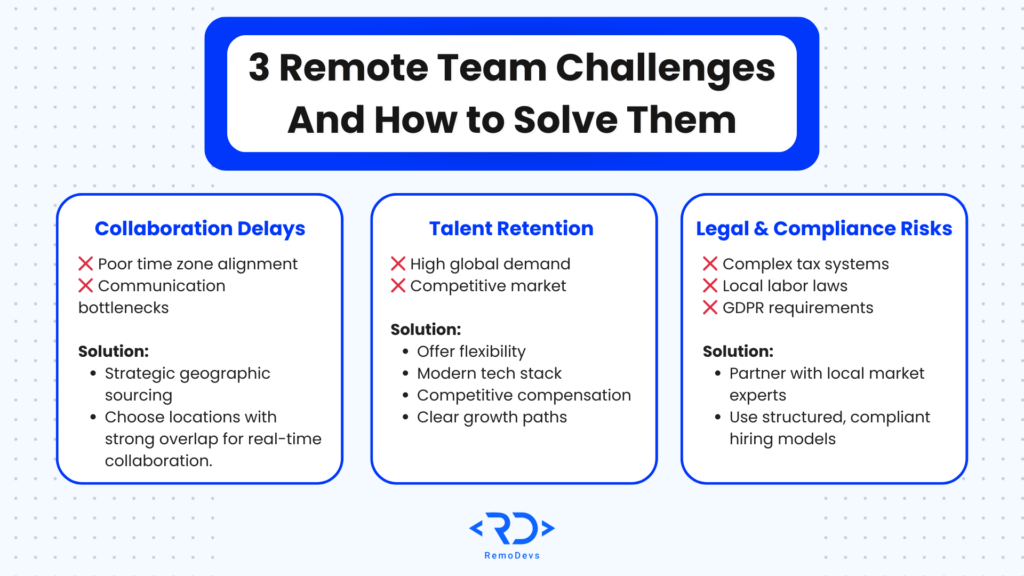
Challenge 1: Collaboration Delays.
Solution: Delays often stem from poor time zone alignment and communication bottlenecks. Leveraging strategic locations solves this immediately. For example, Poland offers a 1–9 hour overlap with the US and full working-hour overlap with the EU, enabling real-time problem-solving and highly responsive workflows.
Challenge 2: Talent Retention in a Competitive Market.
Solution: Top-tier developers are in incredibly high demand. To retain them, you must offer genuine flexibility, modern tech stacks, and competitive compensation. Fortunately, Polish developers provide elite engineering quality at 30-50% less than US or Western European rates, allowing you to allocate your budget toward better tools, benefits, and incentives.
To attract passive, high-quality talent in the first place, your job descriptions and hiring process must be heavily optimized and candidate-friendly.
Challenge 3: Legal & Compliance Hurdles.
Solution: Building a distributed team requires understanding local employment laws, complex tax obligations, and distinct contract requirements. Navigating GDPR compliance and B2B contracts seamlessly is best done by utilizing local market experts.
An experienced IT Talent Acquisition Agency can handle these legal complexities on your behalf, reducing your risk to zero.
The Value of a Long-Term Strategic Partner
Traditional transactional recruiting – such as outdated body leasing or simple placements – frequently fails to yield productive remote teams. These methods focus purely on filling a seat quickly, entirely ignoring cultural fit, soft skills, and long-term project alignment.
The RemoDevs difference is rooted in a much deeper philosophy. We act as an extension of your company, which shows we are partners for the long term, not just the placement. We are fundamentally invested in your overarching business goals and scaling success.
RemoDevs ensure long-term productivity through a structured and rigorous process. Our IT experts conduct deep technical vetting, filtering out 90% of candidates before you even see them. We pair this with profound cultural matching and proven methods to drastically reduce time to hire. Furthermore, our rock-solid guarantees, like our 90-day replacement guarantee, ensure your team scales successfully over years, not just months.
Conclusion
A productive remote engineering team is built on intentional culture, smart management practices, and accessing world-class talent hubs like Poland. By combining strategic hiring with outcome-based management, you can overcome common global collaboration challenges and build a sustainable, high-performing distributed workforce.
Don’t settle for short-term fixes or high-turnover transactional hiring. Build a high-performing, long-lasting remote tech team with a partner who is fully invested in your success, contact RemoDevs today to hire elite, vetted Polish software engineers and start your 30-day free trial.
Visit us
Find a moment in your calendar and come to our office for a delicious coffee
Make an apointment