
Staff augmentation works when a company needs additional engineering capacity but still wants to own the roadmap, priorities and day-to-day delivery. It is a poor fit when the company actually wants a vendor to take responsibility for an entire project or business outcome.
That distinction matters more than advertised savings, country rankings or the size of a supposed “developer pool.” This guide explains how the model works, when Poland may be a practical sourcing market and what a buyer should verify before signing an agreement.
If you have already chosen the model and want to discuss a specific role, see RemoDevs’ IT staff augmentation service in Poland. The rest of this article is for teams still evaluating fit, responsibilities and commercial terms.
The short answer: what is staff augmentation?
In a staff augmentation engagement, an external specialist joins the client’s existing team for an agreed period or workload. The client normally controls the backlog, tools, engineering standards and daily work. The provider sources or supplies the specialist and handles the commercial and administrative responsibilities stated in the agreement.
The final sentence is important. Staff augmentation is an operating model, not a single legal structure. It does not automatically mean that the provider is an employer of record, runs international payroll, assumes responsibility for the finished product or guarantees every aspect of tax, data protection and intellectual-property compliance. Those responsibilities must be identified in the proposal and contract.
Who owns what in a staff augmentation engagement?
The cleanest way to understand the model is to map responsibility before discussing candidates.
| Area | Client’s typical role | Provider’s typical role | What to confirm |
| Roadmap and backlog | Sets priorities and decides what is built | Provides context or engagement support | Who may change priorities and approve scope |
| Day-to-day work | Assigns tasks and manages delivery | Supports communication and escalations | Working hours, reporting line and availability |
| Engineering decisions | Owns architecture, standards, reviews and acceptance | Does not normally own technical delivery | Access, review process and definition of done |
| Role definition | Explains outcomes, constraints and must-have evidence | Calibrates the search against the brief | Which requirements are essential and which are flexible |
| Candidate evaluation | Meets candidates and makes the final selection | Sources and performs the agreed initial screening | Who runs technical assessment and what has already been checked |
| Commercial administration | Reviews and approves the structure | Handles the agreed contracting, invoicing and coordination | Contracting chain, taxes, insurance, notice and replacement terms |
| Delivery outcome | Remains accountable for the product or workstream | Supplies capacity rather than a guaranteed outcome | Whether any managed-delivery responsibility has been added |
If the provider manages the team, controls delivery and is accountable for an agreed result, the engagement is moving toward project outsourcing or a managed service. That may be the right choice, but it should not be sold as interchangeable with client-managed staff augmentation.
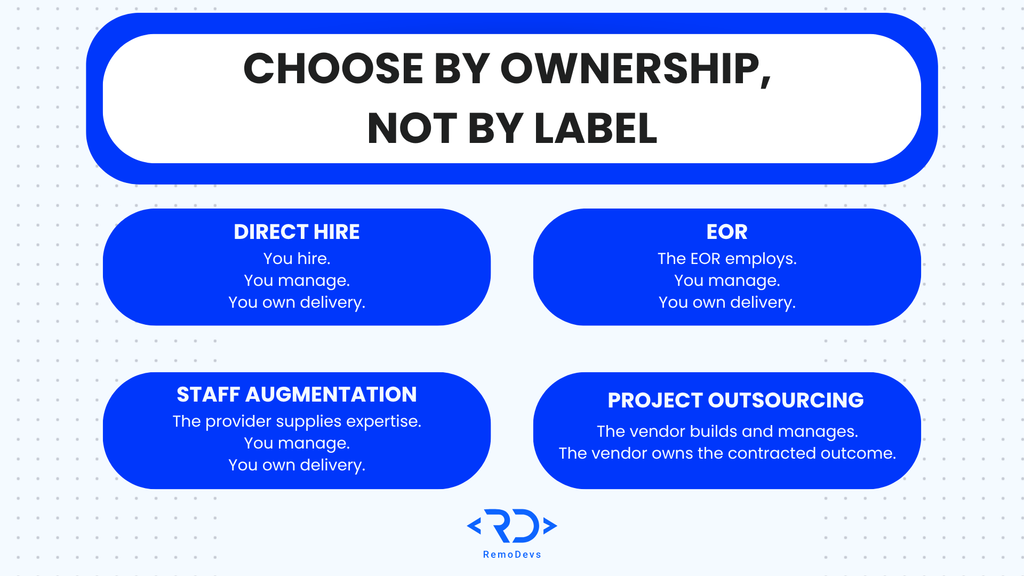
Staff augmentation, direct hiring, EOR and outsourcing are different choices
These models solve different problems. Choosing by label alone creates confusion because terms such as “team extension” and “dedicated team” are used inconsistently across the market.
| Model | Who engages the specialist? | Who manages daily work? | Who owns delivery? | Best fit |
| Direct recruitment | The client hires or contracts with the selected person | Client | Client | Permanent or long-term core headcount |
| Employer of record (EOR) | The EOR is the local legal employer; the client directs the work | Client | Client | An employee in Poland when the client lacks a local employing entity |
| Staff augmentation | A provider supplies a specialist under an agreed commercial structure | Client | Client | Temporary capacity, a specialist skill gap or an evolving workstream |
| Project outsourcing | The vendor assembles and manages the delivery team | Vendor within the contracted scope | Vendor within the contracted scope | A defined project or outcome the client wants the vendor to deliver |
Recruitment process outsourcing (RPO) is different again. It delegates part or all of the client’s recruitment function; it does not by itself determine how the successful candidate will be employed or who will manage their engineering work.
“Team extension” often describes longer-running staff augmentation involving one or more people. “Dedicated development team” can mean either a client-managed extended team or a vendor-managed delivery unit. Ask who owns the backlog, technical decisions and contracted outcome. The answers matter more than the name on the proposal.
For a wider comparison of engagement routes, see our guide to hiring software developers in Poland.
When staff augmentation is a good fit
The model tends to work well when:
- an internal engineering or product leader can manage the additional specialist;
- the team needs a skill it does not currently have, such as data engineering, AI architecture, security or a specific backend stack;
- demand is real but its duration does not justify a permanent role yet;
- the scope will evolve and direct collaboration is more useful than a fixed specification;
- the company wants the specialist to work inside its tools, rituals and code-review process; or
- the company needs capacity for a migration, launch, backlog or temporary gap while retaining delivery control.
It is usually the wrong starting point when:
- nobody inside the company has time or expertise to direct the work;
- the buyer wants a fixed outcome and expects the vendor to manage delivery risk;
- the position is a permanent leadership or product-ownership role that should sit inside the company;
- the real requirement is local employment through an EOR; or
- procurement, security or regulatory constraints rule out the provider’s proposed contracting chain.
Staff augmentation can be flexible, but it is not management-free. The client still needs to set priorities, review work, make decisions and create the conditions for the specialist to contribute.
Why source in Poland without turning the country into a marketing claim
Poland can be a practical nearshore market for European teams and a workable remote market for companies farther west. It is an EU member state, operates on Central European time and has established technology communities across several cities.
Public data also supports the existence of a continuing ICT education pipeline, but the definitions must be handled carefully. Eurostat reported that in 2025, 76.8% of employed people in Poland with an ICT education were aged 15–34. Its category includes computer science, software development, database and network fields, computer use and interdisciplinary ICT programmes. Eurostat also notes that a person with an ICT education may not use that education in their current work. The dataset therefore cannot be presented as a count of software developers, senior engineers or immediately available contractors. Read Eurostat’s definitions and 2025 data.
The European Commission’s 2025 Digital Decade report for Poland still recommends measures to increase the number of ICT specialists. That is a useful reality check: Poland has a meaningful technology labour market, but scarce senior profiles remain competitive.
Three conclusions follow:
- Do not convert broad ICT statistics into a precise “developer pool.”
- Do not use an old country ranking from a coding platform as proof that a particular candidate can do the job.
- Do not assume that a specialist is available because the provider has met them before. Skills, motivation, rate expectations and availability must be checked for the current role.
Poland is a sourcing market, not a quality guarantee. Candidate evidence and engagement design still decide the outcome.
Compare total cost, not a salary with an hourly rate
A staff augmentation quote may be hourly, daily or monthly. The client-facing price can include sourcing, the specialist’s compensation, provider margin and some administrative support. Another proposal may separate several of those items. Until the inclusions are clear, two headline rates are not comparable.
A simple starting formula is:
Planned engagement cost = client-facing rate × planned billable time + costs not included in the rate
Depending on the agreement, the second part may include:
- equipment, licences and system access;
- travel or occasional on-site work;
- currency conversion and international payment costs;
- security, legal and tax review;
- internal onboarding and management time;
- overtime, minimum commitments or non-standard working hours; and
- offboarding and knowledge transfer.
When comparing this with direct employment, add the employee’s compensation, employer costs, benefits, equipment, recruitment, onboarding and internal management. For an EOR scenario, include the EOR fee and any deposits or additional service charges. For project outsourcing, account for delivery management, QA, scope changes and the risk premium built into a fixed-price contract.
Do not compare a Polish contractor invoice or staff augmentation rate with a US employee salary and call the difference “savings.” Use the same period, currency, seniority, workload and scope on both sides. Our Poland–US developer cost comparison shows how assumptions change the result. For broad client-facing provider benchmarks, see the methodology in our Eastern Europe outsourcing rates guide.
Staff augmentation may cost less than one alternative and more than another. Its business case can also rest on access, timing and flexibility rather than a universal percentage saving.
Ten questions to ask a staff augmentation provider
1. Which roles do you genuinely recruit for?
Ask for recent, relevant experience by role and seniority. A provider that regularly sources data engineers may not be equally strong in embedded systems, SAP or mobile development.
2. What is the exact contracting chain?
Identify every party involved. Confirm who contracts with the specialist, who invoices the client and which entity handles each administrative responsibility. Do not infer EOR or payroll services from the phrase “staff augmentation.”
3. What has been checked before a profile reaches us?
Request a role-specific answer: recent project relevance, communication, availability, rate, location, working-hour overlap and any technical evidence. “Pre-vetted” is not enough unless the provider explains what it means for this search.
4. Who owns the technical assessment?
The client should know whether the provider performs recruiter screening, a structured technical interview, an assessment designed with the client or no technical validation at all. The final technical and selection decision should have a named owner.
5. Is the proposed timeline a target or a guarantee?
Availability changes with seniority, stack, budget, location and interview speed. Ask what the timeline measures: first profile, completed shortlist, accepted offer or start date.
6. What does the rate include?
Confirm billable hours, holidays, sick time, overtime, equipment, travel, currency, payment terms, minimum commitments and provider fees. Also ask what can change the rate during the engagement.
7. How do notice and replacement work?
Review notice periods, replacement conditions, rate changes, handover obligations and any fees triggered when the engagement ends early. A replacement clause supports continuity; it does not eliminate the operational cost of a mismatch.
8. How are IP, confidentiality and open-source obligations handled?
The agreement should address code, documentation, inventions, pre-existing materials, licences, confidential information and work created during the engagement. Poland’s Patent Office provides a useful overview of copyright, database rights, trade secrets and other forms of intellectual property, but the actual contract should be reviewed for the intended structure and jurisdictions.
9. What happens when personal data or sensitive systems are involved?
EU membership does not make an engagement automatically GDPR-compliant. Map the actual data flows and access. Where one party processes personal data on behalf of another, Article 28 of the GDPR sets requirements for the arrangement. The European Data Protection Board also stresses that controller and processor roles depend on the factual allocation of purposes and means, not only the labels in a contract. See the EDPB’s final Guidelines 07/2020.
Confirm access controls, device rules, incident reporting, subprocessors, retention, deletion and any international data transfers with qualified legal and security advisers.
10. What is the onboarding and exit plan?
Ask who grants access, documents decisions, reviews the first weeks and owns knowledge transfer. A flexible contract is useful only if the team can add and remove capacity without losing critical context.
A practical implementation process
1. Define the capacity problem
Describe the work that is blocked, the expected contribution and why the current team cannot cover it. “We need a senior Python developer” is weaker than “we need someone who can own API performance work in an existing FastAPI and PostgreSQL environment for the next two quarters.”
2. Build a role scorecard
Separate must-have evidence from preferences. Include responsibilities, technical environment, seniority, working-hour overlap, language, location, budget, expected duration and interview owners.
3. Confirm the operating and contractual model
Decide whether the real need is staff augmentation, direct hiring, EOR or project outsourcing. Then review the proposed contracting chain, pricing, data access, IP terms, notice and replacement provisions.
4. Evaluate candidates against the current role
Use the same scorecard for every candidate. Review relevant past work, ask scenario-based questions and let the client’s technical team validate the evidence that matters for the role. An old test result or generic database status should not replace a current assessment.
5. Onboard the specialist as part of the team
Provide product context, architecture documentation, access, coding standards, decision paths and a named internal owner. Agree on the first deliverables and the feedback cadence before work begins.
6. Review contribution and plan the exit
Track outcomes relevant to the work rather than hours alone. Review the engagement at agreed intervals and keep documentation current. If the role ends or moves in-house, allow enough time for knowledge transfer and access removal.
Common reasons the model fails
- The buyer wants outsourced delivery but purchases capacity. The specialist waits for direction while the client expects the provider to own the result.
- The brief is a wish list. A rare combination of skills, a restricted location, an aggressive rate and an immediate start can shrink the realistic market to almost nobody.
- “Vetted” is never defined. Each side assumes someone else checked technical depth, availability or motivation.
- There is no internal owner. The specialist joins meetings but lacks priorities, context and timely decisions.
- Commercial terms are reviewed too late. Rate inclusions, data access, IP, notice and substitution become urgent only after work has started.
- Offboarding is improvised. Documentation and system knowledge leave with the specialist.
Most of these problems can be found before the first profile is presented. A clear brief and responsibility map are more useful than a promise to deliver a large shortlist in a fixed number of days.
How RemoDevs supports staff augmentation in Poland
Disclosure: RemoDevs provides recruitment and staff augmentation services in Poland. This section describes our own published service scope.
RemoDevs focuses its staff augmentation offer on senior Data, AI and Security specialists, alongside selected Senior Java, Senior Python and Solution Architecture requirements.
The client explains the work, meets the proposed specialists, makes the final selection and manages the backlog, tools and day-to-day delivery. RemoDevs supports role calibration, active sourcing, initial screening, interview coordination, the agreed contractual and administrative work, onboarding coordination and ongoing communication.
The process is role-specific. A candidate is not universally suitable because they were screened for another company, and timing depends on the requirements and current market availability. Our article on how RemoDevs screens software engineers explains which checks are performed and which decisions remain with the client.
If the responsibility model in this guide matches your requirement, review the RemoDevs staff augmentation service or discuss the role, expected duration and working setup with our team.
Frequently asked questions
Is staff augmentation the same as project outsourcing?
No. In staff augmentation, external specialists work inside the client’s team and the client manages delivery. In project outsourcing, the vendor normally manages its delivery team and is responsible for an agreed scope or outcome.
Is team extension different from staff augmentation?
The terms often overlap. “Team extension” usually suggests a closer or longer-running addition to an existing team, but it has no universal commercial definition. Confirm who manages the work, who owns delivery and how the specialists are engaged.
Do we need a Polish legal entity to use staff augmentation?
Not necessarily. A provider may contract with the specialist and invoice the client under a business-to-business service arrangement. That is different from the client directly employing someone in Poland or using an EOR. The right structure depends on the actual relationship, countries involved and legal and tax circumstances, so it should be reviewed rather than assumed.
Does a staff augmentation provider handle all compliance?
No universal rule says it does. The provider should perform the responsibilities stated in the agreement, while the client retains its own obligations. Data protection, security, IP, tax and employment questions depend on the facts of the engagement.
How quickly can a specialist start?
There is no responsible universal timeline. It depends on the role, seniority, rate, location, availability, notice period, interview schedule and contracting requirements. Ask for a role-specific estimate and clarify which milestone it describes.
How much does staff augmentation in Poland cost?
Pricing varies by skill, seniority, availability, engagement length, working pattern, provider scope and rate inclusions. Compare the total client-facing cost and responsibilities, not a developer salary with a provider’s hourly rate.
Visit us
Find a moment in your calendar and come to our office for a delicious coffee
Make an apointment