
- Polish software engineers cost 40–60% less than US equivalents without sacrificing output quality, directly compressing your engineering burn rate.
- The real ROI calculation goes beyond salary – it includes hiring speed, retention rates, timezone overlap, and the hidden cost of a bad hire (typically 1.5–2x annual salary).
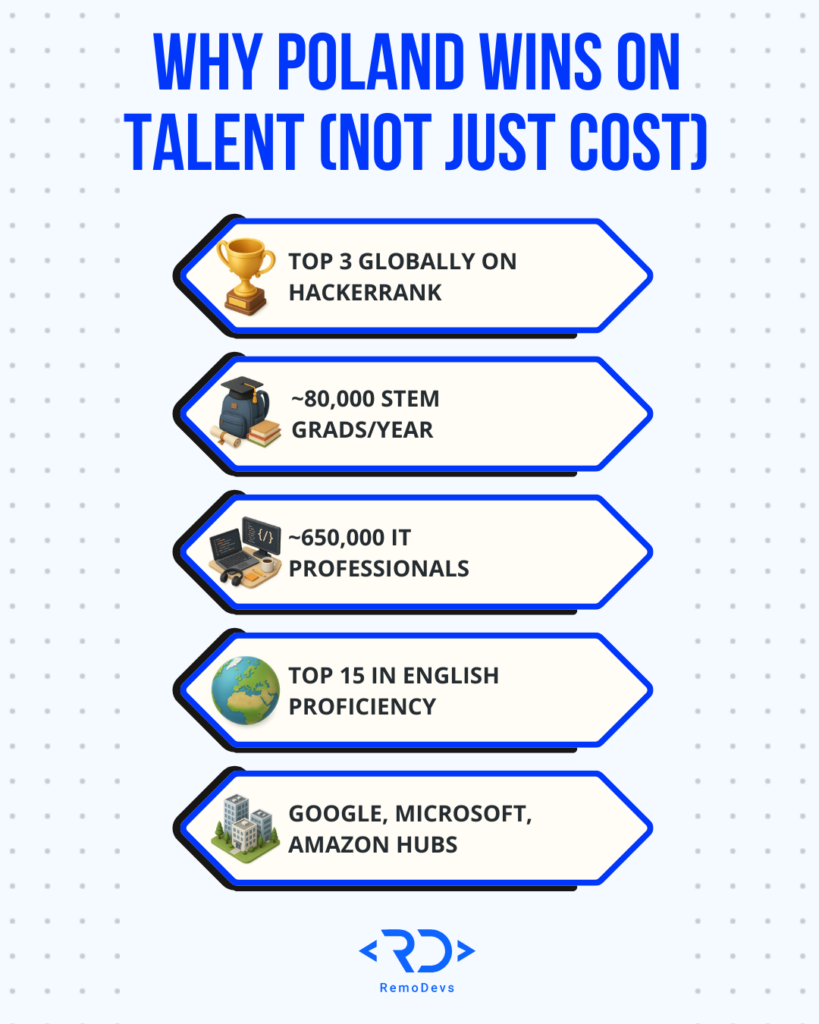
- Poland produces ~80,000 STEM graduates per year and consistently ranks in the top 3 globally for developer skill on HackerRank – this is not a compromise, it’s an upgrade.
- Working with a vetted recruitment partner eliminates the #1 ROI killer: spending 3–6 months hiring the wrong person.
The Real Cost of Your Next US Engineering Hire
You already know US senior engineers are expensive. What you may be underestimating is how expensive, once you factor in the full picture.
The average total compensation for a senior software engineer in San Francisco or New York sits between $180,000 and $270,000 per year – and that’s before benefits, payroll taxes, equity, recruiter fees, and onboarding overhead.
Add a 3–6 month ramp-up period and the statistical likelihood of that hire leaving within 18 months, and the true cost of a single mis-hire easily exceeds $300,000–$400,000.
This article gives you a clear, numbers-driven framework for calculating the ROI of hiring Polish software engineers, allowing you to make a defensible business case to your board, not just a gut-call.
The Cost Comparison: US vs Poland Engineering Salaries
Polish developers operate on a B2B contractor model by default. This means no benefits overhead, no payroll taxes, and no long-term employment liabilities for the US company. You pay a monthly rate. That’s it.
Here is how the numbers compare across common roles based on current 2025–2026 market data:
| Role | US Total Comp (Annual) | Polish B2B Rate (Annual Equiv.) | Savings |
| Mid-level Full-Stack Engineer | $140,000 – $170,000 | $60,000 – $80,000 | ~55% |
| Senior Backend Engineer | $180,000 – $230,000 | $80,000 – $105,000 | ~55% |
| Staff / Principal Engineer | $240,000 – $320,000 | $110,000 – $140,000 | ~55% |
| Engineering Manager | $220,000 – $290,000 | $95,000 – $125,000 | ~57% |
US total comp includes base, benefits, equity, and employer taxes. Polish figures reflect B2B net contractor rates without hidden overhead.
What “B2B Contract” Means for Your Balance Sheet
In Poland, the standard engagement model between a developer and a foreign company is a B2B (business-to-business) contract. The developer registers as a sole proprietorship or LLC and invoices monthly.
For US companies, this provides:
- No employer-side payroll taxes (FICA, FUTA, state taxes).
- No benefits overhead (health insurance, 401k matching, PTO accruals).
- No employment law exposure under US labor regulations.
- Clean P&L classification, placing engineering spend as a simple contractor line item.
Building the ROI Model: What to Actually Measure
Salary delta is the most visible number, but a rigorous ROI model has five distinct components.
1. Fully-Loaded Cost Savings
Take the annual salary difference between a US hire and a Polish equivalent. Multiply by headcount. For a team of 5 senior/staff engineers, the conservative annual saving is:
(5 × $130,000 average delta) = $650,000/year
That is pure runway, that is an additional product initiative. That is margin.
2. Time-to-Hire Velocity
Every week an engineering seat is open is a week of lost productivity. In the US market, the average time-to-hire for senior engineers is 45–90 days – often longer in competitive specializations like ML, platform, or distributed systems.
A specialized Polish IT recruitment partner with a pre-vetted talent pool can deliver a shortlist of qualified candidates in 5–10 business days. That velocity advantage must be modeled directly into your roadmap.
3. The Bad Hire Cost – The ROI Killer You’re Ignoring
The Society for Human Resource Management (SHRM) estimates the cost of a bad hire at 50–200% of annual salary. For a senior engineer at $200,000 total comp, that’s a $100,000–$400,000 loss.
Bad hire costs include:
- Lost productivity during the hiring and onboarding cycle.
- Team morale and momentum damage.
- Manager bandwidth consumed on performance management.
- Recruiting fees and time-to-hire for the replacement.
- Codebase debt introduced by an underperforming developer.
4. Retention and Attrition Rates
US tech attrition runs at 13–18% annually, heavily driven by continuous poaching and a job-hopping culture.
Polish engineers hired through a structured process – where culture fit, communication skills, and long-term motivation are screened upfront – show significantly lower attrition, typically under 10% annually for direct-hire engagements. Lower attrition means less re-hiring, less onboarding drag, and more compounding team performance.
5. Timezone Overlap and Async Productivity
Poland operates on CET/CEST, providing:
- 3–4 hours of real-time overlap with the US East Coast (EST).
- 6+ hours of overlap for core business hours when teams start at 9 AM CET.
This is meaningfully different from deep-offshore models. Daily standups, sprint planning, and PR reviews happen in real time. Collaboration overhead drops, and delivery cadence improves.
Why Poland? The Talent Quality Case
Cost arbitrage only makes business sense if the quality holds. Here are the facts:
- HackerRank consistently places Polish developers in the global top 3 for overall programming skill.
- Poland now boasts a talent pool of ~650,000 working IT professionals and produces approximately 80,000 STEM graduates annually.
- Major global engineering hubs – including Google, Microsoft, Intel, OpenAI, and Amazon – all operate significant R&D centers in Warsaw, Kraków, and Wrocław. They are there for the talent density, not just the cost.
- English proficiency is exceptional: Poland consistently ranks in the top 15 globally on the EF English Proficiency Index.
- Polish developers work within strict EU legal and IP frameworks, including GDPR compliance, making it highly secure for companies handling proprietary user data.
Common Objections – Addressed Directly
“We tried nearshore/offshore before and it didn’t work.”
The failure mode in most remote engagements is poor candidate screening, not geography. When a recruiter optimizes for placement speed over fit, you get warm bodies instead of engineers. Rigorous vetting is the only solution.
“How do we manage someone in a different timezone?”
The exact same way you manage any remote US engineer – with clear async documentation, agreed-upon overlap hours, and modern tooling. Poland is structurally no harder to manage than a team split between Austin and Seattle.
“What about IP and contracts?”
Polish contractors operating on B2B agreements sign US-governed contracts containing full IP assignment and non-disclosure clauses. It is legally straightforward and an industry standard.
How RemoDevs Eliminates the #1 ROI Risk: The Bad Hire
Every number in this ROI model assumes you hire the right person. That is where most companies burn cash.
RemoDevs operates on a fundamentally different model than a standard IT outsourcing shop. We filter out 90% of candidates at the initial screening stage. The 10% we present have passed rigorous technical assessments, English communication evaluations, cultural fit screenings, and motivation profiling.
What that means in practice:
- You don’t spend 3 months interviewing 40 candidates to find one that works.
- You don’t get a developer who looks good on paper but fails to communicate with your product team.
- You don’t absorb the $150,000–$400,000 cost of a mis-hire six months down the line.
The ROI of hiring Polish engineers through RemoDevs is about compressing the risk out of the equation entirely so the savings hit your bottom line.
The Bottom Line: What This Looks Like at Scale
For a US tech company building or scaling an engineering team of 5–10 people, the annual fully-loaded savings versus a US-based team range from $750,000 to $1,500,000.
That figure assumes:
- Competitive Polish B2B rates.
- No US benefits or payroll tax overhead.
- Lower attrition and reduced re-hiring costs.
- Faster time-to-hire.
- Zero bad hires.
For most growth-stage or scaling companies, this is the difference between burning runway and extending it by 12–18 months.
Ready to See the Numbers Applied to Your Headcount?
Book a free 15-minute discovery call with the RemoDevs team. We will walk you through our current vetted candidate shortlist, provide a realistic time-to-hire estimate for your specific stack, and show you exactly what your annual savings look like.
No pitch deck. No fluff. Just data and vetted candidates.
→ Book Your 15-Minute Call with RemoDevs
Visit us
Find a moment in your calendar and come to our office for a delicious coffee
Make an apointment