
Searching for the “top 1 IT agency in Poland” sounds like a sensible shortcut. Instead of reviewing dozens of providers, you find the company at the top of a ranking and move on.
The problem is that “number one” has no universal definition in IT recruitment. One ranking may prioritise client reviews, another company size, search visibility, geographic presence or the range of services offered. An agency can lead one list while being a poor fit for the role you actually need to fill.
A ranking can help answer:
Which agencies should we investigate?
It cannot independently answer:
Which agency is the best fit for this particular hire?
Why there is no objective “#1” IT recruitment agency
Recruitment agencies work across different roles, markets and engagement models. A provider experienced in high-volume customer support recruitment is not automatically the right choice for a senior machine learning search. An agency known for staff augmentation may have a different process from one focused on permanent success-fee recruitment.
The right fit depends on the assignment:
- technology and role;
- required seniority;
- location and working model;
- compensation range;
- permanent recruitment, staff augmentation or embedded recruitment support;
- hiring deadline;
- screening expected from the agency;
- commercial and replacement terms.
No single ranking position can account for every combination of these factors.
Even review scores require context. A positive review for building an outsourced development team does not necessarily demonstrate experience recruiting an individual Head of Engineering in Poland. The feedback may be genuine and useful, but its relevance depends on what the reviewed project involved.
What agency rankings can and cannot tell you
Rankings and directories are useful discovery tools. They can introduce buyers to agencies they have not encountered, collect client feedback and provide an initial view of the market.
Their limitations begin when ranking position is treated as proof of suitability.
Different lists may evaluate:
- review scores and review volume;
- company size or years in business;
- service categories;
- geographic coverage;
- editorial research;
- platform-specific profile data;
- search visibility;
- technology or industry specialisation;
- sponsored participation or placement.
These are not necessarily bad criteria. They simply answer different questions.
A company with many reviews may have a broad track record, while a smaller specialist may have more relevant experience for a narrow technical search. An editorial ranking may apply its own assessment criteria, while a directory may rely more heavily on information submitted through company profiles and client reviews.
The position only becomes meaningful when the reader understands how it was produced.
How to read an IT recruitment ranking
Before treating an agency’s position as evidence, check five things:
| Area | What to check | Why it matters |
|---|---|---|
| Ranking owner | Who created and published the list? | A directory, editorial team and agency blog may use different methods |
| Methodology | Which factors determine the order? | Review volume, specialisation and company size measure different things |
| Commercial involvement | Are sponsored profiles or placements clearly identified? | Paid visibility should not be confused with independent evaluation |
| Review relevance | Which services and projects do the reviews describe? | Feedback about outsourcing may not prove permanent recruitment expertise |
| Date and evidence | When was the ranking reviewed and are its sources inspectable? | Agency services, teams and market positioning change over time |
A useful ranking should explain its scope and make it possible to inspect the evidence behind the selection. If the methodology is unclear, use the list to discover providers rather than to decide which one to hire.
Our current overview of IT recruitment agencies in Poland can help companies build an initial shortlist. Each agency should still be evaluated against the actual hiring requirement.
Why Poland’s market size does not determine agency fit
Poland has a substantial technology workforce. Eurostat recorded approximately 778,800 employed ICT specialists in Poland in 2025, representing 4.5% of total employment.
This is a useful measure of the wider market, but it is not a count of software developers available for hire. Eurostat’s ICT specialist category also covers ICT managers, database and network professionals, technicians and several related occupations.
Once a company applies requirements such as technology, seniority, compensation, location and availability, the relevant candidate pool becomes much narrower. The size of the overall market therefore says little about whether a particular recruitment agency can deliver a suitable shortlist.
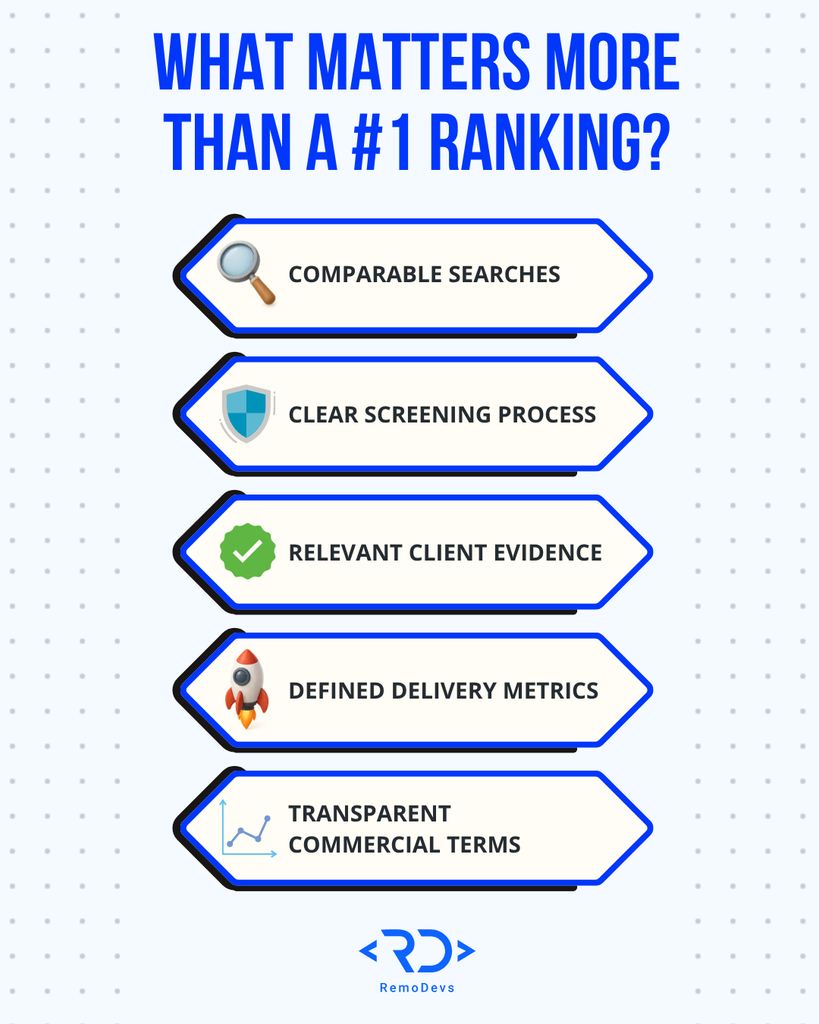
What matters more than the #1 position
After using rankings to identify possible providers, look for evidence connected to your actual search.
Comparable assignments
Ask whether the agency has worked on roles with similar technologies, seniority and constraints. General experience in “IT recruitment” is less informative than evidence from searches resembling yours.
A defined screening process
Clarify what the agency verifies before recommending a candidate. Screening may cover relevant experience, motivation, communication, availability and compensation expectations. If technical validation is included, ask who performs it and what it involves.
A selective shortlist can be valuable, but an internal rejection rate does not prove that the remaining candidates represent the “top 10%” of the market. Screening percentages and market percentiles are not the same thing.
Relevant client evidence
Reviews are more useful when the project described resembles your requirement. Look for specific feedback about candidate relevance, communication, difficult searches and process management rather than relying only on an aggregate score.
Clearly defined delivery metrics
Ask what “time to first candidate” means. It may refer to a sourced profile, a contacted person or a screened candidate ready to interview.
Time to hire is a separate metric influenced by interview availability, feedback speed, assessment stages and offer approval. Precise comparisons between undefined groups such as “generalist agencies” and “traditional HR firms” should be treated cautiously unless they come from a consistent dataset.
Transparent commercial terms
Confirm what triggers the fee, when payment is due and which replacement conditions apply. A headline guarantee period is not enough without the terms governing eligibility, exclusions and the remedy offered.
For a complete selection process, see our guide to choosing an IT recruitment agency in Poland.
How RemoDevs approaches IT recruitment in Poland
RemoDevs helps international companies recruit technology professionals across Poland. Searches cover software engineering, AI and machine learning, data, cloud and DevOps, product and design, and technical leadership.
The process begins with role calibration, including the required skills, seniority, budget and hiring context. RemoDevs then manages sourcing and initial screening before presenting a focused shortlist with recruiter context.
Screening is adapted to the role and covers relevant experience, motivation, communication, availability and practical fit with the hiring requirement. The purpose is to recommend candidates who match the agreed brief, not to claim that they belong to an arbitrary market percentile.
For many searches, the current RemoDevs recruitment page states that the first qualified candidates can be presented within five working days. Difficult or highly specific roles may require more time. This is a qualified delivery expectation, not a universal guarantee that every recruitment process will result in a hire within that period.
Success-fee recruitment is available, with the commercial model and fee agreed before the search begins. The current proposition describes a 30-day period before payment and a 90-day replacement guarantee. The applicable conditions should be confirmed in the agreement for the specific search and should not be assumed to apply identically across every RemoDevs service model.
Rather than asking whether RemoDevs or another provider is objectively “number one,” ask the agency to show how it would run your search: who it can reach, what it will screen, what you will receive with each candidate and which commercial terms will apply.
If you are planning to hire technology professionals in Poland, talk to RemoDevs about your search.
Conclusion
An agency’s ranking position is one signal, not a hiring decision.
Use rankings to discover providers and understand the market. Then compare the agencies using evidence relevant to the role, including comparable searches, screening scope, client feedback, delivery definitions and commercial terms.
The right recruitment partner is not automatically the company shown at number one. It is the company whose process and experience fit the search you are about to run.
Visit us
Find a moment in your calendar and come to our office for a delicious coffee
Make an apointment