
Poland remains one of Europe’s most important technology hiring markets. International companies can access experienced software engineers, data specialists, cloud professionals and AI talent without limiting their search to candidates located in Western Europe or the United States.
Before hiring software developers in Poland, however, companies need to choose an appropriate engagement model.
The two most common options are:
- a B2B contract with an independent Polish business;
- an employment contract, known in Poland as an umowa o pracę or UoP.
The difference is not limited to taxation or total hiring cost. The chosen model determines how the relationship can be managed, which statutory protections apply, how payroll and social security are handled and whether the individual is genuinely operating as an independent contractor.
This distinction became even more important on July 8, 2026, when a reform of the Polish State Labour Inspectorate, known as PIP, entered into force.
The reform did not prohibit legitimate B2B cooperation or create a new definition of employment. It strengthened PIP’s ability to intervene when a civil-law or B2B contract is used for work that is, in practice, performed under employment conditions.
This guide explains how B2B contracts in Poland differ from employment contracts, what changed in July 2026 and what international technology companies should consider before hiring Polish developers.
This article provides general information and is not legal, tax or payroll advice. It is based on publicly available legislation and official guidance available on the last update date. Companies should have their specific engagement model reviewed by qualified Polish counsel.
What Is a B2B Contract in Poland?
A Polish B2B contract is a commercial agreement between two independent businesses.
In the IT sector, the contractor usually operates through a sole proprietorship known as a jednoosobowa działalność gospodarcza, or JDG. The contractor provides agreed services, issues invoices and handles their own business-related tax and social security obligations.
The relationship is generally governed by the Polish Civil Code and the terms agreed between the parties rather than by the Polish Labour Code.
A foreign company can normally sign a commercial agreement directly with a Polish sole proprietor without opening a Polish subsidiary. The company should nevertheless verify issues such as:
- the governing law and dispute-resolution mechanism;
- VAT and invoicing arrangements;
- intellectual property ownership;
- confidentiality and data protection;
- termination provisions;
- liability and contractual penalties;
- the real working conditions under which the services will be delivered.
Calling an agreement “B2B” does not determine its legal classification. Polish authorities may examine how the relationship operates in practice.
What Is an Employment Contract in Poland?
An employment contract, or UoP, creates an employer–employee relationship governed by the Polish Labour Code.
The employee works under the employer’s direction, at a time and place determined by the employer, in exchange for remuneration. The employer is also responsible for statutory employment protections and obligations.
These typically include:
- paid annual leave;
- rules governing working time and overtime;
- sick leave;
- parental and maternity protections;
- minimum notice periods;
- payroll and social security settlements;
- occupational health and safety obligations;
- statutory protection against unlawful termination.
A foreign company does not necessarily have to establish a Polish subsidiary to employ someone working in Poland. However, it must still address Polish payroll, social security, tax and labour-law obligations.
Depending on the structure, an international company may:
- employ the individual through its own Polish entity;
- register and manage the relevant obligations as a foreign employer in the Polish social security system;
- use an Employer of Record;
- establish another locally compliant employment structure.
Our guide to hiring programmers in Poland without a local entity provides a broader overview of the available operational models.
Because cross-border employment can create tax, social security and permanent-establishment considerations, the setup should be reviewed individually.
B2B vs Employment Contract in Poland: Key Differences
| Area | B2B contract | Employment contract |
| Legal basis | Primarily a commercial relationship governed by civil law | Employment relationship governed by the Labour Code |
| Relationship | Independent contractor providing services as a business | Employee working under the employer’s direction |
| Working organization | Contractor should retain meaningful independence over how services are delivered | Employer may determine tasks, working time, place and working methods |
| Payment | Contractor issues invoices | Employer pays salary through payroll |
| Taxes and social security | Contractor generally handles their own income tax, ZUS and applicable VAT obligations | Employer calculates and remits payroll taxes and social security contributions |
| Annual leave | No statutory entitlement to paid annual leave | Normally 20 or 26 days of statutory paid annual leave |
| Sick leave and parental protection | Depends on insurance status and contractual arrangements | Statutory protections apply |
| Equipment and business costs | May be provided or covered under the agreement, but the contractor should retain genuine business independence | Usually provided or covered by the employer |
| Intellectual property | Requires carefully drafted contractual provisions | Special statutory rules may transfer rights to software created by an employee within their duties |
| Termination | Governed mainly by the contract | Subject to Labour Code rules and statutory protections |
| Business risk | Contractor should bear genuine commercial responsibility and risk | Business risk generally remains with the employer |
The classification depends on the overall relationship. No single factor automatically determines whether a person is an employee or an independent contractor.
What Changed Under the July 2026 PIP Reform?
The reform of the State Labour Inspectorate entered into force on July 8, 2026. The full amendment was published as the Act of March 11, 2026, Journal of Laws item 473.
Before the reform, PIP could identify a potentially misclassified relationship, but establishing the existence of an employment relationship usually required proceedings before a labour court.
PIP now has a stronger administrative process for cases in which a civil-law or B2B arrangement appears to function as employment.
The reform did not change Article 22 of the Polish Labour Code or create a separate legal test specifically for software developers and IT contractors.
Legitimate cooperation between independent businesses remains permitted.
The key change concerns enforcement.
How the new procedure works
According to the government’s official questions and answers on the PIP reform, the process may generally involve the following stages:
- A labour inspector examines the actual working relationship.
- Both parties can explain how the cooperation operates.
- If the inspector identifies employment-like conditions, they may issue an instruction intended to bring the relationship into compliance.
- The parties may respond by establishing employment or by genuinely changing the way the independent relationship operates.
- If the instruction is not followed, the matter may be referred to a Regional Labour Inspector.
- The Regional Labour Inspector may issue an administrative decision establishing an employment relationship, discontinue the proceedings or bring a case before the labour court.
- Both parties have the right to challenge the decision before the court.
An administrative decision generally establishes the employment relationship from the date the decision is issued.
Where the Regional Labour Inspector believes the relationship should be recognized with retroactive effect, the matter may instead be brought before the labour court.
Companies should therefore avoid claiming that every PIP decision automatically creates five years of retroactive tax or ZUS liability. The consequences depend on the procedure, the effective period established and the final outcome of the case.
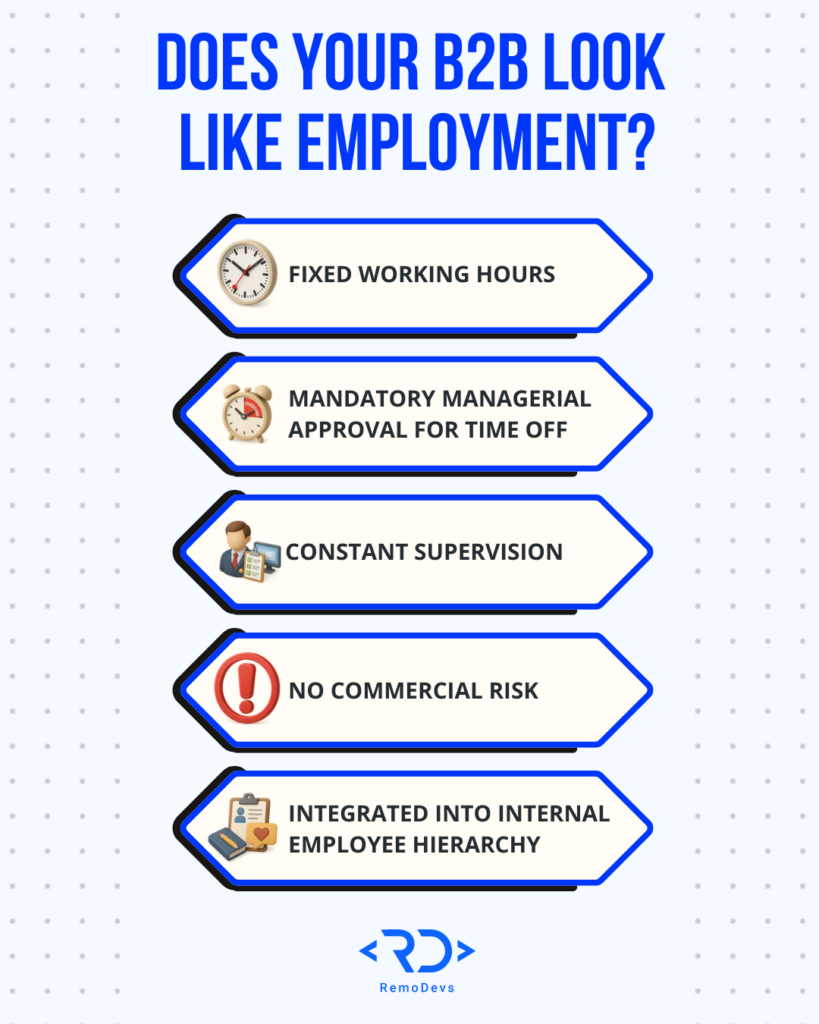
What Can Make a B2B Relationship Look Like Employment?
PIP examines the reality of the working arrangement rather than relying only on the title or wording of the contract.
Potential indicators of employment may include:
- performing work under ongoing managerial direction;
- having working hours unilaterally imposed by the company;
- being required to work from a specific location;
- needing permission for ordinary periods of unavailability;
- performing work personally and continuously;
- being managed in the same way as internal employees;
- having little control over how the work is performed;
- carrying no meaningful business responsibility or commercial risk;
- being integrated into the company’s organizational hierarchy;
- being evaluated primarily through attendance and availability rather than contracted services or outcomes.
PIP has emphasized that factors such as organizational subordination, imposed working hours and location, managerial control and the absence of genuine commercial risk are assessed together. Its official explanation can be found in the interview “Wchodzimy w nową erę jakości kontroli”.
A fixed meeting, shared deadline or preferred period of availability does not automatically create employment. Equally, adding a clause stating that the contractor is independent will not protect the company when the actual relationship operates like an employment arrangement.
The parties’ preferences are relevant, but they cannot override mandatory employment law.
Are Fixed Hours Allowed in a Polish B2B Contract?
Some coordination requirements can exist in a legitimate commercial relationship.
For example, a contractor may agree to attend planning meetings, communicate during an agreed overlap period or meet delivery deadlines. A cybersecurity consultant may also need to respond during a scheduled maintenance window.
The risk increases when the company:
- imposes the same daily schedule as it does on employees;
- closely monitors the contractor’s attendance;
- requires approval for routine schedule changes;
- controls not only the expected outcome but also the exact method of working;
- treats availability during particular hours as the main contractual obligation.
A more independent structure may focus on agreed services, deliverables, service levels, deadlines and outcomes while leaving the contractor meaningful freedom to organize the work.
Simply describing ordinary staff augmentation as “project-based work” does not automatically make it B2B-compliant.
Do B2B Contractors in Poland Receive Paid Vacation?
B2B contractors do not receive statutory annual leave under the Polish Labour Code.
The parties may contractually agree on periods during which services are not provided. They may also structure the commercial fee so that short periods of unavailability do not reduce the agreed payment.
However, international companies should be careful about copying employee leave arrangements directly into a B2B contract.
In July 2026, the Chief Labour Inspector stated that giving contractors the same 20 or 26 days of leave available to employees may be treated as an argument supporting employment classification, particularly when the contractor must obtain managerial approval before using those days. This position is explained in the official PIP guidance on the reform.
This does not mean that every compensated break creates an employment relationship.
The safer approach is to review:
- whether the contractor informs the company or requests permission;
- whether the arrangement is identical to the employee leave policy;
- whether the contractor remains responsible for agreed outcomes;
- whether the contractor has meaningful control over service availability;
- whether other parts of the relationship also resemble employment.
The terminology used in the agreement should reflect the commercial relationship. Terms such as “annual leave entitlement,” “holiday approval” and “line manager” can be particularly problematic when the actual arrangement also lacks independence.
How Are Taxes Handled Under B2B Contracts?
A Polish sole proprietor generally invoices the client and is responsible for their own:
- income tax;
- social security and health insurance contributions;
- accounting;
- applicable VAT obligations.
Some IT contractors use the Polish lump-sum tax system known as ryczałt od przychodów ewidencjonowanych.
Certain software-related services may qualify for a 12% lump-sum rate. The Polish Ministry of Finance lists relevant software and IT service categories in its official information about PIT-28 and lump-sum taxation.
However, the correct tax rate depends on the services actually performed and their legal and statistical classification, including the relevant PKWiU category.
The contractor’s job title does not determine the rate.
Companies should therefore avoid statements such as:
- every software engineer pays 12%;
- every DevOps or infrastructure contractor pays 8.5%;
- B2B always produces a particular net salary.
Different services, business structures, tax choices, contribution levels and personal circumstances can produce different outcomes.
For employers and hiring teams, the practical point is that candidates commonly compare B2B offers based on the invoiced monthly amount rather than the gross salary used in employment contracts.
Our Polish software engineer salary report explains the market ranges companies may encounter when recruiting developers in Poland.
Who Owns the Code Created by the Developer?
Intellectual property should be addressed under both models.
Employment contract
Under Article 74(3) of the Polish Copyright Act, economic rights to a computer program created by an employee while performing employment duties generally belong to the employer unless the contract provides otherwise.
This rule relates specifically to computer programs.
Other materials, including documentation, designs, databases, written content, inventions or training materials, may require separate analysis and appropriate contractual provisions.
B2B contract
The customer should not assume that paying an invoice automatically transfers all rights to code or other deliverables.
A B2B agreement should contain properly drafted provisions covering:
- transfer or licensing of economic copyrights;
- the relevant fields of exploitation;
- the timing of the transfer;
- derivative works and modifications;
- documentation and related materials;
- open-source components;
- pre-existing contractor materials;
- moral rights where relevant;
- further transfers within the client’s corporate group.
Generic statements saying that “all IP belongs to the client” may not be sufficient under Polish copyright law.
Why Do Polish IT Professionals Choose B2B?
B2B remains common in Poland’s technology sector, particularly among experienced software developers, consultants, architects and other specialists.
Candidates may prefer it because of:
- greater organizational flexibility;
- the ability to provide services to different clients;
- commercial rather than employee-style cooperation;
- control over business expenses and tax arrangements;
- potentially higher take-home income;
- the ability to negotiate notice periods, liability and availability individually.
The financial implications depend on seniority, rate, benefits and the exact structure. Our guide to the cost of hiring developers in Poland provides a broader comparison of the expenses companies should consider.
However, candidate preference alone does not determine whether B2B is legally appropriate.
A person cannot become an independent contractor only by signing a declaration that they prefer B2B when the actual conditions meet the legal definition of employment.
Companies should also avoid assuming that all Polish developers prefer B2B. Some candidates prioritize:
- paid leave;
- employment stability;
- parental protections;
- mortgage-related income predictability;
- employer benefits;
- reduced accounting responsibility;
- long-term employee career paths.
Contract preference should be confirmed early in the recruitment process.
When May a B2B Contract Be Appropriate?
A genuine B2B model may be appropriate when:
- the specialist operates an independent business;
- the services require senior expertise and autonomous judgment;
- the parties define a commercial scope of services;
- the contractor has meaningful control over how work is organized;
- cooperation is evaluated through outcomes, deliverables or service levels;
- the contractor bears genuine responsibility for the services;
- employee procedures are not copied automatically;
- the contractor is not integrated into the company’s hierarchy in the same way as an employee;
- the company can accommodate a relationship based on independence rather than subordination.
This may apply to consultants, fractional leaders, architects, independent engineers and project specialists.
A senior job title does not make the arrangement automatically compliant. The actual conditions still matter.
Companies making this decision as part of a larger expansion should also define their hiring model before they build a dedicated development team in Poland.
When May Employment or an EOR Be More Appropriate?
An employment structure may be more appropriate when:
- the company needs to set and monitor regular working hours;
- the person works within a direct reporting hierarchy;
- a manager controls their daily tasks and methods;
- the work must be performed continuously and personally;
- the person is integrated into employee policies and processes;
- the role requires employee-style availability;
- the individual manages internal employees as part of the company structure;
- the company intends to provide statutory protections and long-term employee development;
- the practical relationship is not genuinely independent.
An Employer of Record can help a foreign company employ someone in Poland without immediately establishing a local subsidiary.
An EOR does not remove the need to choose the correct engagement model. It provides an employment structure when the company needs or prefers an employee relationship.
Practical B2B Compliance Checklist for Tech Companies
Before engaging a Polish IT contractor, review both the agreement and the proposed working model.
Contract structure
Check whether the contract clearly addresses:
- the scope of services;
- remuneration and invoicing;
- intellectual property;
- confidentiality;
- data protection;
- liability;
- termination;
- governing law;
- dispute resolution;
- use of subcontractors where appropriate;
- contractor equipment and expenses;
- periods of unavailability.
Daily cooperation
Check whether the company will:
- manage the contractor like an employee;
- impose fixed working hours;
- require approval for time off;
- track attendance rather than services;
- restrict all work for other clients;
- place the contractor in the employee hierarchy;
- provide identical employee benefits and procedures;
- control the exact working method;
- remove any genuine commercial risk.
Internal communication
Managers should understand the distinction between a contractor and an employee.
Even a well-drafted agreement may be undermined when a manager:
- refers to the contractor as an employee;
- approves their “vacation”;
- requires daily clock-in and clock-out reporting;
- conducts employee-style performance reviews;
- applies the employee handbook automatically;
- controls every part of the working process.
Compliance therefore requires alignment between legal documentation, recruitment, HR practices and day-to-day management.
How RemoDevs Supports IT Hiring in Poland
Choosing the legal structure is ultimately a decision for the company and its legal, tax or EOR advisers.
RemoDevs supports the recruitment side of the process.
As an IT recruitment agency in Poland, we help international technology companies:
- define the target candidate profile;
- understand candidate contract preferences;
- benchmark B2B rates and employment salaries;
- identify candidates who accept the proposed model;
- evaluate technical skills, communication and ownership;
- reduce late-stage offer rejections caused by contract mismatches;
- coordinate recruitment with the company’s chosen employment or contracting structure.
We do not replace legal or tax advisers. Where a proposed B2B relationship raises classification concerns, the final structure should be reviewed by qualified Polish counsel.
Companies considering a broader engineering expansion can review our guide to building a dedicated development team in Poland or explore our Success Stories.
Frequently Asked Questions
Can a foreign company sign a B2B contract with a Polish developer?
Generally, yes. A foreign company may enter into a commercial agreement directly with a Polish sole proprietor without establishing a Polish subsidiary.
The parties should still review governing law, VAT, intellectual property, data protection, tax considerations and whether the relationship is genuinely independent.
Does a foreign company need a Polish entity to employ a developer?
Not necessarily.
A foreign employer may be able to employ a person working in Poland without creating a Polish subsidiary, but it must address Polish employment, payroll, tax and social security obligations.
Companies often use a Polish entity or an Employer of Record to make this process easier to administer.
Can a B2B contractor work full time for one client?
Working predominantly or exclusively for one client does not automatically prove employment.
However, it may become relevant when combined with factors such as subordination, imposed working hours, employee-style leave, lack of commercial risk and integration into the client’s internal structure.
The full relationship must be assessed.
Can a company give a B2B contractor 20 or 26 paid days off?
The parties may agree on compensated periods of unavailability, but directly copying the statutory employee leave model may increase classification risk.
PIP has specifically indicated that giving contractors 20 or 26 days off can support an employment finding, especially where managerial approval is required.
The provision and the wider operating model should be reviewed by Polish counsel.
What changed for B2B contracts in July 2026?
The legal definition of employment did not change.
PIP received stronger tools to investigate potentially misclassified civil-law and B2B relationships. Following an inspection and an opportunity to correct the arrangement, a Regional Labour Inspector may now issue an administrative decision establishing an employment relationship or bring the case before the labour court.
Can PIP automatically impose five years of retroactive ZUS payments?
An administrative decision generally takes effect from the date it is issued.
Where PIP believes the employment relationship should be established retroactively, the Regional Labour Inspector may bring the matter before the labour court. Financial consequences depend on the period ultimately established and the outcome of the relevant proceedings.
Companies should not assume that every administrative decision automatically creates five years of retroactive liability.
Who owns code written under a B2B contract?
The client should not assume that ownership transfers automatically because invoices have been paid.
A B2B agreement should contain properly drafted copyright assignment or licensing provisions covering the code and other deliverables.
Is B2B always cheaper than employment?
Not necessarily.
A B2B arrangement may reduce certain payroll costs, but companies should also consider:
- the invoiced rate expected by the contractor;
- VAT treatment;
- legal and accounting support;
- misclassification exposure;
- equipment and benefits;
- notice periods;
- recruitment competition;
- differences in candidate availability.
The most appropriate model depends on the actual role and working relationship, not only the headline cost.
Build Your Technology Team in Poland
Both B2B and employment contracts can be valid ways to engage technology professionals in Poland.
The correct choice depends on how the relationship will operate in practice.
B2B is not simply a lower-cost version of employment. It should represent genuine cooperation between independent businesses. Where the company needs employee-style availability, supervision and organizational integration, an employment contract or EOR arrangement may be more appropriate.
RemoDevs helps international companies understand the Polish talent market, align candidate expectations and recruit engineers who match the proposed engagement model.
Discuss your hiring needs with RemoDevs.
Visit us
Find a moment in your calendar and come to our office for a delicious coffee
Make an apointment