
In the early stages (Seed through Series B), your ability to ship product is directly limited by your ability to hire the builders who create it. Yet, many founders make a critical error when scaling their teams: they default to the “safe” choice, partnering with massive, global recruitment brands like Randstad because of name recognition.
- Hiring speed is a growth limiter: Every week a seat sits empty is a week of lost product velocity.
- The brand trap: Founders often assume big agencies equal better results, ignoring that those agencies are built for stability, not speed.
- The core tension: Enterprise recruitment processes act as a brake on high-growth startup environments.
This creates a dangerous misalignment. High-growth startups need a startup recruitment agency built around agile recruitment, not corporate staffing models designed for Fortune 500 compliance.
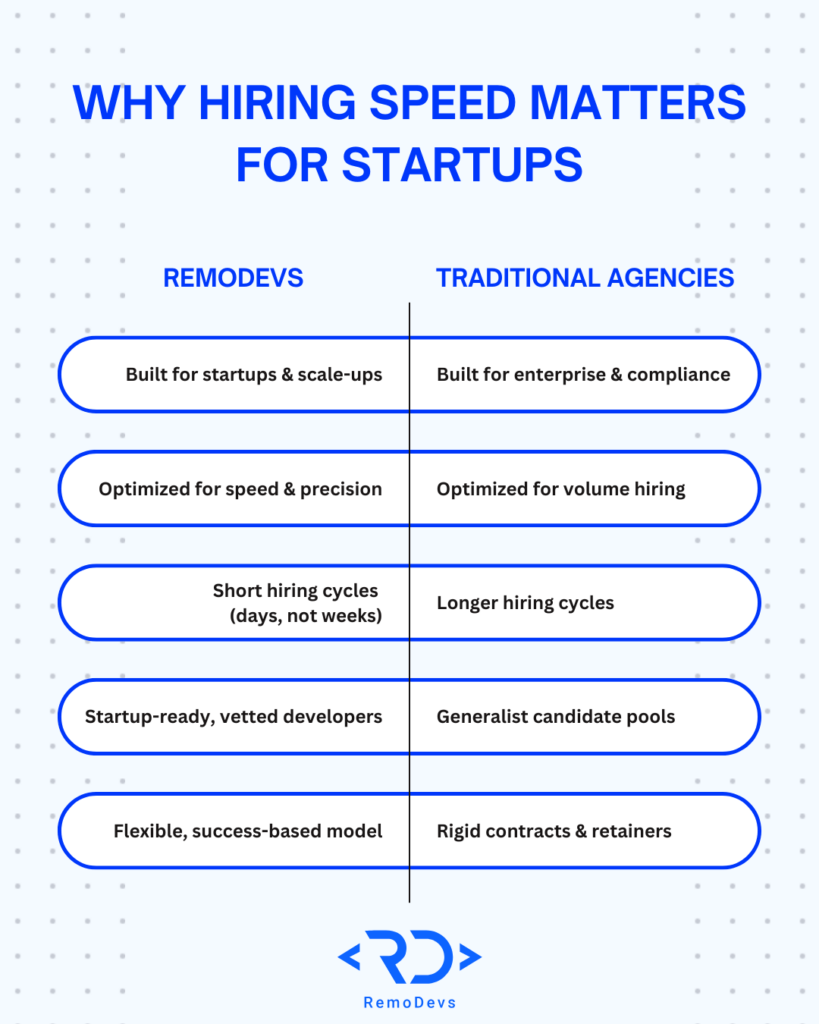
How Traditional Agencies Actually Operate
Global agencies are impressive machines, but they are engineered for a different purpose than yours. They are optimized for volume hiring, strict compliance, and risk minimization – factors that matter immensely to a bank, but often strangle a startup.
When you engage a giant like Randstad, you are entering a process designed for stability, where “process” often supersedes “outcome.”
- Volume over precision: Large agencies focus on filling hundreds of similar roles efficiently, rather than hunting for the unique “10x” engineer a startup needs.
- Compliance first: Their workflows prioritize risk aversion and long decision cycles, which protects them but slows you down.
- Generalist recruiters: You are often dealing with generalists juggling dozens of accounts, not tech-specialized partners.
This leads to the “Volume Game.” In the remodevs vs randstad comparison, the operational focus is starkly different. Traditional agencies play a numbers game, flooding your inbox with resumes that match keywords but miss the mission.
- Keyword matching: reliance on automated filters means candidates are selected for buzzwords, not problem-solving ability.
- The CV forwarder problem: CTOs waste hours reviewing irrelevant profiles because the agency hasn’t done the deep technical vetting.
- Slower iteration: Feedback loops are long, meaning by the time you clarify what you need, the best talent is gone.
Why Traditional Recruitment Fails High-Growth Startups
The failure mode of traditional agencies in the startup world is rarely about incompetence; it is about misalignment. Startups need adaptable builders who are comfortable with ambiguity and rapid change. Traditional pipelines, however, tend to skew toward corporate-safe, process-oriented profiles who may struggle in a chaotic, high-growth environment.
- Talent Misalignment: Candidates from big agencies often expect clear roadmaps and 9-to-5 stability – luxuries early-stage startups cannot afford.
- Runway burn: A hiring mistake or a 3-month search burns precious runway, directly impacting revenue milestones and investor confidence.
- Lost momentum: When product velocity slows, your competitive advantage erodes.
Furthermore, the commercial structures of big agencies are often rigid. They typically demand retainers, exclusivity clauses, or long-term contracts that don’t account for the pivot-heavy nature of startups.
- Rigid contracts: Long lock-in periods prevent you from switching strategies if your hiring needs change overnight.
- Upfront risk: Retainers force you to pay before you see results, shifting the financial risk entirely onto the founder.
- Lack of flexibility: They rarely offer the trial periods or success-based models that agile teams require.
Agile Recruitment – The Hiring Model Built for Startups
To survive, startups must adopt agile recruitment. This isn’t just a buzzword, it’s the application of agile development principles to hiring. Just as you iterate on your product based on user feedback, you must iterate on your candidate profiles based on market feedback.
- Iterative process: Hiring isn’t a linear path, it’s a loop of sourcing, interviewing, and recalibrating requirements.
- Feedback-driven: Every interview should refine the search, making the next batch of candidates more accurate.
- Adaptive to change: The ability to pivot a role’s focus halfway through the search without financial penalty.
Agile recruitment aligns the mechanics of hiring with the mechanics of a startup. It replaces months-long search cycles with short hiring sprints.
- Short sprints: Aim to move from brief to shortlist in 48–72 hours, not weeks.
- Tight feedback loops: immediate debriefs ensure no time is wasted on the wrong profiles.
- Continuous recalibration: As your understanding of the role evolves, the search strategy evolves with it.
Critically, this model distributes risk. Unlike the enterprise model, agile recruitment agencies often operate on success-based fees or offer guarantees.
- Success-based fees: You pay for results, not effort.
- Trial periods: Structures that allow you to “try before you buy,” mitigating the risk of a bad hire.
- Founder-friendly: The agency takes on the upfront workload, protecting your time and runway.
RemoDevs: Built for High-Growth
RemoDevs explicitly segments the market. We are not a vendor for corporate giants; we are a growth partner for startups and scale-ups. Our entire infrastructure is built to win the remodevs vs randstad comparison by offering what big agencies can’t: specialized speed and deep technical vetting.
- Strategic focus: We focus on startups and scale-ups because that is where our DNA lies.
- No CV spam: We don’t measure success by the number of CVs sent, but by the number of offers accepted.
- Partner mindset: We act as an extension of your team, not an external service provider.
The core of our value is the vetting advantage. We know that a CTO’s time is the most expensive resource in a startup. That’s why we perform deep technical screening before a candidate ever reaches you.
- Technical filtering: We reject the majority of applicants so you only see the top tier.
- Cultural fit: We screen for the “builder” mindset – candidates who thrive in uncertainty.
- Time protection: You interview only the candidates who are already viable.
Speed is a feature of our service. We design our processes to keep pace with your product development cycles.
- Rapid delivery: Expect shortlisted, vetted candidates in days, not weeks.
- Flexibility & Safety: Our model includes success fees and trial periods (up to 30 days) to ensure you are completely satisfied before committing.
- Agile alignment: We are ready to pivot the search instantly if your business priorities change.
RemoDevs vs Traditional Agencies Comparison
When you compare the models directly, the choice for a startup becomes clear.
| Feature | Traditional Agencies (e.g., Randstad, Hays) | RemoDevs |
| Speed to Shortlist | 1–2+ weeks | 24–72 hours |
| Vetting Approach | Keyword matching & CV filtering | Senior technical screening |
| Client Focus | Generalist, enterprise, volume | Tech startups, high-growth teams |
| Commercial Model | Retainers, rigid contracts | Success-based, flexible (Success Fee & Trial Period) |
Conclusion: Choose the Model That Matches Your Stage
Recruitment is a strategic decision. If you are building a massive corporate department where compliance is king, traditional agencies are a fine choice. But if you are building a high-growth startup where speed and adaptability are the currency of success, you need an agile partner.
- Context matters: The winner of remodevs vs randstad depends entirely on your growth stage.
- Agility wins: For Seed to Series B, agility is the only competitive advantage that matters.
- Strategic decision: Choose the best IT recruitment agency that aligns with your velocity, not just a famous logo.
Don’t let slow hiring stall your momentum.
Contact RemoDevs today to experience agile recruitment and meet your first vetted candidate within days.
Visit us
Find a moment in your calendar and come to our office for a delicious coffee
Make an apointment