
Scaling an AI product requires more than access to funding and powerful foundation models. The real challenge is finding engineers who can turn a promising prototype into a secure, reliable and cost-efficient production system.
That means hiring people who understand more than prompt engineering or basic API integrations. Depending on the product, companies may need experience in machine learning, retrieval-augmented generation, data engineering, model evaluation, cloud infrastructure and MLOps.
As demand for these skills grows, CTOs and engineering leaders are increasingly looking beyond their local markets. Poland has become one of the strongest European locations for building technical teams, offering access to experienced engineers, strong communication skills and convenient collaboration with companies across Europe and North America.
This guide explains what the Polish AI talent market looks like in 2026, how much experienced specialists cost and what companies should evaluate before hiring.
Why Hiring AI Engineers Is More Difficult Than It Looks
The rapid adoption of generative AI has significantly increased the number of candidates describing themselves as AI engineers. However, experience with an LLM API or a framework such as LangChain does not necessarily translate into the ability to build production-ready AI systems.
A prototype may work well during an internal demonstration but fail once it encounters real users, larger datasets and changing business requirements. Production AI systems require engineers who can address issues such as:
- model and retrieval quality,
- hallucination detection,
- data security and access control,
- latency and infrastructure costs,
- observability and monitoring,
- prompt and model versioning,
- evaluation pipelines,
- data and model drift,
- integration with existing systems.
The market therefore rewards engineers who combine AI knowledge with strong software engineering fundamentals. Hays reports that 75% of surveyed organisations are focusing on AI and machine learning expertise in their recruitment processes. It also identifies AI-focused contractors as some of the specialists receiving the most attractive offers and fastest rate increases.
Data from Just Join IT supports the same direction. In its analysis of almost 111,000 job advertisements published during 2025, the platform found that AI and machine learning professionals recorded a 15% increase in B2B compensation. Data also became the largest recruitment category on the platform, accounting for 10.78% of published vacancies.
The challenge is no longer simply finding someone who has used AI tools. It is identifying engineers who understand how AI affects the architecture, security, cost and reliability of an entire product.
Why Companies Hire AI Engineers in Poland
Poland is not simply a lower-cost alternative to Western European technology markets. It has developed a mature engineering ecosystem supported by international technology companies, universities, local product businesses and a large professional services sector.
The Polish Investment and Trade Agency estimates that approximately 600,000 programmers work in Poland, representing more than a quarter of the development community in Central and Eastern Europe. More than 70,000 people were also studying ICT-related subjects during the 2022/2023 academic year. These figures refer to the broader technology market rather than AI specialists alone, but they demonstrate the scale of the country’s engineering ecosystem.
Companies including Google, Amazon and Microsoft have made substantial technology investments in Poland. Warsaw, Kraków, Wrocław, Gdańsk and Poznań have all developed into established engineering centres, with specialists working across cloud computing, fintech, cybersecurity, data platforms and artificial intelligence.
Strong English Skills
English is the working language of many Polish product companies, technology centres and international development teams.
Poland ranked 15th among 123 countries and regions in the 2025 EF English Proficiency Index, receiving a score of 600 and being classified in the “very high proficiency” category. Individual candidates should still be evaluated for communication skills, but companies can recruit from a broad group of engineers already accustomed to working in English.
Convenient Timezone
Poland operates in the CET/CEST timezone, providing full working-day overlap with most European companies.
Teams on the US East Coast can usually maintain several hours of synchronous collaboration with Polish engineers. This is enough for planning sessions, stand-ups, technical discussions and incident handovers without requiring either team to work permanently outside normal hours.
Experience in International Teams
A significant part of Poland’s technology workforce has experience working for global product companies, consultancies or distributed engineering organisations.
For employers, this means that many candidates are already familiar with remote collaboration, code review, agile delivery, cloud platforms and communication across different business cultures. However, these abilities should still be verified during recruitment rather than assumed based only on location.
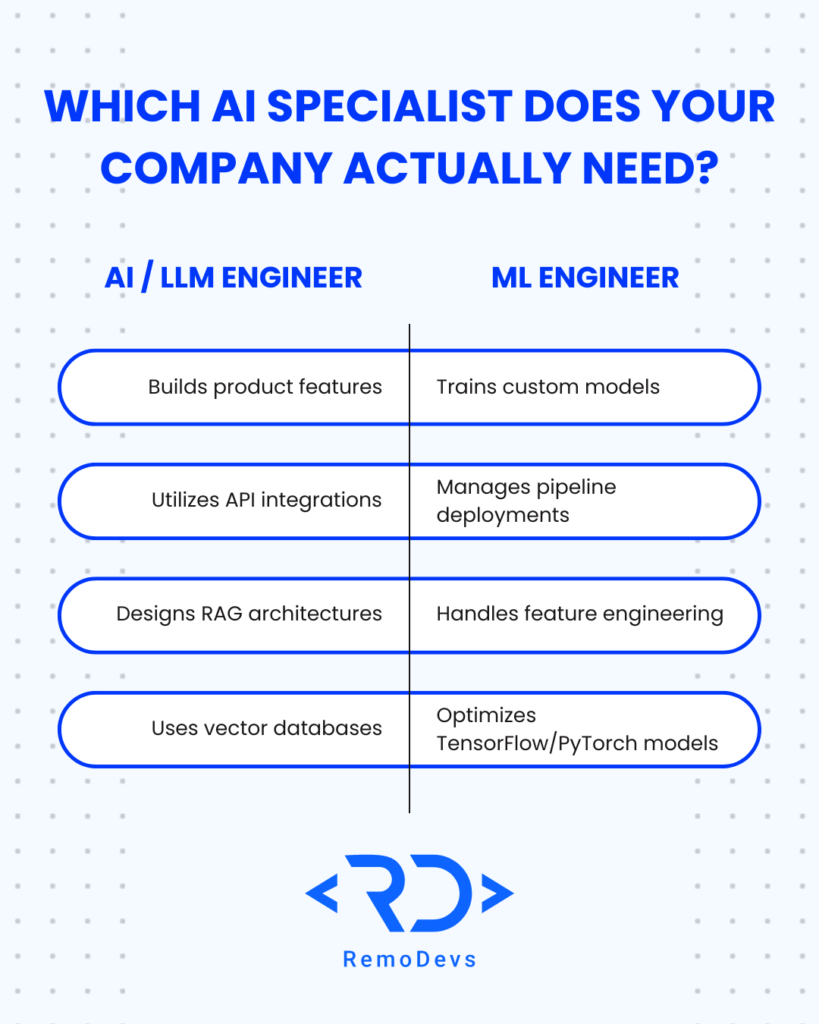
Which AI Specialist Does Your Company Actually Need?
“AI engineer” is often used as a broad label for several different roles. Defining the actual business and technical problem before opening recruitment significantly improves candidate quality.
| Role | Main area of responsibility | Common skills |
| Applied AI or LLM Engineer | Building product features using foundation models | Python, LLM APIs, RAG, agents, evaluation, vector databases |
| Machine Learning Engineer | Training, deploying and maintaining machine learning models | Python, PyTorch, TensorFlow, scikit-learn, feature engineering |
| MLOps Engineer | Operating models and AI infrastructure in production | Docker, Kubernetes, CI/CD, model registries, monitoring, cloud platforms |
| Data Engineer | Building the pipelines and platforms supplying data to AI systems | SQL, Python, Spark, Kafka, Airflow, Databricks, cloud data services |
| Data Scientist | Experimentation, statistical analysis and predictive modelling | Python or R, statistics, experimentation, model development |
| AI Architect or Tech Lead | Defining the wider AI architecture and technical roadmap | System design, cloud architecture, governance, security and leadership |
A company building an internal document assistant may primarily need an Applied AI Engineer with strong backend and RAG experience. A business deploying predictive models at scale may require an ML Engineer and MLOps specialist. A company whose data is fragmented or unreliable may need to begin with Data Engineering before expanding its AI team.
Hiring the wrong profile can create months of unnecessary work, even when the candidate is technically competent.
AI and Machine Learning Salary Benchmarks in Poland
Compensation varies considerably depending on seniority, contract type, location, domain knowledge and the depth of production experience required.
The following figures should be treated as indicative monthly hiring budgets for B2B cooperation rather than official national averages.
| Role | Approximate monthly B2B range |
| Mid-Level AI or ML Engineer | PLN 18,000–26,000 |
| Senior Machine Learning Engineer | PLN 25,000–35,000 |
| Senior Applied AI or LLM Engineer | PLN 28,000–42,000 |
| Senior MLOps Engineer | PLN 28,000–40,000 |
| AI Tech Lead or Architect | PLN 35,000–50,000+ |
Current Polish job listings show experienced AI and machine learning specialists commonly being offered between approximately PLN 20,000 and PLN 30,000 per month, with particularly specialised senior and lead positions exceeding those levels. RemoDevs has also recruited for Senior AI Engineer positions offering approximately EUR 8,000–10,000 per month, illustrating the premium attached to strong production AI expertise.
The highest rates are usually associated with a combination of several capabilities:
- production experience with LLM or ML systems,
- strong backend or data engineering fundamentals,
- cloud and infrastructure ownership,
- security or regulated-industry experience,
- technical leadership,
- the ability to connect architecture decisions with business outcomes.
A B2B amount should not be described as a net salary. It is normally the value of the contractor’s monthly invoice, excluding VAT and before the contractor settles taxes, social contributions and operating expenses.
Is Hiring in Poland Cheaper Than Hiring in Western Europe or the US?
Experienced Polish engineers generally command lower compensation than equivalent specialists in markets such as London, New York or San Francisco. However, companies should avoid treating Poland as a source of inexpensive developers.
The real advantage is the relationship between technical experience, compensation and operational compatibility.
A proper comparison should account for:
- base salary or contractor rate,
- employer taxes and mandatory benefits,
- recruitment costs,
- equipment and allowances,
- legal and payroll administration,
- employee retention,
- onboarding time,
- the cost of an unsuccessful hire.
The cheapest candidate is rarely the most cost-effective option for a complex AI product. An engineer who builds an unreliable retrieval pipeline, ignores security risks or chooses an unnecessarily expensive architecture can quickly cost more than the initial salary difference.
B2B and Employment Contracts in Poland
Experienced technology professionals in Poland commonly consider both standard employment contracts and B2B cooperation.
Under a B2B arrangement, the specialist operates their own business and invoices the client or an intermediary for their services. This model can provide flexibility for both sides and is particularly common among experienced contractors working with international businesses.
A standard employment contract, known as an Umowa o Pracę or UoP, provides statutory employment protections and benefits. It also involves additional employer-side costs and more formal obligations under Polish labour law.
When hiring internationally, companies should consider more than the payment method. Contracts should clearly address:
- intellectual property transfer,
- confidentiality,
- data protection,
- termination conditions,
- invoicing and payment terms,
- equipment and expenses,
- the applicable law and jurisdiction,
- the practical nature of the working relationship.
The correct model depends on the company’s structure, the level of control over the specialist’s work and the expected duration of the cooperation. Companies should obtain appropriate legal advice instead of treating B2B as a universal replacement for employment.
How to Evaluate an AI Engineer
Generic coding questions rarely provide enough information about a candidate’s ability to build and operate an AI product.
A strong interview process should examine the candidate’s past decisions, the systems they personally owned and how they responded when those systems failed.
1. Ask About Production Ownership
A candidate should be able to explain what happened after an initial model or AI feature was deployed.
Useful topics include:
- monitoring and alerting,
- latency and throughput,
- infrastructure costs,
- fallback behaviour,
- deployment and rollback,
- user feedback,
- model or prompt versioning.
Be careful when a candidate describes only experimentation while another team handled deployment, infrastructure and production incidents.
2. Evaluate RAG Experience Beyond Framework Names
For a RAG-based role, ask how the candidate approached:
- document parsing and chunking,
- embedding selection,
- metadata filtering,
- retrieval quality,
- reranking,
- access permissions,
- citation accuracy,
- evaluation datasets,
- hallucination and failure analysis.
A senior candidate should be able to explain the trade-offs behind these decisions rather than simply listing tools.
3. Discuss Evaluation
One of the clearest differences between a demo and a mature AI product is the evaluation process.
Ask how the candidate would determine whether a new prompt, model, retrieval strategy or agent workflow is better than the previous version. Strong candidates may discuss offline test sets, human review, task-specific metrics, regression testing and production feedback.
4. Test Software Engineering Fundamentals
AI systems still need maintainable code, tests, APIs, databases, infrastructure and deployment pipelines.
An engineer working with LLMs should not be excused from standard engineering expectations simply because the underlying technology is new. Depending on the role, evaluate:
- Python and backend engineering,
- API design,
- database selection,
- automated testing,
- cloud architecture,
- CI/CD,
- security,
- system reliability.
5. Assess Business Judgement
A good AI engineer should also understand when AI is not the right solution.
Ask how they would compare a deterministic workflow, traditional search, a smaller machine learning model and an LLM-based architecture. Senior candidates should consider accuracy, cost, latency, maintainability, privacy and the value delivered to the user.
Common Hiring Mistakes
The first common mistake is writing a job description that combines five different roles. A company may ask for advanced machine learning research, backend development, data engineering, MLOps and cloud architecture while offering compensation for a standard software engineering position.
The second is selecting candidates based on the number of tools listed on their CV. Experience with LangChain, Hugging Face or a vector database provides little information without context about the scale, complexity and outcome of the project.
The third is overvaluing research knowledge for a product engineering role, or doing the opposite. Some positions require strong mathematical and research foundations, while others depend more heavily on backend architecture, data systems and reliable delivery.
Finally, companies often move too slowly. Experienced AI engineers regularly participate in several recruitment processes at the same time. Unnecessary interview stages, unclear ownership and delayed feedback can cause strong candidates to accept another offer.
How RemoDevs Supports AI Hiring in Poland
RemoDevs works exclusively in the Polish technology market, helping international companies find and hire vetted software engineers and technical specialists.
Instead of sending a high volume of loosely matched CVs, the recruitment process focuses on candidates whose experience, expectations, communication and availability fit the role.
Depending on the hiring model, RemoDevs can support companies with:
- defining the required candidate profile,
- sourcing within the Polish market,
- initial candidate screening,
- evaluating English and communication,
- verifying experience and motivation,
- coordinating the interview process,
- managing contracts, compliance and HR administration.
For companies seeking to hire AI, machine learning, or MLOps engineers directly, our IT recruitment service in Poland supports targeted sourcing, initial screening, and interview coordination while your team retains the final hiring decision.
The client’s technical team should remain involved in evaluating product-specific architecture and engineering depth. RemoDevs reduces the sourcing and initial-screening burden so that engineering leaders can spend their time interviewing relevant candidates instead of reviewing unsuitable applications.
Building an AI Team in Poland
Poland offers access to a large and mature technology market, strong English proficiency and engineers experienced in working with international product organisations.
The strongest hiring results come from companies that define the role precisely, offer compensation aligned with the required experience and evaluate candidates based on production ownership rather than AI terminology.
Hiring an AI engineer is not about finding someone who can connect an application to an LLM. It is about finding someone who can build a system that remains useful, secure and reliable after the initial demonstration.
RemoDevs helps international companies navigate the Polish technology market, identify relevant specialists and manage the recruitment and contracting process.
Looking for an AI, machine learning, MLOps or data engineer in Poland? Contact RemoDevs to discuss your technical requirements and hiring plan.
Frequently Asked Questions
How much does an AI engineer earn in Poland?
Mid-level AI and machine learning engineers commonly require monthly B2B budgets of approximately PLN 18,000–26,000. Experienced senior specialists typically require PLN 25,000–42,000, while lead and architect-level candidates may exceed PLN 50,000 depending on their expertise and responsibilities.
How long does it take to hire a Senior AI Engineer in Poland?
The timeline depends on the required technologies, compensation, interview availability and complexity of the recruitment process. RemoDevs begins presenting vetted candidates within days, while the complete process may take several weeks.
Do Polish AI engineers speak English?
Many Polish technology specialists work in English with international teams. Poland ranked 15th globally in the 2025 EF English Proficiency Index, although every candidate’s communication skills should still be evaluated individually.
What is the difference between an AI Engineer and an ML Engineer?
An AI Engineer often focuses on integrating AI capabilities into software products, including LLMs, RAG systems and agent workflows. A Machine Learning Engineer is usually more focused on developing, deploying and maintaining machine learning models. The responsibilities can overlap, so companies should define the expected outcomes rather than relying only on job titles.
Do I need an MLOps Engineer?
A dedicated MLOps Engineer becomes valuable when a company operates multiple models, frequently deploys new versions or requires strong monitoring, governance and infrastructure automation. At an earlier stage, an experienced ML or AI Engineer with solid DevOps knowledge may cover part of this responsibility.
Can a foreign company hire Polish engineers without opening a local entity?
Yes. Depending on the situation, companies may cooperate with Polish B2B contractors or use a recruitment, team-building or employment partner. The chosen structure should be reviewed for contractual, tax, intellectual property and employment-law implications.
Visit us
Find a moment in your calendar and come to our office for a delicious coffee
Make an apointment