
Finding companies that claim to offer IT Staff Augmentation is easy. Determining whether one can supply the right specialist under the right operating, commercial and contractual model is much harder.
A polished website and an impressive client list do not answer the questions that matter at the point of purchase. Who will source the engineer? What has actually been screened? Who employs or contracts the person? Where will they work? What is included in the rate? What happens if they leave?
The best choice is not necessarily the largest provider, the cheapest quote or the company with the most candidates in a database. It is the provider that can support its proposal with relevant evidence and give you a workable way to start, manage and end the engagement.
This guide begins after you have broadly decided that Staff Augmentation may fit your needs. If you are still deciding between external capacity, direct hiring, an Employer of Record and vendor-managed delivery, start with the RemoDevs buyer’s guide to the Staff Augmentation model.
Start With the Requirement, Not the Vendor
Vendor selection becomes unreliable when every provider receives a different description of the role. One sales team may quote for a general backend developer, another for a payments specialist and a third for an architect expected to lead technical decisions. The proposals may share a job title while describing different purchases.
Define one exact requirement before asking for profiles or prices. At minimum, document:
- the work the specialist will contribute to;
- the responsibilities they must own;
- must-have technical and domain evidence;
- the seniority and autonomy required;
- location and working-hour expectations;
- expected capacity and engagement horizon;
- the planned start date;
- the client-side manager and interview owners;
- relevant security, data or industry constraints.
This does not require a fixed project specification. Staff Augmentation is often used precisely because the backlog will evolve. The purpose of the brief is to give every provider the same problem to solve.
In Poland, this role-level definition matters more than national talent-pool claims. A provider may recruit successfully for mainstream web roles and still lack credible access to a Senior Data Engineer, AI Architect or Security specialist with the required domain experience.
RemoDevs’ Polish IT Market Report explains why broad ICT workforce figures cannot be treated as the number of relevant, available candidates for a particular search.
Confirm What the Provider Is Actually Selling
“Staff Augmentation,” “team extension” and “dedicated team” are used inconsistently. Before comparing candidate quality, establish the responsibility model in writing.
In client-managed Staff Augmentation, the external specialist joins your team. Your organization controls the roadmap, priorities, technical direction, daily work, acceptance and delivery outcomes. The provider supplies capacity and performs the sourcing, screening, coordination and administrative responsibilities stated in the agreement.
That differs from several adjacent services:
| Model | Who engages the specialist? | Who manages daily work? | Who owns delivery? |
|---|---|---|---|
| Recruitment | The client hires or contracts the selected person | Client | Client |
| Staff Augmentation | Provider or its disclosed contracting chain | Client | Client |
| EOR | EOR is the legal employer | Client | Client |
| Managed outsourcing | Vendor or its subcontracting chain | Vendor | Vendor within the agreed scope |
| Dedicated team | Depends on the proposal | Client or vendor | Client or vendor |
The label is not the test. Ask who controls the backlog, who evaluates day-to-day performance and who is contractually responsible for the result. If the vendor runs delivery and accepts an agreed outcome, you are evaluating managed outsourcing, even if the proposal uses Staff Augmentation language.
What to Evaluate in a Staff Augmentation Company
1. Fit for the Actual Requirement
Begin with evidence that the provider understands the role. Its response should reflect the responsibilities, environment and constraints in your brief rather than repeat a generic job description.
Useful evidence includes recent searches or engagements involving comparable skills and seniority, examples of how the provider would search the Polish market and an honest explanation of which requirements will restrict availability.
A credible provider may challenge an unrealistic combination of skills, budget, location and start date. That is more valuable than agreeing to everything and returning irrelevant CVs.
Do not use a broad capability deck as a substitute. “We supply software developers” says little about access to a Solution Architect with regulated-industry experience or a Senior Python engineer who has owned production performance work.
2. Engagement-Model Clarity
Map every party in the engagement:
- the entity signing the client contract;
- the party employing or contracting the specialist;
- any subcontractor, partner or marketplace in between;
- the person managing daily work;
- the party handling invoicing, administration and escalation;
- the party responsible for delivery outcomes.
An additional contracting party is not automatically a problem. It changes the due-diligence work, communication path and allocation of obligations. The problem is discovering the chain only when procurement reviews the agreement.
3. Sourcing Capability
Ask where the proposed candidates will come from. Common routes include active sourcing, an internal bench, an existing database, public marketplaces, subcontractors and partner networks.
None is inherently superior:
- Active sourcing can reach people who are not applying, but it takes time and still requires current availability checks.
- An internal bench may allow a quicker start, but the available person may not be the closest fit.
- A database or marketplace can widen reach, although an old profile does not prove present interest or suitability.
- Subcontracting and partner networks can add scarce capability, but the contractual and communication chain must be visible.
The provider should explain which route applies to your role, when candidate consent and availability are checked, and whether the person presented is genuinely being considered for this engagement.
4. Screening Quality
“Vetted,” “top talent” and “pre-approved” are not assessment methods. Request a list of the checks completed before a profile reaches you and distinguish them from checks planned later.
For each proposed specialist, you should be able to see:
- why their recent work is relevant;
- which requirements were discussed and which remain unverified;
- who conducted the screening;
- whether technical evaluation occurred, in what format and against which criteria;
- whether location, working hours, rate expectations and start availability were confirmed;
- whether you may interview and approve the person yourself.
A recruiter interview can test experience consistency, communication, motivation and practical fit. It is not automatically a technical assessment, live-coding exercise, reference check or background check. RemoDevs documents those distinctions in its guide to screening software engineers in Poland.
The goal is not the longest possible process. It is a role-appropriate division of assessment responsibilities, with no ambiguity about what has been verified.
5. Evidence From Comparable Engagements
A relevant Staff Augmentation reference should resemble the service you intend to buy. Look for evidence that external specialists joined a client-managed team under comparable role, scale and operating conditions.
Different forms of proof answer different questions:
- a Staff Augmentation case can show experience supplying client-managed capacity;
- a recruitment placement shows sourcing capability but not necessarily ongoing engagement support;
- a software-development case study may demonstrate engineering delivery while describing a vendor-managed model;
- a general testimonial can support responsiveness or communication but may say little about your role.
Third-party reviews are useful when their service category, scope, date and reviewer context are visible. For example, Clutch’s RemoDevs profile includes verified reviews categorized as Staff Augmentation or recruiting, including an engagement involving .NET and Angular developers.
That establishes evidence of past work; it does not guarantee how a different specialist or future engagement will perform.
Ask for one or two references that match your intended model, then verify what the provider actually did.
6. Candidate Transparency
Evaluate the real specialist proposed, not only the vendor’s brand. Confirm:
- current location and intended working location;
- relevant responsibilities, not only tools listed on a CV;
- allocation to your team and any other commitments that could affect it;
- working-hour overlap and availability for meetings or on-call work;
- notice period and realistic start date;
- the contractual circumstances in which the person may be substituted.
A provider’s Polish office does not establish that a particular engineer is based in Poland. If Poland-based sourcing is part of the business case, request candidate-level confirmation.
7. Commercial Transparency
The headline rate is only one part of the proposal. Request a written inclusions-and-exclusions schedule covering:
- planned hours, days or allocation;
- equipment and software licences;
- holidays, sick leave and other absences;
- overtime, on-call work and non-standard hours;
- minimum term or minimum capacity;
- currency, invoicing and payment terms;
- rate reviews, indexation and exchange-rate provisions;
- travel, setup and pass-through expenses;
- provider fees and any additional charges.
Normalize every offer to the same role, capacity, period and set of inclusions. RemoDevs’ Staff Augmentation Cost Poland guide contains the detailed rate benchmarks, hourly-versus-monthly comparison and quote-normalization method; duplicating those calculations here would blur the intent of both pages.
8. Contract Terms and Exit Risk
Commercial flexibility exists only when the agreement explains how it works. Review the terms with qualified legal, tax, security and procurement advisers where appropriate. This article is not legal advice.
The practical review should cover:
- notice periods for both parties;
- termination rights and early-exit charges;
- replacement conditions and process;
- conversion or direct-hire restrictions and buyout fees;
- confidentiality and intellectual-property provisions;
- access, data-protection and information-security responsibilities;
- disclosed subcontractors and rules for adding new ones;
- liability, insurance and dispute provisions where relevant;
- offboarding, access removal, documentation and handover;
- the process if the specialist resigns or becomes unavailable.
Do not infer IP transfer from payment of an invoice. Do not infer GDPR compliance from the provider being in the EU. The actual roles, data flows and contractual obligations matter.
The EDPB’s controller and processor guidance emphasizes that these roles depend on the factual allocation of purposes and means, while Article 28 of the GDPR sets requirements where processing is carried out on behalf of a controller.
9. Replacement and Continuity
“Replacement guarantee” is incomplete without a process. Ask what triggers replacement, who decides that a mismatch exists and what happens next.
A workable clause should clarify:
- how quickly the provider restarts the search;
- whether the client may interview and reject proposed replacements;
- whether rates, minimum terms or other conditions can change;
- how knowledge transfer is handled if the outgoing specialist is available;
- what occurs when no suitable replacement can be found;
- whether either party may end the engagement instead.
Replacement reduces sourcing risk; it cannot remove lost context or delayed delivery. Continuity also depends on documentation, access management and avoiding a single point of failure inside the client’s team.
10. Ability to Start With a Limited Engagement
For a new provider relationship, consider beginning with one clearly defined role or a limited initial engagement before adding several people. This gives you evidence about profile relevance, candidate communication, onboarding coordination, invoicing and ongoing support.
Do not call this a free trial unless the provider genuinely offers one. The objective is to limit initial scope while using normal commercial terms and real work. Agree in advance what would justify continuing, changing or ending the arrangement.
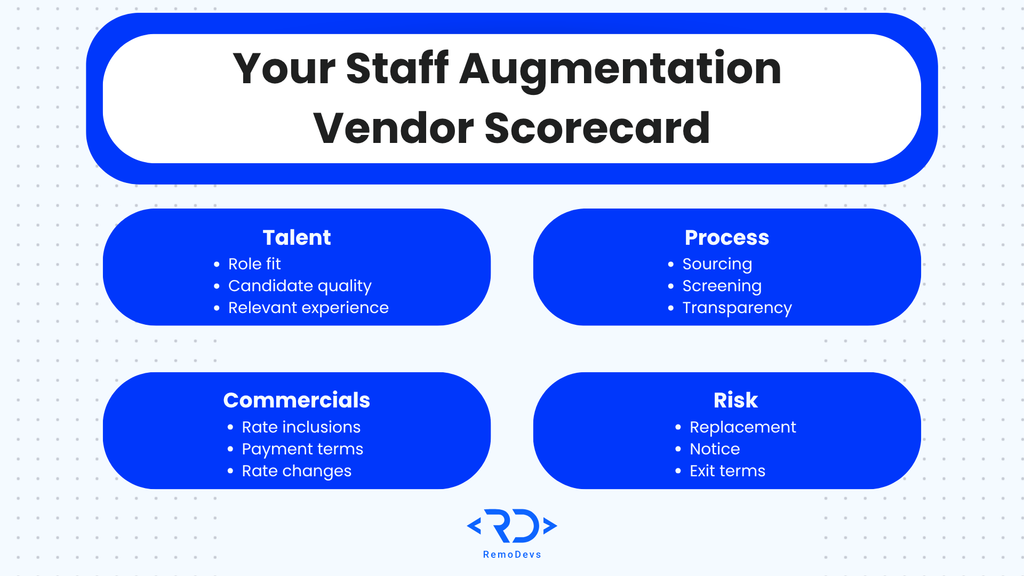
Staff Augmentation Vendor Evaluation Scorecard
Use the scorecard to make evidence gaps visible, not to manufacture a mathematically certain winner. A provider with an attractive total but an unresolved contracting or security issue is not automatically acceptable.
| Evaluation area | What to verify | Evidence to request | Red flag |
|---|---|---|---|
| Requirement fit | Access to the exact role, seniority, domain and location required | Comparable recent searches; role-specific market feedback; sourcing plan | Generic capability deck or immediate agreement to an unrealistic brief |
| Engagement model | Who contracts, manages and owns delivery | Written responsibility map and complete contracting chain | “Staff Augmentation” label without named responsibilities |
| Sourcing capability | How candidates are found and when suitability is reconfirmed | Search channels; source of each proposed specialist; current interest and availability | Unexplained profiles or hidden intermediaries |
| Screening | Checks completed, evaluator and client approval rights | Per-candidate screening summary; assessment criteria and results where applicable | “Top X%” or “pre-vetted” without a method |
| Comparable evidence | Experience with a similar client-managed engagement | Relevant case, reference or inspectable third-party review | Software-house case presented as proof of Staff Augmentation |
| Candidate transparency | Location, allocation, availability and commitments | Current CV; interview; written logistical confirmation | No client interview or unclear working location |
| Commercials | Total price basis and included responsibilities | Itemized proposal with assumptions, inclusions and exclusions | Low headline rate followed by material undefined costs |
| Contract and exit | Notice, termination, conversion, IP, security and handover | Draft agreement and schedules before selection | Pressure to commit before contractual review |
| Replacement | Trigger, process, client choice and commercial effect | Written replacement procedure | “Guaranteed replacement” with no timing or outcome defined |
| Limited start | Ability to validate one role before scaling | Initial scope, review point and expansion conditions | Large commitment required before meeting actual specialists |
A simple internal rating such as strong evidence / partial evidence / unresolved is often more useful than a weighted score to two decimal places. Record the reason and the document supporting each rating.
How to Compare Staff Augmentation Providers Step by Step
1. Define one exact requirement
Select a real role that matters to the business. Avoid testing providers with a generic future need, because it will not reveal their current access to relevant specialists.
2. Shortlist three or four plausible providers
Use role fit, operating model and Poland capability to narrow the market. If you still need an initial list, the RemoDevs ranking of Staff Augmentation companies in Poland is designed for provider discovery. Do not recreate the ranking inside the final selection process.
3. Send every provider the same brief
Keep responsibilities, must-haves, working model, capacity and requested start consistent. Allow vendors to identify risks or propose justified changes, but preserve a common comparison baseline.
4. Request the same evidence
Send the scorecard with the brief. Ask each vendor to identify the contracting chain, screening stages, source of candidates, commercial inclusions, replacement process and relevant engagement evidence.
5. Evaluate the response before the sales presentation
Look for role-specific reasoning. A provider that asks precise questions, flags trade-offs and documents unknowns is giving you evidence about how the engagement may operate.
6. Review and interview the actual specialists
Company-level due diligence cannot replace candidate evaluation. Use the same role scorecard and interview structure for each person, and record which provider checks you are relying on versus verifying internally.
7. Normalize commercial and contractual terms
Compare the same capacity and engagement period. Add excluded costs, review payment and rate-change provisions, and surface conversion, notice and termination terms. Resolve material contract differences before treating prices as comparable.
8. Check replacement, exit and security scenarios
Walk through realistic events: the specialist resigns, performance is below expectations, sensitive production access becomes necessary, the project stops early or you want to hire the person directly. The proposal should explain what each event triggers.
9. Choose the proposed engagement, not the company logo
The final decision should combine provider evidence, the actual specialist, the operating model, commercial terms and exit risk. A strong brand cannot compensate for a weak candidate or an unsuitable contract. A smaller provider should not win solely because its quote is cheaper.
Document the final rationale so the decision remains defensible to engineering, procurement, finance and security stakeholders.
Example Brief to Send Shortlisted Providers
Role: Senior Data Engineer
Context: Add capacity to an existing client-led data-platform team. The client owns architecture, backlog, code review and delivery.
Responsibilities: Build and optimize production pipelines; contribute to data-model and observability decisions; document work and collaborate with analytics and ML stakeholders.
Must-have evidence: Recent production work with Databricks, Spark, Python and cloud data platforms; ownership of reliability or performance improvements; experience in a mature engineering environment.
Seniority: Senior, able to work independently inside an existing architecture.
Location and hours: Based in Poland; regular Central European working hours with agreed overlap for client meetings.
Capacity and duration: Full-time-equivalent capacity for an initial six months, with extension subject to review.
Planned start: Target month and acceptable notice-period range.
Client-side owner: Data Engineering Manager.
Selection: Client CV review, engineering interview and system-design discussion.
Security: Client-managed device and access; confidentiality, IP, data-access and offboarding terms required before start.
Provider response requested: Sourcing approach, completed screening, candidate location and availability, full rate inclusions, contracting chain, replacement process, notice and conversion terms.
Change the technologies and context, but keep the structure. Every vendor should be answering the same business and technical need.
Questions to Ask a Staff Augmentation Company
Talent and Sourcing
- Which recent searches or engagements show access to this exact role and seniority?
- Will you source actively for our requirement, propose an internal bench, use a database or involve partners or subcontractors?
- When were the proposed specialist’s interest, location, allocation, rate expectations and start availability last confirmed?
Operating Model
- Which entity signs our agreement, and who employs or contracts the specialist?
- Who sets priorities, manages day-to-day work, evaluates performance and owns delivery outcomes?
- Is any other provider, marketplace or intermediary involved, and what responsibility does each party hold?
Screening
- What has been checked before a profile reaches us, and what remains for our team to assess?
- Who performs any technical evaluation, what does it test and will we receive the relevant evidence?
- Can our team interview, assess and approve every proposed specialist and replacement?
Commercials
- What capacity does the rate assume, and which costs or services are included and excluded?
- How are holidays, absences, overtime, equipment, licences, travel and non-standard working hours treated?
- What can change the rate, currency basis or minimum commitment during the engagement?
Contract, Security and IP
- What are the notice, termination, conversion and direct-hire terms, including any fees?
- How do the agreement and specialist-level documents address confidentiality, IP, subcontractors and work created during the engagement?
- What security and data-processing obligations apply, and how are access, incidents, retention and deletion handled?
Replacement, Exit and Scaling
- What triggers replacement, when does sourcing restart and may we reject unsuitable replacements?
- What handover, documentation and access-removal steps apply if the specialist leaves or the engagement ends?
- Can we begin with one role or limited initial scope, and what changes commercially if we later add or remove specialists?
These questions are deliberately deeper than a first-call checklist. Ask for written answers and supporting documents where the issue could affect cost, control or risk.
Staff Augmentation Provider Red Flags
- The provider cannot clearly identify who contracts the specialist.
- A supposedly client-managed service quietly includes vendor-controlled delivery, or vice versa.
- “Top X%,” “fully vetted” or guaranteed-speed claims are presented without definitions or methodology.
- Your technical team cannot interview and approve the actual specialist.
- Candidate location, allocation or start availability remains vague.
- CVs are generic, stale or poorly matched to the agreed responsibilities.
- A subcontracting or partner chain appears only during contract review.
- Material costs and capacity assumptions are absent from the headline rate.
- Notice, replacement, conversion or early-termination terms remain undefined.
- Broad capability claims are unsupported by role-relevant evidence.
- The provider pressures you to sign before you review the specialist and draft agreement.
- Every difficult role receives the same guaranteed sourcing timeline without reference to market constraints.
One unresolved point does not always disqualify a provider. The red flag is an inability or unwillingness to make the operating reality visible before you commit.
When RemoDevs May Be a Good Fit
RemoDevs’ IT Staff Augmentation service in Poland is designed for companies that already have product and engineering leadership and want to retain control of priorities, technical direction and delivery.
Its strongest fit is one or several selected senior specialists sourced in Poland, particularly in Data, AI, Security and Solution Architecture, with selected senior Java and Python requirements.
RemoDevs supports requirement calibration, sourcing, agreed screening, candidate and interview coordination, contractual and administrative work defined for the engagement, onboarding coordination, ongoing communication and agreed replacement support.
The client interviews the specialists, makes the selection and manages their work.
That focus also defines the limitation. RemoDevs is not positioned as the vendor to take complete ownership of a software project or provide a large vendor-managed delivery organization. A company seeking a supplier to run delivery against a contracted outcome should evaluate a managed outsourcing provider instead.
The sensible way to assess RemoDevs is the same as any other shortlisted company: send the real brief, request the evidence in this guide, meet the proposed specialists and review the actual commercial and contractual terms.
Final Decision Checklist
Before signing, confirm that:
- the requirement and selection criteria are documented;
- the same brief was used across shortlisted providers;
- the complete contracting chain is known;
- management and delivery ownership are written down;
- the proposed specialist has been interviewed and approved by the client;
- completed screening is separated from unverified claims;
- candidate location, allocation and start availability are confirmed;
- relevant evidence matches the intended engagement model;
- proposals are normalized to the same capacity and inclusions;
- notice, replacement, conversion, security, IP and exit terms have been reviewed;
- the initial scope is proportionate to the evidence available;
- the final rationale is recorded, including any accepted risks.
A defensible choice is not “Vendor A had the best presentation.” It is: “Vendor A proposed the strongest specialist for our defined requirement, showed how that person was sourced and assessed, accepted a clear client-managed responsibility split, disclosed the full cost and contracting chain, and gave us workable replacement and exit terms.”
Frequently Asked Questions
How do I choose an IT Staff Augmentation company?
Define one exact role, shortlist three or four credible providers and give each the same brief. Compare role-specific evidence, actual candidates, responsibility split, screening, complete commercial terms, contract conditions and replacement process. Make the decision on the real proposed engagement rather than the company’s marketing position alone.
What should I look for in a Staff Augmentation provider?
Look for demonstrated access to the required specialist, transparent sourcing and screening, client approval of every candidate, a clear contracting chain, full commercial assumptions and practical notice, replacement, security and exit terms. Evidence should match client-managed Staff Augmentation rather than recruitment or vendor-managed project delivery.
How many Staff Augmentation companies should I compare?
Three or four well-matched providers are usually enough to test the market without creating an unmanageable process. Adding more companies often produces more sales calls and duplicate candidates rather than better evidence. A highly regulated or unusually scarce requirement may justify a different approach.
How do I compare Staff Augmentation proposals?
Use the same role, seniority, location, capacity and engagement period. Add excluded costs, confirm what screening and support are included, and compare notice, rate-change, replacement and conversion terms. Then evaluate the actual specialists proposed. The lowest headline rate is not necessarily the lowest-risk or lowest-total-cost option.
Should I choose a recruitment agency or a Staff Augmentation company?
Choose recruitment when you want to hire the person directly into your organization. Choose Staff Augmentation when an external specialist will work inside your team through a provider arrangement for an agreed period or capacity. Both can involve client-led work; the contractual relationship, fee structure, notice and conversion terms differ.
Should I choose the cheapest Staff Augmentation provider?
Not on price alone. First normalize the scope, capacity and inclusions. A cheaper proposal can be good value, but it can also reflect different seniority, limited screening, excluded costs, a longer commitment or weaker replacement terms. Price becomes meaningful only after those differences are visible.
Visit us
Find a moment in your calendar and come to our office for a delicious coffee
Make an apointment