
By understanding Polish IT contracts, businesses can avoid costly missteps and build sustainable remote teams. Whether you are looking to hire a single developer or an entire engineering squad, grasping the nuances of B2B Poland explained is the first step toward success.
In this guide, I simplify key aspects for foreign businesses, ensuring you have the knowledge to make informed decisions when hiring in Poland.
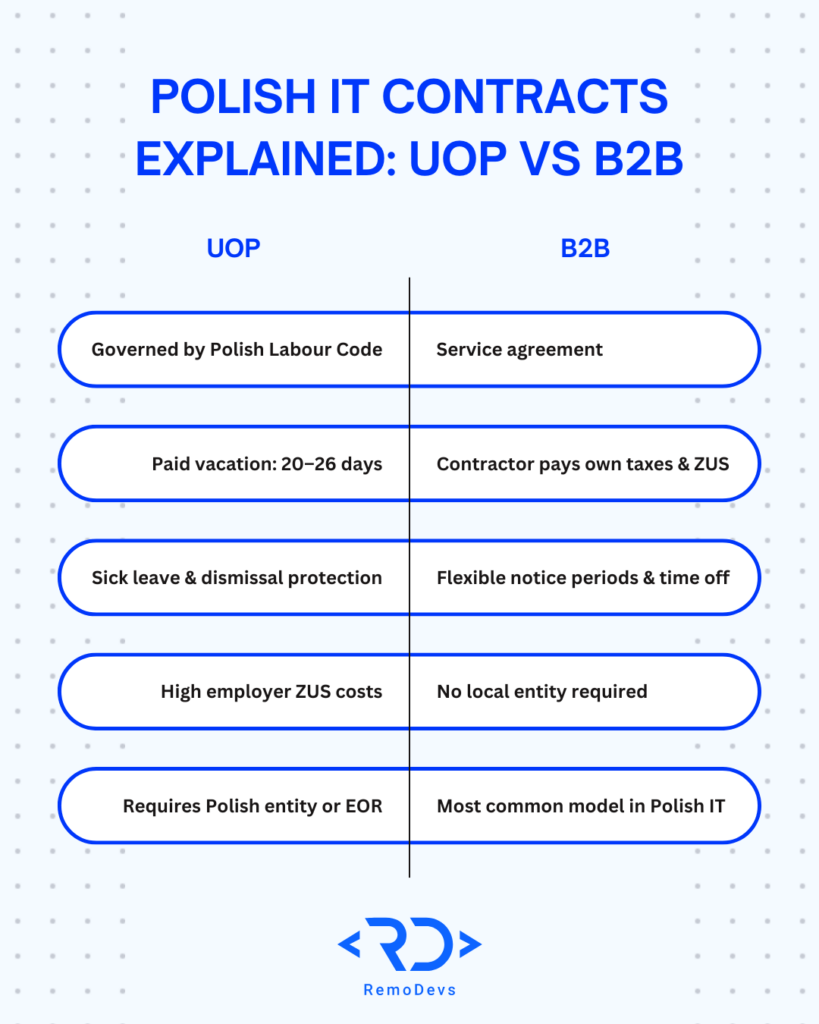
Types of Contracts in the Polish IT Sector
When hiring in Poland, you will primarily encounter two models: the standard Employment Contract (Umowa o Pracę) and the B2B Contract (Business-to-Business).
Employment Contracts (UoP)
The Employment Contract is the traditional model governed strictly by the Polish Labour Code. It offers the highest level of stability and protection for the employee.
- Protection: Employees are entitled to paid vacation (20 or 26 days), sick leave, and protection against unfair dismissal.
- Costs: The employer covers significant social security (ZUS) contributions, which increases the total cost of employment.
- Formalities: Foreign companies without a Polish entity cannot directly employ staff under this model without setting up a local branch or using an Employer of Record (EOR).
For companies seeking long-term retention with full control, this model is standard, though less flexible than other options.
B2B Contracts Explained
A B2B contract in Poland is essentially a civil law agreement between two companies: your company and the developer’s sole proprietorship. This model is dominant in the IT sector due to its flexibility and tax efficiency.
- Nature: It is a service agreement, not an employment relationship; the Labour Code does not apply.
- Taxes: The contractor (developer) is responsible for their own taxes and ZUS contributions, often resulting in higher net income for them.
- Flexibility: Termination notice periods and paid time off are negotiated contractually rather than mandated by law.
Understanding the distinction is vital. While hiring without a local entity is easier via B2B, you must ensure the relationship truly reflects a business partnership to avoid misclassification risks.
Legal Requirements for Foreign Companies Hiring in Poland
Establishing a legal presence or choosing the right partner is the foundation of compliant hiring. Foreign companies often face the choice between direct hiring, which requires a local entity, or partnering with specialized agencies.
Establishing Presence and Tax Implications
If you opt for B2B contracts, your company enters a service agreement. The Polish contractor must be a registered business (typically a sole trader) with a valid tax identification number (NIP).
- VAT: Reverse charge mechanisms often apply for cross-border B2B services within the EU or with non-EU entities.
- Verification: Always verify the contractor’s business status in the CEIDG (Central Register and Information on Economic Activity).
- Agreements: Contracts should clearly define the scope of services to distinguish them from employment duties.
Compliance and Data Protection
In the IT sector, data security is paramount. Since Poland is an EU member, all contracts must comply with GDPR standards.
- Clauses: specific data processing agreements (DPA) should be included in your contracts.
- Security: Ensure contractors adhere to your company’s security protocols, especially when handling sensitive IP.
- Rights: Clearly assign Intellectual Property (IP) rights to your company upon payment, as Polish law defaults IP ownership to the creator unless stated otherwise.
For more on data protection standards, the Personal Data Protection Office (UODO) provides official guidelines.
Visas and Work Authorizations
While hiring EU citizens is seamless, hiring non-EU talent (even if they reside in Poland) requires due diligence regarding work permits and residence cards.
- Blue Card: Many senior IT specialists hold an EU Blue Card, facilitating their work across member states.
- Permits: Ensure your contractor or employee has the legal right to work in Poland to avoid penalties.
Partnering with IT recruitment agencies in Poland can significantly reduce the administrative burden of verifying these documents.
Benefits and Challenges of B2B Contracts in Polish IT
The B2B model is a double-edged sword that offers immense value but comes with specific responsibilities.
Advantages
For foreign companies, the primary benefit is simplicity and cost-effectiveness. You receive an invoice for services, avoiding the complexities of Polish payroll administration.
- Cost Savings: No employer social security contributions means lower overall costs compared to employment contracts.
- Higher Net Pay: Developers often prefer B2B because favorable tax schemes (like the IP Box or flat tax) leave them with more disposable income.
- Agility: Scaling teams up or down is legally simpler than navigating strict employment termination laws.
Challenges and Risks
The main risk is “reclassification.” If a B2B contractor is treated exactly like an employee (e.g., set working hours, direct subordination, paid holidays), tax authorities may reclassify the relationship as employment.
- Audit Risk: Tax authorities may scrutinize contracts that look like “hidden employment.”
- Liability: Companies must ensure the contract language and actual working reality align.
- Regulations: Keep an eye on IT recruitment trends and upcoming legal shifts.
Recent discussions around EU platform work directives and domestic labour law changes (slated for 2026 and beyond) suggest a tightening of B2B regulations. It is crucial to stay updated on these legal and compliance changes to maintain a compliant workforce.
Step-by-Step Guide to Setting Up Polish IT Contracts
Creating a solid contract is not just about legal compliance; it’s about setting the stage for a productive relationship.
Step 1: Identify Needs and Contract Type
Determine if you need a long-term core team member (potentially suited for EOR/Employment) or a flexible specialist (B2B).
- Roles: Senior developers often prefer B2B for tax reasons.
- Duration: Project-based work naturally fits the B2B model.
Step 2: Drafting the Contract
Your contract must be robust. Key clauses include IP transfer, confidentiality (NDA), and clear termination terms.
- IP Rights: Explicitly state that all code created is the property of your company effectively upon creation or payment.
- Non-Compete: Define any restrictions on working for direct competitors during the contract.
- Scope: Describe the “services” to be rendered, avoiding language that implies “duties” of an employee.
Step 3: Onboarding and Payments
Streamline the payment process to build trust. International transfers to Poland are straightforward, but currency exchange rates should be considered.
- Currency: Agree on whether invoices will be paid in EUR, USD, or PLN.
- Tools: Use modern onboarding platforms to manage digital signatures and document storage.
- Invoicing: Ensure contractors issue valid VAT invoices (or invoices with reverse charge notes).
For a deeper dive into managing this phase, read about hiring Polish developers remotely.
Step 4: Monitoring Compliance
Regularly review your contracts and working practices.
- Audits: Periodically check that B2B contractors maintain their independence.
- Updates: Adjust contracts if local laws or your business structure changes.
You can learn from others who have successfully navigated this by reviewing strategies to build remote engineering teams in Poland.
Conclusion
Navigating Polish IT contracts doesn’t have to be complicated. By understanding the distinction between employment and B2B agreements, adhering to tax and GDPR regulations, and structuring your contracts carefully, you can unlock access to some of the world’s best developers.
Poland offers a unique blend of high-quality talent and business-friendly flexibility, provided you respect the legal framework.
While this guide covers the essentials, every company’s situation is unique. Consulting with experts ensures that your specific needs are met with a tailored legal approach.Ready to build your team? Partner with RemoDevs for vetted Polish IT talent and streamlined hiring processes that take the guesswork out of compliance.
Visit us
Find a moment in your calendar and come to our office for a delicious coffee
Make an apointment