You have selected a staff augmentation provider, met the specialist and agreed the commercial direction. Now the agreement arrives. Does it describe the engagement you thought you were buying?
A good review should resolve more than the hourly rate. It should tell you who will work with your team, who directs that work, what time can be invoiced, how the arrangement changes or ends, and whether your company can safely use what the specialist creates.
This guide gives technology and procurement buyers a practical set of questions to take into the final contract discussion. It is buyer education, not a substitute for legal review of a particular agreement.
The short answer: a pre-signing checklist
| Area | What should be clear before signing | Question to ask |
|---|---|---|
| Contracting chain | The supplier, invoicing entity and entity engaging the specialist | Who actually contracts with this person? |
| Role and capacity | Role, start date, allocation and working setup | What does “full time” mean here? |
| Management | Who sets priorities and owns delivery | Who directs the specialist each day? |
| Billing | Rate, unit, time approval and exceptions | What can appear on an invoice? |
| Term and exit | Minimum term, notice, SOW termination and final charges | Can we end this assignment without ending the framework agreement? |
| Replacement | Departure, absence, substitution and handover process | Who approves a substitute, and what happens during a gap? |
| Direct hire | Any restriction or conversion fee | What would it cost to hire the specialist later? |
| Work product | Rights in code, documentation and other outputs | Do the necessary rights reach us from the person doing the work? |
| Confidentiality | Obligations covering the actual specialist and access | Who is bound before repository access is granted? |
| Data and security | Actual data access, roles, controls and incident route | Is a data processing agreement needed for this setup? |
| Risk allocation | Liability cap, exceptions and insurance | What happens if an important obligation is breached? |
| Cross-border terms | Governing law, disputes and formal notices | Which language and forum control if there is a disagreement? |
Treat an unclear answer as a point to resolve in writing. It does not, by itself, mean the provider is unsuitable.
MSA vs SOW: which document does what?
There is no mandatory document pair called an MSA and SOW for every staff augmentation engagement. A supplier might use a master services agreement (MSA), a framework agreement and separate statements of work (SOWs). Another might use an order form, work order or schedules attached to one services agreement. Security and data protection terms may sit in additional documents.
Where an MSA and SOW are used, the MSA usually governs the ongoing relationship: confidentiality, intellectual property (IP), payment framework, liability, disputes and general termination rights. The SOW usually defines a particular assignment: the specialist or role, capacity, location, start date, rate, reporting process and any engagement-specific departures from the framework.
Read them together. Check the order of precedence if the SOW conflicts with the MSA, which schedules are actually incorporated, and how a change becomes binding. A polished SOW cannot fix a missing IP chain in another document merely by naming the client as the owner. Equally, a sound MSA cannot tell your finance team how to approve this month’s hours unless the assignment documents supply that detail.
In a typical client-managed staff augmentation arrangement, you are adding specialist capacity to your own team. You are generally not buying a fixed-scope software project with vendor-owned delivery milestones.
The RemoDevs staff augmentation service page describes a model in which the client retains the roadmap, backlog, technical direction and day-to-day delivery. If your proposal promises a completed outcome, clarify whether you are actually contracting for a different model.
Check the SOW: who, what, when and how much capacity
Define the role beyond its title
“Senior Developer — full time” leaves too much open. The assignment should identify the role and seniority, main workstream, essential technical or domain requirements, expected start, duration or review point, remote or on-site setup, time-zone overlap and the person who will manage the specialist on your side.
If a named candidate was central to your decision, make clear whether the SOW covers that person specifically and what approval is needed for a change.
Describe the expected contribution without pretending the backlog will be frozen. A senior data engineer may help build pipelines, review designs and support production incidents; those responsibilities are more useful than a promise to “deliver the platform” if your own team retains planning and release decisions.
Record unusual requirements such as regulated-environment access, on-call duties or client equipment before the person starts.
Write down the management split
Both sides should know who sets priorities, gives technical direction, reviews code, grants access, approves time, provides performance feedback and decides whether work meets the team’s standards. The provider’s obligations might include sourcing, agreed screening, coordination, administration and replacement support; the exact agreement determines the scope.
For example, if a release slips because the client changed priorities, a provider should not silently be treated as guaranteeing a project milestone that it never controlled. Conversely, the client should know who at the provider will respond when the specialist becomes unavailable. A responsibility table or a few precise sentences are often more useful than a broad promise to “ensure successful delivery.”
Make capacity and invoicing testable
Once you have agreed a commercial model, could both sides calculate the same invoice from the written terms? Look for the rate and currency, hourly/daily/monthly unit, planned allocation, minimum commitment, billable activities, timesheet submission, approver and deadline for disputing time. What happens if the approver is away? Do not leave the treatment of unreviewed time implicit.
What happens to the invoice during public holidays, planned leave, sickness or other unavailability? How are unused monthly capacity, overtime, on-call work and hours beyond the agreed overlap handled? Who authorizes additional work, and in what form? List chargeable expenses such as travel, hardware and software licences, including any prior approval rule.
Check rate reviews, taxes or VAT as applicable, invoice frequency, payment term and any currency-conversion method. The task here is to capture your agreed terms accurately.
Check the main agreement: people, rights and exit
Identify the full contracting chain
Which legal entity signs and invoices the client? Does that entity employ, contract with or source through another business the person who will do the work? Is subcontracting allowed, and will you be told when that chain changes? These answers matter for confidentiality, IP, security and escalation. Do not assume that a provider is automatically the specialist’s legal employer, or that the company named on the invoice is the only entity with obligations to the person.
Where a Poland-based engagement uses B2B or another civil-law structure, the documents should match how the relationship actually works. Under Article 22 of the Polish Labour Code, the characteristics of the work, including direction and where and when it is performed, matter more than the contract’s label when determining whether there is an employment relationship. B2B collaboration is not inherently invalid, and staff augmentation does not automatically create employment. The practical point is to keep the written model and day-to-day arrangement consistent. See the Polish Labour Inspectorate’s explanation of Article 22.
Know how an assignment changes or ends
Start with the minimum term, automatic renewal and notice provision. Can either side terminate for convenience? Can you end one specialist’s SOW while keeping the MSA and other assignments in force? What counts as material breach, is there a chance to remedy it, and when can termination be immediate? The agreement also needs a clear method and effective date for notice.
Then calculate the exit, not just the notice period: which fees remain payable, how is approved work in progress invoiced, and are there minimum-capacity charges after the specialist stops working? Who transfers documentation and unfinished work, returns equipment, revokes accounts and confirms deletion or return of information?
If a six-month plan can still create six months of charges after an early stop, the arrangement is less flexible than the headline proposal suggests. There is no universal “standard” notice period to assume.
Separate replacement from a guarantee of instant availability
The agreement should distinguish resignation, extended absence, poor fit and provider-initiated substitution. Can the supplier replace a named specialist without approval? Who evaluates a proposed replacement, what comparable requirements apply, who pays for overlap and handover, and how are gaps billed? Can the client request removal of a specialist, and what happens if no suitable replacement is found?
A replacement process can require prompt sourcing, candidate review and transition support. It cannot sensibly promise that an identical engineer will be available immediately in every market condition. Check the actual remedy and timeline rather than reading “replacement support” as an unlimited guarantee.
Check direct-hire and conversion terms early
If your team might later hire the specialist directly, identify any non-solicitation restriction, its duration, whether it also applies after the engagement and the exact fee or calculation method for a permitted conversion. Clarify whether the fee changes with time and whether it applies if the candidate approaches you independently. These terms can be reasonable commercial protections, but a fee discovered only when you want to make an offer is a preventable surprise.
Protect the work product and the environment
Trace IP from the creator to the client
Ask what the agreement covers: source code, tests, documentation, designs, configurations, data pipelines and, where relevant, AI-related work product. Who initially holds any relevant rights, how do those rights reach the client through the actual employment or subcontracting chain, and when does the transfer or licence take effect? Is it conditional on payment? What can the client use before payment or after a disputed invoice?
Separate newly created work from the specialist’s pre-existing tools, client materials, third-party components and open-source dependencies. For AI work, also clarify rights and permitted use of training inputs, prompts, model configurations and outputs where relevant; calling everything “work product” does not answer every technical or legal question.
Polish rules for copyright transfers, for example, require attention to the parties, subject matter, specified fields of exploitation and form. A generic international “work for hire” phrase should not be assumed to settle the chain. PARP’s guide to Polish copyright transfer agreements explains these issues. Have counsel adapt the provision to the jurisdictions and actual people involved.
Match confidentiality to real engineering access
Before repository access is granted, make sure confidentiality obligations reach everyone who will see client information, including the actual specialist and permitted subcontractors. Identify what information is protected, permitted uses and disclosures, duration, incident escalation, and return or destruction at exit.
Translate the clause into an access list: repositories, cloud accounts, production systems, customer data, tickets, architecture diagrams and credentials. Decide who grants least-privilege access, approves elevated privileges, records devices and removes accounts on departure. A confidentiality clause is useful, but it does not itself provision or revoke a production account.
Decide the GDPR role from the actual processing
Do not assume that every augmentation provider is a GDPR processor simply because its specialist may access a client system. Map which personal data the work involves, who determines why and how it is processed, which entity has access and under whose authority the specialist acts. The European Data Protection Board (EDPB) treats controller and processor as functional roles based on actual activities.
Its guidance contrasts systematic IT support access, which can make the service provider a processor, with a bug-fix assignment involving only incidental and very limited access, where the provider was not treated as one. The examples are fact-specific, not universal classifications. Read the EDPB’s final Guidelines 07/2020.
If the facts establish a controller–processor relationship, check that an Article 28 arrangement covers the required processing terms and any sub-processors. The EDPB notes that those terms can be incorporated into a broader agreement rather than a document separately titled “DPA.”
In every case, define appropriate access controls, permitted locations, incident reporting, offboarding and any data return or deletion obligations. For access outside the EEA, assess the transfer position separately rather than assuming a remote-working clause resolves it.
Understand liability rather than counting clauses
Find the liability cap and its calculation base. Does it apply to one claim, all claims under an SOW, or the entire relationship? Are confidentiality, IP, security, data incidents or payment obligations handled differently? What losses are excluded? If indemnities appear, who controls a third-party claim and what must the other party do? Check whether any required insurance actually matches the risks and the party carrying them.
There is no universally fair cap. The question for the buyer is whether the contract allocates the plausible risks of this specific engagement in a way the company can accept. A developer with read-only access to a test environment presents a different exposure from someone deploying to production and handling customer records.
Finally, verify governing law, forum or dispute mechanism, controlling language version and the addresses and methods for formal notices. Cross-border teams need to know which version of the documents wins before a dispute arises.
Example: what a clear SOW should let you answer
The following is an illustrative field list, not a contract template or a RemoDevs offer:
| Field | Illustrative answer |
|---|---|
| Assignment | Senior Data Engineer supporting the client’s existing data platform team |
| Specialist | Named candidate, with client approval required for substitution |
| Capacity and setup | Up to 152 billable hours per month; remote from Poland; 09:00–13:00 overlap in Poland local time |
| Dates | Agreed start date and initial term, with an identified review point |
| Management | Named client engineering manager sets priorities and reviews work |
| Commercials | Agreed rate, billing unit, time-reporting cycle, approval and extra-hours rule |
| Exit and replacement | Applicable SOW notice, approved replacement process and handover responsibilities |
| Documents | Identified MSA, SOW and any applicable security or data-processing schedule |
An actual SOW needs the real agreed values where this illustration says “agreed.” It should point to the relevant MSA provisions rather than leaving conflicting definitions of capacity or notice in separate documents.
Red flags to resolve before signing
- The invoicing entity differs from the contracting entity without an explanation of the relationship.
- “Full time” appears without a billable capacity or availability definition.
- A client-managed specialist is described as though the provider guarantees a fixed project outcome.
- Overtime, travel or unused capacity can be billed without an approval or calculation rule.
- The provider may substitute a named person without client review.
- Replacement is promised but the process, interim billing and handover are absent.
- Direct hiring is restricted, while the conversion fee remains undefined.
- IP wording names only the supplier, with no clear route from the person creating the work.
- Security terms are generic despite production or customer-data access.
- An individual SOW cannot clearly be ended without affecting unrelated assignments.
- The SOW and MSA contradict each other, and no document has defined precedence.
Each is a request for a concrete answer or amendment, not proof that the supplier acts in bad faith.
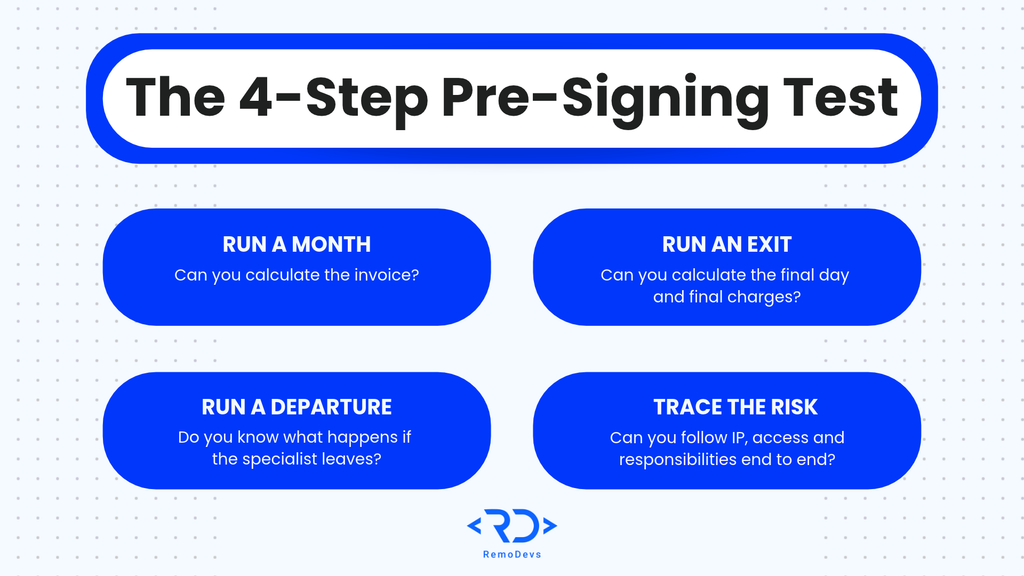
Your final 15-minute pre-signing review
Put the proposed document set beside the proposal and see whether you can:
- Name the parties and the person: identify who signs, invoices and engages the specialist, and whether substitution needs approval.
- Run a sample month: calculate an ordinary invoice and one with absence, overtime or expenses using the written rules.
- Run an exit scenario: calculate the last day, final invoice, handover, account removal and surviving obligations if the assignment ends early.
- Run a departure scenario: identify the contact, replacement steps, approval point, handover and charges during a gap.
- Trace one deliverable: follow rights in a piece of code from its actual creator to your company, including any pre-existing or third-party components.
- Map one sensitive access path: identify the system, personal data if any, authorized users, GDPR roles where applicable and incident contact.
- Resolve conflicts: check incorporated schedules, order of precedence, formal notices and who can sign a change.
If two reasonable readers reach different answers from the same documents, ask for a written clarification before signing.
Frequently asked questions
What should a staff augmentation contract include?
It should make the parties, specialist-supply model, management split, commercials, term and exit, replacement, IP, confidentiality, security and risk allocation clear. The terms can be distributed across a framework agreement, SOW and schedules; the complete set matters more than the document names.
What is a staff augmentation SOW?
A statement of work normally records the specifics of one assignment: role or named specialist, capacity, start, work setup, rate, reporting and any engagement-specific conditions. Some providers call it a work order or order form.
What is the difference between an MSA and a SOW?
An MSA commonly sets relationship-wide rules that can apply to multiple assignments. A SOW commonly records the commercial and operational terms for a particular specialist or team. Confirm their order of precedence and how each can be amended or ended.
Should the SOW include software deliverables and acceptance milestones?
It can describe the workstream and expected responsibilities. In client-managed augmentation, fixed vendor-owned deliverables and acceptance milestones may misstate who manages and bears responsibility for the outcome. Use them only when they reflect the real agreed model.
Who owns code produced by an augmented developer?
Do not infer ownership from the fact that the code sits in your repository. Review the applicable IP provisions, the creator’s relationship to the supplier, the rights chain, timing of transfer or licence and treatment of pre-existing and third-party material. The answer depends on the documents and applicable law.
What happens if the specialist leaves, and can we hire them directly?
Both depend on the contract. Check the replacement process, handover and interim billing for a departure. Separately check whether direct hiring is allowed, any non-solicitation period and the calculation of a conversion fee before discussing a future offer.
Make the paperwork match the engagement
The best contract review is operational: can engineering, finance, security and the supplier all describe the same first month, a change of specialist and the end of the assignment? Resolve the points they interpret differently while the proposal is still open.
If you are planning a client-managed specialist engagement in Poland, talk to RemoDevs about the role, sourcing and screening, onboarding coordination and the operational setup to be reflected in the agreed documents. RemoDevs’ published offer includes contractual and administrative support and replacement support; the specific terms belong in the agreement you review.
Visit us
Find a moment in your calendar and come to our office for a delicious coffee
Make an apointment