
Poland’s tech sector has moved well past the point where “cheap outsourcing” is a fair description. Over the last decade, the country has quietly repositioned itself as one of Europe’s most technically capable markets – not by competing on hourly rates, but by developing dense concentrations of senior engineering talent, EU-grade compliance infrastructure, and increasingly, original R&D capacity.
According to the McKinsey Digital Challengers report, Central and Eastern European economies have the potential to add up to €200 billion in additional GDP through digitization – and Poland is leading that charge.
Global companies that still evaluate Polish IT partners primarily on cost are working with an outdated map.
What Is the Current State and Future of IT in Poland?
Poland currently employs over 650,000 IT professionals, making it the largest tech talent market in the CEE region. According to the PARP IT/ICT Sector in Poland Report 2025 – published by the Polish Agency for Enterprise Development and co-financed by the EU – the country operates over 100,000 ICT entities and is actively evolving from a service delivery hub into a global innovation center.
Warsaw, Kraków, Wrocław, and Gdańsk have each developed distinct specializations – Warsaw leans toward fintech and enterprise SaaS, Kraków toward cybersecurity and data engineering, Wrocław toward embedded systems and hardware-adjacent software.
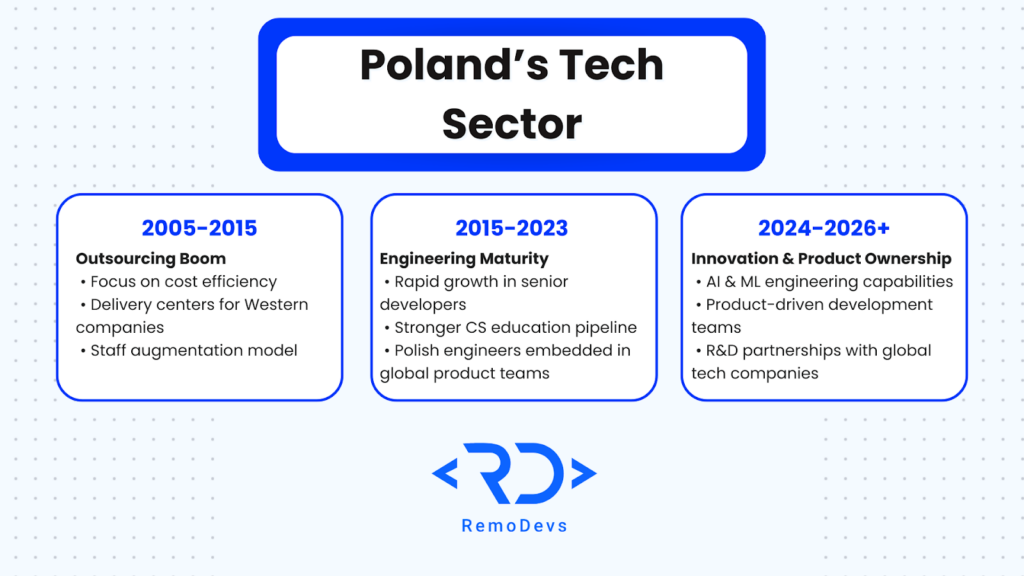
The structural shift happening now is from delivery-center model (execute specs, ship code) to product-partner model (own architecture decisions, drive technical strategy). This is partly driven by the maturing of local universities producing engineers with stronger CS fundamentals, and partly by Polish developers accumulating a decade of experience working directly on Western European and US product teams.
How Is AI in Poland Transforming the Software Development Landscape?
Polish developers are not waiting for AI adoption to trickle down from management. The integration is happening at the engineering level, which is where it actually matters.
Specifically, the adoption patterns breaking through in 2025–2026 include:
- Generative AI in enterprise workflows: Polish dev shops building internal LLM tools for legal document processing, contract review, and structured data extraction for mid-size EU enterprises
- Custom model fine-tuning: Teams working with open-weight models (Mistral, LLaMA variants) rather than defaulting entirely to OpenAI APIs, this matters for GDPR compliance and data residency requirements
- ML infrastructure engineering: A growing cohort of Polish engineers specializing in MLOps – model deployment pipelines, monitoring, and retraining loops – rather than pure data science
Hire specialized AI/ML engineers for your product team
The practical effect: companies hiring Polish engineers today are often getting someone who has shipped an LLM-integrated feature in production, not just someone who has experimented with prompt engineering.
Polish R&D Centers and the Drive for AI Innovation
The presence of global tech giants in Poland has accelerated local AI capability faster than any domestic initiative could have.
Google’s engineering hub in Warsaw, Samsung R&D in Warsaw and Kraków, Motorola Solutions in Kraków, Volvo’s software center in Wrocław – these are not call centers or support operations. They are engineering offices working on core product problems, and they have trained an entire generation of Polish engineers on enterprise-grade software architecture. In February 2025, Google launched an AI research partnership with Polish universities specifically to advance multilingual LLMs for Central European languages.
When a developer spends four years at one of these centers, they leave with exposure to large-scale distributed systems, ML pipelines, and security-by-design practices that most small consultancies cannot replicate. This talent then circulates through the broader market – including the mid-sized product agencies and remote teams that B2B companies are hiring.
The downstream effect is a local market where senior engineers in their 30s often have CV lines from Google, EPAM, Cognizant, or IBM before going independent or joining smaller product teams.
What Are the Key Tech Predictions for Poland in 2026 and Beyond?
The Evolution of Cloud Native and Cybersecurity
The NIS2 Directive, which EU member states including Poland were required to transpose into national law by October 2024, is now actively reshaping procurement decisions. As the European Commission’s official NIS2 policy page states, the directive establishes a unified legal framework covering 18 critical sectors across the EU, with hard requirements around incident reporting, supply chain security, and risk management.
In January 2026, the Commission proposed further targeted amendments to increase legal clarity and ease compliance for tens of thousands of companies.
Polish IT firms have responded by investing heavily in:
- Zero-trust architecture implementations, particularly for financial services and healthcare clients
- Cloud-native security tooling – shifting security left into CI/CD pipelines rather than bolting it on post-deployment
- SOC 2 and ISO 27001 certification, which are increasingly baseline requirements for enterprise contracts
For B2B companies evaluating partners, this means Polish vendors are often ahead of peers in other regions on compliance readiness – not because of altruism, but because the regulatory environment has forced it.
Growth in GreenTech and Sustainable Engineering
This is an emerging area rather than a mature one, but the trajectory is clear. Polish engineers are increasingly working on:
- Carbon footprint optimization at the code level – profiling energy consumption of cloud workloads, right-sizing infrastructure, writing more efficient algorithms for compute-heavy processes
- Renewable energy sector software – grid management systems, energy trading platforms, and IoT integrations for wind and solar installations
- Participation in EU-funded GreenTech R&D programs, which bring Polish universities and private companies into joint research tracks with Western European counterparts
The honest take: sustainable engineering is not yet a primary selling point for most Polish IT companies. But for clients building in the energy, logistics, or manufacturing sectors, it is increasingly a differentiator worth asking about directly.
Traditional IT Outsourcing vs The Future Polish IT Partnership
| Feature | Traditional Outsourcing (Past) | Polish Tech Partnerships (Future) |
| Primary Value | Cost arbitrage & cheap labor | High-end engineering & strategic innovation |
| Core Technologies | Legacy systems & basic web/app dev | AI, Cloud-Native, Complex Data Science, Cybersecurity |
| Engagement Model | Task-based staff augmentation | Autonomous, product-focused remote IT teams |
| Security & Compliance | Basic NDA agreements | Proactive EU-compliant cybersecurity (NIS2, GDPR) |
| Communication Style | Reactive, spec-following | Proactive, architecture-advising |
| Team Continuity | High churn, rotating resources | Long-term dedicated team members |
How Can Global Companies Leverage Poland’s Evolving Tech Ecosystem?
The companies extracting the most value from Polish IT talent right now are not treating it as a staffing exercise. They are building dedicated product teams – small, senior groups (typically 4–8 engineers) with enough context about the business to make architectural decisions independently.
This model works because:
- Timezone overlap with both the US (morning/afternoon in Eastern time) and Western Europe (full overlap) makes synchronous collaboration viable
- English proficiency among Polish engineers is high – Poland ranks #15 globally in the EF English Proficiency Index 2025, with a “Very High” proficiency rating and an IT-sector score of 621, above the national average
- Cultural alignment with Western business norms (direct communication, deadline orientation, written documentation) reduces the coordination overhead common in other offshore markets
How to build a dedicated remote IT team?
The practical approach: define a product area – an API layer, a data pipeline, a mobile client – and hire a team that owns it. Not a team that takes tickets, but a team that ships features and flags architectural risks before they become production incidents.
Future-Proofing Your Tech Strategy: What Should You Do Next?
The window for treating Polish IT as simply a cost play is effectively closed. The engineers who built Poland’s reputation on cost are now senior, and senior Polish engineers are not cheap. What they are is good.
If you are evaluating your tech strategy for 2026 and beyond, the questions worth asking are:
- Do your current development partners have demonstrated experience with AI integration, not just familiarity with the concept?
- Is your vendor prepared for NIS2 and GDPR compliance requirements, or are you carrying that risk yourself?
- Are you building a team that owns outcomes, or are you managing a group that executes tasks?
Polish IT talent answers all three of those questions well – if you structure the engagement correctly.
RemoDevs connects B2B companies with vetted senior Polish developers and pre-built remote teams, matched to your specific product requirements. Whether you need a single principal engineer or a full autonomous product squad, the process starts with understanding your technical context, not sending you a stack-ranked resume pile.
Frequently Asked Questions About the Future of IT in Poland
What is the future of IT in Poland?
Poland is transitioning from a cost-driven outsourcing market to a high-value engineering and R&D hub. The focus is shifting toward AI integration, cloud-native development, and cybersecurity, with global tech companies establishing R&D centers in Warsaw, Kraków, and Wrocław that are actively raising the ceiling on local engineering capability.
What are the top tech predictions for Poland over the next five years?
The most significant shifts are: widespread enterprise adoption of generative AI and custom LLM tooling; mandatory compliance-driven investment in cybersecurity infrastructure under NIS2; growth in cloud-native architectures replacing legacy systems; and an emerging sustainable engineering practice tied to the EU’s GreenTech funding programs.
How fast is the adoption of AI in Poland compared to the rest of Europe?
Poland ranks among the fastest-growing EU markets for AI skills adoption. The share of Polish IT professionals actively using AI tools at work rose by 12 percentage points to 61% in a single year. The combination of strong STEM university output, established R&D centers from global tech firms, and EU funding for digital transformation has accelerated AI skill development significantly.
Why should companies hire remote developers from Poland in 2026?
The strongest case is the combination of senior engineering experience (often from global tech company R&D centers), EU-compliant security practices, full English fluency (Poland ranks #15 globally in the EF EPI 2025 with “Very High” proficiency), and real timezone overlap with both US and European teams. Unlike many offshore markets, Polish engineers typically operate as technical co-owners of product areas rather than task executors – which meaningfully reduces management overhead on the client side.
Visit us
Find a moment in your calendar and come to our office for a delicious coffee
Make an apointment