A technical recruitment brief tells your agency why you’re hiring, what the engineer will own and which requirements should guide the search. It also sets out the approved pay range, working arrangements and who makes hiring decisions.
A short document or email is enough if the recruiter can use it to explain the role and recognise a promising candidate.
Job description, recruitment brief or technical assessment?
| What you’re preparing | Who uses it and why |
|---|---|
| Job description | Describes the responsibilities and requirements. The candidate-facing version explains the role, team and terms to people considering applying. |
| Recruitment brief | Gives the hiring team and the agency a shared view of the role, including which skills are essential, where there’s flexibility and what to check before an interview. |
| Technical assessment | Gives the engineering team a way to evaluate a candidate’s skills through a discussion, practical exercise or interview that reflects the work. |
If you already have a software engineer job description, use it as a starting point. Add the decisions an agency needs to work with. For instance, if the advert says ‘cloud experience’, explain whether the hire must operate AWS services from the start or can learn AWS with support from the platform team.
What to include in a technical recruitment brief
1. Project context and responsibilities
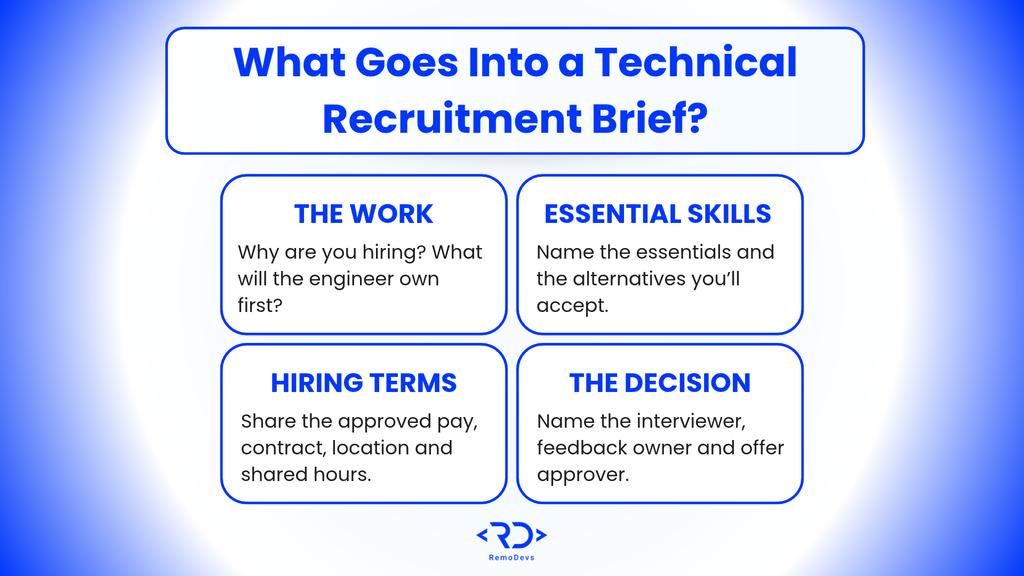
Explain what the product does, why you’re hiring now and what you expect the engineer to own in their first few months. Name the team they’ll join, who they’ll report to and where they’ll get support. Include architectural details where they change the search. Maintaining a live billing service calls for different experience from building a prototype.
2. Must-have skills, useful extras and seniority
Tie essential skills to the work the person will do. ‘Has diagnosed slow SQL queries in production’ gives the recruiter something concrete to look for. List skills the team can teach separately, and state which equivalent tools or backgrounds you’d consider.
Describe seniority through the decisions you expect the engineer to make. If they’ll lead a service rollout and own the rollback plan, say so. If a staff engineer will set the design, explain what the new hire will own within it.
3. Communication and remote collaboration
Describe the work behind phrases like ‘good communicator’. Will the engineer write incident handovers in English, explain trade-offs to a product manager or make design decisions with colleagues in another time zone? Tell the recruiter which of those situations they should discuss with candidates.
4. Logistics, budget and hiring decisions
For a search in Poland, state the approved engagement model. If employment and direct B2B contracting are both available, give a separate pay range for each, with its currency, pay period and basis. For example, specify gross monthly salary for employment and whether an invoiced B2B rate excludes VAT. Keep the candidate’s compensation and the agency fee separate.
Confirm where the engineer must be based, whether the role is remote or hybrid, any office or travel requirements, and the hours the team needs to share. Give the hours in a named location’s local time. Specify the target start date and how much room there is for notice periods. Agree who screens candidates, who runs the technical interview, who returns feedback and who approves the offer.
Technical recruitment brief example for a Senior Backend Engineer
Illustrative example. The role, budget and timings are fictional.
- Role and outcome. Senior Backend Engineer for a UK subscription software company hiring in Poland. The billing team needs a dedicated owner for its existing API as it reworks how failed payments are retried. The hire reports to the Engineering Manager, with support from a platform engineer. In the first three months, they’ll ship a change that lets the team trace a failed payment through its retries.
- Must-haves. Experience building and operating Node.js APIs in production, diagnosing slow PostgreSQL queries and leading a production change from design through rollout. Ask for an example of a change the candidate personally owned.
- Useful extras. NestJS and Amazon SQS. Experience with another Node.js framework or message queue is welcome. The team can help the hire learn its tools.
- Working arrangements. Fully remote within Poland, with shared hours from 10:00 to 14:00 Warsaw time. The team works in English and records incident handovers in writing. The engineer joins the on-call rota after onboarding, covering one week in six.
- Terms and start. Direct employment only. Approved base salary of PLN 24,000–29,000 gross per month. Aim for a start within three months of offer acceptance. Flag longer notice periods at screening.
- Screening and decision. The recruiter checks role alignment, compensation, availability and what the candidate owned in a recent backend project. The Engineering Manager and a senior engineer ask how the candidate investigated a slow PostgreSQL query and how they’d make a failed payment retry safe to run again and easy to trace. The Engineering Manager returns feedback within two working days and makes the hiring recommendation. The CTO approves the offer.
How RemoDevs uses your brief
The recruiter uses the brief to decide who to approach and explain what the engineer will be hired to do. When the first profiles come in, give specific feedback. ‘They operated the service but another team owned deployment’ tells the recruiter what to clarify with the next candidate.
RemoDevs helps international employers clarify the role, source and screen candidates in Poland, and coordinate interviews. Our software engineer screening process explains the recruiter’s checks and how the client’s engineers typically handle the technical assessment.
If you’re preparing a permanent technical hire in Poland, discuss your brief with RemoDevs. Bring the role outcome, approved range and any requirements you’re still deciding on.
Common mistakes that slow down the search
- Sending the advert as the brief. Add the constraints the agency needs to use, including which experience it can accept as equivalent.
- Making the whole stack essential. If the backend engineer also needs to maintain infrastructure or write frontend code, say what they’ll own in each area. Move tools they can learn into the optional list.
- Leaving pay or office days open. Confirm what the recruiter can tell candidates. A role described as remote will reach different people from one that requires a weekly office visit.
- Leaving decisions with a group. Give the recruiter one person who can clarify the brief, a technical interviewer and a named approver. Agree when feedback is due and who covers if someone is away.
Checklist before you send the brief
- The reason for hiring, the team and the first meaningful outcome.
- Essential skills, acceptable alternatives, useful extras and the level of ownership expected.
- Approved engagement model and compensation range, with currency and pay period.
- Location, remote or hybrid policy, shared hours and any travel or on-call duties.
- Target start, interview stages, assessment owner, feedback deadline and offer approver.
Visit us
Find a moment in your calendar and come to our office for a delicious coffee
Make an apointment