
When production deployments slow down or systems experience intermittent downtime under heavy load, technical leaders know they need infrastructure support. The harder question is determining exactly what kind of expertise their current architecture requires.
DevOps and Site Reliability Engineering (SRE) are frequently used interchangeably in job descriptions. However, treating them as identical can lead to unclear responsibilities, mismatched expectations, and unnecessary hiring costs.
Poland has developed a mature pool of cloud and infrastructure engineers supporting international enterprises and fast-growing technology companies. Hiring effectively in this market requires looking beyond job titles and evaluating the specific engineering skills behind them.
For technical leaders, that starts with understanding how SRE applies DevOps principles in practice and how the Polish infrastructure talent market operates.
DevOps vs. SRE: Philosophy and Implementation
The industry often creates an artificial conflict between DevOps and SRE, presenting DevOps as the engine for delivery speed and SRE as the safeguard for reliability.
In practice, the relationship is more closely reflected by Google’s well-known statement:
“Class SRE implements interface DevOps.”
DevOps is a broad cultural philosophy and set of practices designed to reduce barriers between development and operations teams. It promotes shared ownership, automation, rapid feedback, and reliable software delivery.
A DevOps engineer typically focuses on building the platforms and automated workflows that allow code to move from a developer’s environment to production safely and efficiently.
Site Reliability Engineering is a more specific engineering approach to implementing many DevOps principles.
SREs apply software engineering methods to operational problems. Their work often involves writing software and automation that improves the reliability, scalability, and observability of production systems.
They may work on deployment systems, but their responsibilities typically extend further into production architecture, incident response, capacity planning, and reliability management.
DevOps vs. SRE at a Glance
| Area | DevOps Engineer | Site Reliability Engineer |
| Primary objective | Improve software delivery and reduce friction between development and operations | Improve the reliability, scalability, and resilience of production systems |
| Typical focus | CI/CD, cloud infrastructure, deployment automation, Infrastructure as Code and developer platforms | Observability, SLOs, incident response, capacity planning and reliability automation |
| Approach | Builds repeatable platforms and workflows for delivering software | Applies software engineering methods to operational and reliability problems |
| Common metrics | Deployment frequency, change lead time, change fail rate, failed deployment recovery time and deployment rework rate | SLI and SLO performance, error-budget consumption, incident frequency, latency and toil reduction |
| Programming expectations | Scripting and automation are commonly required, although expectations vary between organizations | Strong software development ability is often required, particularly in Go or Python |
| Common technologies | Terraform, Ansible, Helm, Jenkins, GitHub Actions, GitLab CI and cloud platforms | Prometheus, Grafana, OpenTelemetry, Kubernetes, Go, Python and distributed-system tooling |
| Best fit | Organizations that need better deployment processes, cloud foundations or internal developer tooling | Organizations operating complex systems that need stronger reliability practices and production automation |
| Typical problem solved | “We cannot deliver software quickly and consistently.” | “We can deliver software, but operating it reliably is becoming difficult.” |
The table should be treated as a practical guide rather than a rigid division. Responsibilities frequently overlap, particularly in smaller engineering teams.
The exact boundary between DevOps and SRE varies between organizations. Companies should therefore evaluate responsibilities, production ownership, and required engineering skills rather than relying on the job title alone.
The Reality of SLOs and Error Budgets
A defining element of SRE is the use of quantitative reliability metrics.
A Service Level Indicator, or SLI, measures a specific aspect of service performance. Examples include request latency, availability, and the percentage of successful API responses.
A Service Level Objective, or SLO, defines the target level of performance expected from that service.
The error budget represents the acceptable margin for failure within the SLO.
A common simplification is that a 99.9% availability objective always equals exactly 43.8 minutes of acceptable downtime per month. That calculation can be useful for a strictly time-based availability indicator, but not every error budget is measured in minutes.
For example, an organization may measure reliability through request success rates. A 99.9% success objective would allow approximately one unsuccessful request per 1,000 requests during the measurement period.
What happens when an error budget is exhausted depends on the company’s internal reliability policy.
Some organizations temporarily restrict feature deployments until the service stabilizes. Others use the depleted budget as a signal to prioritize technical debt, incident prevention, and reliability improvements during the next development cycle.
An error budget is therefore not an automatic release freeze. It is a decision-making mechanism that helps engineering and product teams balance delivery speed with reliability.
The Cloud and Infrastructure Talent Market in Poland
Poland has an established infrastructure engineering market with professionals experienced in cloud platforms, distributed systems, automation, and international delivery environments.
The precise level of experience varies between candidates, but several technologies frequently appear in senior infrastructure and reliability roles.
Commonly Requested Technologies
Container orchestration
Production experience with Kubernetes, including managed services such as:
- Amazon EKS
- Google Kubernetes Engine
- Azure Kubernetes Service
Cloud platforms
Experience with one or more major providers:
- Amazon Web Services
- Google Cloud Platform
- Microsoft Azure
Infrastructure as Code and deployment tooling
Frequently requested technologies include:
- Terraform
- Terragrunt
- Helm
- Ansible
- GitHub Actions
- GitLab CI
- Jenkins
The presence of these tools on a CV should not be treated as proof of senior-level expertise. Employers should verify how candidates have used them in production, what scale they supported, and how much ownership they had over architecture and operational decisions.
Understanding B2B Contracts in Poland
Business-to-business contracts are widely used among experienced Polish technology professionals, particularly when working directly with international companies.
Under this model, the engineer operates through their own registered business and invoices the client for services.
B2B cooperation can offer operational flexibility, but companies should understand that tax treatment and contractual requirements depend on the actual nature of the services being provided.
Tax Considerations
Polish contractors may be eligible for lump-sum taxation known as ryczałt. A 12% rate is commonly associated with certain software and IT-related services.
An 8.5% rate may apply to some categories of services, but eligibility depends on the correct classification of those services under the Polish PKWiU system. It should not be assumed that every infrastructure, DevOps, or software engineering service qualifies for the lower rate.
The 5% IP Box regime may be available to contractors who generate qualifying intellectual property income and use the progressive or 19% flat-tax system.
IP Box is not available under the lump-sum taxation regime. It also requires separate records documenting qualifying income, intellectual property, and related research and development activity.
Some contractors seek an individual tax ruling to obtain additional certainty regarding their specific situation.
Tax eligibility ultimately depends on the contractor’s activities and circumstances and should be assessed by a qualified tax adviser.
Contracting and Compliance
A recruitment partner can help international clients understand the hiring models commonly used in Poland and coordinate the recruitment process with the client’s legal, payroll, or tax advisers.
However, the final contract structure, tax treatment, intellectual property provisions, and potential employment or permanent-establishment risks should be reviewed by appropriately qualified specialists.
Practical Salary and Budget Ranges
DevOps and SRE titles overlap significantly, which makes direct salary comparisons difficult.
SRE positions may command higher budgets when they require strong software engineering skills in addition to cloud infrastructure, observability, and production operations experience.
As a practical budgeting guide rather than a universal market median, monthly expectations for senior engineers working directly with Western clients may fall within the following ranges:
Senior DevOps Engineer
USD 6,000–7,500 or more in monthly invoice value, excluding VAT.
Senior Site Reliability Engineer
USD 7,500–9,000 or more in monthly invoice value, excluding VAT.
These ranges are more representative of experienced engineers with strong English communication skills and backgrounds in international environments.
The final budget will depend on factors such as:
- Technical specialization
- Level of production ownership
- Cloud platform experience
- Programming ability
- Industry requirements
- On-call expectations
- Contract duration
- Management responsibilities
- Required working hours and time-zone overlap
Highly specialized experience, such as designing large-scale distributed systems or developing custom Kubernetes operators in Go, may place a candidate in the upper end of the market.
Which Role Does Your Architecture Require?
The right choice depends on the engineering bottleneck your organization is currently facing.
Focus on a DevOps Engineer When:
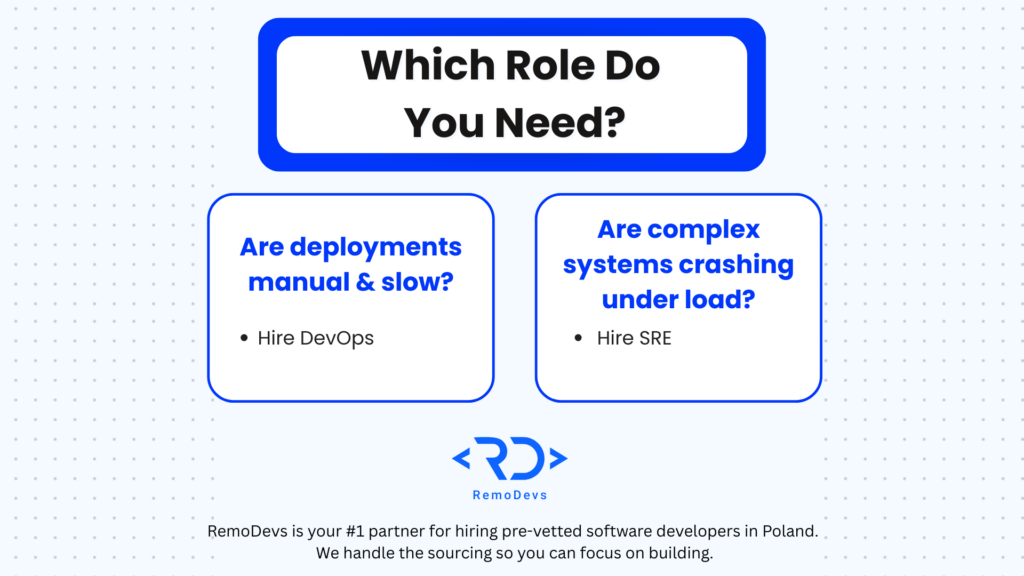
- Your deployment process is manual, slow, or unreliable.
- Developers cannot easily provision infrastructure or testing environments.
- Your company is migrating to the cloud.
- You need to introduce Infrastructure as Code.
- Your CI/CD pipelines are incomplete or difficult to maintain.
- Development teams need better internal platforms and deployment tooling.
Primary goal: Reduce delivery friction and create a reliable, repeatable path from development to production.
Focus on an SRE When:
- You operate complex or high-volume distributed systems.
- Small performance problems can create wider service failures.
- Your engineering team spends excessive time responding to incidents.
- Production troubleshooting relies on manual log analysis.
- You lack useful SLIs, SLOs, or error-budget policies.
- Reliability work requires substantial software development and automation.
Primary goal: Improve observability, resilience, incident response, capacity management, and SLO-driven reliability.
Many organizations eventually need capabilities associated with both roles.
A DevOps engineer may build the delivery platform, while an SRE develops the reliability practices and automation required to operate increasingly complex systems. In smaller teams, one experienced engineer may cover parts of both areas.
The most important step is defining the actual responsibilities before starting the recruitment process.
How RemoDevs Matches Infrastructure Talent
Recruiting experienced cloud and infrastructure engineers requires more than matching job-description keywords against candidate profiles.
A candidate may list Kubernetes, Terraform, and AWS without having owned a production environment or made meaningful architectural decisions.
At RemoDevs, the recruitment process is designed to evaluate the depth and relevance of a candidate’s experience.
Technical Stack Alignment
We verify whether candidates have practical production experience with the cloud platforms, orchestration systems, automation tools, and programming languages required by the client.
Responsibility and Ownership Verification
We examine what the candidate personally designed, implemented, maintained, and improved rather than relying only on technologies listed on the CV.
Scenario-Based Screening
Candidates can be evaluated through practical discussions covering areas such as:
- Live incident response
- Infrastructure design
- Kubernetes operations
- Deployment failures
- Scalability bottlenecks
- Observability
- Reduction of operational toil
Communication and Team Integration
We assess English communication, remote-work experience, time-zone compatibility, and the candidate’s ability to explain technical decisions clearly.
Hiring-Model Coordination
We help clients understand the practical differences between employment and B2B cooperation in Poland and coordinate the recruitment process with their legal, payroll, or tax advisers where necessary.
Our success-fee recruitment model means that the recruitment fee becomes payable only after the client successfully hires a candidate who meets the agreed requirements.
Whether the company needs an SRE to improve production reliability or a DevOps engineer to rebuild its delivery platform, the objective is the same: identify candidates whose actual experience matches the engineering problem the company needs to solve.
Conclusion
The choice between DevOps and SRE is not about deciding which discipline is superior.
It is about identifying the specific bottleneck limiting your engineering organization.
DevOps practices create the platforms, automation, and workflows needed to deliver software efficiently. SRE applies software engineering methods to keep increasingly complex systems observable, reliable, and resilient.
Companies hiring in Poland can access an experienced pool of cloud and infrastructure professionals, but successful recruitment depends on clearly defining the required responsibilities and verifying real production experience.
RemoDevs provides technical candidate matching, structured screening, and practical guidance on navigating the Polish hiring market.
Schedule a consultation with RemoDevs to discuss the infrastructure expertise your organization needs.
Visit us
Find a moment in your calendar and come to our office for a delicious coffee
Make an apointment