
When international companies evaluate Poland as a location for AI hiring, cost is often one of the first factors discussed. It should not be the only one.
Poland’s reputation as a technology talent market is also connected to its long-standing strength in mathematics, algorithms and competitive programming. This foundation has helped create a market where companies can find experienced Machine Learning Engineers, Applied AI Engineers, MLOps specialists, data professionals and Python developers capable of working on complex systems.
However, rankings and academic achievements only explain part of the picture. They do not mean that every Polish developer is automatically an exceptional AI engineer.
The real advantage of hiring in Poland comes from combining a strong technical education pipeline with a mature commercial engineering market, and knowing how to distinguish theoretical knowledge from genuine production experience.
For a broader overview of the market, see our report on the state of AI and ML talent in Poland.
Poland’s Strength in Mathematics and Algorithmic Problem-Solving
Many of Poland’s strongest computer science programs place considerable emphasis on algorithms, data structures, mathematics and logical problem-solving.
The Faculty of Mathematics, Informatics and Mechanics at the University of Warsaw is one of the clearest examples. Its research and teaching strengths include algorithmics, computer logic and machine learning. More than 30% of its first-year undergraduate students are former finalists or laureates of Poland’s national mathematics or informatics olympiads.
This type of education can be particularly relevant to artificial intelligence.
Machine learning engineers need more than familiarity with a specific framework. They must understand how systems behave, evaluate competing approaches, work with imperfect data and recognize why a model performs differently outside a controlled development environment.
A strong foundation in mathematics and computer science can make it easier to learn new tools as the technology changes. PyTorch, cloud platforms and LLM frameworks will continue to evolve, while knowledge of probability, optimization, algorithms and software architecture remains useful across different generations of technology.
That said, academic strength should be treated as an indicator, not as proof that a candidate can build and operate a production AI system.
Evidence from International Programming Competitions
Poland’s performance in international programming competitions provides visible evidence of the country’s algorithmic talent pipeline.
HackerRank developer rankings
In HackerRank’s widely cited 2016 assessment, Poland placed third among the evaluated countries for overall programming performance. Polish participants also ranked first in Java and second in both Python and algorithms.
This remains a useful historical indicator, but it should always be presented with the year attached. It is not a current 2026 ranking of the entire Polish developer market, and it reflects the performance of developers active on the HackerRank platform rather than every software engineer in Poland.
International Olympiad in Informatics
Polish students also have one of the strongest historical records at the International Olympiad in Informatics.
By 2025, Polish participants had accumulated 135 IOI medals: 45 gold, 54 silver and 36 bronze. According to the official Polish Informatics Olympiad, Poland ranked fifth in the all-time medal classification and second globally by the total number of medals won.
The competition tests advanced algorithmic problem-solving under significant time pressure. It therefore provides evidence of a strong educational pipeline for identifying and developing exceptional young programmers.
International Collegiate Programming Contest
Polish universities have also achieved notable results in the International Collegiate Programming Contest.
The University of Warsaw won the ICPC World Finals in 2003 and 2007, placed second in 2012 and 2017, and became the only university to qualify for the World Finals 31 consecutive times.
These results demonstrate that Poland has institutions capable of developing programmers with exceptional algorithmic and analytical ability.
However, competitive programming and commercial AI engineering are not the same discipline.
Programming competitions rarely test whether someone can operate a model in production, design a reliable data pipeline, manage cloud infrastructure, monitor model quality or communicate trade-offs to a product team. Competition results help explain the strength of Poland’s technical pipeline, but they should not replace role-specific candidate assessment.
From Algorithmic Talent to Commercial AI Engineering
Modern AI products require a combination of skills that extends far beyond model development.
A production AI system may involve:
- data collection and validation;
- Python services and APIs;
- model training or fine-tuning;
- retrieval pipelines and vector databases;
- cloud infrastructure;
- evaluation frameworks;
- monitoring and observability;
- latency and inference-cost optimization;
- privacy and security controls;
- integration with existing product workflows.
This creates demand for several different types of specialists.
A Research Scientist may focus on developing or improving models. A Machine Learning Engineer turns models into reliable software systems. An Applied AI Engineer may integrate existing foundation models into a product. An MLOps Engineer focuses on deployment, infrastructure, monitoring and reproducibility.
Poland’s broader software and data engineering market allows companies to recruit across these connected disciplines rather than limiting their search to candidates carrying the generic “AI Engineer” title.
Companies building AI products should therefore consider candidates with backgrounds in Python development and AI/ML engineering as well as specialists with experience building production data infrastructure.
Polish researchers have also contributed to internationally recognized AI organizations. Wojciech Zaremba, for example, was listed as one of OpenAI’s founding research engineers and scientists when the organization was introduced in 2015.
Individual examples do not prove the quality of an entire national talent market. They do, however, show that Polish computer scientists participate at the highest levels of global AI research and product development.
Why International Companies Hire Polish AI Engineers
For technology companies, Poland offers more than a pipeline of mathematically trained graduates.
It also provides access to engineers who have worked in international product companies, consultancies, software houses, research teams and enterprise technology organizations.
Several practical factors make the market attractive.
Access to adjacent engineering skills
Successful AI products need backend, data, platform and cloud expertise in addition to machine learning knowledge.
Companies hiring in Poland can look for candidates whose experience combines AI with areas such as Python backend engineering, data infrastructure, distributed systems, DevOps or cloud architecture.
This is particularly important for companies that need to ship a complete product rather than run an isolated AI experiment. Our broader guide to hiring software engineers in Poland explains how the local engineering market is structured and what companies should expect during recruitment.
English communication
Poland ranked 15th out of 123 countries and regions in the 2025 EF English Proficiency Index, placing it in the “Very High Proficiency” category.
National rankings do not guarantee that every candidate can communicate effectively in a technical environment. English proficiency should still be assessed during recruitment, particularly when the role involves explaining architecture, challenging product requirements or collaborating directly with international stakeholders.
Location and time-zone compatibility
Poland’s Central European location supports straightforward collaboration with teams across Europe. It also provides a partial working-hours overlap with companies based in North America.
For businesses building distributed engineering organizations, this can make Poland easier to integrate than markets with substantially larger time-zone differences.
Strong Academic Credentials Are Not Enough
One of the biggest mistakes companies make when hiring AI engineers is overvaluing theoretical knowledge while failing to verify production ownership.
A candidate may understand machine learning concepts and still lack experience building reliable commercial systems.
Similarly, mentioning technologies such as LangChain, PyTorch, vector databases or GPT models does not demonstrate the depth of the candidate’s contribution.
During screening, companies should determine:
- what the candidate personally designed and implemented;
- whether the solution reached production;
- how model or output quality was evaluated;
- which metrics were used;
- how the team handled latency, cost and reliability;
- what happened when the system produced incorrect results;
- how data and model changes were monitored;
- which architectural trade-offs the candidate made;
- what they would change if they built the system again.
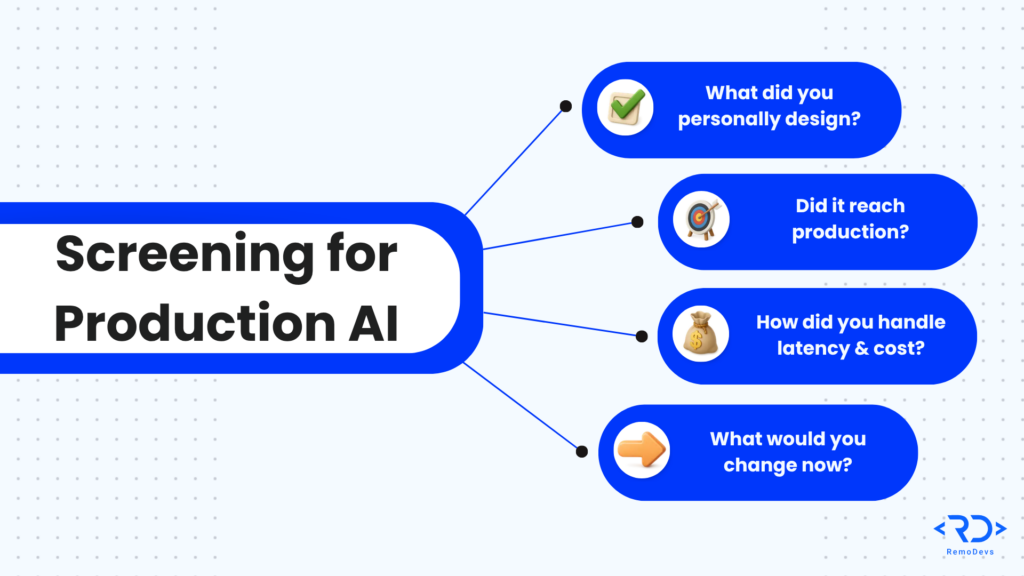
The difference between a strong AI engineer and someone who has only experimented with AI tools is often visible in the specificity of their answers.
Experienced engineers can usually explain the limitations of their solution, the decisions they personally owned and the measurable effect their work had on the product.
How to Assess Polish AI Engineers
A strong recruitment process should evaluate candidates against the actual type of AI work the company needs.
1. Define the role precisely
“AI Engineer” can describe several substantially different positions.
Before sourcing candidates, determine whether the company needs:
- an ML Researcher;
- a Machine Learning Engineer;
- an Applied AI or Generative AI Engineer;
- an MLOps Engineer;
- a Data Engineer supporting ML workloads;
- a Python Backend Engineer integrating AI features.
Without this distinction, even an impressive candidate may be unsuitable for the actual problem.
2. Verify production experience
Ask candidates to describe one system from the initial problem definition to its operation in production.
A strong answer should cover the candidate’s individual responsibility, architecture, data flow, evaluation process, deployment approach and the problems encountered after launch.
For generative AI projects, ask how the candidate measured output quality, managed hallucinations, controlled inference costs and decided whether fine-tuning, retrieval or prompt-based methods were appropriate.
3. Separate real AI engineering from wrapper experience
Integrating an LLM API can be useful commercial work, but it is not automatically evidence of deep AI engineering ability.
Candidates should be able to explain why the model was chosen, how the system was evaluated, what safeguards were implemented and how the surrounding software was designed.
The appropriate depth depends on the position. A product-focused Applied AI Engineer does not need to be a foundation-model researcher, but they should still understand the limitations of the components they use.
4. Assess product and engineering judgment
The strongest AI engineers do not recommend AI for every problem.
They can recognize when a deterministic solution is more reliable, when an LLM introduces unnecessary cost or complexity, and when additional data will create more value than changing the model.
This judgment is particularly important in startups and scale-ups, where engineering decisions directly affect product speed and operating costs.
5. Test communication and ownership
Technical knowledge alone is not enough for senior positions.
A senior candidate should be able to explain complex decisions clearly, challenge weak assumptions and take responsibility for outcomes rather than only describing the work of the wider team.
Questions about incidents, failed experiments and difficult trade-offs often reveal more than questions about a candidate’s preferred technology stack.
This is one reason RemoDevs uses a selective candidate screening process rather than forwarding every technically relevant CV to the client.
How RemoDevs Finds AI Talent in Poland
Finding strong Polish AI engineers requires more than searching LinkedIn for popular framework names.
As a specialized IT recruitment agency in Poland, RemoDevs helps international technology companies define the position, identify relevant candidates across the Polish market and verify whether their experience matches the actual engineering challenge.
Our process focuses on:
- calibrating the role before beginning the search;
- sourcing candidates with relevant technical and industry experience;
- assessing individual ownership rather than team-level achievements;
- distinguishing production AI experience from experimental projects;
- presenting a curated shortlist instead of a high volume of loosely matched CVs;
- supporting the company through interviews and offer negotiations.
For many specialized AI, data and engineering searches, the first matched candidates can be presented within several working days.
Review our Success Stories to see how we have helped technology companies recruit difficult-to-find engineering talent in Poland.
Frequently Asked Questions
Why does Poland produce strong AI engineers?
Poland has a long-standing educational and competitive programming pipeline focused on mathematics, algorithms and computer science. Its strongest universities and informatics olympiads develop students with advanced problem-solving skills that can provide a valuable foundation for machine learning and AI engineering.
However, this does not mean that every Polish developer is an AI specialist. Commercial experience, production ownership and role-specific skills still need to be assessed individually.
Are Polish developers ranked among the best in the world?
Polish developers and students have achieved strong historical results in HackerRank challenges, the International Olympiad in Informatics and the International Collegiate Programming Contest.
These achievements show the strength of the country’s algorithmic talent pipeline. They should not be treated as a current ranking of every professional developer in Poland.
What should companies look for in a Polish AI engineer?
The required skills depend on the role, but companies should usually verify production ownership, Python and software engineering ability, data experience, model evaluation, deployment knowledge and the ability to explain technical trade-offs.
For generative AI roles, it is also important to assess experience with retrieval, evaluation, hallucination management, latency and inference costs.
Is a mathematics or computer science degree required?
Not always.
A strong academic background can be valuable for research-heavy or mathematically complex positions. For applied and product-focused roles, demonstrated experience building and operating AI systems may be more important than a particular degree.
How quickly can RemoDevs find AI engineers in Poland?
The timeline depends on the seniority, technology requirements and industry experience involved. For many AI, data and senior engineering roles, RemoDevs can present the first pre-screened candidates within several working days.
Build Your AI Team in Poland
Poland’s reputation for technical talent is supported by genuine strengths in mathematics, algorithms and competitive programming.
Those strengths create a valuable foundation, but they are not enough on their own. The best Polish AI engineers combine theoretical knowledge with software engineering, production experience, product judgment and clear ownership of delivered systems.
Companies that define the role precisely and assess candidates beyond technology keywords can access a highly capable market of AI, machine learning, data and platform engineers.
Looking for Polish AI engineers with relevant production experience?
Discuss your hiring needs with RemoDevs.
Visit us
Find a moment in your calendar and come to our office for a delicious coffee
Make an apointment