
- A bad culture fit hire at the senior engineer level costs startups $30,000–$150,000+ when you factor in lost productivity, recruitment costs, and team disruption.
- Culture fit is not about hiring people who think alike – it’s about shared values, communication norms, and a tolerance for ambiguity that defines early-stage startup life.
- Most technical screening processes ignore culture fit entirely, which is why 89% of hiring failures are due to attitude and soft skills, not technical incompetence.
- Filtering candidates for culture fit requires a structured, repeatable process – not gut instinct and a casual Zoom call.
Your Best Engineers Are Quitting. Your Culture Hire Is Why.
You ran a solid technical screen. The take-home project came back clean. The system design interview went well. Six months later, the rest of your engineering team is quietly updating their LinkedIn profiles.
This scenario plays out in startups every day. The culprit is almost never technical skill – it’s a culture fit failure that no one caught during the hiring process.
For a Series A or Series B company, one misaligned senior hire doesn’t just slow a team down. It reshapes team dynamics, creates attrition pressure on your best people, and ultimately stalls product velocity at the exact moment you can least afford it.
This article breaks down what culture fit actually means in a startup context, why the standard interview process misses it, and how to build a screening framework that catches problems before they become $100K mistakes.
What “Culture Fit” Actually Means (And What It Doesn’t)
Culture fit is one of the most misused terms in hiring. Used poorly, it becomes a shield for unconscious bias – a way to hire people who went to the same schools, share the same hobbies, or simply feel familiar. That’s not culture fit. That’s pattern matching, and it kills team diversity.
Used correctly, culture fit is about operational and behavioral alignment. It answers one question: Will this person thrive in the specific environment of your company right now?
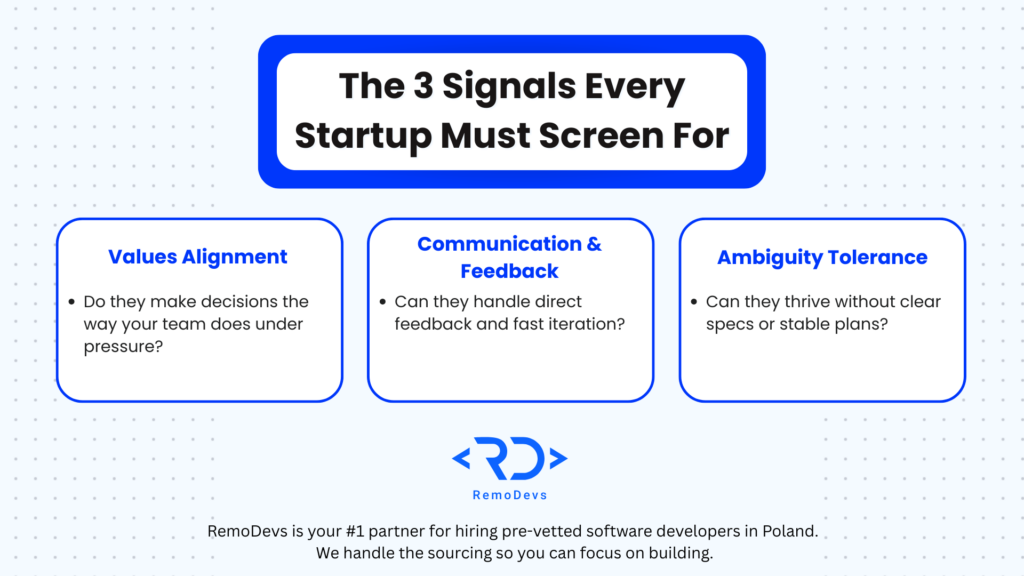
The Three Dimensions of Startup Culture Fit
These three dimensions are measurable. They’re also almost entirely invisible in a standard technical screening process.
| Dimension | Description & Startup Impact |
| 1. Values alignment | Does the candidate’s decision-making framework match yours when the stakes are real? A developer who optimizes for process and approval chains will suffocate in a startup that ships daily and asks for forgiveness rather than permission. |
| 2. Communication & feedback norms | Startups depend on radical transparency and fast feedback loops. A candidate who shuts down under direct critique, or who escalates every disagreement, introduces friction that compounds exponentially at speed. |
| 3. Ambiguity tolerance | Early-stage engineering is inherently undefined. Requirements change. Priorities shift. A developer who needs complete specifications and a stable backlog will struggle – and ultimately leave – when the roadmap pivots for the third time in a quarter. |
Why Technical Screening Alone Fails Startups
The data here is damning. According to research from Leadership IQ, 89% of hiring failures are attributable to poor attitude, motivation, and temperament – not missing technical skills. Yet the average engineering hiring process allocates roughly 80% of its evaluation time to technical assessment.
That’s a structural mismatch between where risk actually lives and where companies focus their screening effort.
The Hidden Costs of a Culture Fit Failure
For a startup burning $400K/month, a single bad culture hire that triggers even one downstream resignation is an existential-level event, not an HR inconvenience.
| Cost Category | Estimated Impact |
| Direct recruitment costs (re-hire) | $15,000 – $30,000 |
| Lost productivity during onboarding | 3–6 months of reduced output |
| Team disruption and attrition risk | 1–2 engineers updating their résumés |
| Manager time on performance management | 5–10 hours/week during failure period |
| Missed sprint commitments / delayed roadmap | High – varies by role seniority |
| Total estimated cost (senior engineer) | $50,000 – $150,000+ |
Why Remote and Nearshore Hiring Amplifies the Risk
When your team is distributed, culture fit failures are harder to catch early and harder to remediate. The informal signals – body language in a hallway, lunch table conversations, the casual Slack banter that shows someone is genuinely engaged – disappear. By the time a remote culture fit failure surfaces visibly, the damage to team morale is already done.
This is why the screening process itself must do the work that proximity used to handle passively.
How to Actually Screen for Culture Fit: A Structured Framework
Gut instinct is not a process. The goal is to build a repeatable evaluation system that surfaces behavioral evidence, not vibes.
Step 1: Define Your Culture in Writing Before You Post the Role
You cannot screen for something you haven’t defined. Before opening a requisition, document:
- Your top 3–5 non-negotiable values with behavioral descriptions (not slogans)
- Your current team’s communication style – async-first, high-candor, low-hierarchy?
- The specific stressors of this role – what will make someone struggle in the first 90 days?
Note: This document becomes the scoring rubric for every subsequent step.
Step 2: Embed Behavioral Questions Into Technical Interviews
Don’t silo culture screening into a separate “culture interview” at the end of the process. By then, candidates are in performance mode and know what you’re looking for. Instead, weave behavioral questions into every interview stage:
- “Tell me about a time you disagreed with a technical decision made by someone senior to you. What did you do?”
- “Walk me through a project where the requirements changed significantly mid-build. How did you adapt?”
- “Describe the most direct critical feedback you’ve received on your work. How did you process it?”
Listen for specific examples with real friction – not polished narratives with clean resolutions. Candidates who only tell success stories haven’t been tested.
Step 3: Use a Structured Debrief Protocol
After each interview, have every interviewer submit independent scores on your predefined culture dimensions before group discussion. Group calibration without independent scoring is just confirmation bias in a Zoom call.
Score against:
- Ambiguity tolerance (1–5)
- Communication and feedback receptivity (1–5)
- Values alignment based on specific responses (1–5)
A candidate who scores 4.5/5 on technical skills but 2/5 on ambiguity tolerance is a liability at a Series A company, not an asset.
Step 4: Reference Checks Are Not Optional
Reference checks done correctly are the highest-signal data point in the process. Most companies treat them as a formality. That’s a mistake. Ask references:
- “On a scale of 1–10, how well did [candidate] handle situations where the problem wasn’t fully defined?”
- “Describe a conflict they navigated with a teammate or manager.”
- “Would you rehire them specifically for an early-stage startup environment?”
If a reference hesitates on that last question, that hesitation is your answer.
Culture Fit Is a Two-Way Street: Are You Selling Your Culture Too?
The best developers are evaluating your culture with the same rigor you’re evaluating them – and they’re doing it with more information than you think.
Top engineers talk to each other. They check Glassdoor, read your engineering blog, and ask former employees what the team is actually like. If your culture is high-pressure and opaque, they’ll find out. If it’s genuinely collaborative and mission-driven, that’s a competitive recruiting advantage.
Three things that signal culture authentically to senior candidates:
- A documented engineering process – even a short blog post about how you run retrospectives signals maturity and care.
- Honest job descriptions – candidates trust specificity over superlatives; say “high-pressure release cycles” not “fast-paced environment.”
- Access to the team before the offer – a 30-minute informal conversation with a future peer closes more strong offers than any equity calculator.
How RemoDevs Eliminates Culture Fit Risk Before a Candidate Reaches Your Desk
Here’s the structural problem with most startup hiring: culture screening is slow, expensive in senior leadership time, and only effective if the technical pipeline is already filtered down to serious contenders.
At RemoDevs, culture fit evaluation isn’t a final-round checkbox – it’s built into the first stage of screening.
We filter out 90% of applicants before you see a single profile. That 90% is eliminated on the basis of both technical competence and behavioral alignment. By the time a candidate lands in your shortlist, they’ve already passed:
- A technical skills assessment calibrated to your stack and seniority level
- A structured soft skills and communication evaluation
- A culture alignment interview conducted against a profile of your company’s environment
- Reference verification for every candidate we advance
What you receive is the top 10% of vetted developers – candidates who can write clean code and won’t fracture your team six months after joining.
We treat every search as if we’re hiring for our own company. That’s not a tagline – it’s why our clients don’t come back to us with re-hire requests.
Stop Gambling on Culture Fit. Start Screening for It.
The cost of a culture fit failure isn’t just financial. It’s the senior engineer who quietly stops going above and beyond, it’s the sprint velocity that drops 20% and never recovers. It’s the departure conversation six months later where your best people tell you they’ve been thinking about it for a while.
None of that shows up in a LeetCode score.
If you’re scaling your engineering team and want a shortlist of developers who are both technically exceptional and genuinely aligned with how your company operates – book a 15-minute discovery call with the RemoDevs team.
We’ll show you exactly who we’ve already vetted, what our screening process flagged, and why the candidates we recommend are in the top 10% – technically and culturally.
→ Book Your Free 15-Minute Discovery Call
No pitch. No pressure. Just a shortlist built for your team.
Visit us
Find a moment in your calendar and come to our office for a delicious coffee
Make an apointment