
Hiring a senior Machine Learning Engineer is not primarily a volume problem. The real challenge is identifying candidates who have moved models beyond experimentation and can operate them reliably in production.
A candidate may understand statistics, Python and model development but still lack experience with deployment, monitoring, cloud infrastructure or production incidents. This makes ML recruitment fundamentally different from hiring for a conventional backend or frontend position.
For international companies planning to hire Machine Learning Engineers in Poland, success depends on three things: defining the role precisely, reaching experienced passive candidates and assessing real production ownership rather than theoretical knowledge.
This guide explains what the Polish ML talent market looks like in 2026, what senior candidates expect and how to build a recruitment process that identifies engineers capable of delivering production-ready AI systems.
The Machine Learning Talent Market in Poland in 2026
Poland has developed a mature technology market with experienced engineers working for international product companies, research teams, financial institutions and global technology organizations.
Demand for data and AI expertise remains strong. Data-related positions have become one of the largest categories in Polish IT recruitment, while AI and Machine Learning specialists continue to experience strong compensation growth.
For a broader analysis of the market, talent availability and current hiring trends, read our report on the state of AI and Machine Learning talent in Poland.
However, the expansion of the broader AI market does not mean that every candidate with AI-related experience is qualified to build production ML systems.
The available talent pool includes several different profiles:
- Data Scientists focused on experimentation, statistical analysis and model development.
- Machine Learning Engineers responsible for deploying and integrating models into software products.
- MLOps Engineers focused on infrastructure, automation, monitoring and model lifecycle management.
- Applied AI Engineers working with technologies such as large language models, retrieval-augmented generation and model fine-tuning.
These areas frequently overlap, but they are not interchangeable. Before starting a search, employers must determine which type of expertise the product actually requires.
Why Hiring ML Engineers Is Different
A standard software engineering interview usually focuses on system design, coding ability, maintainability and engineering practices.
ML recruitment adds another layer of complexity. Employers must assess whether the candidate understands both the model and the system surrounding it.
A strong Machine Learning Engineer should be able to explain:
- how training data was collected and validated;
- how the model was deployed;
- how predictions were integrated into the product;
- how performance and data drift were monitored;
- how the system handled failures;
- how infrastructure costs and latency were managed;
- and which parts of the solution the candidate personally owned.
Without this context, companies risk hiring candidates who can produce a promising notebook but cannot turn it into a reliable production service.
The Main Challenges of Recruiting ML Engineers in Poland
Reaching experienced passive candidates
Many senior ML specialists are not actively applying for jobs. They receive frequent recruiter messages and are unlikely to respond to generic outreach that focuses only on technologies and salary.
Effective outreach should explain the actual ML problem, the maturity of the product, available data, expected ownership and the engineering environment around the role.
“Join an innovative AI project” is not enough. A strong candidate wants to know what is being built, whether the company has usable data and whether the position involves meaningful engineering work or simply connecting external APIs.
Reaching these candidates requires more than publishing another job advertisement. It requires an established network, targeted outreach and an actively maintained talent pipeline. You can read more about how we develop the RemoDevs technology talent pool.
Filtering irrelevant applications
An ML Engineer job advertisement may attract Data Analysts, junior Data Scientists, Python Developers and candidates whose experience is limited to university projects or online courses.
Keyword filtering alone cannot reliably identify production experience. A CV containing Python, PyTorch, AWS and Kubernetes may still provide no evidence that the candidate deployed or maintained an ML system.
Recruiters therefore need to evaluate scope and ownership, not only the presence of specific tools.
Evaluating real production experience
The most difficult part of ML recruitment is distinguishing participation from ownership.
A candidate may have worked on a large AI project without being responsible for deployment, infrastructure or production decisions. During screening, it is important to establish what the candidate personally designed, implemented and maintained.
Questions should go beyond “Which models have you used?” and explore specific engineering decisions, incidents and trade-offs.
Data Scientist, ML Engineer or MLOps Engineer?
One of the most common hiring mistakes is using these job titles interchangeably.
A Data Scientist typically focuses on analyzing data, designing experiments, building models and measuring their business value.
A Machine Learning Engineer usually focuses on turning models into scalable software systems, building inference services and integrating ML components with the rest of the product.
An MLOps Engineer is more focused on the infrastructure supporting the ML lifecycle, including pipelines, model registries, CI/CD, observability, orchestration and cloud environments.
An Applied AI Engineer may work across research and production, particularly on LLM applications, RAG systems, evaluation frameworks, fine-tuning and AI agents.
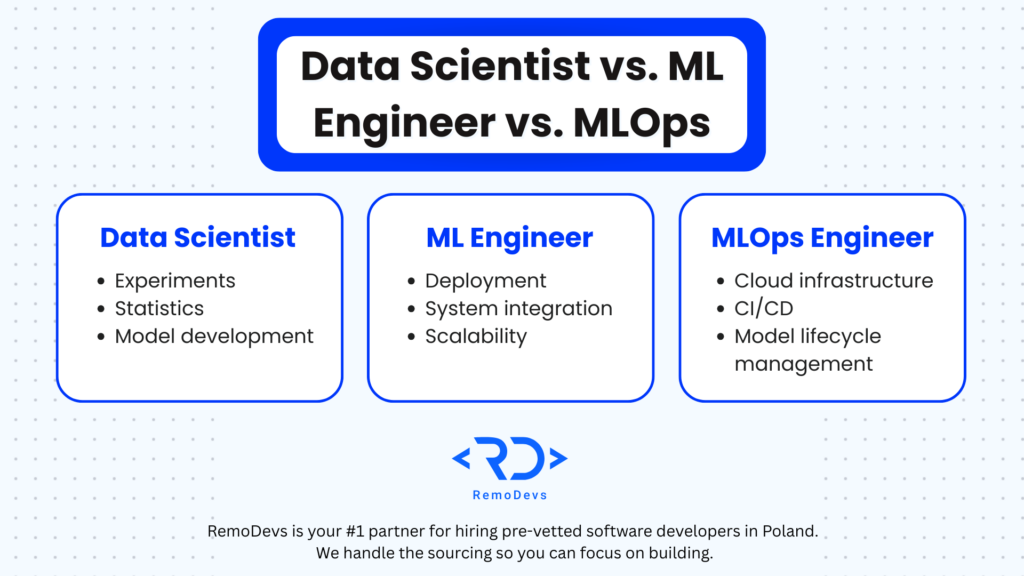
The boundaries differ between companies. Some Data Scientists own production deployments, while some ML Engineers also conduct extensive experimentation. The job title matters less than clearly defining the expected responsibilities.
Before launching recruitment, clarify:
- Who develops the models?
- Who deploys them?
- Who owns the data pipelines?
- Who monitors performance after deployment?
- Who responds when the system fails?
- Is the role focused on classical ML, computer vision, NLP, LLM applications or ML infrastructure?
Clear answers will significantly improve sourcing accuracy and candidate quality.
How to Screen a Senior Machine Learning Engineer
The best screening questions encourage candidates to discuss systems they have actually built rather than repeat definitions.
1. Tell us about a model you personally deployed into production
Ask the candidate to describe the full path from experimentation to deployment. Clarify their individual contribution, the architecture and the people involved.
A strong answer should cover more than model training. Look for deployment decisions, interfaces, infrastructure, testing and integration with the wider product.
2. How did you monitor the model after deployment?
Production ML systems can deteriorate even when the underlying code does not change.
The candidate should be able to discuss metrics such as model quality, drift, latency, errors, data quality and infrastructure performance. They should also explain what actions were triggered when those metrics changed.
3. Describe a production failure involving an ML system
This question helps reveal genuine operational experience.
Strong candidates usually provide a specific example, explain how the problem was detected and describe what they changed to prevent it from happening again.
Be cautious when a candidate cannot recall any failures despite claiming several years of production ownership.
4. How did you balance accuracy, latency and cost?
The most accurate model is not always the best production model.
An experienced ML Engineer should understand that model selection depends on business requirements, response times, infrastructure costs, maintainability and the consequences of incorrect predictions.
5. How did you test changes to models and data pipelines?
Look for an understanding of data validation, model evaluation, integration testing, versioning and controlled releases.
The candidate should be able to explain how the team prevented an apparently successful experiment from causing problems in production.
6. What did you own directly?
This simple follow-up should be used throughout the interview.
Ask which components the candidate designed, which decisions they made and which tasks belonged to other team members. This prevents large team achievements from being presented as individual ownership.
Machine Learning Engineer Salaries in Poland
Compensation depends on seniority, specialization, contract type, industry and the scope of responsibility.
Current market data suggests the following practical ranges for senior AI and ML specialists in Poland:
| Role | Hourly B2B rate | Approximate monthly B2B rate |
| Senior AI/ML Engineer | 180–220 PLN/h net | 28,800–35,200 PLN net + VAT |
| Senior MLOps Engineer | 190–220 PLN/h net | 30,400–35,200 PLN net + VAT |
| Senior Applied AI or Research Engineer | 190–240 PLN/h net | 30,400–38,400 PLN net + VAT |
The monthly equivalents assume 160 billable hours per month. The actual monthly invoice may vary depending on the number of working days, paid time off arrangements and the agreed billing model.
Broader salary reports may show lower averages because they include different seniority levels, company types and positions with less production ownership. When recruiting a senior engineer with strong cloud, infrastructure and end-to-end ML experience, employers should generally budget toward the upper end of the available range.
For additional benchmarks covering other engineering specializations, see our complete Polish software engineer salary report.
B2B cooperation remains common among experienced Polish technology professionals, but companies should not assume that every candidate prefers it. Some engineers prioritize the stability, paid leave and employment protections offered by a Polish employment contract.
Companies unfamiliar with the distinction can review our guide to B2B and employment contracts in the Polish IT industry.
A competitive offer should also account for:
- remote or flexible working arrangements;
- technical ownership;
- access to appropriate infrastructure and data;
- product maturity;
- learning opportunities;
- the quality of engineering leadership;
- and the speed and transparency of the recruitment process.
Compensation may attract a candidate’s attention, but an unclear role or poorly prepared AI project can still cause them to reject the offer.
How to Improve Your ML Hiring Process
Define the problem before defining the technology stack
Do not begin with a long list of frameworks.
Start by explaining what the engineer will build, what data is available, what already exists and what success should look like during the first six months.
The technical requirements should follow from the product problem.
Separate essential experience from optional experience
Many ML job descriptions combine responsibilities from Data Science, backend development, DevOps, data engineering and research.
Requiring every possible skill dramatically reduces the candidate pool and may create an unrealistic position.
Decide which capabilities must already be present and which can be developed after joining.
Replace generic coding tests with relevant discussions
A generic algorithmic challenge rarely demonstrates whether someone can build and maintain an ML system.
Use an architecture discussion, a review of a previous production deployment or a practical scenario related to your product. The goal should be to understand the candidate’s decisions, not to test their ability to memorize an interview pattern.
Keep the process focused
Senior ML candidates may be interviewing with several companies simultaneously.
A practical recruitment process can usually be organized around:
- an initial qualification and motivation call;
- a technical interview focused on previous ownership and system design;
- a final conversation with the hiring manager or product leadership.
Additional stages should only be introduced when they provide information that cannot be gathered elsewhere.
Provide feedback and make decisions quickly
Long delays between stages create uncertainty and increase the risk of losing the candidate.
Agree internally on the decision-makers, assessment criteria and salary limits before interviews begin. This allows the company to move quickly once a strong candidate is identified.
Why Work with RemoDevs?
Recruiting an ML Engineer requires precision. Sending a large number of loosely matched profiles only transfers the screening burden to the hiring team.
RemoDevs helps international companies recruit experienced technology professionals from Poland. We begin by calibrating the role, identifying its essential technical requirements and understanding the level of ownership expected from the candidate.
Our recruitment process includes:
- targeted sourcing across the Polish technology market;
- direct outreach to passive candidates;
- verification of relevant experience and individual ownership;
- assessment of communication skills and motivation;
- and support throughout interviews and offer negotiations.
Instead of reviewing hundreds of applications, your team receives a focused shortlist of candidates whose experience has already been assessed against the actual requirements of the position.
Our clients regularly highlight the speed of the process, the quality of presented candidates and our ability to identify engineers with rare combinations of skills. Explore our technology recruitment success stories to see how companies have used RemoDevs to fill senior engineering positions.
RemoDevs operates through a success-fee recruitment model. You pay only after hiring a candidate, receive a 30-day trial period before payment and are covered by a 90-day replacement guarantee.
Frequently Asked Questions
How long does it take to hire a senior Machine Learning Engineer in Poland?
The timeline depends on the specialization, compensation, notice period and complexity of the interview process. Companies relying only on job advertisements and internal sourcing should generally prepare for a multi-week search.
A specialized recruitment partner can shorten the sourcing stage by reaching relevant passive candidates and screening them before presenting their profiles.
How much does a Senior Machine Learning Engineer earn in Poland?
Senior AI and Machine Learning Engineers commonly expect approximately 180–220 PLN/h net on a B2B contract.
Assuming 160 billable hours, this corresponds to approximately 28,800–35,200 PLN net + VAT per month. Applied AI, MLOps and research-oriented specialists may expect more.
What is the difference between a Data Scientist and a Machine Learning Engineer?
Data Scientists are generally more focused on experimentation, statistics, analytics and model development.
Machine Learning Engineers are generally more focused on deployment, software engineering, scalability and operating models in production.
The distinction is not universal, so employers should evaluate responsibilities and previous ownership rather than relying only on job titles.
What should we look for in a senior ML candidate?
Look for evidence that the candidate has personally deployed, monitored and maintained ML systems.
Strong candidates should be able to discuss production incidents, testing, data quality, infrastructure, latency, costs and the trade-offs involved in their technical decisions.
Do Polish ML Engineers prefer B2B contracts?
B2B cooperation is common among experienced Polish technology specialists and can expand the available candidate pool.
However, preferences vary, and some candidates favor employment contracts. Companies should confirm the candidate’s preferred contract type early in the recruitment process.
Can we hire an ML Engineer in Poland without opening a local company?
International companies can usually cooperate directly with a Polish specialist through a B2B agreement. Employment-based arrangements normally require a Polish legal entity or an Employer of Record.
The appropriate model depends on the relationship, responsibilities and legal structure of the cooperation. Read our guide to hiring technology professionals in Poland without opening a local entity for a broader overview.
Companies should obtain appropriate legal and tax guidance before selecting a cooperation model.
Hire Machine Learning Engineers in Poland with RemoDevs
The strongest ML candidates are not identified through keywords alone.
Finding the right person requires a clear understanding of the role, targeted access to the Polish technology market and a screening process that verifies production ownership rather than theoretical familiarity.
RemoDevs can help you define the position, reach experienced candidates and build a curated shortlist of Machine Learning, MLOps and Applied AI Engineers.
Tell us what you are building and start your search for vetted ML talent in Poland.
Visit us
Find a moment in your calendar and come to our office for a delicious coffee
Make an apointment