
The optimal remote onboarding checklist is a structured, four-phase process designed to minimize friction and accelerate a developer’s time-to-productivity:
- 1. Pre-onboarding: Hardware delivery, localized contract execution, and identity/access management (IAM) setup for core tools.
- 2. Day One: Team introductions, virtual office tours, and assignment of a dedicated technical onboarding buddy.
- 3. Week One: Local environment configuration, pair programming sessions, and shipping the first small pull request.
- 4. Month One: 30-day performance review, establishment of long-term KPIs, and transition to full autonomy.
When you partner with a trusted IT outsourcing provider, this framework is actively managed to ensure seamless integration into your existing engineering workflows.
Why is a Structured Remote Onboarding Checklist Crucial?
Remote engineering teams lack the organic “water cooler” moments that naturally acclimate new hires to company culture and technical standards. Without a deliberate strategy for onboarding remote developers, companies face delayed productivity, misaligned technical expectations, and high early-attrition rates.
A standardized onboarding process mitigates these risks by providing immediate clarity. According to Gallup research on employee onboarding, organizations with a strong onboarding process improve new hire retention by 82% and productivity by over 70%.
For engineering teams specifically, a clear checklist transitions a new hire from a logistical burden to an active code contributor within days rather than weeks.
The Ultimate Checklist for Onboarding Remote Developers from Poland
To successfully integrate engineering talent, technical leadership must execute a chronological, standardized process.
| Phase | Timeline | Focus Area | Key Actions | Success Metric |
| Pre-Onboarding | Before Day 1 | Logistics & Access | Hardware delivery, IAM setup, contracts signed, documentation shared | Zero Day-One blockers |
| Day One | First 24 Hours | Context & Connection | Stakeholder 1:1s, squad intro, onboarding buddy assigned | Clear role alignment |
| Week One | Days 2–7 | Technical Immersion | Environment setup, pair programming, first Jira tasks | First PR merged |
| Month One | Days 8–30 | Performance & Autonomy | 30-day review, KPIs set, recurring 1:1s | Independent contribution |
Phase 1: Pre-Onboarding (Setting the Stage)
Logistical friction is the primary cause of Day One delays. Resolve administrative and access blockers before the developer’s start date.
- Hardware & Logistics: Ensure enterprise-grade hardware is shipped within the EU to arrive prior to the start date.
- Access Provisioning: Pre-configure accounts for your tech stack (e.g., GitHub/GitLab, Jira, Slack/Teams, AWS/GCP IAM roles).
- Documentation: Send a welcome packet containing the employee handbook, localized compliance documents, and a high-level architecture overview.
Phase 2: Day 1 (Orientation & Welcome)
The first day should focus strictly on context and connection, not coding.
- Stakeholder Introductions: Schedule brief 1:1s with the Engineering Manager, Product Owner, and the immediate squad.
- The “Buddy” System: Assign a tenured engineer as an onboarding buddy to answer immediate domain or workflow questions.
- Communication Norms: Establish expectations around async communication, Slack etiquette, and core meeting hours.
Phase 3: Week 1 (Technical Immersion & The RemoDevs Advantage)
Transition the developer into the codebase with heavily supported, low-risk tasks.
- Environment Setup: Allocate time for setting up local development environments, utilizing containerization (Docker) to minimize “works on my machine” issues.
- Pair Programming: Mandate shadowing and pair programming sessions for the first few Jira tickets.
- The First PR: The goal of week one is to merge a minor, non-critical pull request to build confidence and test the CI/CD pipeline access.
The RemoDevs Advantage: Onboarding shouldn’t be a solo burden on your internal management. Unlike transactional vendors, we provide value well after the hire. During this critical first week, our technical HR team stays actively involved, monitoring setup and ensuring the developer’s output aligns with your expectations.
You can see how this long-term partnership model accelerates scaling by reviewing our client case studies.
Phase 4: Month 1 & Beyond (Feedback and Autonomy)
Shift from hand-holding to performance management and feedback loops.
- The 30-Day Review: Conduct a structured feedback session assessing technical velocity, code quality, and cultural fit.
- Goal Setting: Define quarterly KPIs and OKRs specific to the developer’s role.
- Continuous Feedback: Implement regular 1:1s. Refer to resources like First Round Review’s guide to engineering leadership for best practices on maintaining high-performing, autonomous remote engineers.
Cultural Alignment: Mastering Poland Developer Onboarding
Executing a successful Poland developer onboarding requires understanding the specific nuances of the region’s work culture. Polish engineers are globally recognized for a distinct set of professional traits that benefit fast-moving product teams:
- Engineering Mindset Over Order-Taking: Polish developers generally prefer to understand the “why” behind a feature. Encourage them to challenge assumptions and contribute to architectural decisions.
- Direct Communication: The culture values transparency and constructive feedback. You can expect candid discussions regarding technical debt or project timelines.
- Language Proficiency: Communication barriers are minimal. Poland consistently ranks in the “Very High” proficiency tier of the EF English Proficiency Index, ensuring seamless integration into English-speaking teams.
- Time Zone Synergy: Operating in Central European Time (CET) provides a full-day overlap with European teams and a critical 3-4 hour morning overlap with US East Coast teams, ideal for daily stand-ups and agile ceremonies.
How RemoDevs Acts as Your Long-Term Partner
The success of a remote engineering hire is determined by what happens after the contract is signed. At RemoDevs, we don’t just source talent and walk away. We cement our role as your long-term partner by offering continuous post-hire support.
Through ongoing HR augmentation, regular developer check-ins, and proactive performance monitoring, we ensure that your remote team maintains high retention rates, job satisfaction, and technical alignment. We handle the operational overhead so your technical leadership can focus on shipping product.
Ready to scale your engineering output with developers who are supported from day one? Build your dedicated team with us.
Frequently Asked Questions (FAQ) About Remote Developer Onboarding
Q: How long should the remote onboarding process take?
The remote onboarding process should take 30 to 90 days. While the technical setup and access provisioning generally take 1 to 2 weeks, full cultural integration, domain knowledge acquisition, and peak productivity usually require a dedicated 90-day ramp-up period.
Q: What tools are essential for onboarding remote developers?
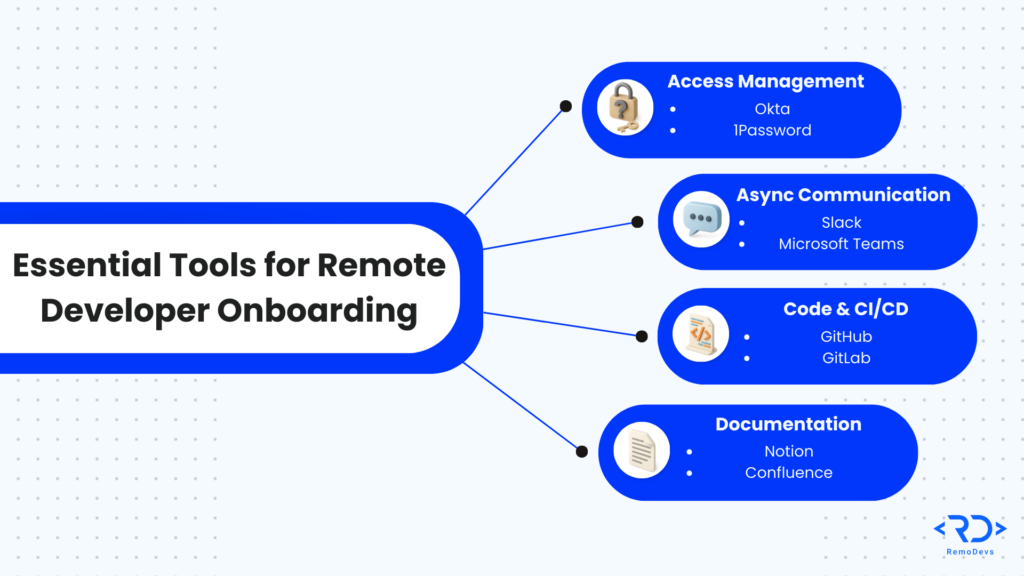
Essential tools for onboarding remote developers fall into four categories: Identity and Access Management (e.g., Okta, 1Password), asynchronous communication (Slack, Microsoft Teams), code repositories and CI/CD (GitHub, GitLab), and centralized documentation (Notion, Confluence) to enable self-serve learning.
Q: How do you handle time zone differences when onboarding Polish developers?
Handle time zone differences by establishing overlapping core hours (typically morning hours in the US / late afternoon in Poland) for synchronous meetings like daily stand-ups or sprint planning. Maximize the non-overlapping hours by adopting an async-first culture, relying on comprehensive documentation and detailed Jira ticket descriptions.
Visit us
Find a moment in your calendar and come to our office for a delicious coffee
Make an apointment