
There is no single “LATAM developer cost.” Brazil, Mexico, Colombia and Argentina are separate labor markets, and the final budget changes materially with the hiring model. Employee compensation, a contractor invoice, an Employer of Record bill and a staff-augmentation rate represent different purchases.
In the 2025 Stack Overflow Developer Survey, median reported annual total compensation for one consistently filtered group of experienced, employed individual-contributor developers ranged from approximately $36,400 in Brazil to $65,500 in Poland. These figures describe survey respondents’ compensation, not contractor invoices, provider rates or total employer cost.
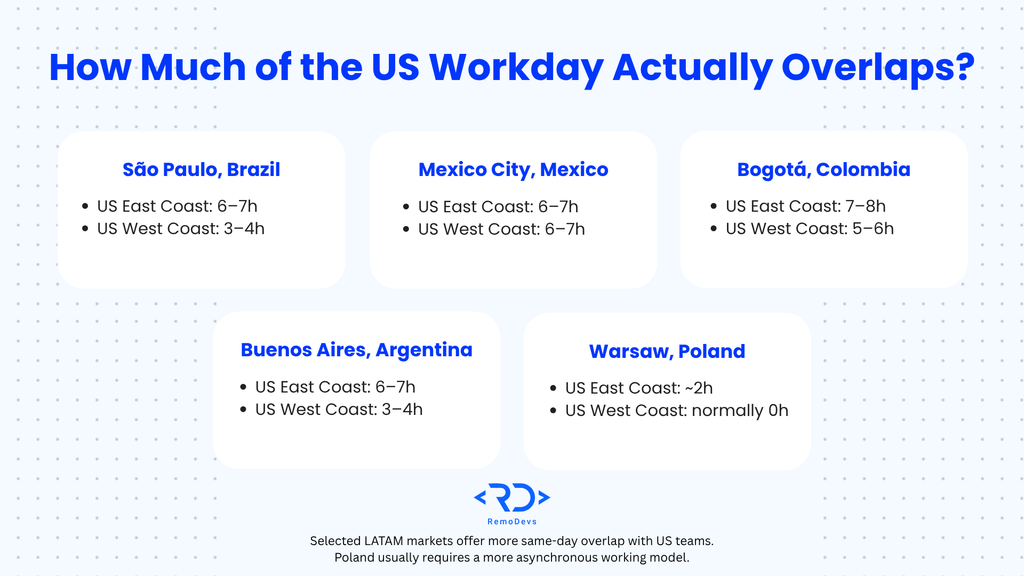
For US companies, the clearest structural difference is how the working day fits. The selected LATAM markets offer several hours of overlap with both US coasts. A standard Polish schedule typically shares about two hours with the East Coast and none with the West Coast.
There is still no sufficiently comparable public dataset for one clean contractor-rate table across all five countries. A defensible buying comparison starts with the same role and engagement model, then uses country-specific employment evidence or normalized quotes with the same scope.
LATAM vs Poland: what are we comparing?
This article compares Poland with four established sourcing markets: Brazil, Mexico, Colombia and Argentina. It does not treat those countries as a single labor market.
For a US-based engineering organization, the four LATAM countries are usually described as nearshore because of their working-hour proximity. Poland is generally considered an offshore European market in the same buying decision. These labels are relative: for a German company, Poland would be nearshore.
The country distinction matters beyond time zones. Compensation, currencies, employment rules, contractor structures, privacy requirements and tax treatment vary across the four LATAM markets. The collaboration analysis below uses Mexico City as its Mexican reference location.
Start with the hiring model, not the country rate
The easiest way to distort an international cost comparison is to mix different purchases. A Polish contractor’s invoice cannot be set against the client rate for a vendor-supplied engineer in Mexico and presented as a geographic saving.
| Hiring model | Cost basis | What to normalize before comparing countries |
|---|---|---|
| Direct employment | Gross compensation through local payroll | Employer contributions, paid leave, benefits, equipment, payroll, recruitment and any local-entity costs |
| Independent contractor/B2B | Invoice from the engineer or their business | Billable capacity, time off, tax or VAT treatment, equipment, currency, recruitment and contract administration |
| Staff augmentation | Provider’s hourly, daily or monthly invoice | Included hours, service scope, equipment, leave treatment, minimum term, notice and additional expenses |
| Employer of Record | Employment cost plus provider and pass-through charges | Benefits, deposits, setup and recurring fees, currency, termination handling and country-specific items |
For direct employment, compare total employer cost. For contractors, compare equivalent invoices and inclusions. For staff augmentation and EOR, request itemized client-facing quotes against the same role brief. A low headline rate may simply exclude more of the service.
A practical comparison uses a different cost equation for each model:
- Direct employment: gross cash compensation + employer statutory costs + benefits and paid leave + payroll administration + equipment + recruitment.
- Independent contractor/B2B: contractor invoice + contract-specific expenses + equipment and tools + currency costs + legal administration + recruitment.
- Staff augmentation: client-facing rate × agreed billable time + excluded expenses and one-off charges.
- EOR: employee compensation + employer-side costs + benefits + the EOR’s recurring and one-off fees.
These equations also clarify what each model buys. An EOR is an employment infrastructure solution. Staff augmentation usually combines access to a specialist with provider-side contracting and account support. Direct recruitment produces a candidate pipeline, after which the client still needs an appropriate employment or contractor setup. Those differences can justify different prices without indicating that one country has become more expensive than another.
What public cost evidence can tell you
No sufficiently transparent, non-competitor dataset was found that reports comparable senior contractor invoices across Poland, Brazil, Mexico, Colombia and Argentina. The official 2025 Stack Overflow Developer Survey does, however, provide one independent cross-country benchmark for reported annual total compensation.
We calculated the medians below from Stack Overflow’s public 2025 raw data using the same filter in every country: respondents who selected “I am a developer by profession,” reported their employment status as “Employed,” identified as individual contributors, selected a Developer, … job category, had at least five years of professional work experience, and supplied a positive ConvertedCompYearly value. The 2025 questionnaire does not provide a separate full-time flag, so “Employed” is the narrowest consistent employment category available. Its WorkExp field measures professional work experience rather than years spent coding professionally.
The survey was fielded from May 29 to June 23, 2025. Stack Overflow defines compensation as current annual salary, bonuses and perks before taxes and deductions, and converted responses to USD using exchange rates from June 25, 2025. Full survey limitations and recruitment channels are described in the official methodology.
| Country | Median reported annual total compensation | Respondents in filtered sample |
|---|---|---|
| Poland | $65,496 | 184 |
| Brazil | $36,407 | 232 |
| Mexico | $37,374 | 62 |
| Colombia | $41,596 | 43 |
| Argentina | $41,800 | 46 |
Medians are rounded to the nearest US dollar. The table is directional, not a cheapest-country ranking: respondents were self-selected, while role mix, local versus international employer mix, and bonus or equity structures can differ between countries. The figures provide reported-compensation context; they do not establish contractor pricing, employer-side statutory cost, EOR cost or a staff-augmentation rate. Those models still require comparable role-specific quotes or itemized payroll calculations.
Poland
The filtered Stack Overflow sample produced a median of $65,496 in reported annual total compensation across 184 respondents in Poland. Local advertised-job data provides another view of direct Polish hiring: RemoDevs’ 2026 Polish IT Market Report summarizes 110,996 Just Join IT advertisements published in 2025. Across the platform’s IT categories, the reported senior medians were PLN 21,573 gross per month on an employment contract and PLN 24,780 as a B2B invoice excluding VAT.
Those figures measure advertised compensation under two different contract structures. The separate senior developer cost guide covers the employer-cost calculation in more detail.
Brazil
Brazil had the largest filtered LATAM sample: 232 respondents, with median reported annual total compensation of $36,407. Brazilian employment costs and international contractor invoices still need separate calculations. For direct employment, obtain a local payroll model covering employer-side obligations and benefits. For a contractor or provider proposal, confirm the invoice currency, expected capacity, leave treatment, equipment and service scope. The timezone comparison below uses São Paulo.
Mexico
The 62 filtered Mexican respondents reported median annual total compensation of $37,374. Mexico’s official Data México occupation profile provides additional employment and salary indicators for the broad category “Analysts and Software Developers and Multimedia,” although the source warns that its salary data has low statistical precision.
For an international hiring budget, use role-specific employment, contractor or provider quotes. Keep the collaboration requirement constant: a role priced for full US-day availability is not equivalent to one built around a short shared meeting window and asynchronous delivery. The timezone table uses Mexico City.
Colombia
Colombia’s median was $41,596 across 43 filtered respondents, the smallest sample in the table. Direct employment requires a Colombian payroll calculation; contractor and staff-augmentation options require comparable quotes for the same role and capacity. “Senior developer” may describe an individual contributor delivering defined work or someone expected to own architecture, mentor others and handle stakeholders. Those profiles should be benchmarked separately.
Argentina
Argentina’s 46 filtered respondents had median reported annual total compensation of $41,800. Keep a local employment budget separate from an international contractor or provider proposal. The contract should state the invoice currency, payment method and how rate reviews will work. A fixed USD invoice, a local-currency salary and a periodically reviewed rate place exchange-rate risk with different parties.
What changes the final cost beyond compensation?
Two similar-looking quotes can cover different services. Before comparing them, check:
- role scope, including architecture, mentoring, on-call work and stakeholder responsibility;
- sourcing, screening, contracting, payroll and account support included by the provider;
- billable hours, holidays, leave, overtime and minimum allocation;
- equipment, licenses, secure environments and background checks;
- minimum term, notice, conversion charges and early termination;
- invoice currency, exchange-rate clauses and banking costs;
- onboarding, engineering management and documentation required from the internal team.
Recruitment and provider fees should come from the proposal itself. No current public percentage was found that measures those fees consistently across all five countries.
Ask vendors to show the engineer’s location, seniority, expected capacity, inclusions, exclusions, invoice currency, minimum term, notice provisions and any conversion fee. That short specification makes competing proposals far easier to compare than a headline hourly rate.
Timezone and collaboration
Timezone is the clearest structural difference for a US buyer.
The table assumes 09:00–17:00 local schedules on both sides. It uses the 2026 civil-time rules for New York, Los Angeles, Warsaw, São Paulo, Mexico City, Bogotá and Buenos Aires. Ranges account for daylight-saving changes.
| Location | 2026 civil-time basis | Overlap with US Eastern | Overlap with US Pacific |
|---|---|---|---|
| São Paulo, Brazil | UTC−3; no clock change | 6–7 hours | 3–4 hours |
| Mexico City, Mexico | UTC−6; no clock change | 6–7 hours | 6–7 hours |
| Bogotá, Colombia | UTC−5; no clock change | 7–8 hours | 5–6 hours |
| Buenos Aires, Argentina | UTC−3; no clock change | 6–7 hours | 3–4 hours |
| Warsaw, Poland | UTC+1/UTC+2 | Usually 2 hours; 3 during DST transition gaps | Normally no overlap |
LATAM is often the easier operating choice when engineers must join US stand-ups, customer calls, incident response or live product work throughout the day. Poland fits teams that already document decisions, use asynchronous handoffs and can concentrate shared meetings into a short East Coast window.
A shifted Polish schedule can create more overlap. If that is required, define it before sourcing because it may affect candidate availability and commercial terms.
Contracts, employment, data and IP
The legal structure follows the working relationship. Direct employees, independent contractors, vendor-supplied specialists and EOR employees create different obligations. Classification risk is jurisdiction- and fact-specific; the title of an agreement is not enough if the relationship operates like employment.
IP ownership also depends on the applicable law and contract. Payment alone does not settle rights to code, documentation, inventions or pre-existing materials. Agreements should address assignment or licensing, covered deliverables, open-source components, further transfers and prior IP. The WIPO Lex record for the Polish Copyright Act provides the statutory reference, while RemoDevs’ Polish B2B and employment guide explains the practical hiring distinction.
Poland’s EU location does not make an engagement GDPR compliant by itself. Where personal data is involved, the parties must establish controller and processor roles, security duties and any international-transfer mechanism. The European Data Protection Board outlines controller and processor obligations, and the European Commission explains transfers outside the EU. The LATAM countries have their own frameworks; Brazil’s data-protection authority, for example, publishes an English version of the LGPD.
This is a commercial comparison, not legal or tax advice. Verify the setup for the chosen country and engagement model.
A practical decision framework
| Decision factor | Selected LATAM markets | Poland |
|---|---|---|
| US working-hour overlap | Substantial with the East Coast and meaningful with the West Coast; varies by country | Short East Coast window under standard hours; normally no West Coast overlap |
| Direct-employment evidence | Stack Overflow provides a directional cross-country benchmark; country-specific salary and payroll evidence is still required | Stack Overflow and Polish advertised-market data provide compensation context; total employer cost still requires a payroll model |
| Contractor pricing | Role-specific quotes required | Role-specific quotes required |
| Staff augmentation | Compare normalized provider proposals | Compare normalized provider proposals; see the RemoDevs Poland cost guide |
| Regulatory context | Four national systems rather than one LATAM regime | Polish law plus applicable EU rules |
| Operating fit | Frequent synchronous work with US teams | European operations, follow-the-sun handoffs and established async practices |
Engineering quality is deliberately absent from the table. It depends on the candidate’s experience, domain knowledge, communication and technical evaluation rather than geography.
Which location fits the way your team works?
A selected LATAM market is likely to fit better when several hours of daily US overlap are non-negotiable, engineers work live with product or customers, or West Coast collaboration must happen during ordinary local hours. The choice still needs to move from “LATAM” to a specific country and candidate market.
Poland becomes more compelling when the company has European customers or engineering operations, can work within a short East Coast window, benefits from follow-the-sun delivery, or is building a longer-term European talent strategy. The commercial case should come from role-specific candidates and normalized quotes rather than a regional assumption.
Before deciding, answer six questions:
- Is the role a permanent employee position, a genuine independent engagement, staff augmentation or vendor-owned delivery?
- What experience and ownership must the engineer demonstrate?
- How many hours of live US overlap are genuinely necessary?
- Do the quotes use the same assumptions for capacity, leave, equipment and provider scope?
- What is the full cost over the intended term, including recruitment, provider fees, currency and internal management?
- Who carries responsibility for payroll, classification, data protection, IP and termination?
How RemoDevs fits into the decision
RemoDevs specializes in technical hiring in Poland. We help companies test whether the Polish market fits the role, budget and working model, then support role calibration, market benchmarking, sourcing, recruiter screening and candidate coordination.
Companies can use RemoDevs for IT recruitment in Poland or engage specialists through IT staff augmentation in Poland, depending on the required service. If extensive US-hour overlap is essential, a selected LATAM market may be the more practical answer. If Poland fits after costs and operating requirements are normalized, the next useful step is to benchmark the exact role.
Final takeaway
There is no defensible single cost comparison between “LATAM” and Poland until the buyer defines the country, role and engagement model. Direct-employment evidence, contractor invoices, EOR costs and staff-augmentation rates answer different questions.
For US teams, timezone overlap is the clearest structural distinction. Brazil, Mexico, Colombia and Argentina provide substantially more same-day overlap, while Poland usually requires a more asynchronous operating model unless working hours shift. Once that operating choice is clear, compare country-specific payroll evidence or normalized proposals for the same role and purchasing model.
Visit us
Find a moment in your calendar and come to our office for a delicious coffee
Make an apointment