
You see a resume with “Senior Architect” and ten years of experience, but in the interview, the candidate struggles to explain a basic database trade-off. This isn’t just nerves, it is the signature of a fake senior developer.
From drastically inflated tenures to candidates using hidden proxies during video calls, the market is full of applicants pretending to have skills they don’t possess. For hiring managers, the challenge isn’t just finding talent anymore, it’s knowing how to vet senior developers to ensure that “10 years of experience” isn’t just one year repeated ten times.
In this guide, I cover the exact interview red flags you need to watch for to stop a costly bad hire at the door.
What Makes a True Senior Developer vs a Fake One?
Seniority is often mistaken for tenure, but true seniority is about impact, not just time served.
- True Senior Developers: They demonstrate leadership by owning trade-off decisions. They mentor juniors, navigate complex system designs, and understand why a solution works, not just how to implement it. They talk about business value and architectural scalability.
- Fake Senior Developers: These are often “resume seniors.” They may have 10 years of experience, but it’s effectively one year of experience repeated 10 times. They might have inflated titles from non-technical companies or rely on outsourced help during the interview process.
To effectively vet senior developers, you must look beyond the CV. You need to dig into behavioral patterns and technical depth that cannot be faked with a quick Google search.
| Feature / Skill | True Senior Developer ✅ | Fake Senior Developer ❌ |
| Ownership of decisions | Leads trade-offs and choices | Vague “we did” answers |
| Mentorship | Coaches juniors and peers | No mentoring experience |
| System Design | Can design scalable architecture | Throws buzzwords without depth |
| Technical Breadth | Knows full SDLC | Narrow skillset (one stack only) |
| Business Understanding | Explains business value | Focuses only on coding tasks |
Top 10 Interview Red Flags for a Fake Senior Developer
When interviewing, look for these specific warning signs. A single flag might be a bad day, multiple flags are a pattern of deception.
1. Vague or “We” Heavy Answers
The candidate consistently uses phrases like “the team decided” or “we built” without ever specifying their personal contribution.
- Why it’s fake: True seniors own their specific decisions, including the difficult ones. If they can’t say “I led X” or “I built Y,” they likely rode the coattails of others.
2. Inability to Explain Past Trade-Offs
They can list the tech stack they used (e.g., “We used React and Node.js”) but crumble when asked why those tools were chosen over alternatives.
- Probe: “Tell me about a time you picked SQL over NoSQL – what were the specific pros and cons for that project?” A fake senior won’t have a nuanced answer.
3. No Evidence of Mentoring or Leadership
They claim a senior or lead title but cannot provide a single concrete example of mentoring a junior developer or leading a code review process.
- Reality Check: Seniority involves elevating the team. A lack of mentoring history often indicates a lone wolf or a junior in disguise.
4. Shallow System Design Knowledge
They struggle with scalable architecture questions. They might throw around buzzwords like “microservices” or “event-driven” but cannot draw a cohesive diagram or explain how data flows between services.
- The Test: Real experts can whiteboard a system and discuss bottlenecks, caching strategies, and failure modes.
5. Over-Reliance on Jargon Without Depth
Their answers are a word salad of trendy technologies (Kubernetes, AI, Blockchain) but fall apart when asked for definitions or practical applications.
- Red Flag: If they can’t explain a complex concept in simple terms, they likely don’t understand it deeply themselves.
6. Poor Fundamentals or Inability to Code Live
They refuse a live coding session or fail basic algorithm questions that any senior should find trivial.
- Warning: While some seniors get rusty on algorithms, a complete inability to write clean, working code for a simple problem is a major hiring red flag.
7. Lack of Breadth Beyond One Language/Stack
They are hyper-focused on a single tool (e.g., only knows React) and lack understanding of the broader ecosystem, such as testing pipelines, deployment strategies (CI/CD), or basic operations.
- Insight: Senior developers understand the full software development lifecycle (SDLC), not just syntax.
8. Evasive About Failures or Lessons Learned
They cannot recall a production bug they caused or a technical decision they regretted.
- Why it matters: Every senior developer has broken production. Hiding it suggests a lack of accountability or a lack of real-world battle scars.
9. Suspicious Remote Behaviors (Proxy Risks)
During a remote interview, you notice long pauses, eyes darting off-camera, or typing sounds when they shouldn’t be typing.
- The Scam: This is a hallmark of “interview-as-a-service” fraud, where a proxy answers questions for the candidate.
10. Inflated Resume Without Verifiable Details
Their LinkedIn profile is generic, their GitHub is empty or filled with forked tutorials, and they cannot point to specific contributions in open-source or public projects.
- Verification: Always look for alignment between their claims and verifiable public activity.
Effective Questions to Unmask Fake Senior Developers
To cut through the noise, use high-signal questions that require deep experience to answer:
- “Walk me through the most complex production bug you’ve ever debugged. How did you find it, and how did you fix it?” (Tests depth and problem-solving).
- “If you had to rebuild your last project today, what would you change about the architecture and why?” (Tests reflection and trade-off analysis).
- “Describe a time you disagreed with a product manager or CTO about a technical direction. What was the outcome?” (Tests soft skills and backbone).
- “Teach me a complex concept you know well in 5 minutes.” (Tests communication and mastery).
Pro Tip: Always ask follow-up questions like “Why?” and “What happened next?” Fakes can memorize a STAR answer but cannot improvise on the details.
Best Practices: How to Vet Senior Developers Properly
Building a rigorous process is your best defense.
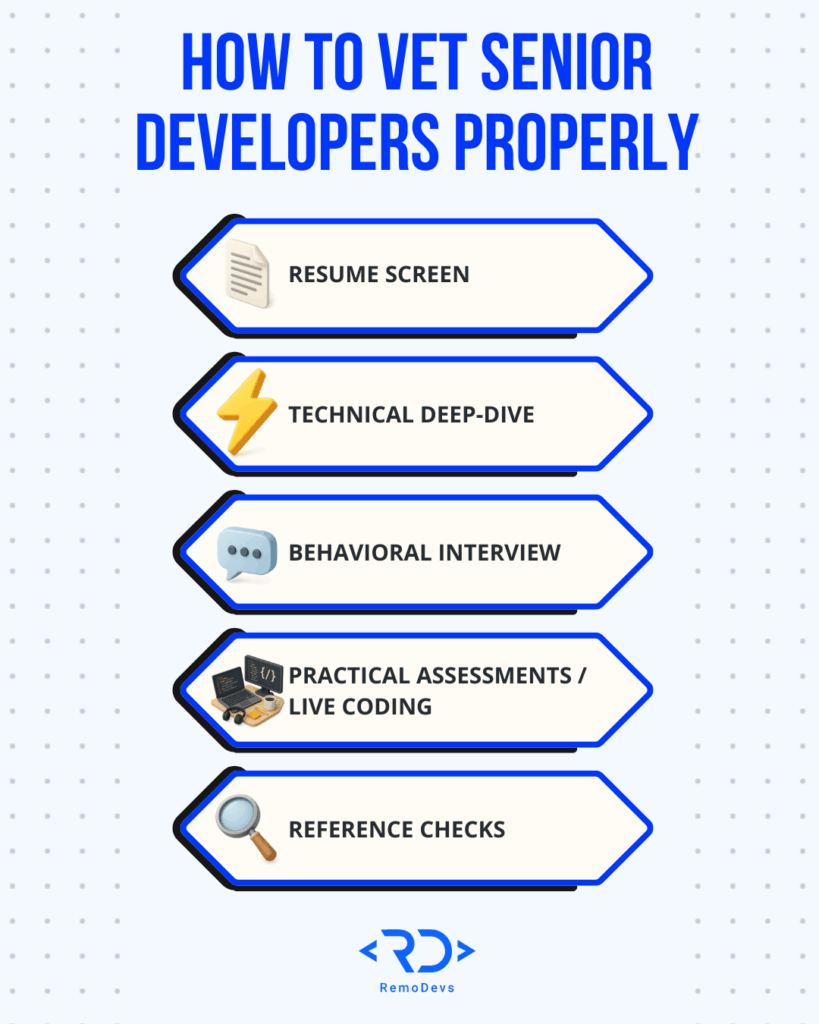
- Structured Multi-Stage Process: Move from a resume screen to a technical deep-dive, followed by a behavioral interview and reference checks.
- Practical Assessments: Use live coding sessions that mimic real work, not just abstract puzzles. Pair programming exercises are excellent for revealing how a candidate thinks and communicates.
- Culture Fit: Ensure they align with your team’s values. A brilliant jerk is just as dangerous as a fake senior.
- Avoid Pitfalls: Don’t rely solely on years of experience (YoE) or LeetCode-style trivia. Focus on problem-solving ability and system design.
Why Partner with Experts Like RemoDevs to Avoid These Risks?
Vetting candidates yourself is time-consuming and risky. Agencies like RemoDevs specialize in filtering out the noise. We pre-vet thousands of developers from Poland and Europe, conducting rigorous technical and behavioral checks before a profile ever reaches your desk.
- Insider Knowledge: We know the local market and the specific tricks bad actors use. Our process ensures zero proxies and verified experience.
- Strategic Value: By partnering with us, you save weeks of engineering time and avoid the massive cost of a bad hire. You get instant access to a pool of truly senior remote talent ready to deliver from day one.
- Guaranteed Quality: We offer a 30-day free trial and 90-day guarantee, putting our money where our mouth is.
Conclusion
Spotting interview red flags is critical to protecting your team’s velocity and culture. By focusing on ownership, technical depth, and verifiable proof, you can filter out the fakes and find the leaders your company needs.
Struggling to vet senior developers? Don’t leave your hiring to chance. Contact RemoDevs today for pre-vetted, battle-tested senior talent. Book a free consultation and hire real experts fast.
Visit us
Find a moment in your calendar and come to our office for a delicious coffee
Make an apointment