
Finding true senior infrastructure talent is notoriously difficult. Technical leaders do not need a junior script-runner who simply knows how to restart a server; they need an architect who understands automation, security at scale, and high-availability systems.
If you plan to hire DevOps engineers in Poland, you are targeting one of the deepest pools of cloud expertise in Europe. However, filtering through unqualified resumes, dealing with passive candidate markets, and navigating international compliance can severely slow down your roadmap.
This guide provides a tactical playbook to evaluate, screen, and legally onboard senior Polish DevOps professionals efficiently.
Why Poland is a Global Hotspot for Senior DevOps Talent
Poland has transitioned from an outsourcing destination to a core engineering hub for global product companies. Western enterprises choose Poland for their infrastructure teams because of three distinct advantages:
- Elite Cloud Infrastructure Expertise: Cities like Warsaw, Kraków, and Wrocław house major engineering hubs for AWS, Azure, and Google Cloud, creating a localized density of enterprise-grade cloud talent.
- High English Proficiency: Technical communication is rarely a barrier. According to the 2025/2026 EF English Proficiency Index, Poland ranks 15th globally with a score of 600, firmly placing it in the “Very High Proficiency” band.
- Timezone Alignment: Operating in the CEST timezone allows for significant overlap with Western Europe (near 100%) and the US East Coast (half-day overlap), enabling seamless daily standups and incident response coordination.
For companies looking to scale, partnering with an experienced IT recruitment agency in Poland helps bypass the initial friction of navigating this highly competitive local market.
The Core Challenges of Screening Senior DevOps Engineers
Standard recruitment pipelines often fail when sourcing DevOps engineers due to a few common traps:
- Misaligned Definitions: Many candidates label themselves as “DevOps” when their experience is limited to traditional SysAdmin roles plus basic Jenkins usage. True senior engineers practice GitOps and build developer platforms.
- The Passive Market: Top-tier DevOps professionals are rarely looking for jobs. They are heavily recruited and ignore generic outreach.
- Over-Long Technical Tests: Handing a senior engineer a 10-hour take-home assignment to deploy a multi-tier app will result in candidate drop-off. Respect their time by replacing exhaustive coding tasks with a 60-minute system design whiteboarding session focusing on a past production outage they successfully resolved.
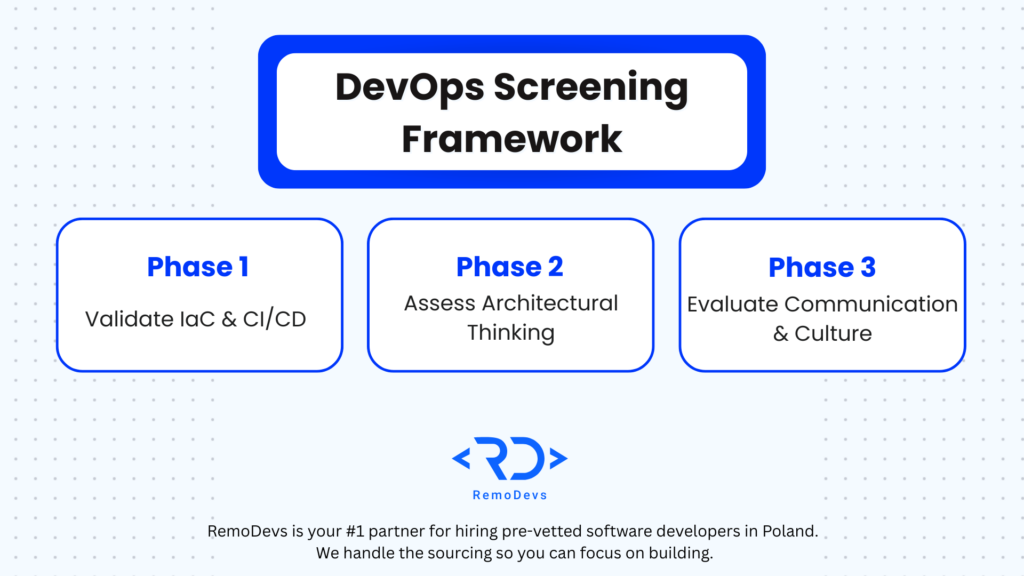
Step-by-Step Screening Framework for Polish DevOps Candidates
To filter out the noise, structure your technical interviews to probe for architectural thinking rather than just syntax memorization.
Phase 1: Validating Technical Competency (Cloud, CI/CD, IaC)
A senior engineer should treat infrastructure as software. Focus your screening on Infrastructure as Code (IaC) maturity, container orchestration, and CI/CD optimization.
- IaC (Terraform / OpenTofu / Ansible): Do not ask what Terraform is. Instead, ask: “How do you handle state file management, locking, and drift detection in multi-region Terraform deployments?”
- Orchestration (Kubernetes): Assess their understanding of K8s at scale. Ask about managing ingress, handling persistent volumes, or mitigating pod eviction during node pressure.
- CI/CD Optimization: Look for candidates who can reduce pipeline execution time and implement security scanning (DevSecOps) directly into GitLab CI or GitHub Actions.
Phase 2: Assessing Architectural & Systems Thinking
Senior DevOps engineers must design systems that survive failure. Present a scenario where a monolithic application needs to be migrated to microservices and ask how they would design the underlying infrastructure. Listen for discussions around observability (Prometheus, Grafana), high availability, auto-scaling, and blast radius limitation.
Phase 3: Evaluating Communication and Cultural Fit
Infrastructure engineers sit at the crossroads of development, QA, and operations. They must be proactive problem-solvers who can push back on bad architectural decisions diplomatically. Gauge their ability to explain complex networking issues to non-technical stakeholders – a crucial skill for remote environments.
Legal and Operational Logistics of Hiring in Poland
When hiring senior tech talent in Poland, understanding the local contracting preferences is critical. The overwhelming majority of senior engineers prefer B2B (Business-to-Business) contracts over traditional employment (UoP) due to tax efficiency. Many tech professionals qualify for the Polish IP Box tax regime, which can lower their income tax to 5%, driving the overwhelming preference for B2B contracting.
2026 Salary Benchmarks for Senior DevOps in Poland (B2B)
| Role Level | Monthly B2B Rate (PLN) | Annual USD Equivalent (Approx) |
| Mid DevOps Engineer | 16,000 – 22,000 PLN | $51,200 – $70,400 |
| Senior DevOps Engineer | 24,000 – 32,000 PLN | $76,800 – $102,400 |
| Lead / Cloud Architect | 28,000 – 36,000 PLN | $89,600 – $115,200 |
Note: Data reflects average 2026 market rates. Currency conversions fluctuate.
When engaging candidates on B2B contracts, ensure your agreements cover:
- IP Rights Transfer: Clear clauses transferring intellectual property upon invoice payment.
- Confidentiality (NDA): Standard data protection and confidentiality agreements aligned with EU GDPR.
- Notice Periods: Typical B2B notice periods in Poland are 1 month, providing flexibility for both sides.
If managing cross-border payments, compliance, and contract negotiation sounds overwhelming, using success fee recruitment allows you to mitigate risk entirely – you only pay when the right candidate is successfully onboarded.
Streamline Your DevOps Hiring with RemoDevs
Evaluating cloud infrastructure skills and handling Polish B2B logistics takes focus away from your core product. RemoDevs exists to eliminate this friction.
We provide direct access to a pre-vetted pool of senior Polish tech talent. Our multi-stage vetting process filters candidates for technical depth (IaC, Kubernetes, GitOps), proactive communication, and cultural alignment.
If your engineering team needs additional DevOps capacity without outsourcing day-to-day delivery, our IT staff augmentation service in Poland can help source specialists who work under your team’s direction.
Ready to scale your infrastructure team with top-tier talent? Book a discovery call with RemoDevs today to discuss your technical requirements.
FAQ
Why do most Polish DevOps engineers prefer B2B contracts?
B2B contracts offer highly favorable tax frameworks (such as the IP Box relief) for IT professionals in Poland, resulting in higher net retention. It acts as a standard contractor agreement, offering you greater flexibility and saving you from local employer tax burdens.
How long does it take to hire a Senior DevOps engineer in Poland?
With traditional sourcing, it can take 2-3 months due to the passive nature of the market. Working with a specialized tech staffing partner like RemoDevs reduces this timeline to weeks, as we leverage an existing network of vetted professionals.
Will timezones be an issue for a US-based team?
No. Polish engineers operate in CEST, which provides a natural 4-6 hour overlap with the US East Coast. This allows for morning stand-ups and synchronous collaboration while providing uninterrupted deep-work time for the remainder of the day.
Visit us
Find a moment in your calendar and come to our office for a delicious coffee
Make an apointment