
For CTOs, VPs of Engineering, and Tech Leads, scaling QA teams often presents a dilemma: local markets in North America and Western Europe are fiercely competitive, leading to inflated costs and painfully long hiring cycles.
Poland has emerged as a premier hub for QA engineering talent. Boasting a massive pool of highly educated tech professionals, Poland offers an ideal blend of technical expertise and strategic value. However, directly hiring in a foreign market comes with compliance risks and administrative overhead.
Below is a breakdown of the 2026 market realities of hiring Polish QA engineers, comparing manual versus automation testing rates, and exploring the most efficient strategies for augmenting your team without the logistical headaches.
Why Poland is a Top Destination for QA Engineering Talent
When scaling a technical team, accessing global talent is a strategic move, not just a financial one. Poland consistently ranks among the top countries globally for software engineering in historical indices like HackerRank, and continues to dominate recent European IT market reports.
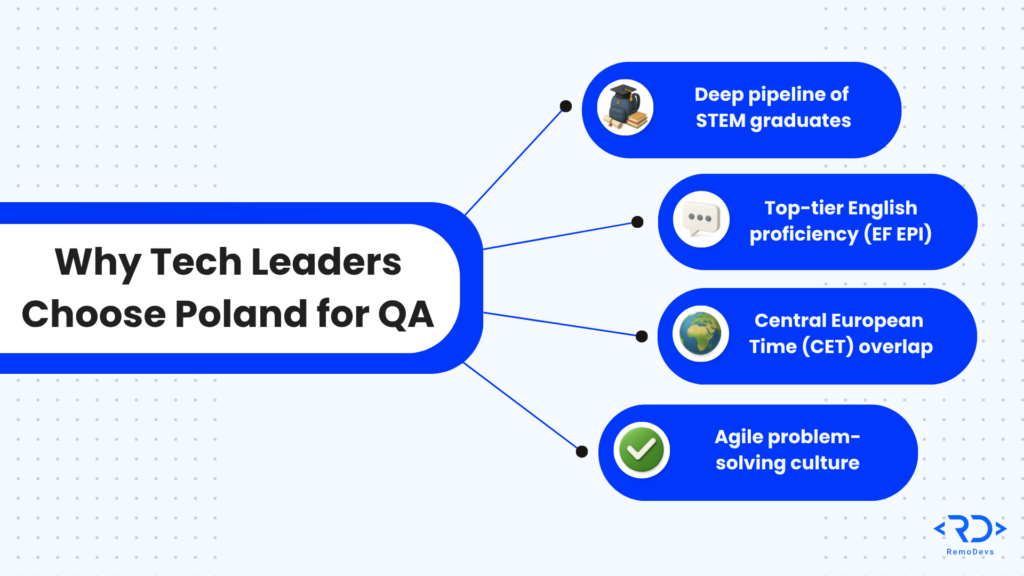
- Strong Engineering Education: Polish universities produce tens of thousands of STEM graduates annually, creating a robust pipeline of junior talent and a deep pool of senior engineers.
- High English Proficiency: Effective QA requires clear, precise communication. Poland consistently scores in the top tier of the EF English Proficiency Index (EF EPI), ensuring seamless integration with international teams.
- Ideal Timezone Overlap: Located in Central European Time (CET), Poland offers full-day overlap with the UK and Western Europe, and a manageable morning-to-midday overlap with North America (EST/PST). This allows for synchronous daily stand-ups and continuous feedback loops.
- Cultural Alignment: Polish work culture shares the same agile methodologies, problem-solving mindset, and direct communication style expected by product companies and tech scale-ups.
To understand how QA hiring fits into the wider Polish engineering market, explore our guide to hiring software developers in Poland, including recruitment approaches, contract structures, and engagement models.
Manual vs. Automation QA: What Does Your Project Need?
Before looking at rates, it is crucial to define the specific testing capabilities your product requires. In many cases, a blended approach yields the best results.
Manual QA
Manual testers excel at exploratory testing, analyzing edge cases, and evaluating user experience (UI/UX). They provide the human intuition necessary to spot visual inconsistencies and usability flaws that automated scripts might miss.
Best for:
- Early-stage startups building MVPs.
- Projects with frequently changing user interfaces.
- Ad-hoc and exploratory testing.
Automation QA
Automation QA engineers (or Software Development Engineers in Test – SDETs) write code to automate repetitive testing processes. They focus on regression testing, API testing, and integrating test suites into CI/CD pipelines. Because automation requires coding skills (typically Python, Java, JavaScript, or C#), these engineers are essentially software developers specializing in quality.
Best for:
- Scaling products with large codebases.
- Continuous Integration/Continuous Deployment (CI/CD) environments.
- Performance and load testing.
QA Engineer Rates in Poland (2026 Market Data)
Because automation QA requires software development capabilities, Automation Engineers command a premium over Manual Testers. Based on projected 2026 data from major Polish job boards and industry benchmarking, here is what you can expect regarding baseline B2B hourly rates and monthly contractor costs.
(Calculations based on an exchange rate of 1 USD = 3.65 PLN)
| Role & Seniority | Avg. Hourly Rate (PLN) | Estimated Hourly Rate (USD)* | Estimated Monthly (USD)* |
| Junior Manual QA | 40 – 60 PLN | $11 – $16 | $1,750 – $2,630 |
| Mid Manual QA | 65 – 100 PLN | $18 – $27 | $2,850 – $4,380 |
| Senior Manual QA | 100 – 140 PLN | $27 – $38 | $4,380 – $6,130 |
| Mid Automation QA | 100 – 140 PLN | $27 – $38 | $4,380 – $6,130 |
| Senior Auto / SDET | 140 – 190 PLN | $38 – $52 | $6,130 – $8,320 |
Note: USD estimates are subject to exchange rate fluctuations. These figures represent realistic baseline B2B contractor rates. When partnering with a Staff Augmentation firm or Employer of Record (EOR) like RemoDevs, final billed rates will include comprehensive sourcing, vetting, compliance, and administrative overhead.
Availability and Tech Stack Trends in the Polish QA Market
The Polish QA talent pool is not only large but technically mature. As product companies push for faster release cycles, the demand for automation testing has surged.
Polish QA engineers are highly proficient in modern testing stacks, including:
- ISTQB Certification: A vast majority of Polish QA engineers hold International Software Testing Qualifications Board (ISTQB) certifications, guaranteeing a standardized, globally recognized level of theoretical and practical testing methodology.
- Frameworks & Tools: Cypress, Playwright, Selenium, Appium, and Postman.
- Languages: Python, Java, JavaScript, and TypeScript.
- CI/CD Integration: Jenkins, GitLab CI, GitHub Actions, and Docker.
Polish SDETs are also rapidly adopting AI-assisted testing tools (like GitHub Copilot) to accelerate script writing and test maintenance. This ensures your remote experts are utilizing the most efficient, modern methodologies available.
The Hidden Challenges of Hiring Polish Tech Talent Directly
While the talent pool is exceptional, executing a direct local hiring strategy from abroad is fraught with obstacles. For HR and Talent Acquisition Managers, navigating the Polish market independently often leads to:
- Fierce Local Competition: You are competing against global enterprise companies and well-funded local startups that already have established employer branding in Poland.
- Legal and Payroll Complexity: Understanding Polish labor laws, the nuances of B2B (Business-to-Business) contracting versus UoP (Employment Contracts), and managing international tax compliance requires dedicated legal counsel.
- Wasted Engineering Time: Interviewing poorly vetted candidates drains your technical leads’ time. The cost of a bad hire can delay release cycles by months.
Best Strategies to Hire Remote QA Engineers
When looking to integrate Polish QA talent into your organization, you generally have three options:
- Setting up a Local Entity: Establishing a Polish subsidiary gives you complete control but requires massive upfront capital, legal structuring, and months of administrative work.
- Freelancing Platforms: Platforms like Upwork offer quick access to freelancers. However, reliability, cultural fit, and long-term commitment are often lacking, making this unsuitable for core product teams.
- IT Staff Augmentation & Dedicated Teams: Partnering with a specialized tech recruitment and outsourcing firm. This is the most scalable, risk-free option. It allows you to add remote developers and QA engineers to your existing teams rapidly, scaling up or down based on your release cycles, without the overhead of direct employment.
How RemoDevs Builds Your Dedicated QA Team in Days
At RemoDevs, we eliminate the friction of global hiring. We act as your Employer of Record (EOR) or contractor manager, completely shielding you from Polish tax and payroll compliance risks.
Our IT Staff Augmentation model is designed for technical leaders who need to move fast without compromising on quality.
- Rigorous Vetting: We do not just forward resumes. Our multi-stage vetting methodology assesses both deep technical skills (framework knowledge, coding assessments) and soft skills (communication, cultural fit, agile experience). This ensures we only present top-tier candidates matched to your specific tech stack.
- Speed and Efficiency: By maintaining a curated pool of pre-vetted professionals, we reduce the time-to-hire from months to days. We recently helped a US-based FinTech scale their automation team with 3 Playwright experts in just 9 days. You can review profiles, interview the best matches, and onboard your new QA engineer almost immediately.
- Seamless Integration: We handle the contracts, compliance, and monthly invoicing. You manage the engineer exactly as you would an internal team member.
Don’t let the complexities of international hiring slow down your product delivery. Review our case studies to see how we have reduced time-to-hire by over 40% and successfully integrated dedicated QA pods for fast-growing SaaS businesses.
Ready to enhance your product’s quality with vetted tech talent?
Schedule a consultation with our team today to discuss your QA requirements.
FAQ
How long does it take to hire a QA engineer through RemoDevs? Because we maintain a pre-vetted network of top-tier Polish talent, we can typically present matching candidates within a few days, allowing you to onboard your new QA engineer in under two weeks.
Do Polish QA engineers work in my timezone? Yes. Poland (CET) provides a complete overlap with Western Europe and the UK. For North American clients, the timezone difference allows for a highly productive “follow-the-sun” model, with several hours of synchronous overlap in the morning (EST/PST) for stand-ups and collaborative problem-solving.
Who manages the QA engineer’s daily tasks? You do. Our staff augmentation model ensures the QA engineer integrates directly into your internal team, using your tools (Jira, Slack, GitHub) and participating in your agile ceremonies. RemoDevs simply handles the HR, payroll, and compliance administration.
Why are automation QA engineers more expensive than manual testers? Automation QA requires strong software development skills. These engineers must write, maintain, and execute code (often in Python, Java, or JavaScript) to build automated test suites, placing them in a higher compensation bracket akin to software developers.
Visit us
Find a moment in your calendar and come to our office for a delicious coffee
Make an apointment