
- Most job descriptions fail senior developers before they even apply – vague requirements, inflated must-haves, and corporate tone filter out exactly the people you want.
- Senior engineers evaluate your company as much as you evaluate them. Your JD is a sales document, not a checklist.
- The biggest red flags in a JD (years-of-experience gates, buzzword overload, missing salary range) are invisible to most hiring managers but immediately spotted by senior candidates.
- If writing a high-signal JD still doesn’t move the needle, the problem may be pipeline quality – not the document itself. That’s where a recruitment partner who pre-filters 90% of applicants changes the math.
The Real Reason Your Job Description Keeps Attracting the Wrong People
You post a Senior Backend Engineer role. You get 120 applications. Three are worth reading.
That’s not a volume problem. It’s a targeting problem – and it starts with the job description.
Senior developers with 8+ years of experience are not browsing job boards the way a junior does. They’re passive, selective, and deeply skeptical of corporate copy. If your JD reads like a Wikipedia entry for the tech stack, they close the tab in under 30 seconds.
This article breaks down exactly how to write a job description that speaks directly to senior engineers, screens out juniors organically, and positions your company as a place worth leaving a stable job for.
Why Standard Job Description Templates Repel Senior Developers
Most JD templates were written for HR generalists, not engineering leaders. They optimize for compliance and completeness – not conversion.
Here’s what that looks like in practice:
- “5+ years of experience required” – Senior engineers don’t count years. They count scope and impact. This signal tells them the role may be junior-caliber with a senior title.
- “Fast-paced environment” – Every company says this. It means nothing and signals a lack of self-awareness.
- A 20-bullet requirement list – Half of which are “nice to haves” presented as requirements. Senior candidates read this as disorganized leadership, not thoroughness.
- No mention of compensation – A senior engineer earning $160K is not going to spend 45 minutes applying to a role that might pay $110K. Hiding the range wastes everyone’s time and signals that the company knows the pay is below market.
- Vague team context – “Join our dynamic team!” tells a senior engineer nothing about reporting structure, team size, or engineering culture.
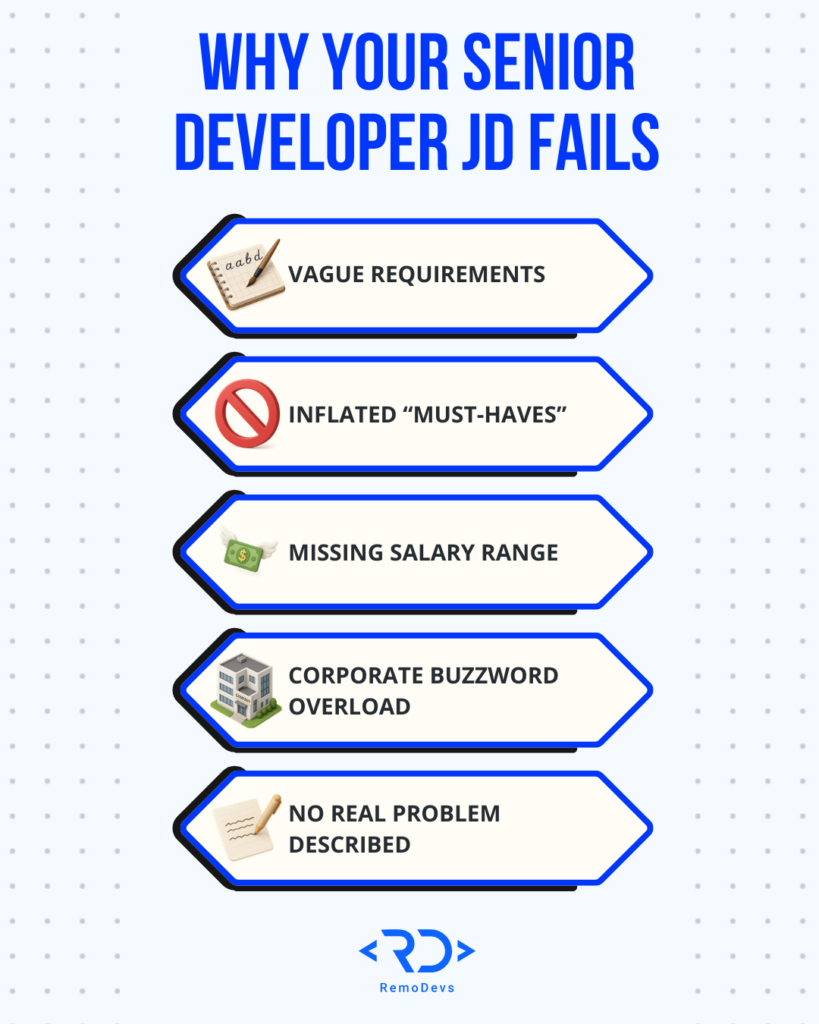
The core issue: junior candidates ignore red flags. Senior candidates use them as filters.
The Anatomy of a Job Description That Converts Senior Talent
Lead With the Problem, Not the Job Title
Senior engineers are builders and solvers. Open your JD with the actual problem they’ll own, not a generic summary of the role.
Weak opening:
“We are looking for a Senior Backend Engineer to join our growing engineering team.”
Strong opening:
“Our payments infrastructure handles $2M in daily transactions and is running on a monolith that’s starting to buckle. We need a senior engineer who’s migrated production systems before and doesn’t need a roadmap handed to them.”
This immediately signals: the problem is real, the scope is meaningful, and we expect senior-level autonomy.
Separate Hard Requirements From Nice-to-Haves – Explicitly
One of the most effective changes you can make is splitting your requirements into two clearly labeled sections.
Non-negotiable requirements (must have every single one):
- 6+ years of production experience with Go or Rust
- Demonstrated experience designing distributed systems at scale (>1M daily active users)
- Previous ownership of a full migration or major refactor in a live production environment
Strong advantages (not required, but valued):
- Experience with Kafka or similar event-streaming platforms
- Open-source contributions or a public portfolio
- Background in fintech or regulated industries
This structure does two things: it respects the senior candidate’s time, and it forces you to be honest about what you actually need versus what would be ideal.
Be Specific About Scope, Ownership, and Impact
Senior engineers want to know what they’ll own – not just what they’ll do.
Replace task-based language with ownership-based language:
| Task-Based (Junior Signal) | Ownership-Based (Senior Signal) |
| “Write clean, maintainable code” | “Own the architecture decisions for the data ingestion pipeline” |
| “Participate in code reviews” | “Set the engineering standards and be the final review gate for the team” |
| “Work with the product team” | “Partner directly with the CPO to define and sequence the technical roadmap” |
| “Debug and resolve issues” | “Own production reliability – define SLOs, run postmortems, drive RCA culture” |
| “Collaborate with stakeholders” | “Represent engineering in executive-level product and strategy conversations” |
The language shift alone signals that this is a role with real leverage – not just a seat to fill.
Show the Engineering Culture, Not Just the Perks
Unlimited PTO and a home-office stipend are table stakes in 2026. Senior engineers are evaluating whether they’ll respect the people they work with and whether the technical environment will make them better.
Include at least one of the following in every senior JD:
- The technical challenge in plain language – What’s broken, what’s being built, what problem hasn’t been solved yet?
- The team structure – Who does this role report to? What does the immediate team look like? How are engineering decisions made?
- How you handle technical debt – Do you dedicate sprint capacity to it? Is there a culture of “ship fast, clean later forever”? Senior engineers have been burned before and they’ll ask.
- What “success” looks like at 90 days and 12 months – Concrete outcomes, not vague expectations.
Include a Compensation Range – No Exceptions
This is non-negotiable for senior hiring in 2026. Multiple US states now legally require it, and beyond compliance, it’s a trust signal.
A senior engineer seeing a salary range immediately knows you’re serious. Hiding it signals that the company is either disorganized or knows it’s below market.
If your range is $140K–$175K base, say so. You will get fewer applications from candidates outside that range – and that’s the point.
The Senior Developer JD Template: Section by Section
Use this structure as a starting point and adapt it to your specific role.
[ROLE TITLE] – [LOCATION / REMOTE STATUS]
THE PROBLEM YOU’LL OWN
[2–3 sentences describing the actual technical challenge. Be specific. Use real numbers where possible.]
WHAT YOU’LL BE RESPONSIBLE FOR
– [Ownership statement #1]
– [Ownership statement #2]
– [Ownership statement #3]
(Limit to 5–6. If you have 12 bullets here, cut them in half.)
WHAT YOU MUST BRING
(Only include genuine non-negotiables.)
– [Hard requirement #1]
– [Hard requirement #2]
– [Hard requirement #3]
WHAT WOULD MAKE YOU STAND OUT
(Nice-to-haves, clearly labeled.)
– [Preferred skill #1]
– [Preferred skill #2]
THE TEAM & STACK
[Describe team size, reporting structure, how decisions are made, and the current stack – without overselling it.]
COMPENSATION
[Base salary range] + [Equity / bonus structure] + [Key benefits – keep to 3–5 meaningful ones]
INTERVIEW PROCESS
[Lay out every stage with estimated time commitment. Senior candidates will skip roles with black-box processes.]
Transparency in the interview process section alone can increase application-to-screening conversion by a meaningful margin – because senior candidates are managing multiple processes simultaneously and allocate their time deliberately.
Common Mistakes That Signal “Junior Role” to a Senior Candidate
Even if your content is strong, formatting and structure choices can undercut the message.
- Wall-of-text paragraphs – Senior engineers are engineers. They scan. Use bullets, headers, and white space.
- Generic company description in paragraph one – Nobody reads it. Move your company context to after the role description, or cut it to two sentences.
- Listing every technology the company has ever touched – “Experience with AWS, GCP, Azure, Docker, Kubernetes, Terraform, Ansible, Puppet, Chef…” signals that nobody actually scoped the role.
- “We move fast and break things” energy – This attracts candidates who are okay with chaos. Senior engineers have usually fixed that chaos somewhere. They want to know you value stability and intentionality.
- Typos and inconsistent formatting – A senior engineer reviewing your JD is already forming an opinion about your engineering culture. Quality of output matters.
How RemoDevs Solves the Pipeline Problem Your JD Can’t Fix Alone
A perfectly written job description is necessary – but not sufficient.
Even with a strong JD, the senior developer market is tight. The best senior engineers are almost never actively job hunting. They’re employed, doing interesting work, and not refreshing LinkedIn. Your post won’t reach them.
This is where RemoDevs operates differently from a standard recruiter or body-shop.
We don’t forward you a stack of resumes. We run a targeted sourcing campaign, conduct deep technical and soft-skill screening on every candidate, and filter out 90% of applicants before a single profile reaches your desk. What you receive is a shortlist of the top 10% – engineers who have been vetted on both their technical depth and their ability to communicate, own problems, and operate at a senior level.
We treat every search as if we were hiring for our own engineering team. That means:
- Technical screening aligned to your actual stack and problem domain – not a generic coding test.
- Soft-skill and culture-fit evaluation – because a senior developer who can’t lead, communicate, or give feedback creates a different kind of problem.
- Pre-vetted availability and compensation alignment – so there are no surprises at offer stage.
The result: you spend your time evaluating finalists, not filtering noise. For a CTO or VP of Engineering whose time costs the company $200–$400/hour, that math is straightforward.
We specialize in sourcing senior developers from Poland and broader Europe for US-based teams – combining access to a deep talent pool with the rigor of a high-stakes screening process. The developers we place are indistinguishable from your domestic hires in terms of communication and collaboration. The cost structure is not.
Stop Writing JDs for an Algorithm. Start Writing Them for a Senior Engineer.
The best job descriptions do three things: they communicate a real problem worth solving, they demonstrate that your company values craftsmanship and ownership, and they make the process transparent enough that a senior engineer feels respected from the first line.
Get those three things right and you won’t need to cast a wide net. You’ll attract the kind of engineer who self-selects in because the role is genuinely compelling.
And if you want to skip the filtering entirely – and go straight to a shortlist of senior developers who have already been screened for technical depth, communication, and culture fit – that’s exactly what we do.
Ready to See a Pre-Vetted Shortlist of Senior Developers?
Book a free 15-minute discovery call with RemoDevs.
We’ll show you active candidate profiles that match your current hiring needs – senior engineers who have already passed our technical and soft-skill screening. No pitch deck, no fluff. Just profiles and a conversation about fit.
You tell us what you need. We show you the top 10%.
Visit us
Find a moment in your calendar and come to our office for a delicious coffee
Make an apointment