
Poland has firmly established itself as a premier IT hub in Central and Eastern Europe.
Attracting global enterprises and fostering a thriving technology ecosystem, Poland continues to lead the region as a mature technology hub. With nearly 650,000 IT/ICT professionals (based on projected growth from 2024-2025 data) and a growing reputation for technical excellence, the market focuses on quality over quantity.
Understanding the recruitment trends shaping 2026 is crucial for both employers seeking top talent and professionals navigating career opportunities. In this comprehensive analysis, I provide actionable insights within a focused framework, examining the most significant developments transforming Poland’s IT recruitment landscape this year.
Overview of the IT Job Market in Poland 2026
The Polish IT job market demonstrates remarkable resilience and maturity. Recent surveys reveal evolving professional dynamics, with a healthy distribution across experience levels and a noticeable shift toward seniority as the ecosystem matures.
Current data indicates a balanced professional ecosystem. According to consolidated market analyses from late 2025 (e.g., SoDA, ABSL, and industry reports), the Polish market has successfully transitioned from simple outsourcing to high-value innovation hubs.
Professional Distribution Breakdown (2026 Market Estimate):
- Trainee/Entry Level (~5%): Graduates and career changers facing a competitive entry barrier.
- Junior Developers (~15%): 1-3 years experience; demand has slowed, but they remain a vital part of the ecosystem.
- Mid-Level Specialists (48%): 3-7 years experience; the core workforce driving most projects.
- Senior Professionals (24%): 7+ years experience; highly sought after for complex problem solving.
- Expert/Architect Level (~8%): 10+ years experience; strategic roles requiring deep niche expertise.
Market sentiment reveals cautious optimism, with 70% of IT professionals expressing satisfaction with their current roles while remaining open to compelling opportunities. This emphasizes the need for strategic recruitment planning rather than reactive hiring.
Major Trends in IT Recruitment
To get a quick overview of the top IT recruitment trends shaping Poland’s market in 2026, check out the infographic below.
Read on for detailed insights and strategic recommendations.
1. Job Mobility and Retention
Polish IT professionals demonstrate selective job mobility, with around 40% considering new opportunities within the next 12 months. However, this openness comes with specific expectations that employers must address strategically.
Primary Drivers for Job Changes:
- Salary advancement opportunities: (75% of respondents)
- Career growth and AI upskilling prospects: (72%)
- Project diversity and technical challenges: (60%)
- Team culture and management quality: (55%)
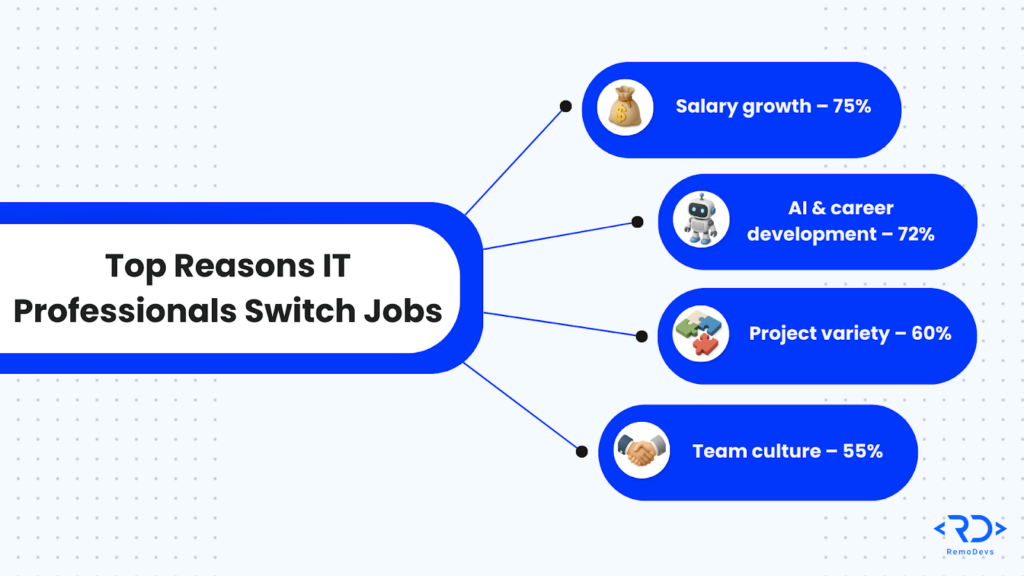
Retention strategies must address these core motivators. Successful companies are now implementing structured career paths and internal mobility programs to maintain engagement. You can read more about how top companies handle this in our Success Stories.
2. Salary Dynamics
Salary satisfaction varies significantly across experience levels. Surveys show that junior developers have lower satisfaction rates due to market saturation, while senior professionals report closer to 75% satisfaction, indicating their leverage in the market.
Currency preferences reflect Poland’s integration into global IT markets:
- 45% of professionals prefer to be paid in PLN.
- 32% prefer EUR (a slight increase from previous years).
- 23% choose USD.
This highlights the demand for flexible, internationally competitive compensation packages, particularly for B2B contractors.
Salary Expectations for 2026:
- Junior developers: 0-5% (stagnation due to high supply of candidates).
- Mid-level professionals: 4-7% (stabilized growth aligning slightly above inflation).
- Senior specialists: 5-10% (increases driven mainly by niche specializations like AI/Cloud).
- Expert level: Project-based negotiation (high variance dependent on ROI).
3. Remote Work and Flexibility
The market has shifted towards a Hybrid-First model. As of early 2026:
- Fully On-site: ~10% (Required mainly for hardware, R&D, and security-critical roles).
- Hybrid (2-3 days office): ~55% (Standard for most corporate and banking sectors).
- Fully Remote: ~35% (Dominant in software houses and international B2B contracting).
Companies offering well-defined flexibility report retention rates 20-25% higher and a notable increase in qualified applicants. Flexibility remains a non-negotiable for employer attractiveness.
4. Recruitment Process Preferences
Candidates increasingly value efficient, respectful, and transparent hiring. Market research confirms that modern IT professionals prefer structured but frictionless evaluations, often aided by AI-driven scheduling and feedback loops.
Preferred Assessment Methods:
- Technical interviews with real-world scenarios: (86% preference)
- Remote coding challenges and portfolio reviews: (74%)
- Pair programming sessions: (60%)
Recruitment processes lasting 2-3 weeks, with clear communication at each stage, result in 40% higher offer acceptance rates. Speed and clarity are massive strategic advantages.
5. Employee Benefits and Perks
Beyond base pay, comprehensive and lifestyle-aligned benefits have become decisive. Recent industry reports from organizations like SoDA (Software Development Association Poland) emphasize that IT professionals now prioritize flexibility, mental health, and AI-enablement over traditional perks.
Most Valued Benefits:
- Remote work flexibility and home office stipends.
- Access to premium AI tools and Copilots.
- Flexible hours and generous time-off policies.
- Comprehensive private healthcare (including mental health).
6. In-Demand Skills and Technologies
Poland’s IT labor market in 2026 is focused on emerging technologies and deep specialization, with demand rising most sharply in AI integration and cloud infrastructure.
Highest Demand Areas:
- AI & Data Specialists: LLM engineers, RAG specialists, data scientists.
- Cybersecurity Experts: SOC analysts, cloud security architects, DevSecOps.
- Cloud & Platform Engineers: AWS/Azure/GCP experts, Kubernetes administrators.
- Full-Stack Developers: Especially those fluent in React, Next.js, and Node.js.
Investing in these areas boosts organizational talent attraction and future-proofs technical capabilities. For deeper dives into these specific tech stacks, visit the RemoDevs Tech Talent Blog.
| Category | Key Points |
| Talent & Mobility | Mature market; 40% open to new roles; top drivers: salary & AI upskilling. |
| Salary & Currency | Annual raises normalized: Juniors 0-5%, Mids 4-7%, Seniors 5-10%; B2B contractors prefer EUR/USD. |
| Work & Benefits | 90% prefer remote/hybrid; key perks: AI tools, flexibility, learning budgets. |
| Recruitment & Skills | Quick, transparent hiring (2–3 weeks); top skills: GenAI, Cloud, Cyber. |
Strategic Insights for Stakeholders
For Employers
Successful recruitment in Poland’s competitive IT market requires adapting strategies to candidate expectations while maintaining quality standards. Companies must balance competitive positioning with sustainable practices that support long-term growth.
Key Recommendations:
- Implement flexible work policies as standard practice.
- Develop transparent salary bands and regular review processes.
- Integrate AI tools into daily workflows to attract forward-thinking talent.
- Invest in employer branding that highlights growth opportunities.
For Job Seekers
IT professionals should align skill development with market demands while preparing for evolving recruitment practices. Success requires strategic career planning that considers both technical advancement and market positioning.
Career Development Strategies:
- Focus on high-demand technologies like Agentic AI and cloud computing.
- Develop both technical expertise and soft skills for senior role preparation.
- Build portfolios demonstrating real-world problem-solving capabilities.
- Network within the Polish IT community and maintain international connections.
Conclusion
Poland’s IT recruitment landscape in 2026 reflects a mature, globally connected market driven by flexibility, technical sophistication, and evolving skill demands. Further validation of Poland’s investment potential can be found through the Polish Investment and Trade Agency (PAIH).
Companies that align with talent expectations – offering remote options, transparent processes, and access to cutting-edge tools – will secure a competitive edge. Looking to hire top Polish tech talent fast? Contact RemoDevs for pre-screened candidates and rapid recruitment solutions tailored to your 2026 goals.
Visit us
Find a moment in your calendar and come to our office for a delicious coffee
Make an apointment